
Agentic AI vs. SaaS: How $234 Billion in Enterprise Software Spend Is Being Disrupted, and What Support Leaders Must Do Now
The numbers are staggering. According to a recent analysis by CIO Dive and Gartner, agentic AI is set to disrupt 20% of SaaS spending by 2030, putting $234 billion in enterprise software spend officially on the line. For support leaders, this isn't just a tech trend, it's a seismic shift that will redefine how customer service is delivered, staffed, and budgeted.
Why Agentic AI Is Different from Previous Automation Waves
Earlier automation tools were reactive: they required predefined rules and human oversight. Agentic AI is proactive and autonomous. It can identify a customer's issue, research a solution from knowledge bases, execute a fix in your product, and follow up to ensure resolution, all without a human agent in the loop.
Which SaaS Categories Are Most at Risk?
The disruption won't be uniform. Based on the data, software categories where workflows are high-volume, repetitive, and rule-based are most vulnerable. Customer support software is at the top of this list, along with email automation, CRM data entry, and marketing automation.
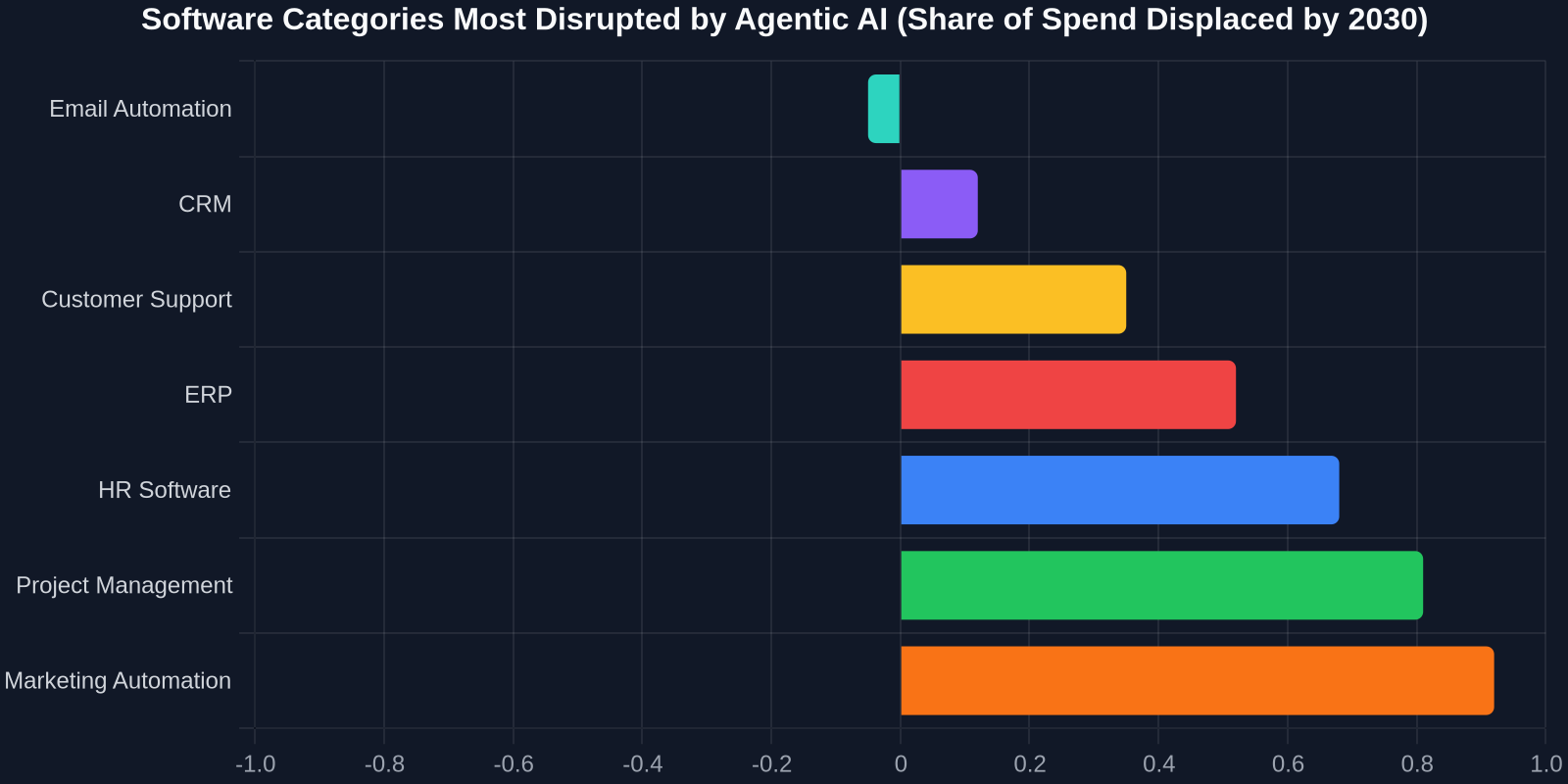
As the chart shows, customer support is projected to see the highest displacement share (around 30%) because agentic AI excels at ticket triage, knowledge retrieval, and first-contact resolution.
The Support Leader's Dilemma: Surviving the Agentic AI Revolution
For support operations professionals, this is both a crisis and an opportunity. On one hand, your current tech stack may become outdated. On the other, you can leapfrog competitors by adopting agentic AI, but you must act strategically.
Why Your Current SaaS Budget Is at Risk
Gartner's prediction implies that $234 billion in software spend will shift away from traditional SaaS toward AI-native platforms. If you're still paying for multiple point solutions (ticketing, knowledge base, chatbot, analytics), you're over-paying for capabilities that agentic AI systems can consolidate.
The Economics of Agentic AI in Support
Let's break down the financial implications of the $234 billion disruption for your support operations.
The Data-Driven Roadmap: How to Adopt Agentic AI in Your Support Operations
Here's a practical framework for transitioning from traditional SaaS to an AI-native support stack, based on industry benchmarks and early adopters' best practices.
Phase 1: Assessment (Weeks 1-4)
- Calculate your current cost per ticket including software, labor, and overhead.
- Identify the top 10 most common ticket types and their resolution steps.
- Measure your current deflection rate and CSAT.
Phase 2: Pilot (Weeks 5-8)
- Deploy agentic AI on a single channel (e.g., email support for a specific product line).
- Train the AI using your top 50 knowledge base articles and 500 past tickets.
- Set clear success metrics: ticket deflection, resolution time, CSAT, and AI-handled rate.
Phase 3: Scale (Weeks 9-16)
- Expand AI coverage to chat, social media, and phone support transcripts.
- Integrate AI with your CRM for personalized responses using customer history.
- Reduce software licenses for tools that the AI now replaces.
Phase 4: Optimize (Ongoing)
- Use AI analytics to identify recurring issues and feed them back to product teams.
- Continuously fine-tune AI responses based on customer feedback and agent reviews.
- Monitor savings monthly: track cost per ticket, handle time, and software spend reduction.
Preparing Your Team for the AI Shift
Adopting agentic AI isn't just about technology, it's about people. Support leaders need to proactively upskill their teams and reshape roles. The support agent of 2030 will be part technical analyst, part AI trainer, and part customer success strategist.
New Roles to Create
- AI Trainer/Quality Analyst: Reviews AI responses, provides feedback, and updates knowledge bases.
- Escalation Specialist: Handles complex, high-touch issues that require human empathy and judgment.
- Customer Success Data Analyst: Uses AI-generated insights to identify churn risks and upsell opportunities.
Frequently Asked Questions About Agentic AI in Support
Will agentic AI replace support agents entirely?
No. It will replace routine tasks and some roles, but human agents remain essential for complex problem-solving, empathy-driven interactions, and building customer relationships. The best support teams will have a blend of AI and humans working together.
How much does agentic AI cost compared to traditional SaaS?
While upfront investment can be higher (data preparation, integration, training), the total cost of ownership is typically 30-60% lower than maintaining multiple legacy SaaS tools. Most companies recoup their investment within 6-12 months.
What's the biggest risk of not adopting agentic AI?
Competitive disadvantage. As more companies adopt AI-native platforms, their support costs drop, response times shrink, and customer satisfaction rises. Companies that stick with traditional tools will struggle to keep up, and may see churn accelerate.
Conclusion: Embrace the Disruption or Be Disrupted
The $234 billion figure from the CIO Dive report is more than a headline, it's a call to action for support leaders. Agentic AI isn't coming; it's already here, and it's reshaping the SaaS landscape faster than most realize. By adopting a strategic approach, assess, pilot, scale, optimize, you can turn this disruption into a massive competitive advantage.
Ready for the Next Step?
If you're a support leader looking to future-proof your operations and capture the benefits of agentic AI, book a demo with Successly today. We'll show you how our platform can help you navigate the $234 billion disruption, and come out ahead.