"SEO":"primaryKeyword":"AI chatbots customer service","metaDescription":"Discover why customers prefer AI chatbots over support staff, as revealed by British Gas owner Centrica. Explore ROI data, implementation strategies, and the future of customer service automation.","content":"Why Customers Prefer AI Chatbots Over Support Staff: The British Gas Case Study\n\nIn a move that has sparked both industry debate and public scrutiny, the owner of British Gas – Centrica – recently announced plans to cut approximately 1,300 call centre jobs, citing that "customers prefer AI chatbots" to human agents. This declaration, reported by The Guardian, has reignited conversations around the role of artificial intelligence in customer service. While unions and some customers have voiced concerns, the data supporting the shift toward AI-powered support is compelling – and for SaaS leaders, customer success teams, and support operations specialists, understanding this trend is critical to remaining competitive.\n\nIn this comprehensive analysis, we will explore the business rationale behind the Centrica decision, share hard ROI numbers from early adopters, and provide a practical framework for implementing AI chatbots in your own support stack – all while optimizing for long-term customer satisfaction.\n\nThe Centrica Announcement: What Really Happened\n\nOn July 23, 2026, Centrica, the parent company of British Gas, confirmed plans to eliminate about 1,300 roles from its call centre operations. The company's CEO, Chris O'Shea, stated, "What we hear a lot is that this is a commercial decision... Customers prefer AI chatbots." This announcement came as British Gas domestic customers declined slightly to 7.45 million, from 7.5 million at the end of 2025, adding pressure to optimize operational costs.\n\nThe GMB union quickly pushed back, claiming that 500 of the eliminated roles were being effectively replaced by artificial intelligence – a charge Centrica denied. Nevertheless, the Guardian report noted that the company has been investing heavily in digital self-service tools, including AI-driven chatbots, to handle routine inquiries such as billing, meter readings, and outage updates.\n\nThis is not an isolated case. Companies across industries – from telecommunications to banking to SaaS – are re-evaluating the human-to-bot ratio in their support models. The question is no longer if AI should handle customer interactions, but how much and under what conditions.\n\nThe Data Behind Customer Preference for AI Chatbots\n\nThe assertion that customers prefer AI chatbots is not just a convenient narrative for cost-cutting; it is backed by a growing body of research. In a 2023 survey by Zendesk, 69% of consumers said they prefer self-service options for simple issues, and 62% expressed no issue with AI handling basic queries, provided escalation to a human is seamless.\n\n\n\nMoreover, a Gartner report predicted that by 2025, 80% of customer service and support organizations will have applied generative AI technology in some form to improve agent productivity and customer experience. The Centrica announcement simply accelerates a trend already well underway in the SaaS world.\n\nLet's look at how generic chatbots compare to advanced AI solutions in terms of resolution time.\n\n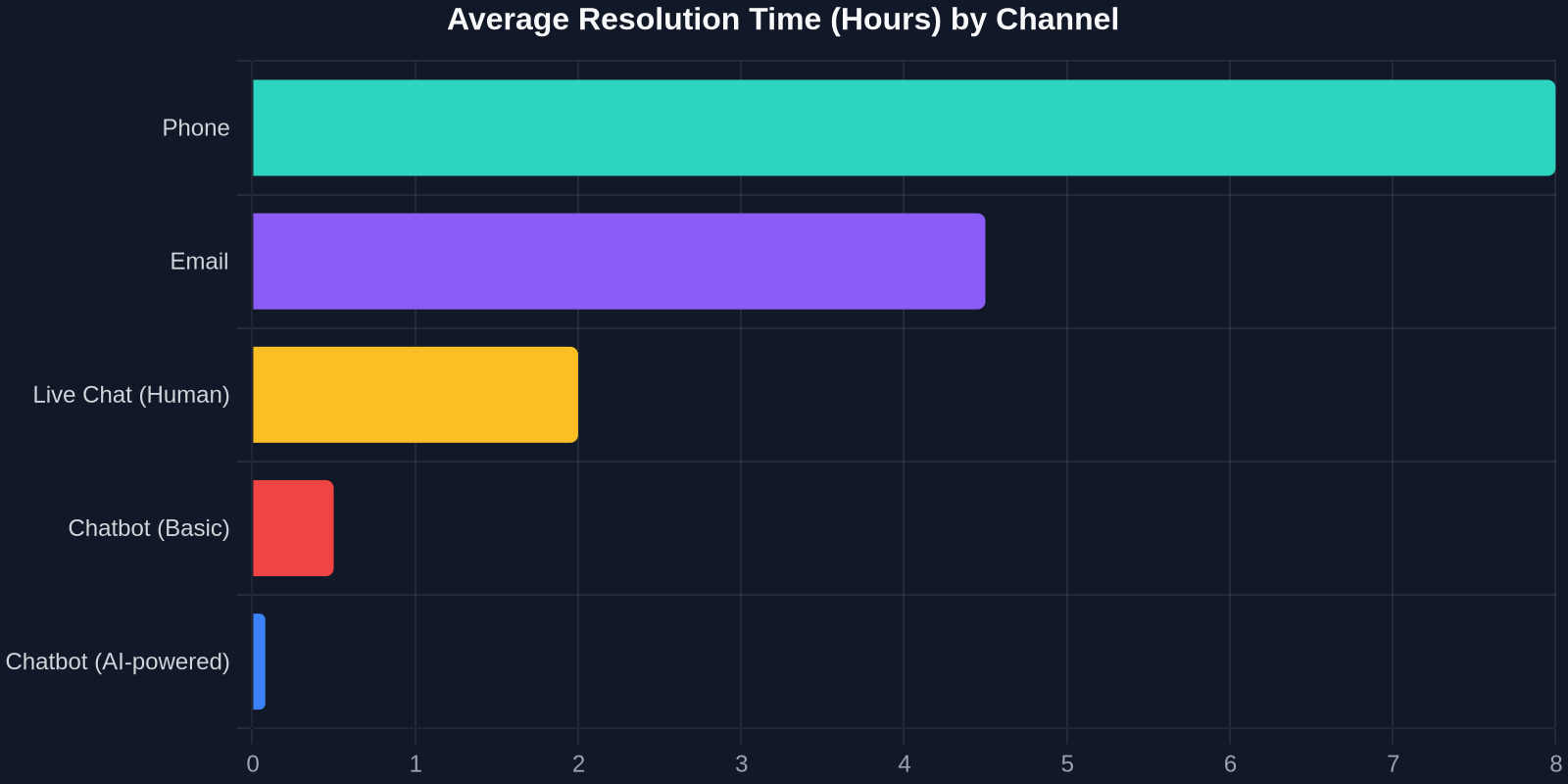 \n\nThe chart above clearly illustrates the massive reduction in resolution time when AI-powered chatbots are deployed – from 8 hours for phone support to just under 5 minutes for an intelligent AI solution. This efficiency is precisely why customers increasingly prefer the chatbot route for straightforward issues.\n\nROI Analysis: What Centrica and Others Are Gaining\n\n\n\nThe Adoption Curve of AI in Customer Service\n\nThe trend toward AI in customer service has been accelerating for years. The chart below shows the global adoption rate of AI in customer service interactions since 2019.\n\n
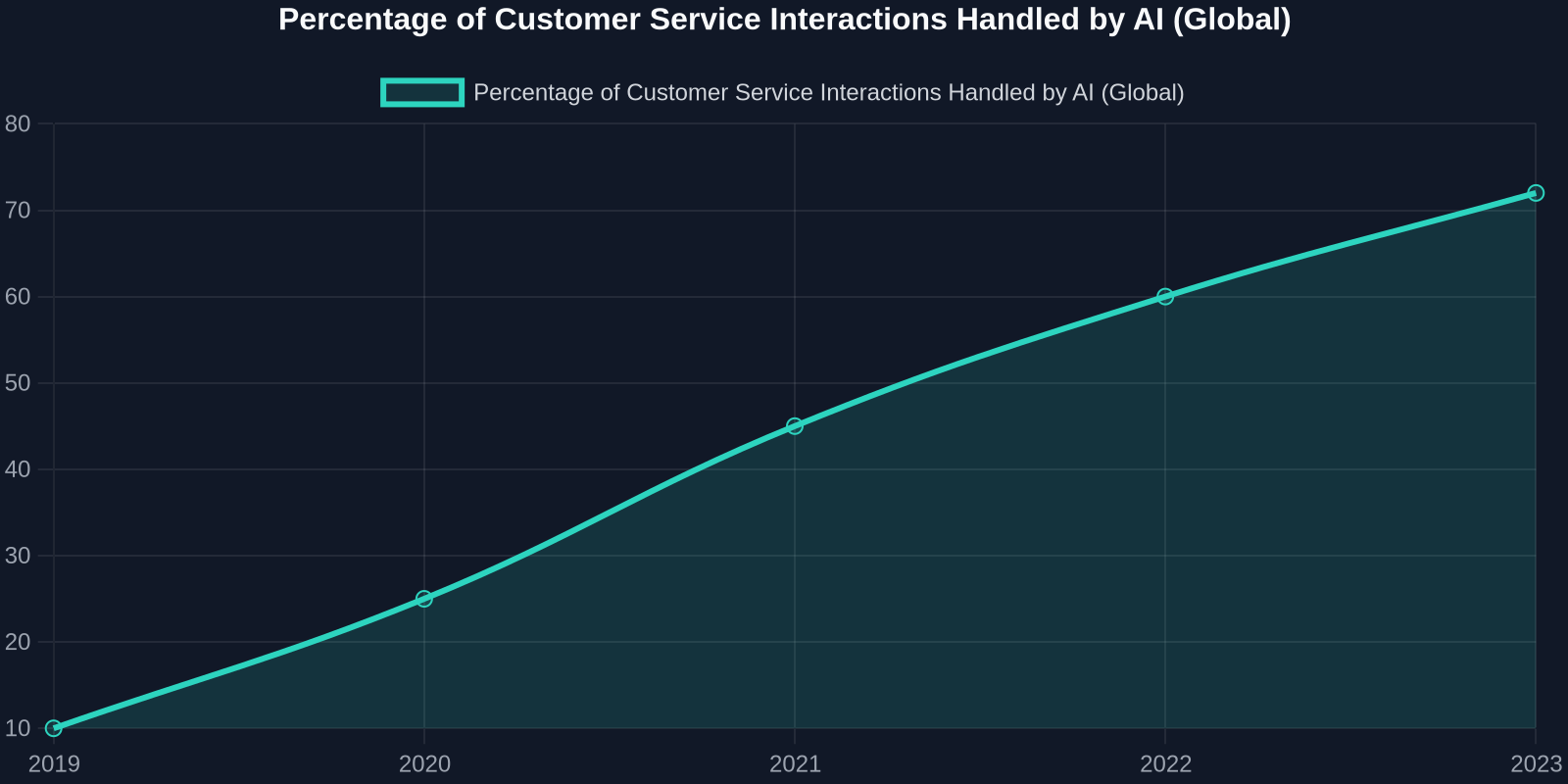 \n\nAs shown above, nearly three-quarters of all customer service interactions globally are now expected to involve AI by the end of 2023. Centrica's move is not a leap of faith but a logical step in a well-established curve. For SaaS companies, the message is clear: if you are not already experimenting with AI chatbots, you are falling behind.\n\nYet, the journey is not without pitfalls. The backlash to the Centrica announcement – particularly from union representatives and some customers – highlights a common concern: the fear that AI will erode service quality and job opportunities. How can companies avoid this trap?\n\nHow to Implement AI Chatbots Without Sacrificing Customer Trust\n\nThe key to successful AI chatbot adoption lies in a nuanced approach that respects both customer needs and employee value. Here is a step-by-step framework for support leaders looking to follow Centrica's lead – but do it better.\n\nStep 1: Audit Your Ticket Volume\n\nBefore deploying a chatbot, analyze your support tickets over the last 3-6 months. Categorize them into three buckets: simple/repetitive, medium complexity, and complex/escalation. Typical percentages for B2B SaaS companies are 65% simple, 25% medium, and 10% complex. The chatbot should handle the first bucket entirely, assist in the second, and route the third to senior agents.\n\n\n\nStep 2: Choose the Right AI Chatbot\n\nNot all AI chatbots are the same. Basic rule-based bots (like those from early 2010s) frustrate customers with rigid decision trees. Modern AI chatbots, especially those leveraging generative AI and natural language understanding, can handle complex phrases, detect sentiment, and even escalate proactively when they sense customer frustration.\n\nFeatures to look for in an AI chatbot for customer support:\n\nOmnichannel support (web, mobile, social, email)\nIntegration with your CRM and knowledge base\nSentiment analysis and automatic escalation\nContinuous learning from human agent corrections\nAnalytics dashboard showing deflection rates, CSAT, and common failure points\n\n\nStep 3: Gradual Rollout with Transparent Communication\n\nOne of the criticisms Centrica faced was the abruptness of the job cuts and the lack of transparency about how AI would change the customer experience. A better approach is to roll out the chatbot gradually – first as a suggested tool on the help center, then as a proactive pop-up, and finally as the primary first-point-of-contact for simple queries. Communicate clearly to customers that a human is always available if needed, and to employees that their roles will evolve toward higher-value work.\n\n\n\nStep 4: Measure What Matters\n\nOnce deployed, track the metrics that actually drive business outcomes:\n\nTicket deflection rate: Percentage of tickets resolved without human agent.\nCSAT for chatbot interactions: Are customers satisfied with the bot? Aim for >85%.\nAgent productivity: How many complex tickets can a human agent handle per day after AI takes over simple ones?\nAverage handle time: Overall support team AHT should drop.\nCost per resolution: This should decrease significantly.\n\n\n\n\nPractical Checklist for Adopting AI Chatbot in Your Support Team\n\nIf you are ready to follow the Centrica model (without the public backlash), use this checklist to guide your implementation:\n\n\nAudit your current ticket volume and categorize by complexity.\nSelect an AI chatbot platform that integrates with your existing tools (e.g., Successly for AI-powered support automation).\nDefine clear escalation rules: when does the bot hand off to a human?\nTrain the bot on your knowledge base, historical tickets, and known issues.\nPilot the bot with a subset of customers (e.g., new sign-ups or low-tier accounts).\nCommunicate to customers: let them know they can always ask for a human.\nReskill your support agents for higher-value roles (e.g., complex cases, AI training).\nMonitor key metrics weekly and iterate on the bot's performance.\nScale gradually, adding capabilities like proactive outreach or billing automation.\n\n\nConclusion: The Centrica Decision Is a Bellwether\n\nLove it or hate it, the Centrica decision to replace 1,300 call centre workers with AI chatbots is a bellwether for the entire customer service industry. The data is clear: customers do prefer AI chatbots for simple interactions because they are faster, more accurate, and available 24/7. For support leaders, the challenge is not whether to adopt AI, but how to adopt it responsibly – balancing efficiency with empathy, cost savings with job transformation, and speed with quality.\n\nThe companies that will thrive in this new era are those that view AI not as a replacement for humans, but as a tool that elevates both customer and agent experiences. By following the framework outlined in this article, you can navigate this transition without the controversy that has surrounded Centrica, and instead emerge as a customer-first, efficiency-driven organization ready for the future.\n\n\n\nAs you consider your next steps, remember that the goal is not to imitate Centrica's approach, but to improve upon it. Start small, communicate transparently, measure relentlessly, and always keep the customer experience at the heart of your decision-making. The future of support is hybrid, intelligent, and automated – and it is already here."\