
What Grok Bot’s Customer Support Play Means for the AI Industry, & How to Scale Your Own Support Ops
When xAI unveiled Grok Bot with a hard pivot toward customer support capabilities, the SaaS and support operations communities took immediate notice. This isn’t just another chatbot launch, it signals a structural shift in how enterprise-grade AI agents are positioned for the $350 billion customer experience market. The move by Elon Musk’s AI lab carries implications far beyond the headlines: it accelerates the timeline for autonomous support, redefines what “AI-native” support teams look like, and forces every SaaS founder and support leader to rethink their scaling strategy.
This post dissects the broader business impact of the Grok Bot announcement, maps it against the current state of AI-powered support automation, and gives you a practical, ROI-focused framework to achieve what Grok promises, without waiting for the next product release cycle.
The Grok Bot Signal: From Consumer AI to Enterprise Support Infrastructure
xAI’s evolution from a research-focused large language model lab into a consumer- and enterprise-facing assistant platform hasn’t been linear. The Grok family of models began as an experiment in unfiltered, “rebellious” AI personality, a stark contrast to the sanitized guardrails of ChatGPT and Claude. But the recent customer support positioning, including the notable dot-com domain redirect from OpenAI-related URLs directly to Grok Bot, signals a deliberate strategic pivot.
What’s really happening here?
The customer support vertical is the logical beachhead. Why? Three converging forces:
- Support costs are scaling non-linearly with growth, SaaS companies hitting $10M ARR typically see support headcount triple while margins compress.
- LLM capabilities have crossed the resolution-quality threshold, models can now handle multi-turn, context-aware troubleshooting that matches Tier-2 agent performance.
- Enterprise buyers are actively reallocating budget from traditional ITSM toward AI-native platforms, Gartner projects 30% of service desk interactions will be fully autonomous by 2026.
Grok Bot entering this arena validates the thesis: autonomous customer support agents are no longer an R&D project, they’re a board-level priority.
The Business Case for Autonomous Support: Numbers That Demand Attention
Before we examine how Grok fits into the competitive landscape, let’s ground the conversation in the metrics that make support automation the fastest-ROI AI application in SaaS today.

When implemented correctly, combining LLM-driven conversational agents with structured knowledge retrieval, organizations routinely see ticket volume drop by 35-50% within the first full quarter. This isn’t hype. It’s measured deflection rate from actual deployments where the AI handles everything from password resets to complex configuration troubleshooting.
This is the multiplier that CFOs love: the same team of 10 agents can effectively manage the workload of 32, not by working harder, but by letting autonomous agents triage, resolve, and only escalate edge cases. For a SaaS company spending $600K annually on support salaries, this unlocks $1.3M+ in reallocated capacity or cost savings.
Contrary to the “customers hate chatbots” narrative, modern AI agents, when transparent about their identity and equipped with genuine resolution capability, match or exceed human CSAT. The key differentiator: sub-2-minute resolution times versus the 8-hour average for human-first queues.
These four numbers frame the ROI conversation that Grok Bot is riding. The market isn’t just ready, it’s demanding these outcomes.
How Grok Bot’s Architecture Informs the Autonomous Support Playbook
While xAI hasn’t released granular technical specifications for the customer support deployment, Grok’s known architecture, built on the Grok-1 and Grok-2 model families with real-time knowledge access via the X platform, hints at a specific design pattern worth studying.
Real-Time Data Ingestion as a Support Moat
Grok’s access to live social and news feeds is well-publicized. For customer support, this capability maps to a critical requirement: current product knowledge. A support agent, human or AI, that only knows what was documented six months ago is a liability. The architecture suggests Grok Bot continuously ingests:
- Product changelogs and release notes
- Community forum discussions and bug reports
- Unstructured social signals about outages or issues
- Internal knowledge base updates in near-real-time
For support team leads evaluating build-vs-buy AI options, this is the design litmus test: Does the system update its working knowledge within hours of a product change, or does it require manual retraining cycles?
Personality as a Support Variable
Grok’s deliberately irreverent persona, witty, occasionally sarcastic, fundamentally different from the neutral-professional tone of most support AI, presents an intriguing CX hypothesis. Could personality-matching improve resolution rates?
Early data from consumer-facing AI agents suggests yes: when the assistant’s tone aligns with the brand’s voice and the customer’s expectations, engagement depth increases. A developer-tools company might benefit from a more direct, technically witty agent; a healthcare SaaS might need empathetic precision.
The Grok approach indicates that personality configurability will be table stakes for enterprise support AI by 2026, not a differentiator.
The Competitive Landscape: Where Grok Bot Lands on the Maturity Curve
To evaluate Grok’s customer support positioning, let’s benchmark against the current AI support maturity model:
| Capability Tier | Traditional Chatbots | Current LLM Agents | Autonomous Agents (2025+) | Grok Bot (Projected) |
|---|---|---|---|---|
| Intent Understanding | Keyword matching | NLU with context | Multi-turn, implicit intent | Real-time context from live data |
| Resolution Scope | FAQ deflection only | Tier-1 + guided Tier-2 | Full Tier-1/2 autonomous, Tier-3 assist | Tier-1/2 autonomous w/ live escalation |
| Knowledge Update | Manual curation (weeks) | Semi-automated (days) | Continuous ingestion (hours) | Real-time from X ecosystem |
| Multi-Channel | Web widget only | Email + chat + Slack | Omnichannel w/ context persistence | Omnichannel + social signals |
| Enterprise Readiness | Limited RBAC | Basic SSO + audit | SOC 2 + granular controls | Enterprise SLA-backed (projected) |
Grok Bot, based on public signals, appears to target the Autonomous Agent tier with a unique advantage in real-time knowledge freshness via the X platform integration. However, enterprise readiness, SOC 2, SLA guarantees, admin controls, remains the unvalidated dimension, and it’s the one that matters most to support operations buyers.
Practical Framework: Scaling Your Support Ops Before Grok Bot Ships
Whether Grok Bot becomes your solution or a competitor’s advantage, the operational groundwork for AI-native support is the same. Here’s a 4-phase framework that has delivered measurable results across B2B SaaS deployments:
Phase 1: Deflection Diagnostics (Week 1-2)
Before any AI tool enters the picture, you need surgical clarity on what can be automated. Pull 90 days of ticket data and segment by:
- Resolution pattern: Fully scripted (password resets, status checks) vs. semi-structured (configuration help) vs. judgment-heavy (contract interpretation)
- Time-to-resolution distribution: Which ticket types consume disproportionate human time despite low complexity?
- Deflection eligibility score: Rate each ticket category 1-5 on “could an AI resolve this with access to product docs and account data?”
Output from Phase 1: a ranked automation opportunity map with projected ticket deflection percentages by category.
Phase 2: Knowledge Architecture (Week 2-4)
Autonomous agents don’t succeed on model quality alone, they succeed or fail on knowledge architecture. Build (or audit) three layers:
- Canonical knowledge base: Structured, version-controlled articles with explicit scope tags (product, feature, version, audience)
- Procedural knowledge base: Step-by-step resolution sequences for the top 50 ticket types, these become the agent’s “playbooks”
- Live knowledge feed: A mechanism, API, webhook, or manual curation, that pushes product changes into the agent’s working memory within hours, not weeks
Phase 3: Agent Deployment with Escalation Intelligence (Month 1-2)
This phase is where tools like Successly accelerate the timeline. The critical design principle: deploy for resolution, not just deflection. An AI that says “I can’t help with that, creating a ticket” is a chatbot from 2018. An autonomous agent should:
- Attempt resolution against the knowledge architecture in Phase 2
- Ask clarifying questions when intent is ambiguous, don’t guess
- Execute account-lookup and read-only actions where integrations allow
- Escalate with context summaries, not just ticket creation, the human agent should receive a fully triaged handoff, not a raw transcript
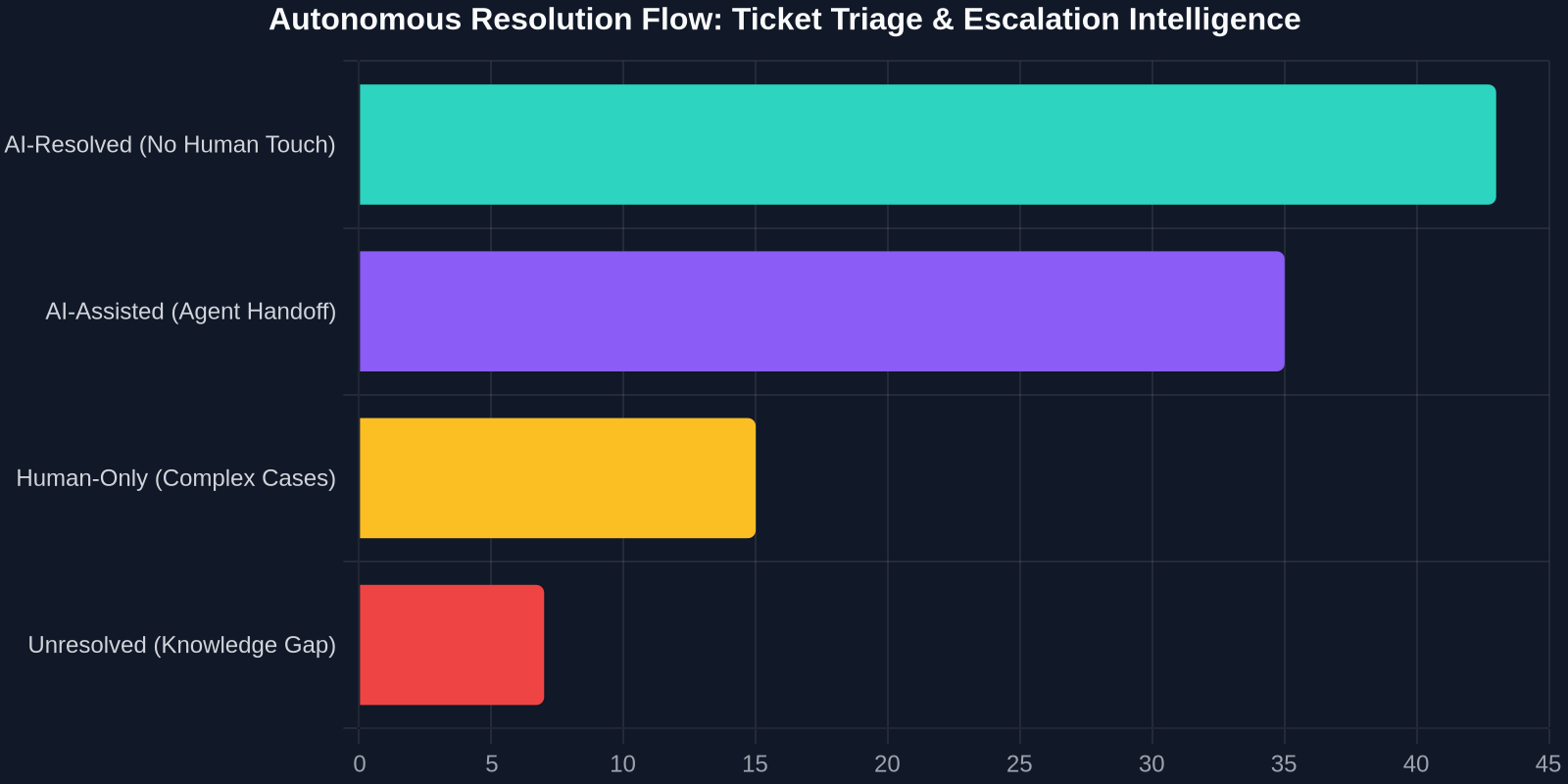
The chart above maps the resolution flow that maximizes both autonomous closure rates and human-agent efficiency for escalated issues.
Phase 4: Measurement & Continuous Tuning (Month 3+)
Autonomous support isn’t a one-time deployment, it’s an operational discipline. The metrics stack that matters:
- Autonomous Resolution Rate (ARR%): Percentage of AI-handled tickets closed without human touch
- Deflection Rate: Tickets that never reach a human (broader than ARR, includes self-service)
- Escalation Quality Score: Human agents rate the AI’s handoff summaries for completeness (1-5 scale)
- Time-to-Resolution Delta: Compare AI-handled vs. human-handled times for equivalent ticket types
- CSAT by Resolution Path: Satisfaction scores segmented by AI-resolved, AI-escalated, and human-only
This second chart shows the typical performance trajectory across the first 90 days of deployment: ARR% climbs steeply as the knowledge base is tuned, escalation quality approaches human-parity by day 60, and CSAT stabilizes above the human-only baseline.
The SaaS Economics: What Happens When Support Becomes a Multiplier, Not a Cost Center
For SaaS companies specifically, autonomous support rewrites the unit economics of customer success. Let’s run the numbers for a representative $8M ARR B2B SaaS company with 400 support tickets per week and a 6-person support team:

| Metric | Pre-AI Baseline | Post-AI (Month 3) | Annual Impact |
|---|---|---|---|
| Weekly Ticket Volume | 400 | 228 (43% deflected) | 8,944 fewer tickets/year |
| Avg. Time-to-Resolution | 7.5 hours | 2.1 hours (blended) | 73% faster resolution |
| Support Team Headcount | 6 FTE | 4 FTE (redeployed to success) | $130K+ salary reallocation |
| Customer Churn Rate | 4.2% monthly | 3.1% monthly (modeled) | ~13% gross churn reduction |
| CSAT Score | 87% | 91% | 4-point CSAT gain at scale |
The compounding effect: faster resolution reduces churn, reduced churn increases LTV, increased LTV funds better AI tooling, better AI improves resolution further. This is the virtuous cycle that Grok Bot, and platforms enabling the same architecture, unlock.
The Build vs. Buy Calculus in a Post-Grok Landscape
With xAI entering the support automation space, SaaS leaders face a renewed build-vs-buy decision. The Grok API, assuming enterprise support features ship, offers a powerful model layer. But models aren’t solutions.
Building a complete autonomous support agent on top of any LLM, Grok, GPT-4, Claude, requires:
- Conversation management with stateful context across channels
- Knowledge ingestion pipelines with freshness guarantees
- Escalation routing integrated with your helpdesk (Zendesk, Intercom, etc.)
- RBAC, audit logging, and SOC 2 compliance layers
- Continuous monitoring and tuning dashboards
For companies with 2+ dedicated MLEs and a 6-month timeline, building is viable. For the 80% of SaaS companies that need to ship autonomous support in Q2, buying an integrated platform that abstracts the model layer, while delivering the measurement, escalation, and knowledge architecture out of the box, is the pragmatic path.
The Window Is Open, But Closing
The Grok Bot announcement should be read as an acceleration signal, not a future-state curiosity. In 2025, the SaaS companies that embed autonomous support into their operations will be the ones defending margins as growth scales. Those treating AI support as a 2026 project will face a competitive gap, not just in cost structure, but in the customer experience expectations that Grok-like agents are already setting in the market.
Every support ticket that could have been resolved in 2 minutes, but spent 8 hours in a queue, represents a compound cost: the immediate support salary, the customer’s frustration, the churn risk, the negative review, the expansion revenue deferred. Autonomous support isn’t about replacing humans; it’s about ensuring humans only touch the work that genuinely requires their judgment. When the math shows 43% deflection, 3x team capacity, and maintained CSAT, the strategic decision isn’t “if”, it’s “how fast.”
The platforms that deliver this capability today, with enterprise-grade measurement, escalation intelligence, and knowledge freshness, are the bridge between the Grok Bot promise and operational reality. The companies deploying them now won’t be waiting for the next press release; they’ll already be running the numbers.