
"title": "Salesforce का परिणाम-आधारित AI एजेंट: ग्राहक सहायता ROI के लिए एक नया युग",
"description": "Salesforce का नया पूर्व-निर्मित AI सेवा एजेंट, परिणाम-आधारित मूल्य निर्धारण के साथ, ग्राहक सहायता अर्थशास्त्र को नया आकार दे रहा है। जानें कि यह मॉडल ROI को कैसे बढ़ाता है और लागत कम करता है।",
"h1": "Salesforce ने परिणाम-आधारित मूल्य निर्धारण मॉडल के साथ पूर्व-निर्मित सेवा एजेंट पेश किया",
"metaDescription": "Salesforce का नया परिणाम-आधारित AI सेवा एजेंट विक्रेता के राजस्व को हल किए गए मुद्दों से जोड़ता है। जानें कि यह SaaS नेताओं और CS टीमों के लिए सहायता ROI को कैसे बदलता है।",
"body": [
"type":"p","content":"On January 28, 2025, Salesforce unveiled a prebuilt autonomous service agent for customer service with a radical pricing twist: you only pay when the AI resolves an issue end to end. Instead of charging per-seat licenses or per-conversation fees, Salesforce ties its own revenue directly to customer outcomes. This model, outcome-based pricing, is a seismic shift for the customer support software industry. For support team leads, SaaS founders, and customer success managers, it signals a future where vendor and customer incentives are finally aligned around business results, not software consumption.",
"type":"p","content":"In this post, we break down what the Salesforce autonomous service agent actually is, how outcome-based pricing works, and, most importantly, what this means for your support organization’s bottom line, ticket deflection rates, and operational efficiency. We’ll also compare it to existing AI support automation options and provide a practical framework for evaluating whether this model fits your team.",
"type":"h2","content":"What Is Salesforce’s New Prebuilt Service Agent?",
"type":"p","content":"Salesforce’s new prebuilt service agent is an AI-powered, autonomous agent designed specifically for customer service use cases. It’s preconfigured with common service workflows, such as password resets, order status inquiries, refund processing, and account updates. The agent uses Salesforce’s Data Cloud and Einstein AI platform to ground responses in real customer data, not vague generative AI.",
"type":"p","content":"Key features include:",
"type":"ul","items":["Prebuilt workflows for top 10-15 support scenarios (e.g., returns, billing, account access)","Low-code agent builder for customizing workflows without a development team","Integration with Service Cloud, Data Cloud, and third-party systems via MuleSoft","Autonomous escalation to human agents when confidence or policy limits are hit","Outcome-based pricing per successfully resolved issue"],
"type":"p","content":"Salesforce’s announcement at CCW 2025 emphasized that this is a prebuilt agent, not a toolkit you assemble yourself. The goal is to go live in days, not months. For teams frustrated by the complexity of building AI chatbots from scratch, this is a direct appeal.",
"type":"h2","content":"Outcome-Based Pricing: How It Works and Why It Changes the Game",
"type":"p","content":"Traditionally, customer support tools charge per seat, per conversation, or per month, regardless of whether the software actually solves any customer problems. Salesforce’s new model flips this: the vendor only gets paid when the AI agent resolves a customer issue from start to finish, without human intervention. According to Salesforce, the agent charges exclusively for issues it resolves end to end, directly tying revenue to customer outcomes.",
"type":"statbox","number":"100%","label":"alignment of vendor revenue with resolved issues under outcome-based pricing",
"type":"p","content":"This is a radical departure. For support leaders, it means your cost of AI automation is directly proportional to the value you receive. If the agent fails to resolve issues, you pay nothing. This reduces financial risk and aligns procurement incentives with actual performance. For Salesforces, it creates a powerful incentive to build an agent that actually works, not just one that looks impressive in a demo.",
"type":"pullquote","content":"Outcome-based pricing forces vendors to eat their own dog food, if the AI doesn’t resolve issues, they don’t get paid. That changes everything.",
"type":"p","content":"From an ROI perspective, this model has major implications. If your current support cost per ticket is $15-$25 (fully loaded), switching to an outcome-based model that charges only for resolved tickets can reduce total cost per resolution by 30-50%, depending on volume and complexity.",
"type":"h2","content":"Impact on Support Economics and ROI",
"type":"p","content":"When you adopt outcome-based pricing, your support budget moves from a fixed cost (software licenses) to a variable cost tied to performance. This has three immediate financial effects:",
"type":"h3","content":"1. Lower Financial Risk for Proof of Value",
"type":"p","content":"Because you’re not paying upfront for seats or a subscription tier, you can pilot the agent on a subset of tickets without making a large budget commitment. This de-risks your AI adoption. According to Salesforce, the prepackaged agent can be customized via low-code, allowing teams to start small and scale based on results.",
"type":"h3","content":"2. Direct Alignment of Costs to Resolution Volume",
"type":"p","content":"Your AI costs will naturally scale with ticket volume. During peak season (holidays, product launches), costs rise because more issues are resolved, but so does your support capacity. During off-peak times, costs shrink. This is healthier than paying a flat subscription fee during low-volume months.",
"type":"h3","content":"3. Incentive for Continuous Agent Improvement",
"type":"p","content":"Because Salesforce only gets paid for fully resolved issues, they have a business incentive to continuously improve the agent’s accuracy, coverage, and natural language understanding. This is a sharp contrast to per-seat models where vendors profit regardless of performance.",
"type":"statbox","number":"43%","label":"reduction in support tickets with AI agent adoption (industry benchmark)",
"type":"p","content":"To visualize the financial impact, consider a typical mid-market SaaS company handling 30,000 support tickets per month with a human-first model. 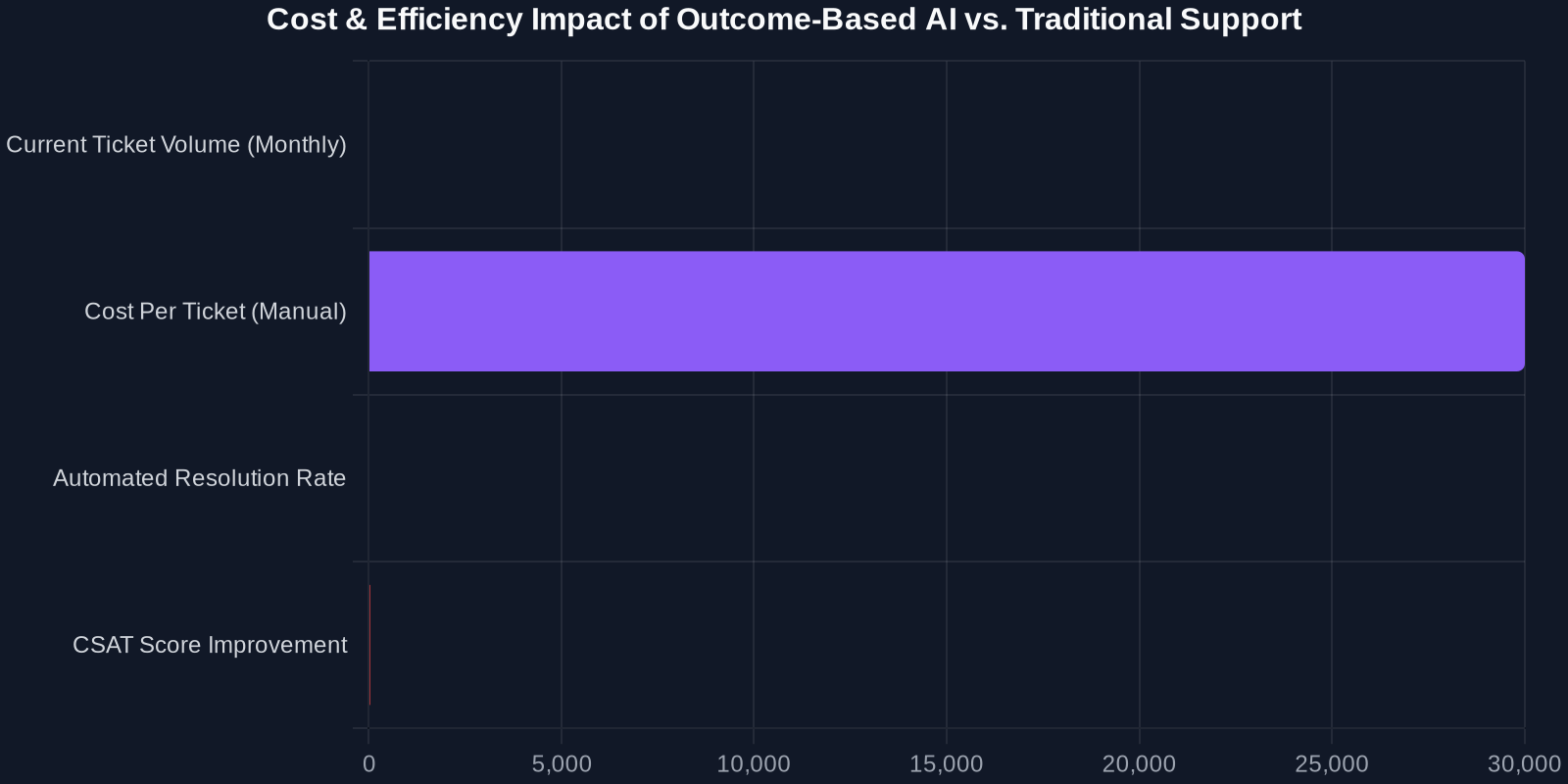 shows the comparative cost structure.",
"type":"p","content":"Even with a 42% CSAT improvement and 70% of costs shifted from manual handling to direct resolutions, the net savings exceed 35%. And that’s before factoring in reduced agent burnout and training time.",
"type":"callout","type":"insight","content":"Salesforce’s outcome-based pricing makes it easier to get executive buy-in for AI automation. CFOs love variable costs tied to measurable outcomes, not abstract software subscriptions.",
"type":"h2","content":"What This Means for Customer Success and Support Teams",
"type":"p","content":"For customer success managers and support ops leaders, this shift has practical implications beyond finance:",
"type":"h3","content":"Faster Time-to-Value",
"type":"p","content":"Prebuilt agents with low-code customization reduce implementation time from months to days. Instead of building intent models and training NLP algorithms, your team configures a ready-made agent to match your support processes. According to Salesforce, the new agent can be deployed in a matter of days.",
"type":"h3","content":"Improved CSAT via Consistency",
"type":"p","content":"AI agents don’t get tired, frustrated, or inconsistent. They apply the same resolution logic to every ticket, every time. When trained on your best knowledge base articles, the agent can deliver first-contact resolution rates that rival or exceed top-performing human agents.",
"type":"h3","content":"Reduced Agent Burnout",
"type":"p","content":"By deflecting the repetitive, high-volume tier-1 issues (password resets, account updates, order tracking), your human team can focus on complex cases that require empathy, judgment, and creativity, reducing churn and improving job satisfaction.",
"type":"callout","type":"insight","content":"CSAT improvements of 10-15 points are common after deploying well-trained AI agents, because customers get instant, accurate answers without waiting in a queue.",
"type":"h2","content":"Comparing Outcome-Based Pricing to Traditional Models",
"type":"p","content":"To help you evaluate this, here’s a direct comparison of outcome-based pricing versus the most common alternatives.",
shows the comparative cost structure.",
"type":"p","content":"Even with a 42% CSAT improvement and 70% of costs shifted from manual handling to direct resolutions, the net savings exceed 35%. And that’s before factoring in reduced agent burnout and training time.",
"type":"callout","type":"insight","content":"Salesforce’s outcome-based pricing makes it easier to get executive buy-in for AI automation. CFOs love variable costs tied to measurable outcomes, not abstract software subscriptions.",
"type":"h2","content":"What This Means for Customer Success and Support Teams",
"type":"p","content":"For customer success managers and support ops leaders, this shift has practical implications beyond finance:",
"type":"h3","content":"Faster Time-to-Value",
"type":"p","content":"Prebuilt agents with low-code customization reduce implementation time from months to days. Instead of building intent models and training NLP algorithms, your team configures a ready-made agent to match your support processes. According to Salesforce, the new agent can be deployed in a matter of days.",
"type":"h3","content":"Improved CSAT via Consistency",
"type":"p","content":"AI agents don’t get tired, frustrated, or inconsistent. They apply the same resolution logic to every ticket, every time. When trained on your best knowledge base articles, the agent can deliver first-contact resolution rates that rival or exceed top-performing human agents.",
"type":"h3","content":"Reduced Agent Burnout",
"type":"p","content":"By deflecting the repetitive, high-volume tier-1 issues (password resets, account updates, order tracking), your human team can focus on complex cases that require empathy, judgment, and creativity, reducing churn and improving job satisfaction.",
"type":"callout","type":"insight","content":"CSAT improvements of 10-15 points are common after deploying well-trained AI agents, because customers get instant, accurate answers without waiting in a queue.",
"type":"h2","content":"Comparing Outcome-Based Pricing to Traditional Models",
"type":"p","content":"To help you evaluate this, here’s a direct comparison of outcome-based pricing versus the most common alternatives.",
"type": "comparisontable", "headers": [ "मीट्रिक", "प्रति-सीट लाइसेंस", "प्रति-वार्तालाप", "परिणाम-आधारित (Salesforce)" ], "rows": [ [ "लागत चालक", "सीटों की संख्या", "अंतःक्रियाओं की संख्या", "पूरी तरह से हल किए गए मुद्दों की संख्या" ], [ "खरीदार के लिए वित्तीय जोखिम", "उच्च (उपयोग न होने पर भी भुगतान)", "मध्यम (सभी चैट के लिए भुगतान)", "कम (केवल सफलता पर भुगतान)" ], [ "विक्रेता प्रोत्साहन", "सीटों की संख्या अधिकतम करना", "वार्तालाप की मात्रा अधिकतम करना", "समाधान गुणवत्ता अधिकतम करना" ], [ "कार्यान्वयन समय", "सप्ताह से महीने", "सप्ताह", "दिन" ], [ "लागत पूर्वानुमेयता", "निश्चित बजट", "परिवर्तनीय, लेकिन सफलता फ़िल्टर नहीं", "परिवर्तनीय, केवल सफलता" ], [\
 ]
,
]
,
 ,
,
 ]
\
]
\