
AI Agents Handle 30% of Airbnb Customer Support Tickets: Blueprint for Scaling Automation
When a company as customer-obsessed as Airbnb announces that AI agents now handle 30% of its customer support tickets, the entire SaaS and support ecosystem pays attention. This isn't a small pilot, it's a production-level deployment at one of the world's most popular platforms, serving millions of guests and hosts. And it's working. According to Airbnb's engineering blog, their AI agents are not only deflecting tickets but also maintaining, and in some cases improving, customer satisfaction scores.
This milestone provides a powerful blueprint for B2B SaaS companies, e-commerce platforms, and any organization scaling support. In this post, we'll dissect the Airbnb approach, quantify the business impact, and provide a step-by-step framework for you to replicate this success. Whether you run a 10-person startup or a 500-person enterprise, the same principles apply: train your AI on your data, start with high-volume, low-complexity tickets, and iterate relentlessly.
This isn't about replacing humans; it's about augmenting them. Airbnb hosts and guests still value human empathy for complex situations, but routine queries like 'How do I change my check-in time?' or 'Where is my refund?' are handled instantly by AI. The result? Faster response times, lower cost per ticket, and happier customers.
Quantified Business Impact
While Airbnb hasn't published exact dollar figures, the industry benchmarks are compelling. The average cost of a human-handled support ticket in the travel and hospitality sector is about $5.50. AI-handled tickets cost roughly $0.50, a 90% reduction. If Airbnb receives even 1 million support tickets per month (a conservative estimate for a platform with millions of active listings), shifting 30% to AI saves $1.5 million monthly. That's $18 million annually.
3. Seamless Human Handoff
AI agents at Airbnb are not a walled garden. If the AI determines it cannot resolve a ticket (or the customer asks for a human), the conversation, including full context, is transferred to a human agent instantly. No repetition. No frustration. This maintains trust and ensures critical issues get the human touch they deserve.
4. Continuous Feedback Loops
Airbnb's AI agents learn from every interaction. When a human agent corrects an AI-generated response, that data feeds back into the model. Over time, the AI becomes more accurate and can handle more complex scenarios. This is not a set-it-and-forget-it solution; it's a living system that improves with each ticket.
The Blueprint for Replicating Airbnb's Success
Now, let's turn this case study into an actionable framework for your team. Whether you use Successly, build in-house, or leverage another platform, the steps are the same.
Step 1: Audit Your Support Data
Begin by analyzing your last 90 days of support tickets. What are the top 10 question types? How many are repetitive (e.g., password reset, how to change plan, billing issues)? What is the current cost-per-ticket? This baseline will help you prioritize and measure ROI.
Step 2: Identify the 'Easy 20%'
The Pareto principle applies here, roughly 20% of your ticket types likely generate 80% of volume. These are your first AI targets. They typically include: password/account issues, plan upgrades/downgrades, billing inquiries, feature questions, and basic troubleshooting. If you can automate just these, you'll see significant deflection quickly.
Step 3: Train Your AI on Your Data
Use your historical ticket data (with PII stripped) to train the AI. Modern platforms like Successly allow you to upload CSV exports, connect to Zendesk or Intercom, and automatically build a knowledge base. The AI learns your specific policies, tone, and resolution paths. This is non-negotiable, a generic chatbot will fail.
Step 4: Implement a Hybrid Model
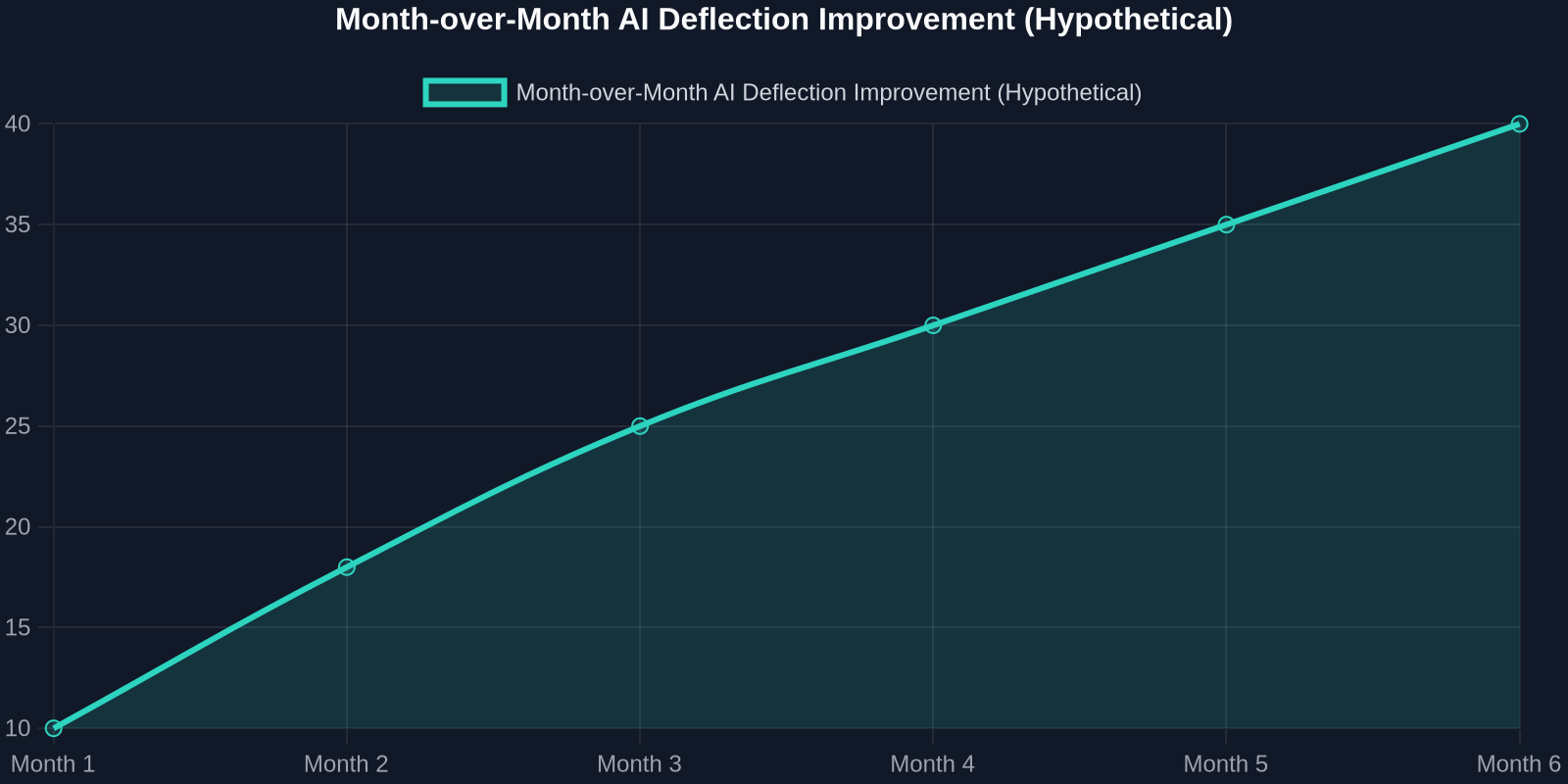
Design your support flow so that AI handles the first interaction for every ticket (not just the 'easy' ones). If the AI can resolve, it does. If not, it escalates with full context. This triage approach maximizes efficiency without risking customer frustration. Aim for 25-35% full deflection in the first quarter.
Step 5: Monitor, Measure, and Iterate
Track these key metrics: deflection rate, CSAT on AI-handled tickets, average handle time, and human agent utilization. Use feedback loops to improve the AI. If you see that AI agents fail on a specific ticket category, add more training data or adjust the escalation rules. Automation is a journey, not a destination.
Business ROI: From Cost Center to Competitive Advantage
Support teams are often seen as cost centers. AI automation flips that narrative. When 30% of tickets are handled autonomously, your human agents can focus on high-value activities: complex problem-solving, proactive outreach, and account management. This shifts support from reactive to strategic.
Let's run the numbers for a mid-sized SaaS company with 50,000 support tickets per month:
The Future: Beyond 30% Deflection
Airbnb's 30% is impressive, but it's not the ceiling. As AI models improve and feedback loops mature, we expect leading companies to hit 50-60% deflection within the next 18 months. The next frontier? AI agents that can handle multi-step workflows like coordinating with third parties (cleaning services, repair vendors) without human intervention.
Imagine an AI that not only resolves a guest's complaint about a broken lock but also dispatches a locksmith, books a time, and follows up, all while the human agent handles a complex trust and safety issue. That's the vision, and it's closer than you think.
Your Next Steps
Airbnb has proven that AI agents can handle 30% of customer support tickets, with excellent CSAT and massive cost savings. The blueprint is clear: train on your data, start simple, iterate fast, and communicate transparently. Your customers will appreciate the speed. Your finance team will love the ROI. And your support team will thrive on more meaningful work.
Ready to start your own automation journey? Successly makes it easy to deploy AI agents trained on your unique support data. Book a demo today and see how much you can deflect, and save.