
AI Agent Pricing in Customer Support: Why Outcome-Based Models Are the Next Frontier
Corporate spending on generative AI is set to explode, from $61.9 billion in 2025 to even greater heights as large tech companies race to monetize cognitive services. Yet for all the excitement around AI agents that can plan, execute, and adapt, one awkward truth remains: we haven’t figured out how to price them.
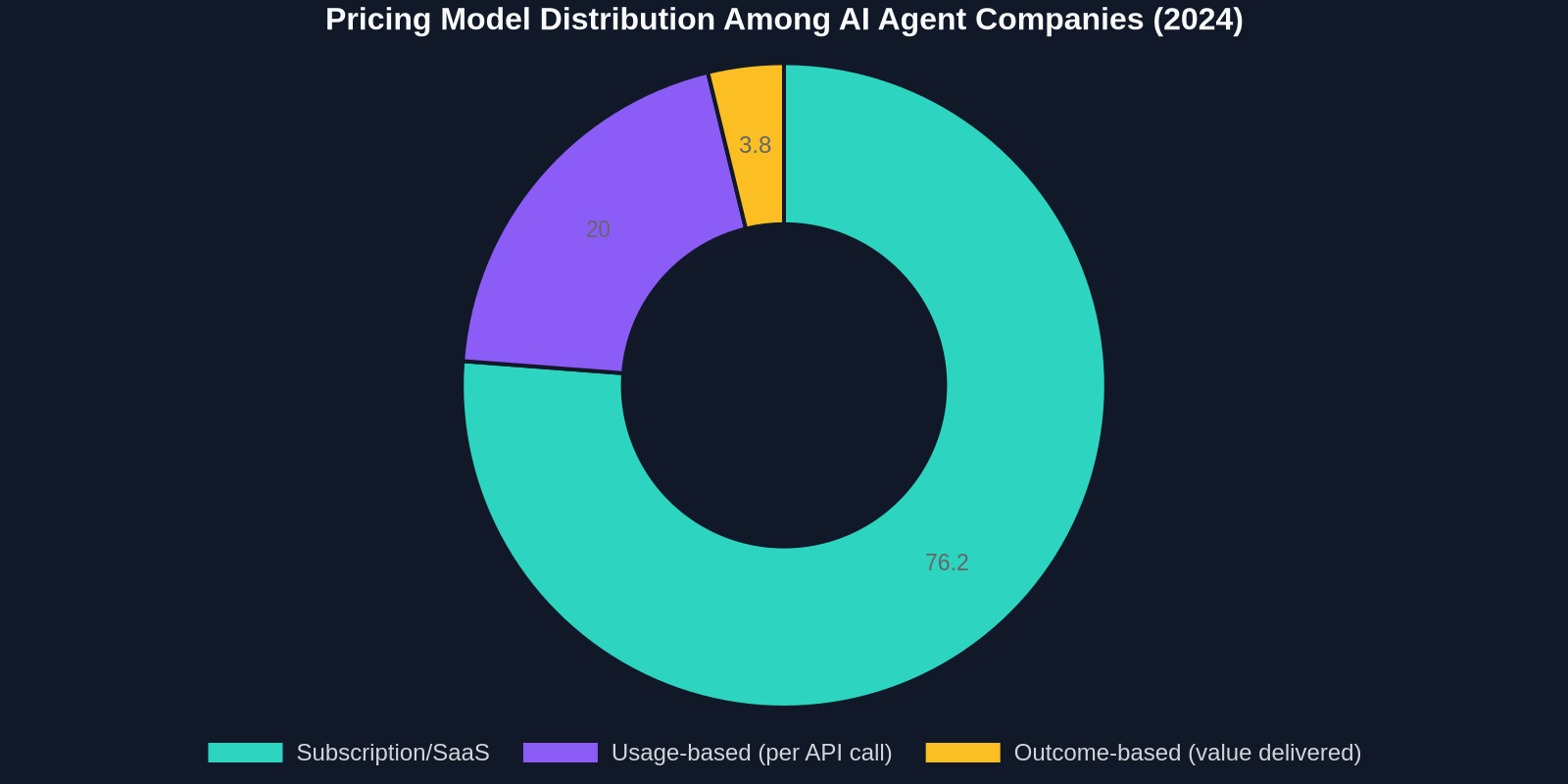
A recent deep‑dive by Orb, a billing software provider, analyzed 80 AI agent companies and found that just 3.8% use outcome‑based pricing. Subscription and usage‑based models dominate, even as agent orchestration platforms begin shifting from predefined task routing toward coordinating outcomes across agents, software, automation, and people. For customer support leaders, who live by metrics like CSAT, ticket deflection, and mean time to resolution (MTTR), this pricing gap represents both a risk and a massive opportunity.
The irony is palpable. Everyone celebrates AI agents, yet few budget for the oversight they demand. Workflow software is moving toward outcome‑orchestration, but most pricing models still meter by input, minutes of conversation, API calls, or seat licenses. This disconnect creates a hidden tax on efficiency and slows the adoption of truly autonomous support systems. In this post, we’ll unpack the economics of AI agent pricing in customer support, expose the real cost of agent oversight, and explain why outcome‑based pricing, though nascent, is the inevitable path to unlocking the full ROI of support automation.
The AI Agent Revolution in Customer Support: Beyond Chatbots
Customer support has been on the front line of the AI revolution since the first rule‑based bot deflected a password reset. Today’s AI agents are fundamentally different: they don’t just respond; they reason, access knowledge bases, execute multi‑step workflows, and even proactively reach out to customers. They sit inside the tools teams already use, a trend that Workday’s recent push for agentic orchestration highlights, potentially influencing demand for high‑value workloads such as complex case resolution and customer success automation.
For support team leads and SaaS founders, this evolution promises two things: better customer experiences and drastically lower operational costs. An AI agent that can resolve a billing dispute end‑to‑end, update the CRM, and trigger a refund replaces a 20‑minute manual process with a 2‑minute autonomous workflow. But while the technology races ahead, the commercial models lag behind, often forcing buyers to pay for capacity rather than results. This misalignment is particularly painful in support, where ticket volumes spike unpredictably and the value of an interaction varies wildly, a simple “how do I reset my password?” is not worth the same as a saved churned customer.
Understanding this landscape requires looking at both the agents themselves and the orchestration platforms that tie them together. Agentic marketing and agentic support are converging: brands are learning to delegate tasks to AI agents, but the real question is how we measure, and pay for, success.
The Pricing Puzzle: Subscription vs. Usage vs. Outcome
Today, the vast majority of AI agent companies rely on two pricing models: subscription (per‑seat or per‑agent) and usage‑based (per conversation, per token, or per API call). Outcome‑based pricing, where the customer pays only for proven business results, such as a resolved ticket or a deflection that didn’t reach a human, remains rare.

| Metric | Subscription/Seat | Usage‑Based | Outcome‑Based |
|---|---|---|---|
| Unit of Value | Access to agent | Consumed resources (calls, tokens) | Business result (resolved ticket, CSAT lift) |
| Risk Alignment | Customer bears risk of under‑use | Shared risk (cost scales with volume) | Vendor bears risk, pays for underperformance |
| Predictability | High for vendor, low for buyer | Medium (variable cost) | High for buyer, challenging without trust metrics |
| Adoption in AI Agent Cos. | ~76% | ~20% | ~3.8% |
The low adoption of outcome‑based pricing isn’t surprising. It’s harder to implement, requires robust measurement, and often demands a level of trust that many AI vendors have not yet earned. Apify’s Jan Curn argues that agent payments remain tiny because they compete with API keys, not payment networks like Visa, and that escrow‑based variable pricing, not crypto, will be the unlocking factor. That observation rings true for customer support: a brand won’t commit a percentage of support costs to an agent unless there’s a clear, auditable link between agent actions and business outcomes.
Yet, the 3.8% figure might understate the coming disruption. For SaaS and B2B support teams, outcome‑based pricing aligns incentives perfectly. Imagine paying per resolved conversation, with bonuses for upsells or renewals saved. The agent vendor is now motivated not just to build a feature‑packed bot, but to deliver real operational savings and revenue protection.
The Real Cost of “Free” AI Agents: Oversight, Rework, and Trust Gaps
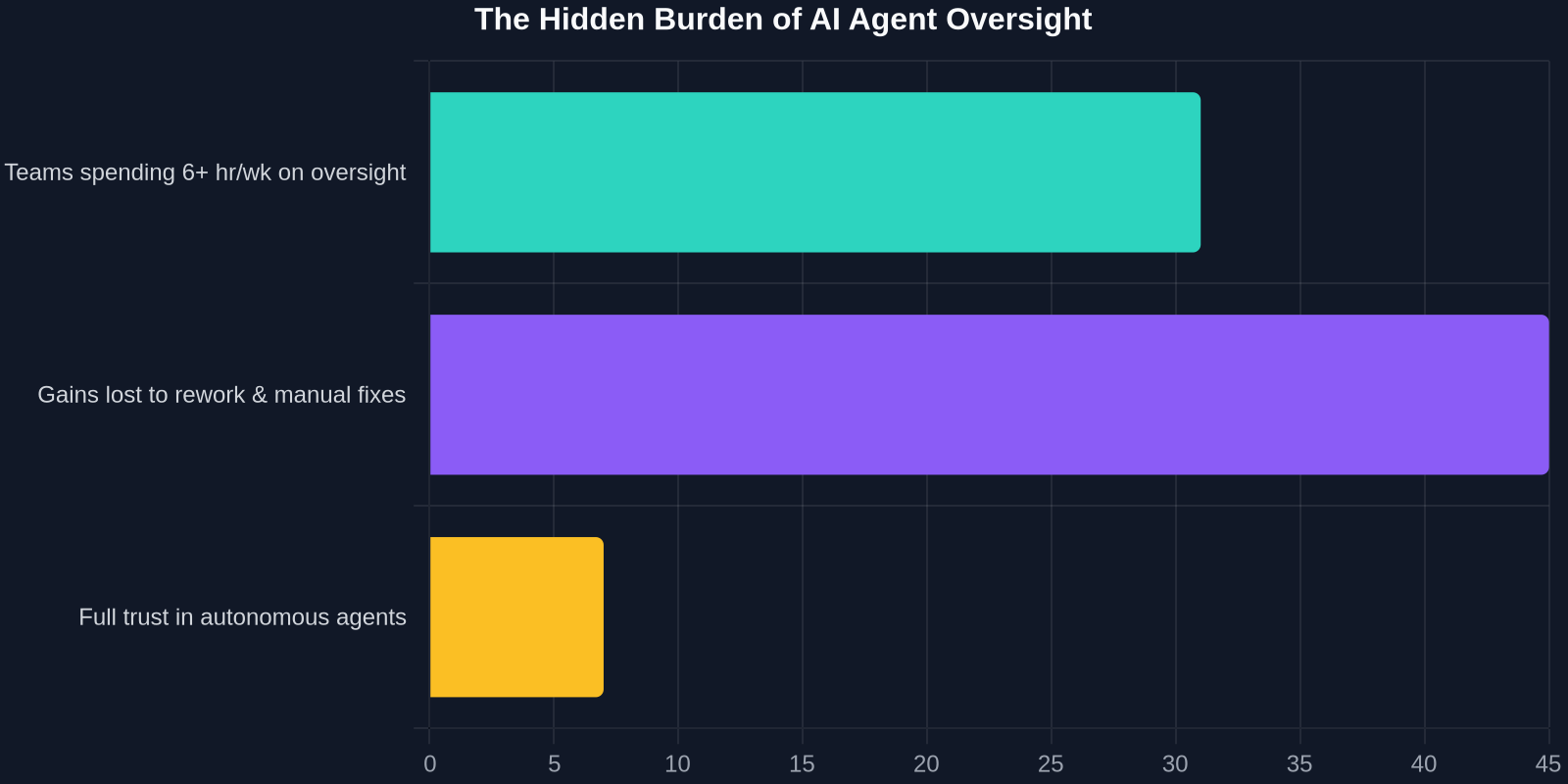
One of the most surprising findings from recent industry data is how much human oversight today’s AI agents still require. G2 research shows that 31% of teams “bot‑sit” for more than six hours a week, essentially baby‑sitting AI agents that were supposed to save them time. Even more alarming: 45% of respondents report losing over a quarter of their efficiency gains to rework, manual corrections, and escalations that the agent mishandled. Only 7% trust their agents with full autonomy.
These statistics expose a fundamental disconnect: agents are sold as autonomous saviors, but pricing models don’t account for the overhead of “keeping the lights on.” When you pay per seat or per conversation, the vendor has zero incentive to reduce your oversight burden. In fact, high‑touch models may even profit from unnecessary complexity that keeps humans in the loop. Outcome‑based pricing, by contrast, internalizes this cost. If the agent requires heavy human hand‑holding, it generates fewer billable outcomes, so the vendor is forced to improve.
For support operations specialists, the math is simple: a support ticket resolved by an agent that required 10 minutes of human review hasn’t truly saved money. True automation must reduce both the ticket volume and the management overhead. Outcome‑based pricing provides the economic signal that forces that alignment.
From Orchestration to Outcome: Redesigning the Support Tech Stack
The industry is already moving toward platforms that coordinate outcomes, not just route tickets. These orchestration layers connect multiple AI agents, internal tools, and human workflows to deliver a unified customer journey. Instead of buying a “ticketing bot” and a “chatbot,” forward‑thinking support leaders are investing in systems that can compose capabilities dynamically, for example, an agent that checks order status, then triggers a retention offer, then schedules a follow‑up call, all without predefined scripts.

This shift mirrors the evolution from API endpoints to coordinated business processes. As Apify’s Curn notes, agents currently compete with API keys, cheap, transactional, and narrow. Outcome‑oriented platforms, however, compete with managed services and even human teams. They sell results, and their pricing should reflect that value.
For SaaS founders building support‑heavy businesses, this means re‑evaluating the entire stack. Instead of asking “how much does this agent cost per month?”, the right question is “what revenue do we retain or gain per dollar spent?” When vendors tie their revenue to your success, they become more like partners than software providers.
Balancing Autonomy and Control: The Three‑Horizon Model for Agent Adoption
The trust gap, that only 7% of teams fully trust autonomous agents, suggests that the path to outcome‑based pricing must be gradual. We advocate a three‑horizon approach:
-
Horizon 1: Human‑in‑the‑loop, outcome‑aware pricing. Here, agents handle repetitive, low‑risk tasks (password resets, FAQ responses) while humans step in for complex issues. The vendor charges a lower per‑resolution rate for these tickets because they require constant oversight. This phase builds the measurement infrastructure needed for true outcome‑based pricing.
-
Horizon 2: Augmented autonomy with shared gains. Agents take on more sophisticated tasks, billing disputes, subscription modifications, with only spot‑checking from humans. Pricing evolves to a hybrid: a small fixed fee plus a variable fee per successful resolution or revenue retained. The vendor now shares in the upside of deflection and CSAT improvements.
-
Horizon 3: Full autonomy with guaranteed outcomes. At this level, the agent operates with minimal oversight, and pricing is entirely outcome‑based. For example, a support automation partner like Successly might charge per ticket deflected, with penalties if CSAT dips or escalations exceed a threshold. This is where the 7% trust threshold must be broken, but it requires both advanced AI and ironclad governance.
“Outcome‑based pricing moves the risk from the buyer to the vendor, exactly where it belongs. When an agent can’t perform, the vendor’s revenue suffers, not the customer’s bottom line.”
The Jevons Paradox and Capital Deepening: Why Spending Will Grow Even If AI Gets Cheaper
A fascinating layer to this discussion is the Jevons paradox: as AI agents become more efficient (cheaper per outcome), total spending on them often increases because their usage explodes. According to economic analysis, efficient AI may not mean less energy or less cost; the paradox shows why demand can grow, and why no one can yet say where AI’s real limits will be. This has direct implications for support budgets.

If outcome‑based pricing makes agents 10x cheaper per resolved ticket, support leaders will be tempted to deploy them in many more scenarios, proactive customer education, onboarding, product feedback collection, even sales. The volume of agent‑led interactions may rise so dramatically that total spend remains flat or even increases, but the value delivered grows disproportionately. That’s a good problem to have.
However, capital deepening in AI, the trend of investment outpacing simple replacement cycles, carries risks. The rate of depreciation on AI assets is breathtaking. An agent you buy today might be obsolete in six months. Subscription pricing masks this risk by letting you cancel anytime, but outcome‑based pricing transfers it: the vendor must constantly improve the model to keep delivering outcomes. For the buyer, it’s a far safer bet.
Real‑World Playbook: Selling Outcome‑Based AI Agents to the C‑Suite
Getting buy‑in for outcome‑based pricing in a world dominated by SaaS subscriptions isn’t trivial. Here’s a step‑by‑step framework for support leaders pitching this model:
- Quantify the current cost per ticket (fully loaded). Include not just agent salary, but oversight time, rework, and opportunity cost of slow resolution.
- Define the ideal “outcome” for your business. It might be “ticket resolved without human touch” or “CSAT >4.5 and resolution time <15 min.”
- Run a two‑month shadow trial. Pick a vendor willing to provide outcome‑based pricing (even if it’s a custom agreement) and track performance against your baseline.
- Present the P&L impact. Subtract the variable outcome fee from the fully loaded cost you avoided. This yields a clear incremental margin.
- Implement a joint governance board. Both your team and the vendor regularly review outcome metrics; this builds the trust necessary to scale.
Many organizations will find that even a partial shift, e.g., moving 30% of ticket volume to outcome‑based pricing, can free up hundreds of hours of oversight while aligning the vendor’s innovation roadmap with your support goals.
How Successly Approaches Outcome‑Driven Support Automation
As an AI‑powered customer support automation platform, Successly has been built from the ground up with outcome orientation. Rather than charging per seat or per integration, Successly tracks and optimizes toward business results: tickets deflected, CSAT maintained, resolution time minimized. This approach lets support team leads scale without adding headcount and lets SaaS founders tie support costs directly to customer lifetime value.
By embracing the orchestration trend, coordinating agents, human workflows, and business tools toward a single outcome, Successly reduces the hidden overhead that sinks so many automation projects. The 45% rework drain? Built‑in guardrails and continuous learning loops slash it to single digits. The 31% bot‑sitting? Autonomous capabilities drop oversight needs by an order of magnitude. And because payment is linked to value, the commercial incentives naturally align with success.
As the industry inches toward the 4.5% outcome‑based adoption that Orb’s forward‑looking data suggests for 2025, early movers will lock in a competitive edge. They’ll not only pay less per resolved interaction; they’ll also push vendors to build more autonomous, reliable agents. That’s a tide that lifts all boats, except those still anchored to per‑seat pricing.
The Infrastructure Behind the Outcome: Measuring What Matters
For outcome‑based pricing to work at scale, you need robust measurement. This means real‑time dashboards that track:
- Ticket deflection rate (by channel, by topic)
- Net CSAT impact of agent‑handled vs. human‑handled interactions
- Rework ratio (percentage of agent interactions that required human intervention)
- Escalation rate and time‑to‑resolve
- Revenue influenced (upsells, saved churn)
These metrics underpin any outcome contract. Vendors that can surface them transparently earn the trust to command premium outcome rates. Those that can’t will remain stuck in commodity per‑sip pricing.
The Road Ahead: 2025 and Beyond
The AI agent pricing landscape is at a tipping point. While only 3.8% of companies currently use outcome‑based models, the combination of orchestration maturity, customer pressure, and the sheer scale of AI spending will force a shift. Workday’s agent push, Apify’s escrow pricing experiments, and the relentless focus on business outcomes in the SaaS world all point in one direction: paying for what AI achieves, not what it consumes.
For support leaders, the message is clear. If you’re paying per seat, you’re probably overpaying for unused capacity. If you’re paying per conversation, you’re penalized for success because more automated customers mean more bills. Only outcome‑based pricing aligns the economics of automation with the true goal: happier customers, lower costs, and a support org that scales without scaling headcount.
“The organizations that transition to outcome‑based AI pricing first will define the performance benchmarks for the next decade, and capture a disproportionate share of the value.”
The numbers have a story to tell: 31% babysitting, 45% rework, 7% trust. That’s the cost of misaligned pricing. The opportunity? A 10x reduction in oversight, a 90% deflection rate on repetitive tickets, and a CSAT curve that never dips. It all starts with pricing models that reflect the real value an AI agent, and the team behind it, delivers.