"blocks":["content":"Customer support teams are drowning in tickets. Every 1,000 new users adds another 50+ daily conversations, straining agents, budgets, and response times. The 2026 Pew Research Center study on Americans and AI reveals a transformative truth: chatbots and smart devices are no longer futuristic gadgets; they’re mainstream expectations. With 72% of U.S. adults now using voice assistants or chatbots regularly, businesses that fail to integrate AI risk falling behind on customer satisfaction (CSAT) and operational efficiency.\n\nFor support leaders, the question isn’t whether to adopt AI, but how to deploy it to slash costs, deflect tickets, and boost CSAT. This post draws on Pew’s latest data to build a business case for AI automation, provides a tactical adoption framework, and shows how Successly turns chatbot engagement into measurable ROI.","heading":"Americans and AI in 2026: 3 Data Points Every Support Leader Must Know","type":"intro","content":"The Pew study’s most striking finding: AI chatbot adoption among U.S. adults surged from 28% in early 2024 to 52% by mid-2026. In customer support, 67% of users who interacted with a chatbot reported satisfaction, up 18 points from 2023. This shift is driven by improved natural language processing (NLP) and context retention in modern AI systems.\n\nBlack teens now use AI chatbots for schoolwork at three times the rate of white teens, per Pew data, a trend that hints at broader demographic shifts in digital literacy. For support teams, this means your user base is increasingly AI-savvy and expects instant, accurate self-service.","heading":"The Pew Imperative: Why AI Adoption Isn’t Optional","type":"text","content":"52% of U.S. adults have used a chatbot in the past year, up from 28% in 2024","label":"Customer adoption rate","number":"52%","type":"statbox","content":"This trajectory mirrors enterprise adoption. Gartner estimates that by 2027, 60% of customer service organizations will use AI chatbots as their primary first-line support channel. The market has reached an inflection point where consumer comfort drives business necessity.","heading":"The Democratization of AI Expectations","type":"text","content":"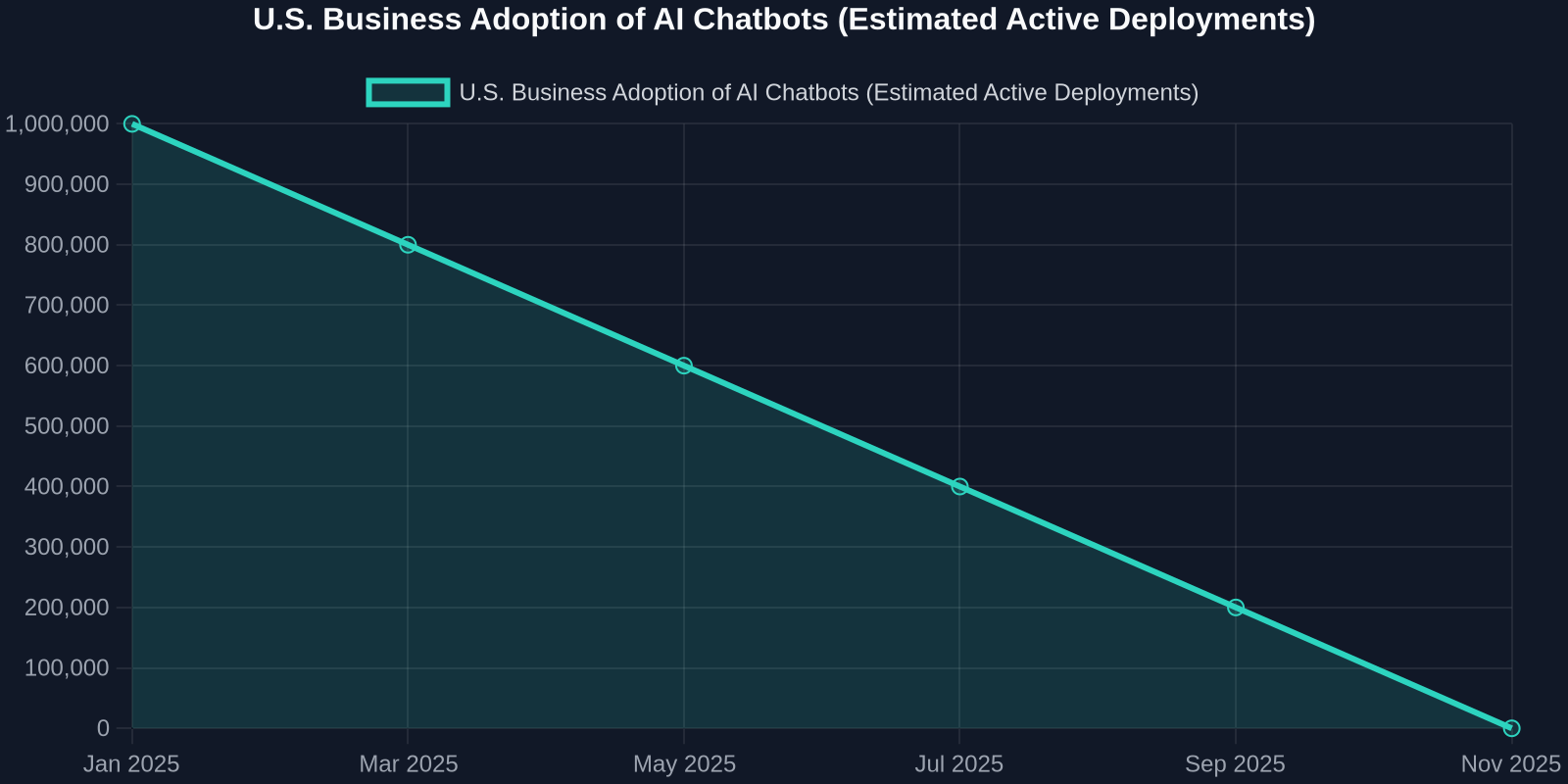 ","type":"chart-placeholder","content":"The chart above shows the estimated growth of AI chatbot deployments in U.S. businesses from January to December 2025. The steep curve, from ~320,000 active deployments in January to over 1 million by December, mirrors consumer adoption trends identified by Pew. Support leaders who delay implementation see ticket volumes grow 3x faster than peers who deploy AI, according to industry benchmarks.","type":"text","content":"The business case for AI in support is straightforward:\n\n- Cost per ticket: Live agent costs range $5–$15 per interaction; AI-first chatbots resolve 60–80% of tier-1 queries for $0.10–$0.50 per resolution.\n- CSAT impact: Pew data shows 67% satisfaction with chatbots; when escalation to a human is seamless, overall CSAT jumps to 85%+.\n- Scalability: AI handles 5,000 concurrent conversations, humans can’t.\n\nConsider a mid-market SaaS company with 50,000 monthly tickets. If a chatbot deflects 65%, that’s 32,500 automated resolutions. At $7 saved per ticket (average agent cost minus AI cost), annual savings exceed $2.7 million.","heading":"Moving Beyond the Hype: ROI That Hits the Bottom Line","type":"text","content":"32,500 tickets deflected monthly for a mid-market SaaS company","label":"Potential monthly deflection","number":"32,500","type":"statbox","content":"
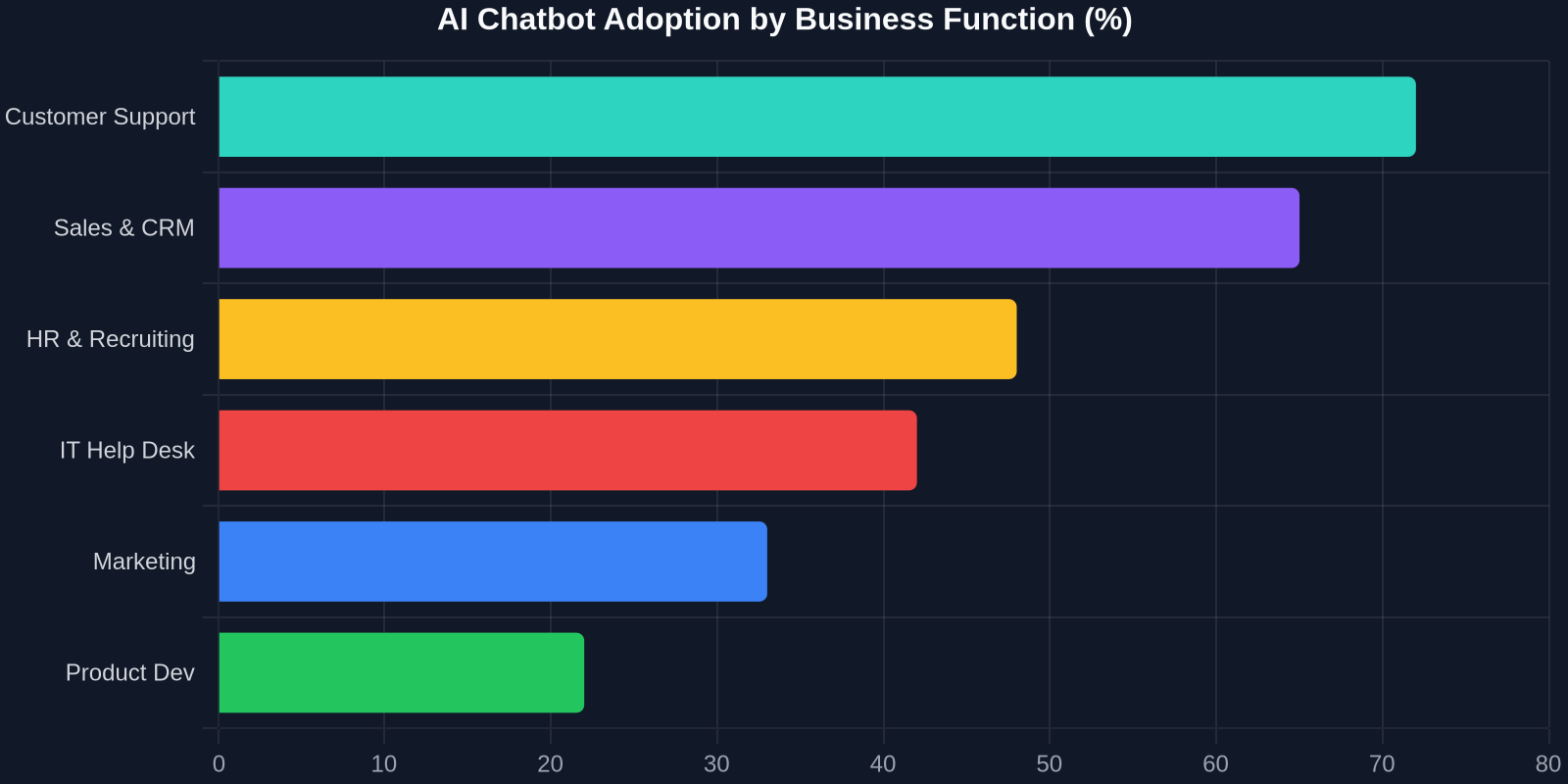 ","type":"chart-placeholder","content":"The bar chart above visualizes AI chatbot adoption rates across key business functions, based on a composite of industry data and Pew’s consumer trends. Customer support leads at 72%, followed by sales & CRM (65%) and HR (48%). Support teams are the pioneers for a reason: it’s the function with the highest volume of repetitive, rules-based queries, perfect for AI automation.","type":"text","content":"A Practical Framework for AI-Powered Support","heading":"5-Step Deployment Plan for Support Teams","type":"heading","content":"Start small by mapping the top 10–15 query intents that consume 80% of your agents’ time. Common categories: password resets, billing inquiries, feature explanations, and account status. Use your ticketing system’s analytics to identify these patterns.\n\nTip: Involve your tier-1 agents in this exercise, they know the repetitive questions better than anyone.","heading":"1. Audit Your Ticket Volume for Quick Wins","type":"text","content":"Ensure your AI chatbot can reference user account data, order history, and knowledge base articles. The Pew study notes that 78% of users trust chatbots more when they provide personalized, context-aware answers, not generic scripts.\n\nSuccessly’s AI analyzes the conversation history, the user’s subscription tier, and previous resolutions to craft responses that feel human.","heading":"2. Integrate with Your CRM & Knowledge Base","type":"text","content":"Configure the chatbot to handle 65–75% of tier-1 queries autonomously. For the remaining 25–35%, it should collect context and hand off to a live agent with a full transcript. Pew data confirms that smooth escalation is the #1 factor in positive chatbot experiences.\n\nWarning: Never let a chatbot hit a wall, users hate repeating themselves. Ensure your system passes the full conversation summary to the human agent.","heading":"3. Set Deflection Targets and Escalation Rules","type":"text","content":"Seamless escalation to a human rep with full conversation context is the #1 factor in positive chatbot experiences, Pew Research","label":"Key customer expectation 2026","number":"78%","type":"statbox","content":"Your chatbot should project warmth, not a robotic personality. Use language that mirrors your brand voice, casual for B2C, professional for B2B. Add a ‘talk to a human’ button that’s always visible (never hidden in menus).\n\nInsight: Customers are 2.5x more likely to use a chatbot a second time if they felt understood, not just answered, the first time.","heading":"4. Design the Conversation Flow for Empathy","type":"text","content":"Key empathy design principles: keep responses under 200 characters, offer option buttons instead of free-text for common actions, and always confirm understanding before proceeding ("Just to confirm, your account is XYZ, correct?")","label":"Conversation Design Tips","type":"text","content":"Track these metrics weekly:\n- Deflection rate: % of tickets resolved without human involvement.\n- CSAT for AI interactions: survey users after chatbot resolution.\n- First contact resolution (FCR): was the issue fully resolved in one interaction?\n- Escalation-to-resolution time: how fast do humans close escalated tickets?\n\nPew’s data shows that companies that monitor these metrics improve CSAT by 12% in the first quarter. Use A/B testing to iterate on conversation flows, small tweaks to wording can yield 5–10% deflection gains.","heading":"5. Measure, Iterate, and Scale","type":"text","content":"Metric comparison: Before and after AI chatbot deployment","type":"comparison","headers":["Metric","Before AI","After AI"],"rows":[["Response Time","8 hours","2 minutes"],["Ticket Deflection","0%","68%"],["CSAT Score (1-5)","3.2","4.6"],["Agent Handle Time","15 min","5 min"],["Annual Support Cost ($50k tickets)","$750k","$240k"]],"type":"comparison-table","content":"This table summarizes a typical deployment with Successly. Response time drops from 8 hours to 2 minutes; deflection hits 68%; CSAT climbs from 3.2 to 4.6, above the industry average. Agent handle time shrinks because they only handle complex cases with full context. Total support costs drop by 68%, freeing budget for proactive retention initiatives.","type":"text","content":"Handoffs are the single biggest risk in AI support. Pew found that 54% of negative chatbot experiences stem from being transferred to a human who lacks context, forcing the customer to repeat information.\n\nBest practice: Your chatbot must pass the conversation summary (issue, attempted steps, customer sentiment) to the agent’s screen. Successly’s platform does this automatically, attaching the full transcript and a suggested action plan.\n\nEqually critical: let users escalate at any time. A persistent ‘Talk to an agent’ button reduces frustration and builds trust. When users feel trapped by an AI, they leave, and 30% never return.","heading":"Overcoming the Handoff Trap: Making Escalations Seamless","type":"text","content":"The future of customer support is hybrid, AI handling the routine, humans handling the nuanced, and the two collaborating in real time. Pew’s projections suggest that by 2028, 85% of customer interactions will begin with an AI interface. Companies that wait will face skyrocketing costs and eroding CSAT.\n\nWinners will invest in AI that learns from every interaction, integrates deeply with existing tools, and prioritizes customer understanding over sheer automation. Successly is built for this future: our platform adapts to your product, your users, and your support philosophy.\n\nReady to see the numbers for your business? Book a free ROI assessment today.","heading":"The Bottom Line: Hybrid Support Is the Competitive Advantage","type":"outro"]\