
From Portfolio Managers to Product Managers: Scaling Complex Workflows with AI, Lessons from the Franklin Templeton & OpenAI Integration
When a global investment giant with $1.6 trillion in assets under management decides to systemically integrate artificial intelligence into its core operations, the business world takes note. The recent strategic collaboration between Franklin Templeton and OpenAI isn't just a tech headline about a big company using a trendy chatbot. It represents a tectonic shift in how mature, regulated, and data-intricate enterprises view AI.
For B2B SaaS founders, customer success leaders, and support operations specialists, the announcement carries a dual significance. First, it validates the movement of generative AI from consumer experimentation to mission-critical business environments. Second, and more critically, it provides a masterclass in tackling the exact same challenges that plague modern support teams: harnessing vast pools of unwieldy data, scaling expert-level analysis, and radically accelerating complex workflows without increasing headcount linearly.
While your startup might not be managing multi-billion-dollar portfolios, the parallel between an investment analyst sifting through research and a senior support engineer troubleshooting a complex API integration is striking. Both rely on tacit domain knowledge, fragmented data sources, and a race against the clock. This article decodes the Franklin Templeton strategy and translates it into a pragmatic playbook for SaaS and customer success teams aiming for enterprise-grade efficiency.
Deconstructing the Partnership: More Than Just ChatGPT for Finance
To understand the implications for support teams, we must first look beyond the jargon. The Franklin Templeton initiative is specifically focused on building custom AI workflows that empower portfolio managers to compare research views and methodically examine investment risks. This is not an off-the-shelf implementation where employees simply ask a generic bot for information. It’s a deeply integrated system designed to reason over proprietary financial models, internal memos, and external market data simultaneously.
Jenny Johnson, CEO of Franklin Templeton, has been a vocal proponent of this transformation, often discussing the challenge of navigating "very complex" structures through technology. The financial industry term "AI debt financing" has surfaced in these discussions, but the underlying business lesson is universal: adopting technology in complex, regulated sectors requires a discerning balance. Franklin Templeton’s choice to partner with both OpenAI and Anthropic indicates a sophisticated, multi-model strategy rather than a reliance on a single black-box solution.
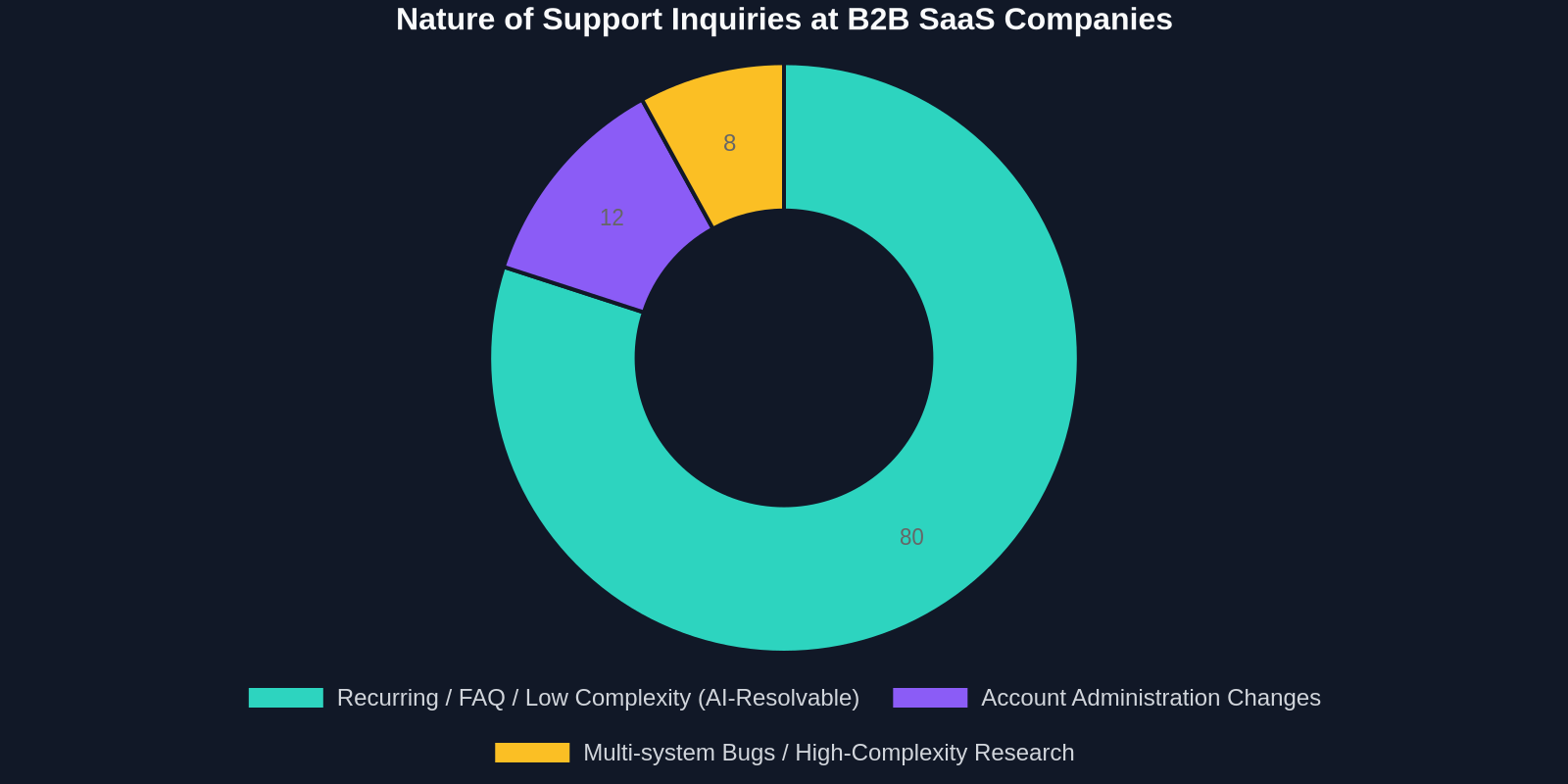
Enterprise firms like Franklin Templeton are not just deploying AI; they are operationalizing it to reason over private data. For SaaS support teams, this translates to moving beyond simple FAQ chatbots to AI that understands the full context of a customer's subscription, historical tickets, and technical setup.
The Meta-Problem: AI-Induced Sampling Bias and Hallucinations
Interestingly, one of the technical challenges highlighted by adjacent research in this space involves sampling from score-based diffusion models. A common strategy employed by these advanced AI systems involves approximations that incur bias, particularly at the point of time discretisation and score function approximation. In business terms, this means the model might "cut corners" and produce outputs that are technically wrong or logically inconsistent, a phenomenon we in SaaS refer to as hallucination.
For a portfolio manager assessing risk, a hallucinated statistical correlation could lead to a poor trading decision. For a support manager, a hallucinated troubleshooting step sent to a paying customer causes churn. The Franklin Templeton case teaches us that high-stakes environments demand AI workflows that are grounded in deterministic data retrieval and validation loops, not just probabilistic text generation.
The Customer Success Translation: From "Comparison of Research Views" to "Fusion of Customer Data"
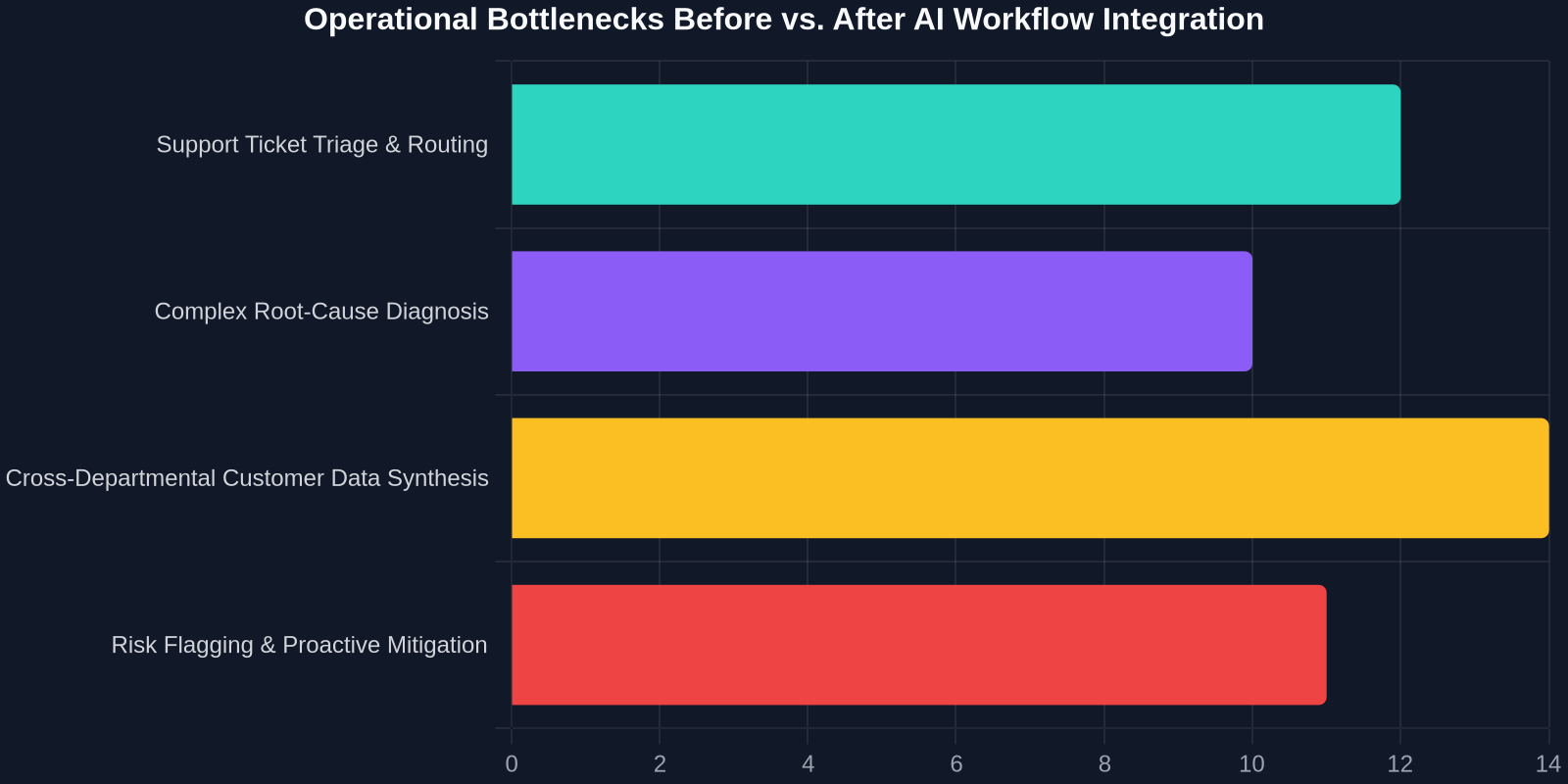
The core user story of the Franklin Templeton integration is the ability to "compare research views." In investment management, this means one dashboard that pits an internal analyst's bullish forecast against a bearish external quantitative model. In customer success and technical support, this means reconciling the view of an account manager ("the client is at risk due to low feature adoption") against the support desk's reality ("the client has had three major bugs this month").

Currently, most support teams operate in siloed systems: the CRM holds the deal context, the ticketing platform holds the technical history, and an analytics tool holds product usage. Connecting these dots requires a human "triage agent", often a team lead, who mentally merges these views. The fragility of this human middleware is an exact parallel to an investment team doing manual spreadsheet lookups. AI, deployed correctly, silences the noise and surfaces the dendrites of risk.
Operationalizing AI: Statistical Tools and Data Solutions for Support
The partnership narrative references "AI-powered statistical tools and data solutions" to support industrial growth. While your industry is B2B SaaS rather than heavy industry, the technical scaffolding is identical. The success of this initiative hinges on Retrieval-Augmented Generation (RAG) and fine-tuned domain models that treat AI not as a magic oracle, but as a reasoning engine bolted onto a structured data warehouse.
For a customer success manager struggling with a bloated support queue, this translates to a critical shift in tooling philosophy. You are no longer buying a "chatbot." You are building, or buying a platform that builds, an AI-powered knowledge worker. This worker can reason over your help center, Jira backlog, and Slack history to perform the following support scaling functions:
- Macro-Trend Correlation: Detecting that a surge in login-authentication tickets started spiking minutes after a new deployment, just as a trading algorithm flags a market deviation.
- Expert Assistant Mode: Providing a junior support agent with the same depth of historical context that a senior agent has, effectively up-skilling the entire team instantly.
- Risk Examination: Automatically generating a pre-emptive health report for an account that combines financial signals (billing delays) with technical signals (API timeout errors).
Jenny Johnson’s reported note on the "very complex" nature of financing and building this infrastructure is a cautionary tale for CTOs. Connecting AI to messy, unstructured backend data is a heavy engineering lift. The competitive advantage does not come merely from accessing the OpenAI API, but from the orchestration layer that manages context windows, token limits, and data freshness.
Leverage a three-tier architecture inspired by FinServ: Data Aggregation Layer (CDP/Ticket system) → Semantic Cache / Vector Store (Unstructured knowledge) → Orchestration & Guardrails (The "AI workflow" logic). This prevents the model from hallucinating by forcing it to reference the source-of-truth tier first.
The Multi-Provider Strategy: Why Anthropic, OpenAI, and Nvidia All Matter
One of the most telling details of the Franklin Templeton news is the explicit mention of a multi-vendor AI stack involving not just OpenAI, but also Anthropic and Nvidia. For a consumer audience, this seems like overkill. For enterprise and SaaS operators, this is the secret to resilience.

In the SaaS support world, we often fall into the trap of tying our entire AI strategy to a single provider’s LLM. When latency spikes or a specific model fails to understand a highly technical query about a JavaScript library, the customer receives a dead-end response. The FinServ approach, using one model for creative summarization of meeting notes and another for deterministic, safe database queries, mirrors the concept of "load balancing" in DevOps.
"The sophistication of an AI implementation is not measured by which LLM you use, but by how intelligently you route the user's intent to the right model at the right cost point." – Enterprise AI Adoption Paradigm
Hardware and Inference: The Nvidia Factor in Support Latency
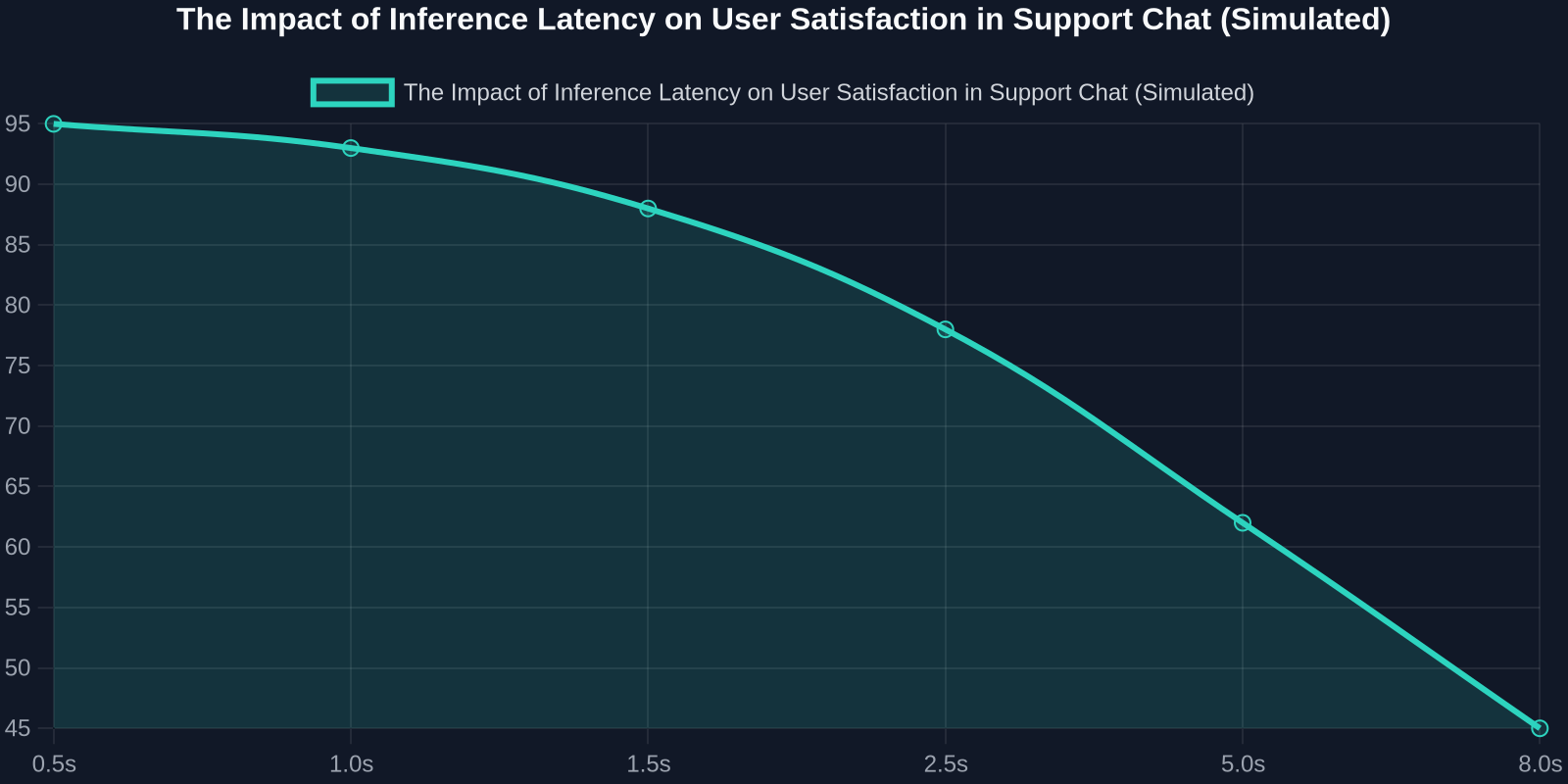
The mention of Nvidia is not just supply-chain news; it signals a focus on inference speed. In support, the "time-to-first-token" (the moment the AI starts typing) is the equivalent of the time-to-pickup in a call center. Investment firms cannot afford a three-second delay when executing a trade; customer support cannot afford a five-second delay when a user is asking why their login is failing. The Franklin Templeton strategy highlights an obsession with infrastructure latency that high-volume support teams must emulate.
Translating FinServ "Research Workflows" to SaaS "Support Workflows"
Let’s dive deeper into the specific phrase: "helping portfolio managers compare research views and examine investment risks." We need to perform a semantic translation exercise to map this to B2B customer success operations.
A "research view" is a thesis backed by evidence. In support, a "view" is a hypothesis about a root cause. A Tier-1 agent might have a view: "User error." A system administrator might have a view: "Server-side timeout." A product manager might have a view: "Poor UI design." Just as a portfolio manager needs AI to analyze systemic risk (the danger that the entire market collapses), a Head of Support needs AI to analyze systemic service risk (the danger that an entire product update breaks the platform for a specific cohort).
Here is how the Franklin Templeton AI workflow model maps directly to a Next-Gen Support Strategy:
- Data Ingestion: The AI consumes every interaction channel (email, chat, community forum posts) in real-time.
- View Formation: The system classifies inputs not just by topic, but by "signal potency." Is there a statistically anomalous spike in payment failures that contradicts the usual seasonal pattern?
- Risk Examination: The AI cross-references the list of affected users against the customer pipeline. If the affected users are all in a segment currently negotiating a contract renewal, the risk score escalates to "critical."
- Actionable Synthesis: Instead of just an alert, the workflow drafts a proactive, empathetic communication that frames the issue, the business impact, and the resolution timeline tailored to the specific stakeholder.
The "view comparison" concept is superior to standard sentiment analysis. Standard analysis says "customer is angry." The Franklin Templeton model says "customer is angry because the realized service gamble didn't pay off for them during a peak risk period, requiring a specific hedged retention strategy." Context isn't just king; it's the entire kingdom.
Navigating the "Very Complex" Debt of Implementation
Perhaps the most sobering technical lesson from the Franklin Templeton & OpenAI discourse is the acknowledgment of complexity debt, referred to in financial circles as "AI debt financing." Jenny Johnson’s remarks highlight that while the returns on AI are massive, reducing costs, augmenting intelligence, the upfront structuring of capital and data is not simple.

For a SaaS support team aiming to build similar complex workflows, this complexity debt usually manifests in two forms:
- Clean Data Debt: You can't perform "portfolio analysis" if your knowledge base articles are contradictory or if your historical tickets lack resolution notes. The AI just amplifies the mess.
- Security Governance Debt: Portfolios have insider trading rules; support desks have GDPR and PII data. Allowing an AI to "reason" over support tickets requires hard access boundaries. Just as Franklin Templeton wouldn't let an LLM leak earnings data, you can't let a support AI leak a user's API key in a summary transcript.
The solution lies in adopting a "Trust but Verify" architecture. This means implementing automated evaluation layers where a secondary AI (the "judge") rates the accuracy and safety of the primary customer-facing AI. This is the equivalent of a compliance officer for your support automation.
The Strategic Pivot for B2B SaaS Leaders
As we step back from the technical architecture, the strategic alignment between Franklin Templeton's initiative and modern SaaS support is undeniable. Both domains are moving from a model of "reactive resolution" to "predictive risk management."
A fund manager who only reacts to a stock crash has already lost money. A support manager who only reacts to a churn notice has already lost the customer. The AI workflows being pioneered in finance are creating "Early Warning Systems." For your B2B business, this is the equivalent of installing an autonomous customer health pulse check that triggers internal intervention workflows (discount offers, dedicated repair sprints, executive check-ins) before the customer realizes they are unhappy.
"The future of support isn't fixing tickets faster; it's preventing tickets from existing. That's the exact paradigm shift Franklin Templeton is chasing in asset management."
Successly was founded precisely to provide this kind of adaptive intelligence layer for customer support teams that lack the massive internal engineering budgets of a Franklin Templeton. By abstracting the complexity of vector embedding, retrieval logic, and multi-model orchestration, a solution like Successly enables a 15-person SaaS startup to operate with the analytical rigor of a trillion-dollar asset manager. It handles the "comparison of research views" by fusing Salesforce data, historical support history, and real-time product telemetry, delivering the same AI workflow efficiency at a fraction of the internal build cost.
Concrete 90-Day Plan for Support Transformation
If you want to bring the Franklin Templeton standard of AI sophistication to your support operations without creating "complex AI debt," follow this accelerated roadmap:
- Week 1-2: Data Aggregation Audit. Identify your "truth sources." Just as a quant team audits their data feeds, map every source of customer truth (billing, support, NPS, product Pendo/Mixpanel data). Ensure these are accessible via API.
- Week 3-4: Define Your "Risk" Metrics. In finance, risk is losing money; in SaaS, risk is LTV decay. Define exactly what combination of factors (e.g., 3+ open tickets + 0 logins in 14 days) constitutes a "risky view."
- Week 5-8: Deploy an Orchestrated AI Agent. Move away from a simple playbook bot. Deploy an AI agent that is instructed to reason over your drafted risk metrics. Ask it to "compare the view" of the account manager against the quantitative data.
- Week 9-12: Human Feedback Loop (RLHF). The Franklin Templeton team doesn't send AI analysis straight to investors. Front-line managers review AI risk flags. Implement a rating system (thumbs up/down) on every AI-generated insight to correct "sampling bias" locally.
Conclusion: The Inevitable Convergence of FinServ and SaaS Support
The OpenAI and Franklin Templeton announcement is not an isolated use case for high-finance. It is a preview of the minimum standard of service intelligence that B2B clients will demand by 2026. When customers know that the technology exists to instantly correlate their technical pain points with business outcomes, a support desk that relies on manual tagging and human memory will feel archaic and negligent.
By adopting the "compare and examine" framework, treating every ticket as a "data point" and every bug as an "investment risk", SaaS leaders can transform technical debt into strategic velocity. The tools have arrived. The orchestration patterns have been proven. The only question left is whether you will settle for a basic chatbot, or if you will build a critical reasoning engine worthy of a trillion-dollar enterprise.