
Apple recently announced the sunsetting of a customer support application that has been a backbone of its service operations for nearly three decades. For 28 years, this tool helped millions of users troubleshoot issues, access resources, and connect with human agents. Its retirement isn't just a headline, it's a clear signal that the era of legacy, scripted support infrastructure is ending, and the age of intelligent, AI-driven customer success has arrived. For support team leads, SaaS founders, and B2B customer success managers, this move validates a critical business imperative: adapt to AI-native support or risk operational obsolescence.
While the specifics of Apple's internal tool remain proprietary, the implications are universal. The shutdown highlights a fundamental truth: maintaining monolithic, rule-based support platforms is no longer viable when customer expectations demand instant, personalized resolutions. This article dissects the strategic reasoning behind such a decision, quantifies the ROI of transitioning to AI-powered support, and provides a practical framework for support leaders navigating their own legacy modernization journeys.
The Hidden Cost of Legacy Support Infrastructure
Apple’s decision to retire a 28-year-old support tool mirrors a challenge faced by countless SaaS and B2B organizations. Legacy systems often become architectural anchors, draining resources and limiting agility. The total cost of ownership (TCO) extends far beyond license fees; it encompasses security vulnerabilities, integration rigidity, and the prohibitive expense of training agents on outdated interfaces.
A reliance on legacy tools creates a disjointed customer experience. Data silos prevent agents from having a 360-degree view of the customer, leading to repetitive information gathering and prolonged average handling times (AHT). For a support operations specialist, the frustration isn't just anecdotal. According to recent industry analysis, companies using legacy platforms see a direct, measurable drag on their Net Promoter Score (NPS) and Customer Satisfaction (CSAT) scores. The business case for modernization is no longer a future consideration; it’s an immediate balance-sheet issue driven by deflection rates, operational efficiency, and customer retention.
Why 'Good Enough' Isn't Good Enough Anymore
The psychology of customer support has shifted. A decade ago, a response within 24 hours was acceptable. Today, 90% of customers rate an "immediate" response as essential or very important when they have a support question. Legacy tools, by their very nature, cannot meet this expectation without a massive, unsustainable human workforce scaling linearly with ticket volume.
This is where the economics of AI become compelling. Platforms like Successly are designed not to patch old systems, but to fundamentally alter the cost curve of quality support. They ingest historical ticket data, knowledge base articles, and community forums to resolve issues autonomously, escalating only the most complex, high-value interactions to human agents.
The Economics of AI-First Customer Support
The migration from a legacy tool to an AI-native platform like Successly isn’t a tech upgrade; it's a business model transformation for support departments, moving them from cost centers to value drivers.

Ticket Deflection: Measuring the Real ROI
The primary metric driving investment in AI support is ticket deflection rate, the percentage of inquiries resolved without human intervention. However, high deflection alone is a vanity metric if it comes at the cost of customer satisfaction. Successful implementations achieve high deflection while maintaining or improving CSAT. They do this by focusing on resolution accuracy and conversational empathy.
Apple's legacy tool, while robust for its time, likely operated on a simple decision-tree logic. Modern AI engines use natural language understanding (NLU) to interpret intent, sentiment, and context across dozens of languages. This capability allows a startup to scale support across global markets without proportionally scaling headcount. The financial impact is immediate: a reduction in cost-per-ticket from an industry average of $15-$200 for human-led resolution to less than $1 for an AI-led interaction.
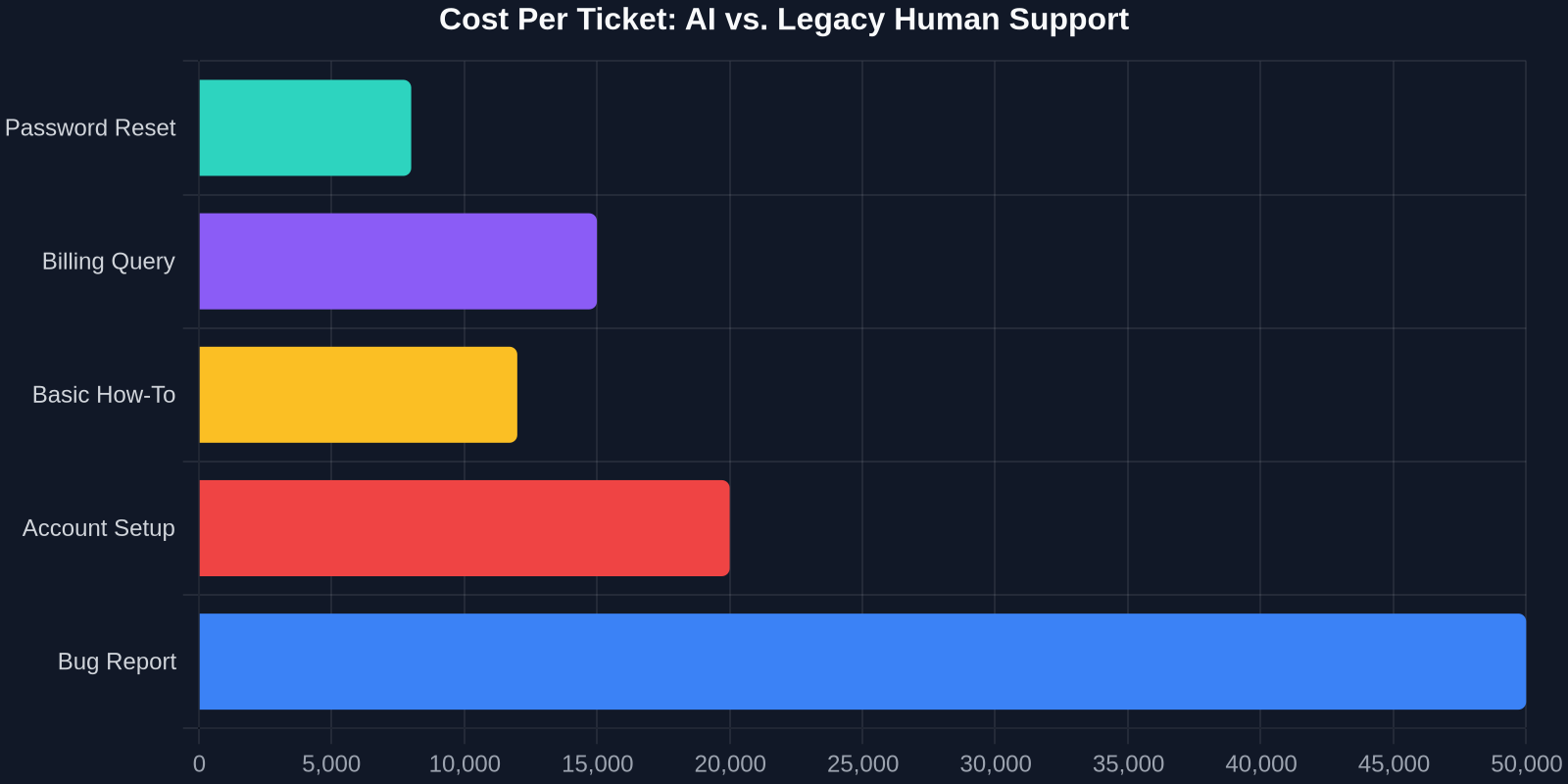
To visualize the inflection point, consider a mid-market SaaS company handling 5,000 tickets per month. With a legacy tool and a full team, their monthly support burn rate is a significant operational expense. By deploying an AI layer that effectively deflects 40-50% of routine questions, password resets, billing queries, 'how-to' requests, they can reallocate budget from reactive firefighting to proactive customer success initiatives, such as onboarding programs and health scoring analysis.
| Metric | Legacy Support Model | Successly AI-Native Model |
|---|---|---|
| Average First Response Time | 4-8 hours (business days) | < 2 minutes (24/7) |
| Ticket Deflection Rate | 5-10% (basic IVR) | 40-60% (effective deflection) |
| Cost Per Resolution | $15 - $50 | $0.50 - $1.50 |
| Agent Turnover | High (repetitive tasks) | Reduced (complex, engaging work) |
| Customer Satisfaction (CSAT) | Fluctuates with wait times | Consistent, contextual responses |
Engineering a Seamless Transition from Legacy Systems
For a support team lead tasked with retiring a decades-old system, the migration path can seem daunting. Apple’s internal engineering teams are surely navigating complex data migrations and API integrations. However, the process for transitioning to an AI support platform doesn't need to be a "rip and replace" trauma. Following a structured framework ensures continuity while accelerating time-to-value.
The Legacy Modernization Framework for Support Leaders
-
Audit and Triage Ticket Archetypes: Begin by exporting 12-24 months of historical ticket data. Categorize every ticket by root cause (e.g., login issues, feature confusion, bug report, billing dispute). This analysis reveals the precise percentage of volume that is repetitive and automatable. You will likely find 20-30% of tickets account for 60-80% of volume.
-
Integrate in Parallel: The Hydration Phase: Avoid the big-bang approach. Deploy your AI platform as a first responder to new tickets while keeping the legacy system accessible for historical data lookups. Allow the AI to "hydrate" its knowledge base by learning from your top-performing agents' responses during a shadow mode.
-
Establish a Human-in-the-Loop (HITL) Escalation Protocol: Define strict criteria for escalation. For example: AI confidence score below 95%, detection of legal or compliance keywords, or explicit customer request for a human. This protocol ensures risk mitigation while the model rapidly improves.
-
Measure and Optimize with Business KPIs: Shift the conversation from "did the AI work?" to "did the business outcome improve?" Track monthly: Expansion MRR influenced by support, churn rate of users who interacted with support, and operational savings realized. Successly’s analytics suite, for instance, surfaces these business-level insights, not just conversation logs.
"The shutdown of Apple's 28-year support tool is a lesson in adaptability. The future of customer support isn't in building longer decision trees, but in deploying adaptive systems that learn from every interaction, systems that turn support from a cost center into a competitive moat."
Apple’s Strategic Pivot: A Case Study for SaaS Founders
Why would Apple retire a “valuable” tool? The term is relative. It was valuable in an era of Mac OS 9 and the first iMacs. In the context of a trillion-dollar services ecosystem spanning iCloud, Apple Music, TV+, and the App Store, "valuable" support means supporting billions of transactions seamlessly across a fragmented device landscape. A monolithic, retrofitted tool becomes a liability.

The strategic move is clear: Apple is consolidating its support intelligence into a unified, most likely AI-driven, platform that can surface insights product teams need to fix bugs before they affect millions. For SaaS founders, the lesson is product-development velocity. Insights captured by AI support platforms feed directly into product roadmaps. When an AI logs that a specific error message spiked in a new software release, product and engineering can deploy a patch in hours, not weeks, a feedback loop impossible with a 28-year-old support silo.
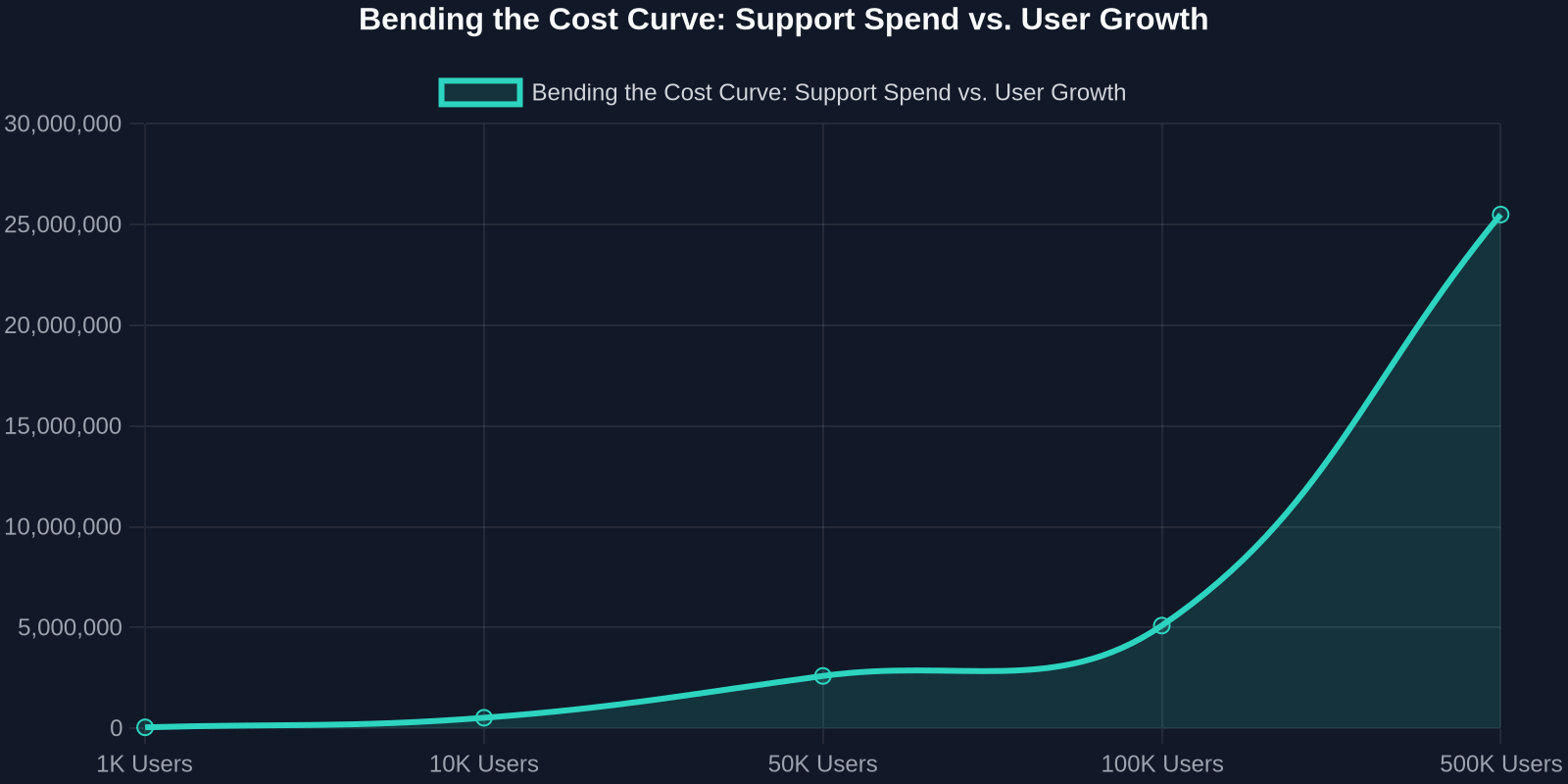
This chart projection illustrates a common trend: as a company scales user base (blue), human-led support costs (red) escalate linearly, almost perfectly. However, deploying an AI-powered resolution layer fundamentally bends the operating cost curve (purple). This decoupling of growth from support cost is the holy grail for venture-backed B2B companies and enterprise support operations alike, enabling profitable scaling.
From Reactive Support to Proactive Success
The shutdown reinforces the shift from reactive break-fix support to proactive customer success management. AI tools excel at pattern recognition. They can identify users repeatedly hitting a dead end or a power user not adopting a high-value feature. Successly uses this capability to trigger automated, hyper-personalized outreach, a tutorial link, a best-practice guide, or an offer for a one-to-one session with a customer success manager. This capability transforms the support function's charter from "solving problems" to "engineering outcomes."
The Data Imperative: Building Your AI Support Foundation
The effectiveness of any AI support platform is directly proportional to the quality and cleanliness of its underlying data. Apple’s migration from its legacy tool will involve a monumental effort to map data schemas from decades past. Most organizations don't face 28 years of clutter, but they do face significant data hygiene challenges.
Clean Data, Clear Results: A Preparation Checklist
Before engaging with an AI support platform, operations specialists should ensure the following datasets are reviewed, cleansed, and standardized:
- Knowledge Base Articles: Remove duplicates, mark deprecated features, and score articles by "resolution effectiveness", a metric easily derived from post-interaction ticket reopen rates.
- Macro and Canned Response Libraries: Audit for tone of voice inconsistencies and outdated branding. AI will learn from these; bad inputs equal inconsistent outputs.
- Historical Ticket Tags and Custom Fields: Simplify categorization taxonomies. Overly complex, agent-defined tags create a "garbage in, garbage out" scenario where the AI cannot learn coherent intent clusters.
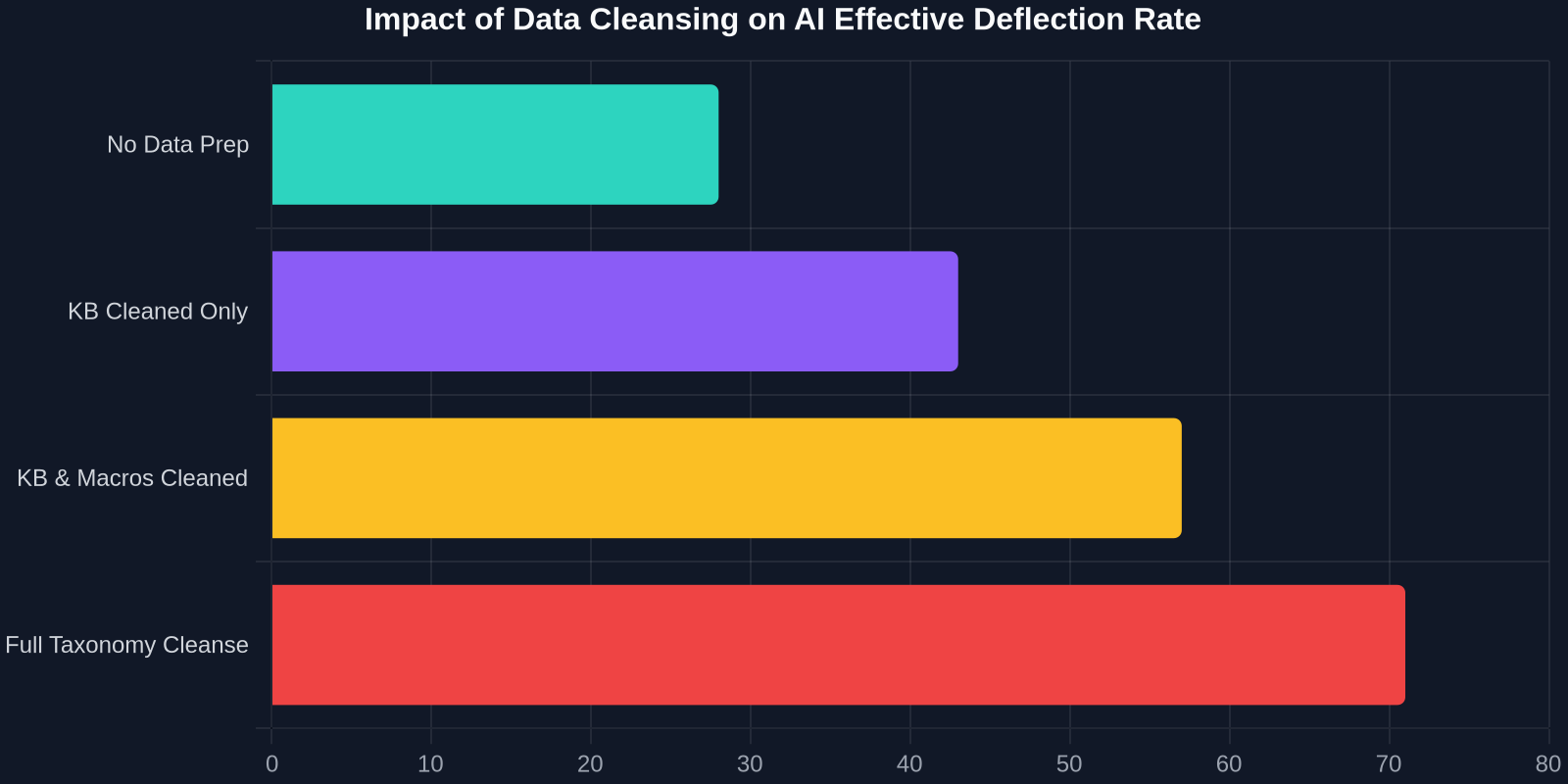
Data from implementations of platforms like Successly demonstrate that a structured data preparation phase is the single highest-leverage activity for maximizing long-term ROI. Skipping this step to accelerate a go-live date almost invariably leads to lower initial confidence scores, more escalations, and slower agent adoption.
The Agent Experience Renaissance
Often lost in the discussion of AI-driven support is the transformative effect on the support agent. The Apple support community, both internal and in forums, has a storied history of dedicated experts. But in a legacy tool, these experts often spend 60% of their day resetting passwords or copy-pasting links. This is a high-burnout, low-fulfillment activity.

AI handles the mundane. Agents level up to knowledge engineers, conversation designers, and escalation specialists handling nuanced, high-empathy cases. This career pathing directly attacks the churn rate notoriously high in support departments. With a tool like Successly, agents transition from reading scripts to analyzing the AI's performance dashboard, identifying knowledge gaps, and creating the authoritative articles that the AI will then use. It’s a flywheel of continuous improvement where human intellect focuses on creative problem-solving and emotional intelligence, the areas where machines fall short.
The Future Is Orchestrated Support
Apple's move signals the end of the "tool era" in customer support and the beginning of the "orchestration era." An AI orchestration platform doesn't just deflect; it intelligently routes across channels, pulls in data from CRMs and product analytics tools, predicts customer health, and seamlessly hands off a complete context package to the right human agent when necessary. This orchestration creates what customers ultimately demand: an experience that is both high-tech and high-touch, without ever feeling fragmented.
For the modern SaaS founder, this evolution is not optional. As support becomes a transparent layer powered by platforms like Successly, the quality of support becomes indistinguishable from the quality of the product itself. In an era where switching costs are low, the company that resolves issues before the customer feels the pain wins. The retirement of a 28-year-old Apple tool is simply the most public acknowledgment yet that the playbook for winning customer support has been completely rewritten.