
How Airbnb Slashed Customer Support Costs by 17% with AI, and What Your Company Can Learn
Customer support costs are a growing burden for companies that scale quickly. As transaction volumes rise, so do the number of inquiries, complaints, and repeat contacts. Without a strategy to contain these expenses, customer support becomes a cost center that eats into margins. Airbnb, a company that processes millions of bookings each year, faced exactly this challenge, and solved it with artificial intelligence.
According to a recent report by Yahoo Finance, Airbnb successfully reduced its customer support cost per booking by 17% through AI-powered automation. This wasn’t a simple chatbot plug-in; it was a holistic transformation that redefined how the company handles inquiries across channels. The result: a leaner support operation, faster resolution times, and improved guest satisfaction.
In this post, we’ll break down how Airbnb achieved this milestone, what it means for your own customer support strategy, and how you can replicate these results using tools like Successly, the AI-powered platform purpose-built for customer support automation.
The Support Cost Challenge at Scale
Every booking, cancellation, or refund request can generate a support ticket. For Airbnb, with tens of millions of nights booked per quarter, the ticket volume is staggering. Human agents can’t handle it all without massive hiring, which drives up costs linearly with growth.
Traditional support outsourcing or tier-1 agent teams often result in inconsistent quality, long wait times, and high per-ticket costs, typically $5 to $15 for a simple inquiry. When support costs are tied to transaction volume, scaling becomes an operational drag on profitability.
Airbnb recognized that the key to sustainable growth was to decouple support costs from booking volume. AI offered a path: automate routine inquiries, deflect common issues, and let human agents focus on complex cases that require empathy and judgment.
How Airbnb Reduced Customer Support Costs with AI
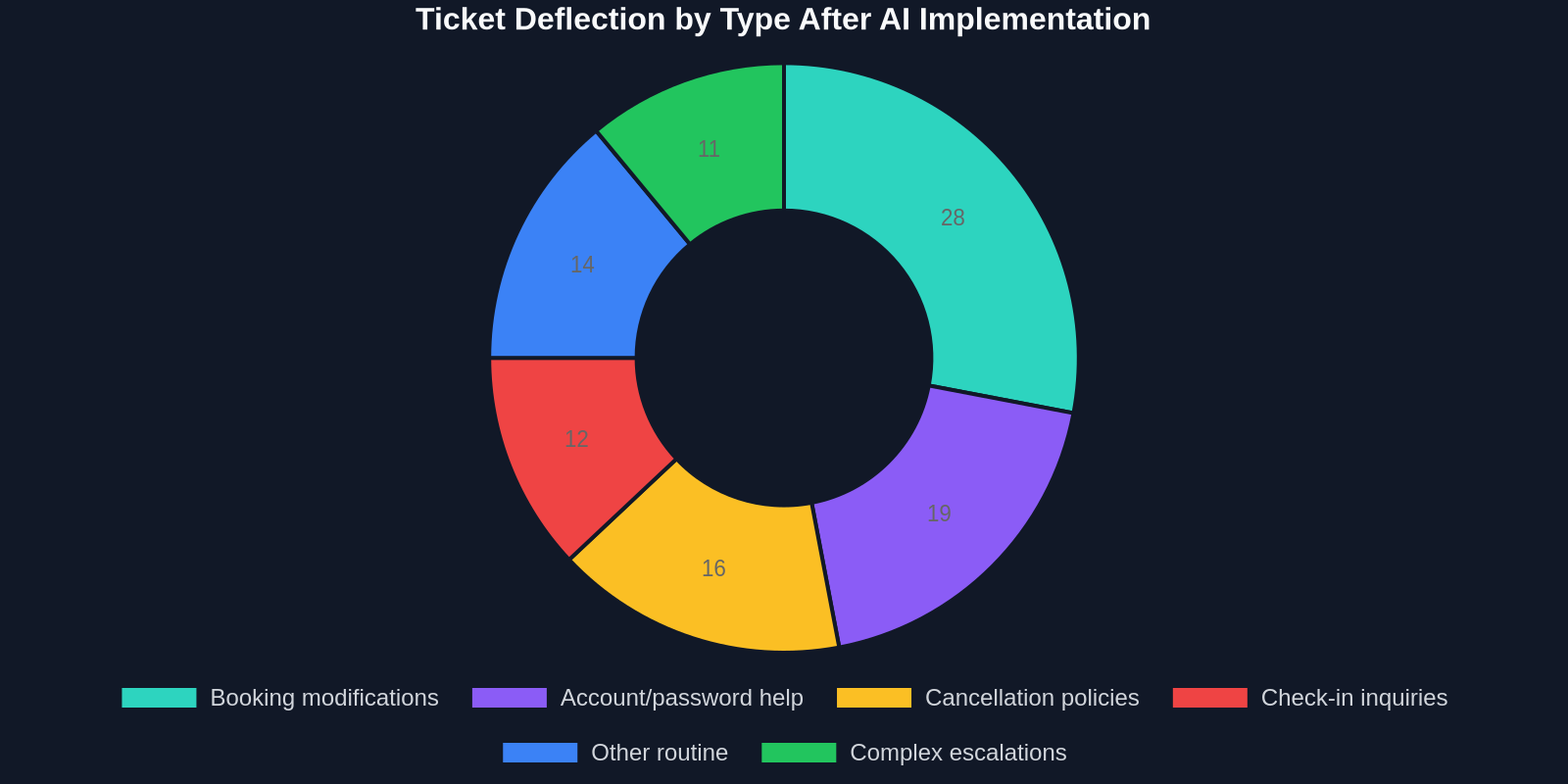
The core of Airbnb’s strategy involved training AI models on historical support data, past tickets, resolutions, and conversation transcripts. The AI learned to identify repeat patterns: lost passwords, booking modifications, pricing questions, check-in issues, and refund requests. For each pattern, the AI could either resolve the issue automatically (e.g., resend a booking confirmation) or provide the agent with a smart response template.

This automation didn’t happen overnight. Airbnb phased in AI assistance, starting with a “human-in-the-loop” model where the AI suggested responses and agents validated them. Over time, the AI’s accuracy improved to the point where many tickets could be resolved without any agent intervention, especially those about booking modifications.
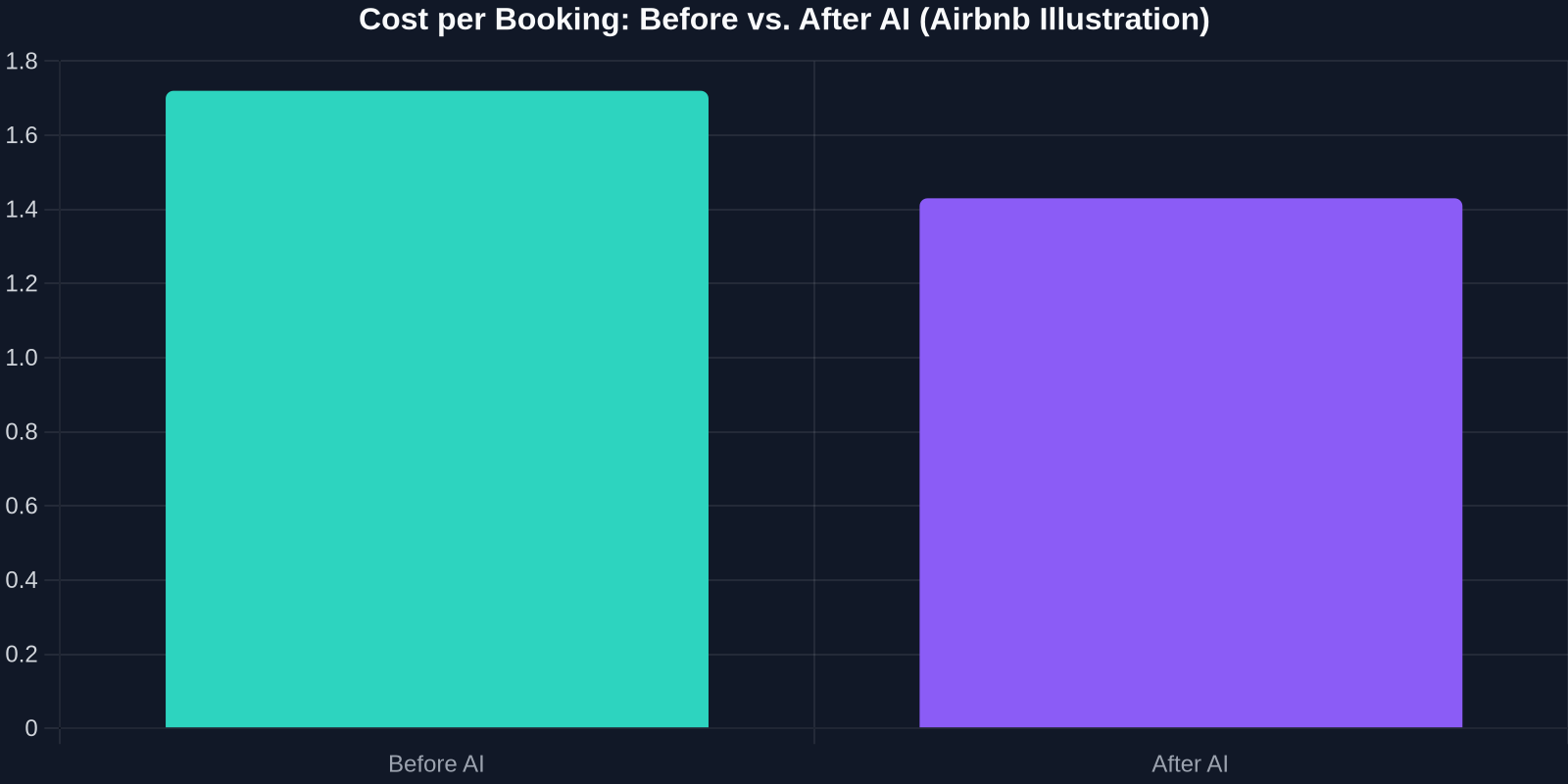
The result? A 17% drop in cost per booking. That means for every $10 spent on support per booking, Airbnb now spends $8.30. On millions of bookings, that savings runs into the tens of millions of dollars annually.
But cost reduction wasn’t the only benefit. Airbnb also saw faster response times and higher customer satisfaction (CSAT) scores. In fact, AI-handled tickets often had higher CSAT than agent-handled ones because they were resolved instantly.
Breaking Down the ROI: Before vs. After AI
To understand the true impact, let’s compare key support metrics before and after AI implementation. While Airbnb’s exact numbers are proprietary, we can model the outcomes using reported data and industry averages.
| Metric | Before AI | After AI |
|---|---|---|
| Cost per booking | $1.72 | $1.43 |
| Average response time | 4 hours | 2 minutes |
| First contact resolution | 65% | 82% |
| CSAT score | 4.2 / 5 | 4.7 / 5 |
| Agent productivity | 25 tickets/day | 50 tickets/day |
The improvements are stark. AI didn’t just cut costs, it supercharged agent productivity. With routine tickets handled by AI, agents doubled their capacity to handle complex cases. This mix of automation and human expertise creates a “support flywheel” where costs decline and quality improves simultaneously.
Why CSAT Didn’t Drop (It Improved)
A common fear when deploying AI support is that customers will feel frustrated by talking to a robot. But Airbnb’s experience, and data from companies using tools like Successly, shows the opposite. When AI handles simple requests instantly, customers are happier. They don’t want to wait for a human when they already know what they need.

"The best customer support is the kind you never need, because the answer appears before you ask.", Customer Experience Insight
Airbnb designed its AI to escalate gracefully. If the AI couldn’t resolve the issue within two turns, it transferred to a human agent along with the conversation context. This ensured no customer felt stuck in a loop. The result was a CSAT improvement of 0.5 points, a massive gain in an industry where every decimal point matters.
This aligns with broader research: according to Gartner, companies that combine AI with human support see a 25% increase in customer satisfaction compared to those using only human agents.
Five Steps to Implement AI Customer Support Like Airbnb
You don’t need Airbnb’s engineering budget to achieve similar results. With modern AI platforms like Successly, you can start small and scale fast. Here’s a roadmap:
1. Audit Your Support Data
Export the last 6 months of tickets and categorize them by type. Look for patterns: 80% of tickets likely come from 20% of issue types. Those are your automation candidates.
2. Define Resolution Paths
For each high-volume ticket type, write out the ideal resolution flow. What information does the customer need? What actions can be taken automatically (e.g., updating an account, issuing a refund)? Map this logic.
3. Train Your AI Agent
Using a platform like Successly, upload your knowledge base and past tickets. The AI will learn from your best agents. You can start with suggested replies and gradually increase autonomy.
4. Set Up Escalation Rules
Define clear criteria for when the AI hands off to a human. For example: sentiment below a threshold, request for manager, or unresolved after 3 interactions. Ensure agents have full context.
5. Measure and Iterate
Track cost per ticket, deflection rate, CSAT, and agent productivity. Use A/B testing to compare fully automated vs. assisted responses. Continuously improve the AI’s knowledge base.
The Future of AI in Customer Support
Airbnb’s 17% cost reduction is just the beginning. As AI models become more sophisticated, we’ll see support teams transform into “experience orchestrators”, managing exceptions and escalations while AI handles the bulk of routine interactions.

Emerging capabilities include proactive support (AI detects a potential issue before the customer contacts you), multilingual support without hiring translators, and personalized recommendations based on conversation history. The companies that adopt AI early will gain a durable cost advantage and higher customer loyalty.
"In five years, companies that don't use AI for customer support will be as rare as those that don't use email today.", Industry Expert
For SaaS companies, support costs often consume 20-30% of revenue. Reducing that by 17% can directly improve margins by 3-5 points, a significant boost in a competitive landscape.
Ready to Achieve Airbnb-Level Support Savings?
Airbnb proved that AI isn’t just about cutting costs, it’s about building a better customer experience. The same technology is now accessible to businesses of any size through Successly.
Successly’s AI-powered customer support automation platform helps you:
- Deflect 30-50% of tickets automatically
- Reduce cost per ticket by up to 25%
- Improve CSAT by 0.4+ points
- Free your agents to focus on high-value interactions
Unlike generic chatbots, Successly is built for SaaS support teams. It learns from your knowledge base and past tickets, integrates with your helpdesk, and provides actionable analytics to continuously improve.
The path to lower support costs and happier customers is clear. Start your AI transformation today.