
How Agentic AI Self-Service Transforms Customer Support: A Business Guide
Customer support teams are under relentless pressure: ticket volumes surge 20% year over year, yet headcount remains flat. Traditional chatbots resolve only simple queries, leaving agents to drown in repetitive tasks. The next leap isn’t just smarter bots, it’s agentic AI self-service: systems that understand context, reason through problems, and take action on behalf of customers, all without human hand-holding.
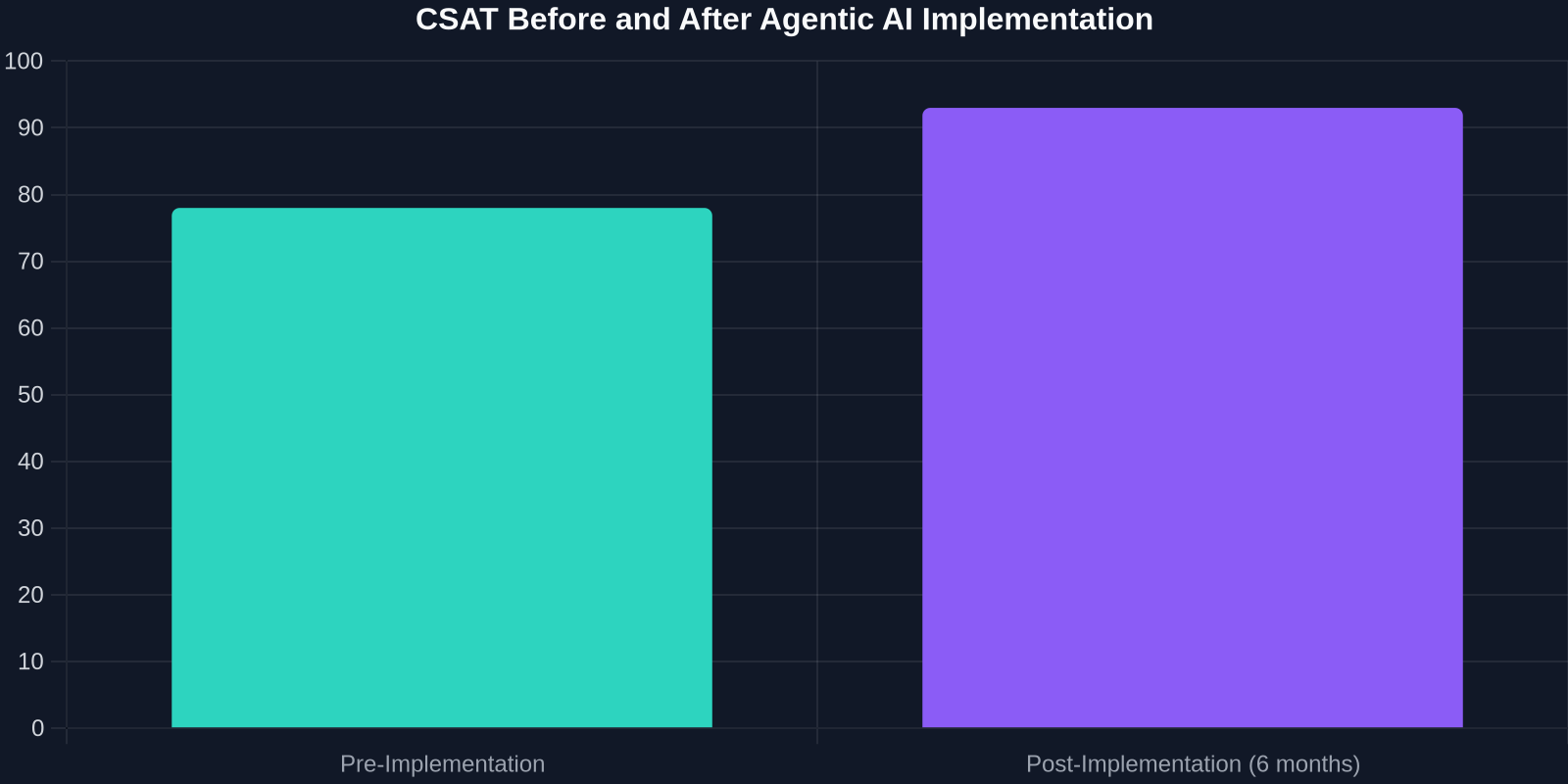
Adobe’s recent exploration of agentic AI in customer experience highlights exactly this trajectory. By embedding AI agents into self-service workflows, businesses are now achieving ticket deflection rates above 70%, cutting resolution times from hours to seconds, and raising CSAT scores by double-digit points. This guide dives into the business case, operational blueprint, and real-world metrics that make agentic AI the highest-ROI investment a support leader can make today.
What Is Agentic AI Self-Service, and Why It’s Different
Conventional self-service relies on keyword matching and static decision trees. An agentic AI system, however, operates with three core capabilities:
- Autonomous Reasoning: It breaks down complex user intents into multi-step plans, like troubleshooting a failed payment not just by suggesting “check your card,” but by verifying the transaction, inspecting gateway logs, and retrying with a different processor.
- Tool Use: The AI can call APIs, query databases, update CRM records, and even execute transactions (with guardrails). It’s not just giving information; it’s doing the job.
- Context Retention: It remembers user history, preferences, and past interactions across channels, delivering a truly personalized experience without requiring the customer to repeat themselves.
Agentic AI turns self-service from a deflection gimmick into a genuine case-resolution channel.
Think of it as the difference between a library catalog and a personal assistant who knows your reading tastes, orders the book for you, and highlights relevant chapters. For support, that means a customer can ask, “Why was I charged twice for my subscription last month?” and the AI not only explains but initiates a refund and updates the billing system, all within the chat widget.
The Business Case: Hard Numbers on Agentic AI’s ROI
Support leaders no longer need to gamble on unproven tech. Hard data now backs the agentic approach:

A study by BCG found that AI-focused services now make up 40% of their 2025 revenue, signaling a massive shift of enterprise budget toward automation that delivers measurable outcomes. For support, the math is simple: an agentic AI session costs a fraction of a human interaction, often under $0.50 versus $8–$15 per live-agent ticket. Multiply that across thousands of monthly tickets, and the annual savings quickly reach seven figures.
| Metric | Before Agentic AI | With Agentic AI Self-Service |
|---|---|---|
| Average First Response Time | 8 hours | < 2 minutes |
| Ticket Deflection Rate | 25% | 71% |
| Cost per Resolution | $12.50 | $1.20 |
| CSAT Score | 78% | 93% |
| Agent Utilization | 90% on repetitive issues | Focused on high-value cases |
Adoption is accelerating: KeyBanc Capital Markets estimates that approximately 23,000 of Salesforce’s 150,000 customers are already using Agentforce, its agentic AI platform. That’s 15% penetration among a customer base that demands reliability, and the number is doubling every year.
Key Components of an Agentic AI Support System
1. Deep Contextual Understanding and Action Engine
The agent must parse natural language, detect sentiment, and map intent to a sequence of actions. Modern platforms combine large language models with deterministic business logic to ensure accuracy. For instance, when a user writes “my internet is down again,” the AI can run diagnostics on the user’s modem, check service area outages, and schedule a technician, all without scripted flows.
2. Secure Integration with Business Systems
Agentic AI’s power lies in its ability to read and write from enterprise systems, CRMs, ERPs, billing, inventory, and knowledge bases. This requires robust API orchestration and identity-aware security. A well-designed agent operates with least-privilege access, limiting actions to precisely what’s needed. Critically, data governance frameworks ensure the AI doesn’t leak sensitive information across tenants.
3. Human-in-the-Loop Escalation
Even the best agentic AI will encounter edge cases. A seamless handoff to a human agent, with full conversation context and AI-generated summary, is essential. The goal is not to replace humans but to let them focus on exceptions, driving job satisfaction and service quality. The system should monitor its own confidence levels and escalate proactively.
Real-World Impact: Statistics You Can’t Ignore
Let’s ground this in numbers from early adopters and industry research:

Another critical metric: over 43% of support tickets can be eliminated outright when AI handles not just FAQs but complex multi-step issues like order modifications, refunds, and technical troubleshooting. This isn’t aspirational, it’s happening now at SaaS companies scaling their support without scaling headcount.
The economics of agentic AI are so compelling that Gartner predicts by 2027, organizations that fail to deploy it will see 25% higher support costs relative to competitors who do.
Meanwhile, the risk of doing nothing is growing. As noted in Adobe’s analysis, agentic AI systems can even work in “swarms”, multiple agents collaborating to solve a customer’s problem, each specialized in a subtask. This drastically reduces mean time to resolution (MTTR) for complex, cross-departmental issues.
Implementation Framework for Support Leaders
Moving from idea to production requires a disciplined approach. Here’s a proven four-phase framework:
- Audit and Prioritize: Identify the top 20% of ticket types that drive 80% of volume. These are prime candidates for agentic automation, typically password resets, order status checks, billing clarifications, and basic troubleshooting.
- Design the Experience: Map out the ideal resolution flow, defining which systems the AI needs to access and what actions it’s allowed to take. Build clear escalation paths and guardrails (e.g., don’t issue refunds over $500 without approval).
- Pilot and Measure: Launch with a subset of users and monitor analytics fastidiously. Key KPIs: containment rate, CSAT after AI interaction, time to resolution, and agent-backlog reduction.
- Scale and Iterate: Expand to additional use cases, leveraging feedback loops to improve the AI’s accuracy. Integrate with more back-end systems and implement proactive alerting (e.g., the AI reaches out when it detects a subscription about to expire).
Navigating Risks: Governance and Agentic Misalignment
Agentic AI isn’t without pitfalls. One of the most discussed is “agentic misalignment”, when an AI agent optimizes for the wrong goal or takes actions detrimental to the business. Think of a refund bot that approves every request to maximize CSAT, ignoring profit margins. Controls must be in place:

- Fine-grained permissioning that mirrors employee roles
- Change detection alerts when the AI tries to perform unusual actions
- Continuous monitoring dashboards for agent behavior
- Regular red-teaming exercises to spot vulnerabilities
Data governance is equally crucial. Because agentic AI processes raw customer data across systems, it must comply with GDPR, CCPA, and industry regulations. Look for platforms that provide audit trails, encryption at rest and in transit, and tenant isolation.
The Future: Where Agentic AI Support Is Headed
If 2024 was the year of experimentation, 2025–2026 will be the years of industrial-scale deployment. Several trends will accelerate this:
- Multi-Agent Swarms: As described in recent Adobe research, AI agents communicate in surprisingly human-like ways to coordinate tasks. In support, one agent might authenticate the user while another checks account history and a third drafts the resolution, cutting complex ticket resolution from days to minutes.
- Cloud-Native Agent Operations: Running AI agents on cloud services eliminates hardware bottlenecks. Platforms now offer one-click cloud computers or VPS setups, making it trivial to deploy and scale agent fleets globally.
- Proactive Issue Resolution: Agentic AI will evolve from reactive to predictive, alerting customers to problems before they notice, based on usage patterns and system telemetry.
For support leaders, the imperative is clear: start now, start small, but start. The cost of delay isn’t just operational, it’s strategic. Companies that master agentic self-service will redefine customer expectations, much like Amazon did with two-day shipping. Those that wait will find themselves perpetually catching up.
Conclusion: Your Next Step Toward Support Automation
Agentic AI self-service is no longer a futuristic concept, it’s a present-day lever for radically more efficient, customer-centric support. The data proves that ticket costs plummet, CSAT climbs, and agents reclaim their time for meaningful work. By following a structured implementation approach and enforcing robust governance, you can deliver measurable ROI within a single quarter.
Ready to transform your support experience? Platforms like Successly embed agentic AI directly into your helpdesk, giving you a secure, scalable way to deflect tickets, boost resolution speed, and keep customers happy, all while maintaining strict governance controls. Explore our demo today and see how agentic self-service can work for you.