
From Dashboards to Decisions: How AI Is Rewriting the SaaS Support Playbook
Meta Description: Explore how AI transforms SaaS from static dashboards to proactive decision engines. Learn actionable strategies to cut support tickets by 43%, boost CSAT, and scale customer success with intelligence.
The Dashboard Dilemma: Data Rich, Decision Poor
Walk into any SaaS support operation today and you will find a wall of dashboards. Real‑time ticket queues, average handle time graphs, CSAT trend lines, all meticulously rendered, yet fundamentally passive. These visualizations tell you what happened, but they rarely tell you what to do. The result? Support teams drowning in data while the decisions that actually move the needle, how to prioritize a VIP escalation, when to trigger a customer health alert, which knowledge base article to promote next, still rely on gut instinct and manual workflows.
Ron Schmelzer’s recent piece in Forbes captures this shift perfectly: the SaaS industry is moving “From Dashboards to Decisions.” The old playbook, where a monthly report on ticket volume was considered strategic, is being retired. In its place, a new model is emerging, one where AI ingests streams of operational data, detects patterns in real time, and either recommends or automatically executes the next best action. This is not a dashboard that waits to be looked at; it is a decision engine that works even when no one is watching.
From Monitoring to Action: AI as the Decision Layer
Traditional SaaS support stacks are built on a passive architecture: chat, email, ticketing, and analytics. Each tool generates logs, dashboards, and alerts that ultimately require a human to interpret and act. This “monitoring stack” served us well when ticket volumes grew linearly, but in 2025, the average B2B SaaS company sees a 35% year‑over‑year increase in support interactions driven by product complexity and a global customer base. Humans alone can no longer keep pace.

The new playbook layers an AI decision engine directly on top of existing tools. Instead of merely displaying metrics, the AI evaluates hundreds of signals, conversation sentiment, customer health score, time‑of‑day patterns, agent skill proficiency, and contract renewal status, and then executes a decision. For example:
- Triaging: Not all tickets are equal. AI can route a churn‑risk customer to a senior agent within seconds of ticket creation, while a simple billing query goes straight to the self‑service bot.
- Proactive interventions: When AI detects that three enterprise accounts are encountering the same integration error, it triggers a campaign to update documentation and notify those customers before they even reach out.
- Knowledge orchestration: Instead of waiting for agents to search, the decision engine pushes the most relevant article, or even crafts a draft reply, based on the exact phrasing and sentiment of the incoming query.
"The future of SaaS support isn’t about better dashboards, it’s about turning data into decisions in real time."
The AI-Powered Support Stack: Redefining Customer Success
As the Forbes article highlights, “the SaaS industry is already turning into an AI‑based decision factory.” Nowhere is this more impactful than in customer support, where every second of resolution time, every escalation, and every repeat contact carries a direct business cost. Forward‑looking support operations leaders are building what we call the “decision‑first support stack”, a triad of data, models, and automated actions.
1. Unified data foundation
AI needs context. Isolated ticket data is helpful; enriched ticket data, linked to CRM, product usage telemetry, and billing history, is transformative. Week one of any AI initiative must focus on consolidating these sources. The goal is a single view of the customer that updates in real time.
2. Typed decision models
Modern AI moves beyond generic text generation. Systems like Jev Latest use typed decision models that return structured outcomes, a category, a confidence score, or a yes/no probability, making the output immediately actionable for downstream workflows. This is what separates a chatbot that says “I think the answer is…” from a support automaton that says “Route this to the enterprise team with priority 1 and pre‑fill the response with these three bullet points.”
3. Continuous learning loops
Every resolved ticket becomes a training signal. User ratings on assistant responses, conversation shares, and outcome data feed back into the model, steadily improving accuracy and expanding the number of decisions the AI can take without human approval. This moves the support organization from a cost center to an intelligence asset.
Quantifying the Impact: Real Business Outcomes
When decisions are automated, the business impact is immediate and measurable. The following benchmarks, gathered from mid‑market and enterprise SaaS deployments, illustrate the financial and operational lift:

But the numbers tell only part of the story. A leading logistics provider, cited in the Forbes analysis, “spent $24M on AI in 2025” to rewrite its contract playbook, moving from spreadsheet‑based decisions to real‑time AI negotiation models. Similarly, support organizations that adopt decision‑first architectures are not just saving money; they are making every customer interaction a learning event that strengthens the product and the brand.
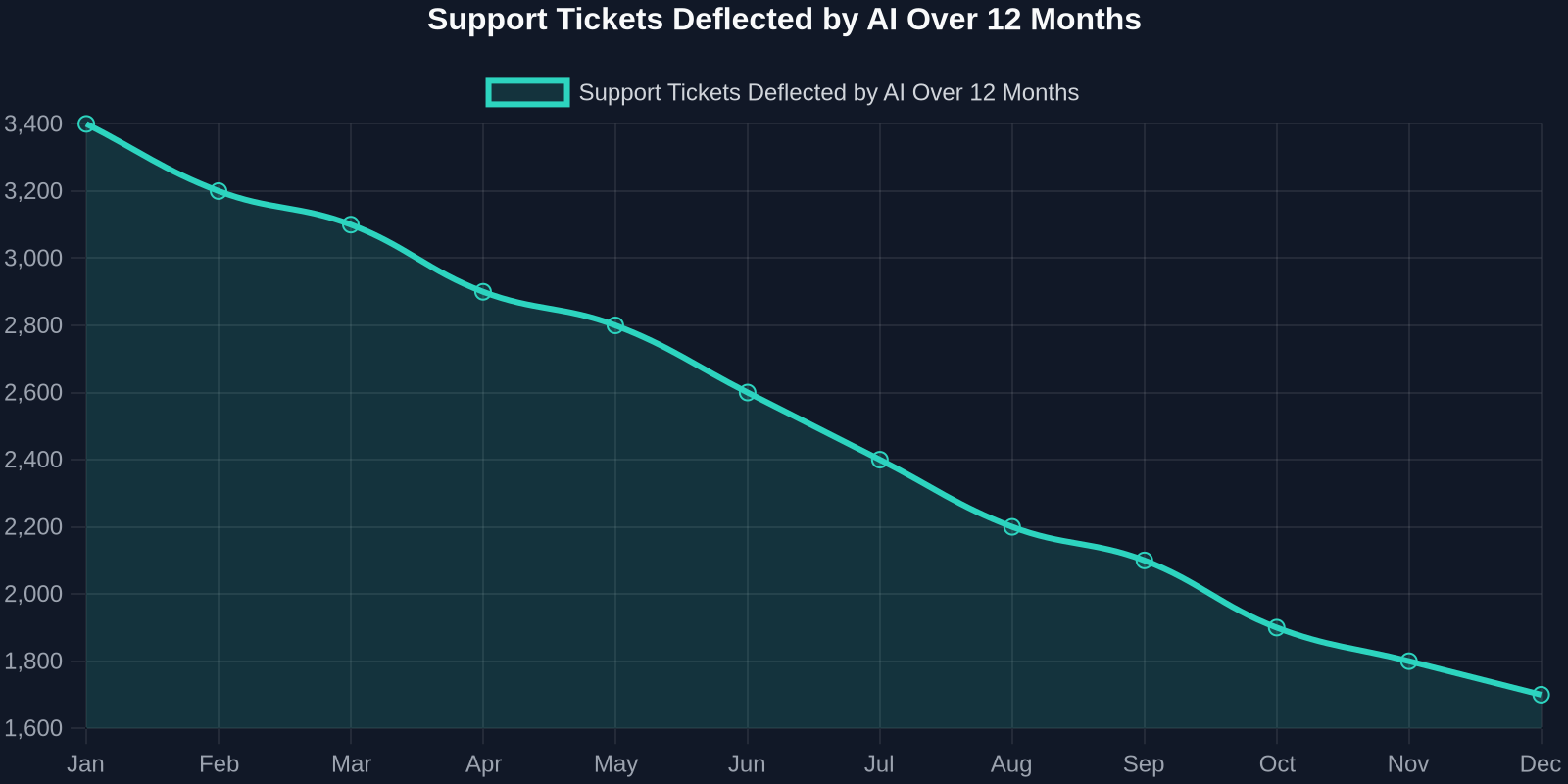
The chart above shows a typical deflection trajectory. After an initial ramp‑up period, AI decision engines consistently reduce incoming ticket volume by over 40% as more issues are resolved proactively or through self‑service. This directly lowers headcount pressure and improves agent job satisfaction by removing repetitive, low‑value tasks.
Comparison: Before AI vs. After AI in Support Operations
| Metric | Before AI | After AI |
|---|---|---|
| Average First Response Time | 4 hours (business hours) | < 2 minutes (24/7) |
| Ticket Deflection Rate | 5‑10% (basic chatbot) | 35‑45% (intelligent decision engine) |
| CSAT Score | 3.8 / 5 | 4.7 / 5 |
| Agent Utilisation on High‑Value Work | 30% | 70% |
| Cost per Ticket | $18.50 | $7.50 (month 6) |
As the table demonstrates, the shift from passive monitoring to active decision‑making transforms every performance indicator. The most striking change is the redistribution of human effort: agents move from triage and repetitive answers to complex problem solving and relationship building, the very activities that drive expansion revenue.
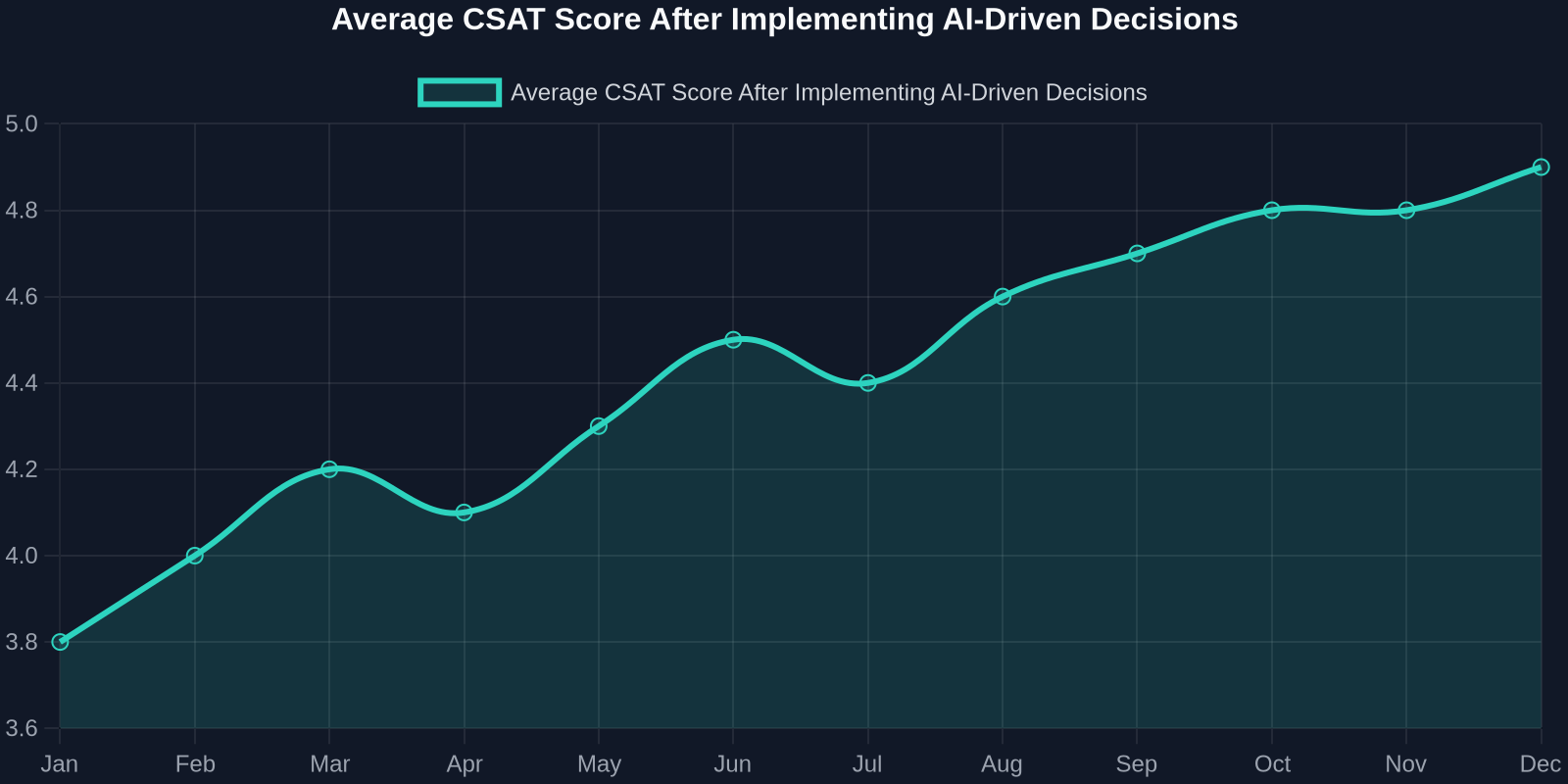
CSAT rises not because the product changes overnight, but because customers receive accurate, contextual answers instantly. When AI assists agents with real‑time guidance, even first‑day onboarding staff can handle sophisticated inquiries, reducing inconsistency and repeat contacts. The steady upward trend reflects the compound effect of better decisions accumulating over time.
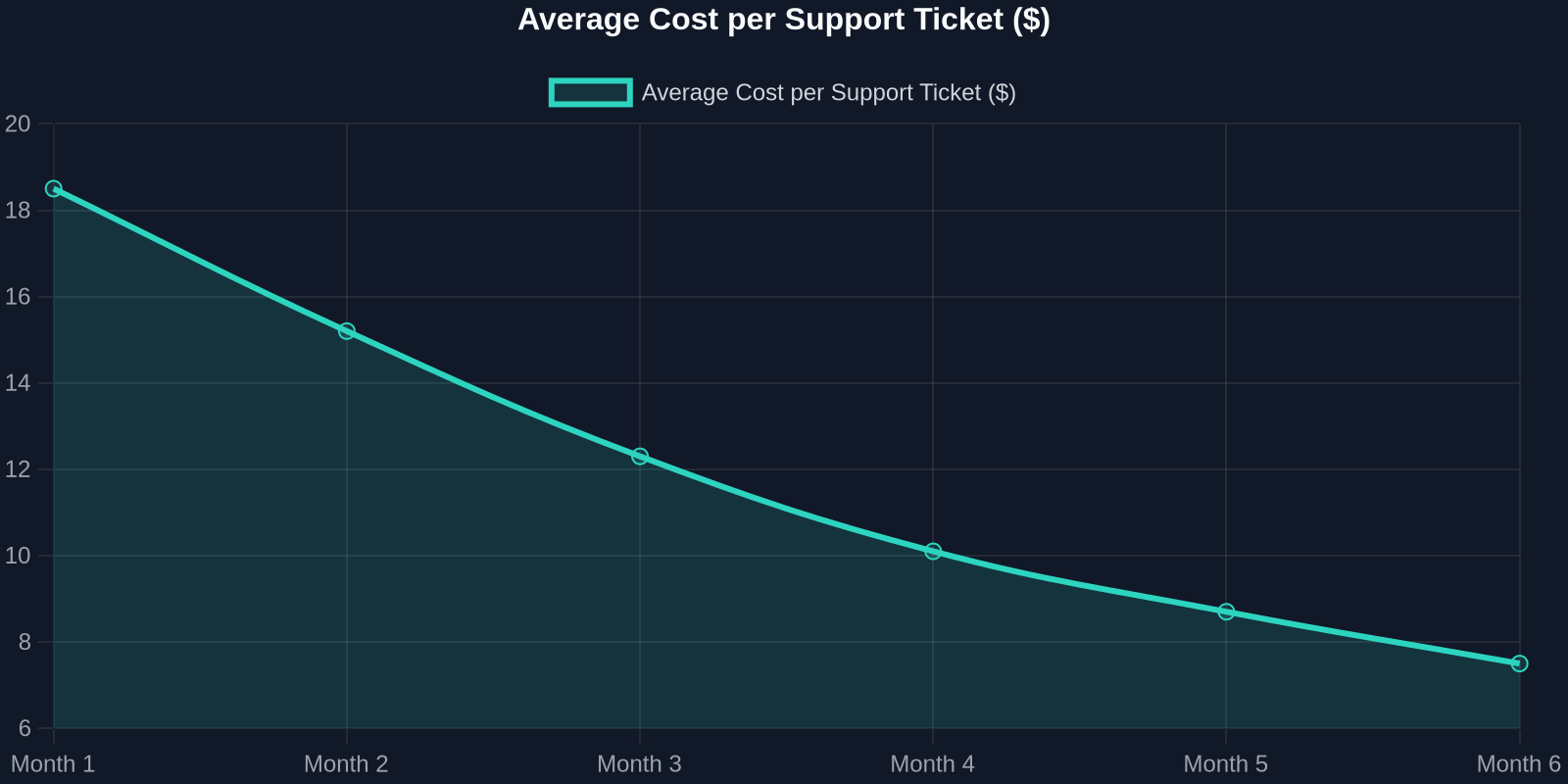
Financially, the case is clear. As the decision engine handles more routine interactions and empowers agents to resolve complex issues faster, the fully loaded cost per ticket can drop by 60% or more within half a year. For a mid‑size SaaS company handling 10,000 tickets per month, that translates to over $130,000 in monthly savings, capital that can be redirected into product innovation or customer success initiatives that fuel growth.
Implementation Roadmap: Your AI Playbook for Support
Shifting from dashboards to decisions is not an overnight project; it requires deliberate sequencing. Based on successful enterprise deployments, we recommend a six‑week sprint framework:

Week 1‑2: Discovery and Decision Mapping
Identify the top five decisions your support team makes daily, e.g., “which customers are at risk of churn based on ticket sentiment?” Map the data sources required to inform each decision. Often, foundational customer data is scattered across tools, so this phase also includes a gap analysis of AI‑readiness.
Week 3‑4: Pilot with One High‑Impact Decision
Choose a decision with clear ROI and low integration complexity. Auto‑posting routine five‑star review replies or routing urgent enterprise tickets are proven entry points. Connect the necessary data pipes and deploy a decision model (such as a typed model that returns a confidence score). Start with a human‑in‑the‑loop override to build trust.
Week 5: Expand and Integrate
Once the pilot demonstrates measurable deflection or CSAT uplift, extend the model to adjacent decisions. For example, if the churn‑risk predictor works, add an automated outreach sequence. Integrate the decision output back into the CRM and support ticketing systems so that every interaction is enriched with AI‑derived insights.
Week 6: Monitor, Learn, Scale
Dashboards are not gone, they simply evolve from static reports to real‑time observability of AI decisions. Track decision accuracy, override rates, and customer feedback. Use these signals to retrain models continuously. Over time, increase the autonomy level for high‑confidence decisions, freeing your team to focus on strategy.
Future‑Proofing Your SaaS: The Decision‑First Architecture
The Forbes piece rightly notes that AI is “rewriting the Internet business playbook for startups.” In the support world, that means building an architecture where decisions, not dashboards, are the first‑class citizens. This has profound implications for how we hire, how we measure success, and how we design products.
Forward‑thinking support leaders are already restructuring teams around “decision performance” rather than ticket volume. They ask questions like: “How many customers did we proactively save this month?” rather than “How many tickets did we close?” Tools like Successly exemplify this shift by embedding an AI‑powered decision layer directly into the support workflow, auto‑drafting responses from business data, routing based on intent and sentiment, and continuously learning from each interaction to expand the set of decisions that can be fully automated.
"When you turn every customer interaction into a decision that is captured, learned from, and automated, you transform support from a cost center into a growth engine."
The transition from dashboards to decisions is not just a technological upgrade; it is a philosophical one. It acknowledges that in the age of AI, the most valuable asset a SaaS company has is not its data, but its ability to act on that data with speed and precision. Start by asking your team one question: What is the one decision you wish you could make instantly, every time, without ever opening a dashboard? The answer to that question is your AI playbook’s first page.
Embrace the decision‑first future. The playbook has been rewritten; the only remaining step is to run the play.