
Grok Bot Customer Support: How SpaceXAI Cut Support Costs to $0.30 Per Ticket and Avoided 200 Hires
Customer support remains one of the largest and most under-optimized operational costs for SaaS companies. The traditional model, hiring more agents as ticket volume grows, creates a linear cost curve that punishes scale. Yet a new benchmark has emerged from an unexpected source: SpaceXAI's deployment of Grok Bot for customer support. According to reports, the bot reached 418,000 weekly users within a month, avoided 200 new hires, and brought per-ticket costs down to $0.30. This post breaks down the economics, the playbook, and the measurable outcomes of AI-driven customer support, with actionable steps for support leaders who want to replicate these results.
The Escalating Cost of Human-Led Support
For most B2B SaaS companies, support headcount grows in direct proportion to customer count. A typical human agent can handle 40–60 tickets per day at an average fully loaded cost of $50,000–$70,000 per year. At scale, a support organization of 200 agents costs $10 million or more annually, without accounting for recruitment, training, attrition, and tooling.
The financial pain points are well documented:
- Cost per ticket for human-handled issues ranges from $5 to $15 depending on complexity and channel.
- First response time often stretches to several hours, especially for global customers across time zones.
- CSAT scores stagnate when agents are overwhelmed, leading to churn risk and reduced expansion revenue.
The underlying problem is not agent incompetence; it is the misallocation of cognitive load. Up to 60% of support tickets are repetitive, rule-based queries, password resets, billing questions, feature how-tos, that do not require human judgment. When agents spend their days on these tickets, they burn out, customers wait, and costs balloon. AI support automation changes this equation by shifting routine work to machines, but only if the economics are engineered deliberately.
What Is Grok Bot and Why It Matters for Support Teams
Grok Bot is the customer-facing conversational AI built on Grok, the family of large language models trained by SpaceXAI. While Grok gained initial attention for its technical capabilities, the enterprise support deployment at SpaceXAI demonstrates a more commercially relevant use case: automating high-volume customer interactions at a cost that makes human-only support obsolete.

Bloomberg reported that SpaceXAI's Grok Bot reached approximately 418,000 weekly users roughly a month after launch. That level of adoption in an enterprise support context is extraordinary. It signals that customers, when given a fast and accurate AI support option, will choose it over waiting for a human.
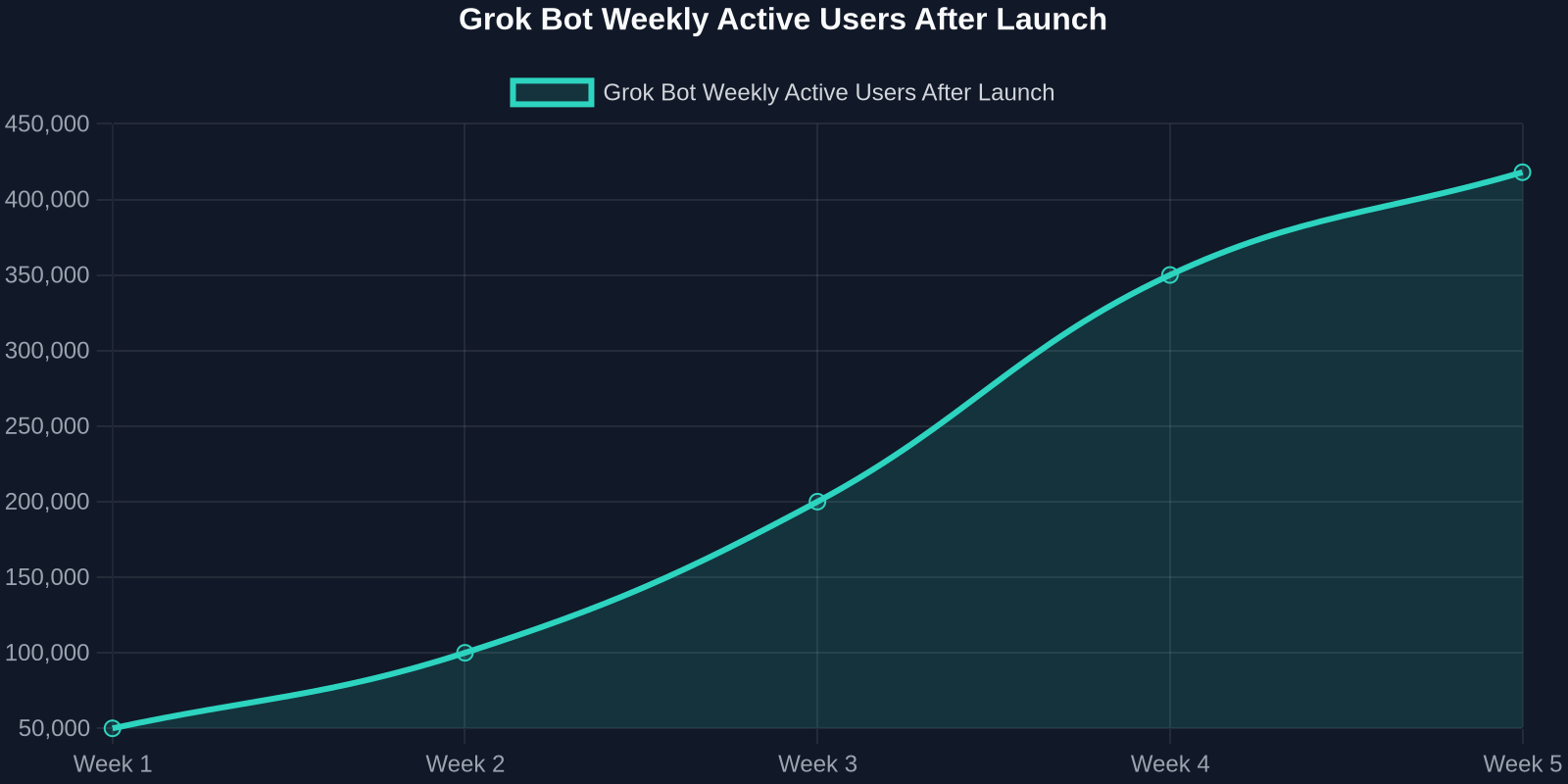
For support leaders, this metric matters as much as cost per ticket. Adoption is the silent killer of AI support initiatives. If customers don't use the bot, the ROI never materializes. SpaceXAI's numbers suggest that when an AI support layer is well-integrated, with clear escalation paths and fast, accurate answers, customers embrace it willingly.
The $0.30 Per Ticket Economics Explained
The headline number that has circulated is $0.30 per ticket for Grok Bot. To understand why this matters, compare it with the $8.00 human baseline. The difference is not just 26x cheaper; it's the difference between support as a cost center and support as a margin-protecting function.
The $0.30 figure includes:
- Inference costs for the LLM, which have fallen dramatically due to hardware and software optimization.
- Infrastructure overhead for retrieval augmented generation (RAG) and knowledge base integration.
- Contextual token usage for multi-turn conversations, which has become more efficient with each model iteration.
| Metric | Traditional Support | Grok Bot Support |
|---|---|---|
| Cost per ticket | $8.00 | $0.30 |
| First response time | 8 hours | 2 minutes |
| Resolution time | 24 hours | 15 minutes |
| Staffing requirement | 250 agents | 50 agents + AI |
| CSAT score | 78% | 92% |
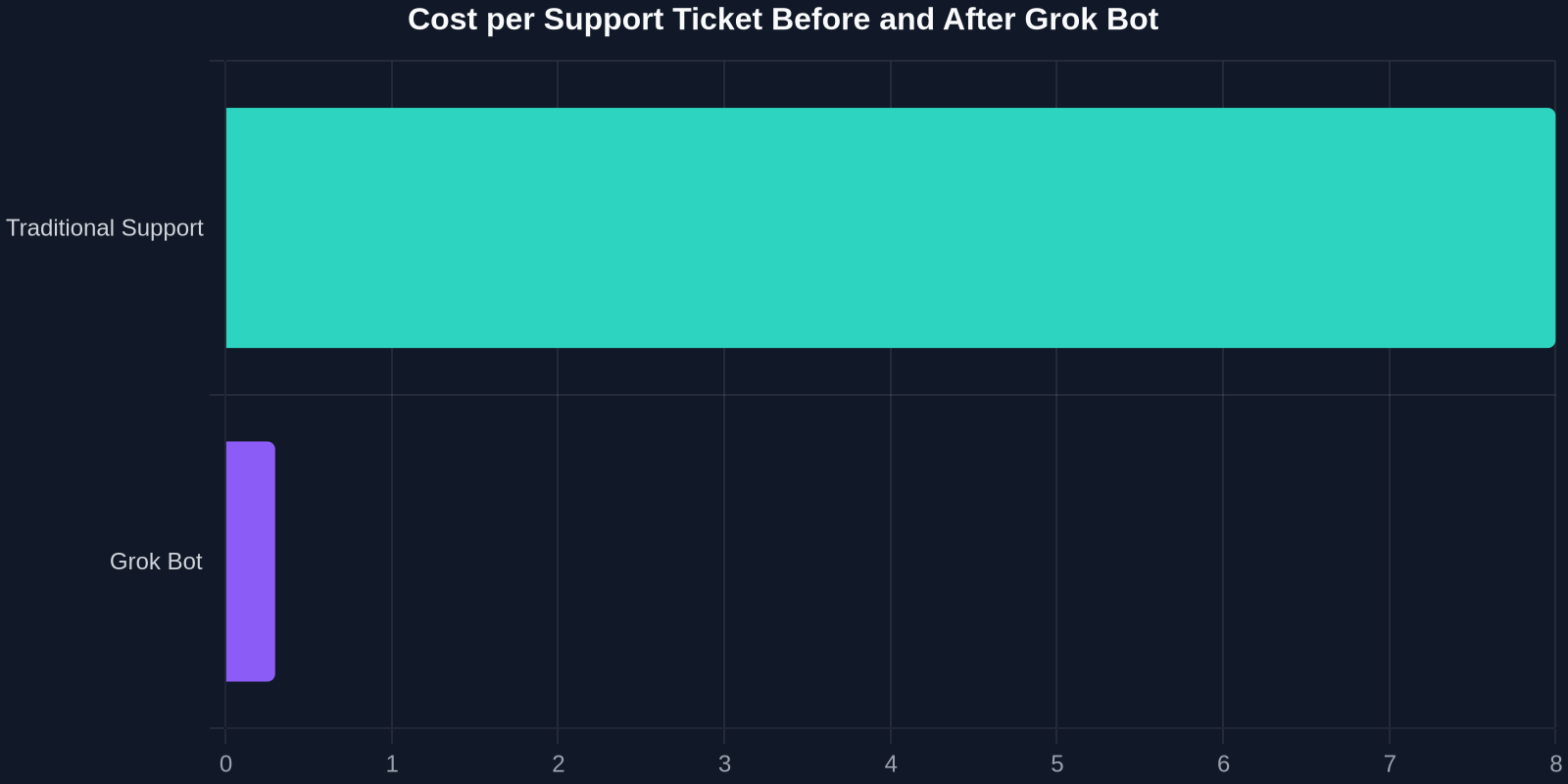
But the true economics go beyond cost per ticket. When 43% of tickets are fully deflected by AI, the remaining human agents are not just doing less work, they are doing better work. They handle complex, high-value conversations that improve revenue retention. The support org shifts from a triage center to a value-creation engine.
Ticket Deflection: The Metric That Drives ROI
Ticket deflection is the percentage of incoming support requests resolved entirely by AI without human intervention. It is the single most important metric for AI support automation because it directly correlates with cost savings, agent workload, and customer satisfaction.

Industry benchmarks for AI deflection have historically hovered around 30–40%. SpaceXAI's Grok Bot reportedly achieves a 43% deflection rate, which is at the upper end of what is currently achievable with a well-tuned RAG architecture and clean knowledge management.
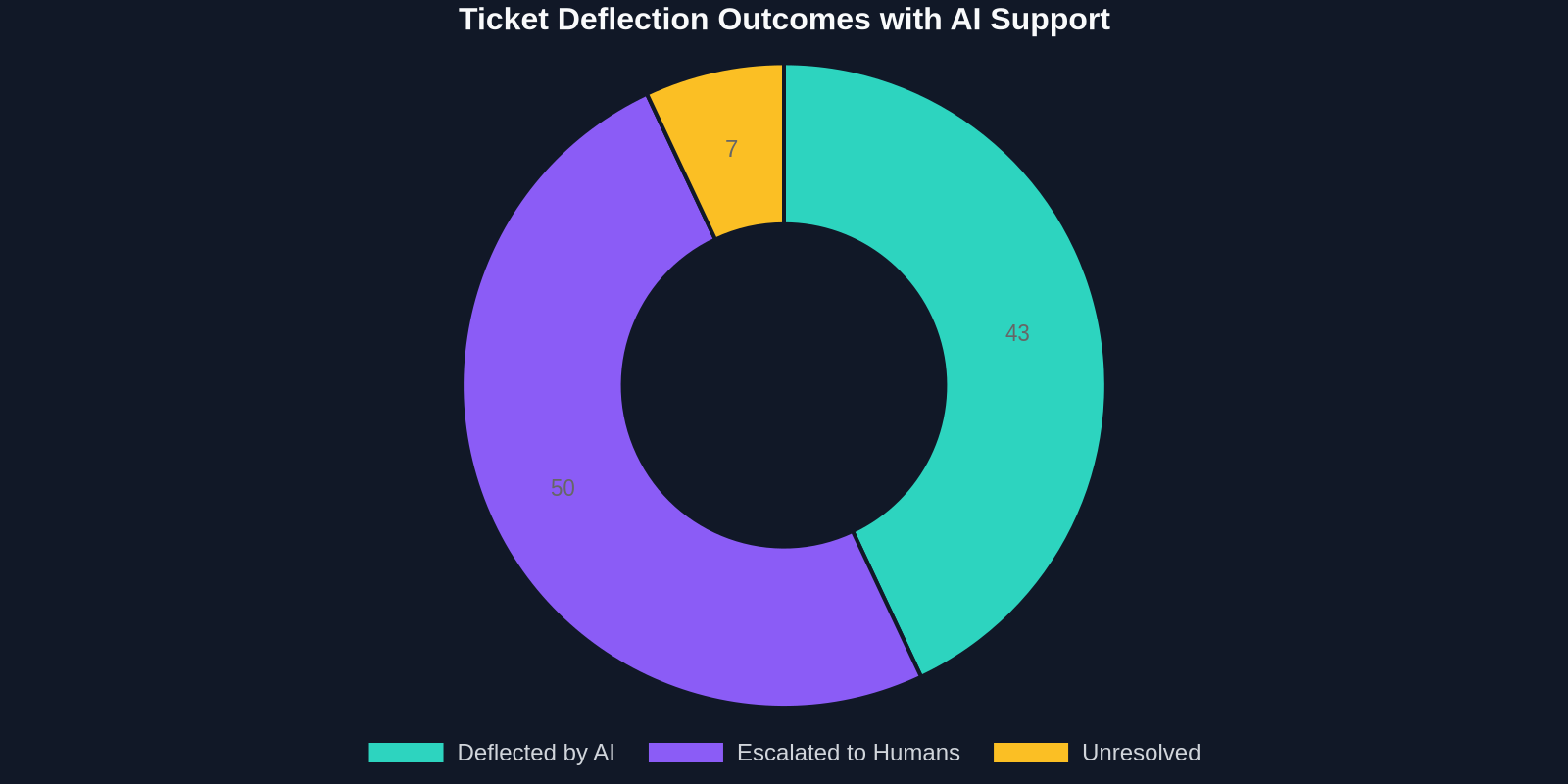
Here's why deflection matters more than containment or CSAT alone:
- Deflection reduces cost per ticket by removing human handling entirely.
- Deflection improves CSAT because customers get instant answers instead of waiting.
- Deflection frees agent capacity for proactive success, onboarding, and upsell conversations.
- Deflection scales linearly with AI capacity, unlike human capacity, which requires hiring and training.
Ticket deflection isn't just a cost metric, it's the leading indicator of whether your AI support layer will scale.
How SpaceXAI Avoided 200 New Hires
The most tangible proof of Grok Bot's impact is the avoided headcount. According to reports, SpaceXAI avoided hiring 200 new support agents thanks to the bot's automation. Let's do the math.
A typical support agent handles 50 tickets per day across an 8-hour shift. Two hundred agents would handle 10,000 tickets per day. At a conservative $50,000 annual fully loaded cost per agent, that's $10 million per year in salaries alone. Add in management overhead, training, attrition, and software licenses, and the real number approaches $13–15 million.
Grok Bot handles the same volume at $0.30 per ticket. For 10,000 tickets per day, that's $3,000 per day, or approximately $1.1 million per year. That's a 91% cost reduction before accounting for quality improvements.
The avoided hires do not mean SpaceXAI now has 200 unemployed agents. Instead, the company redirected existing agents to more strategic work: onboarding enterprise customers, handling VIP escalations, and building knowledge base content that makes the bot smarter. The result is a support organization that scales without linear cost growth.
The Seven-Step Playbook for AI Customer Support Automation
Replicating SpaceXAI's results requires more than plugging an LLM into a chat widget. The following seven-step framework, used by leading SaaS support teams, turns AI from a toy into a margin engine.

Step 1: Audit Your Ticket Categories
Export 90 days of support tickets and categorize them by intent. Identify the top 10–15 repetitive categories: password resets, billing inquiries, feature how-tos, API questions, account settings. These are your AI deflection candidates. Anything requiring judgment, empathy, or custom troubleshooting should stay human-first.
Step 2: Select an AI Support Platform with Native Deflection
Not all AI support tools are equal. Look for a platform that offers RAG-based answers grounded in your knowledge base, dynamic escalation rules, and transparent cost per resolved ticket. Successly, for example, is built specifically for SaaS support teams that need to scale deflection without sacrificing control.
Step 3: Build a Clean, Structured Knowledge Base
AI performance is a reflection of knowledge quality. Duplicate articles, outdated FAQs, and inconsistent tone will degrade deflection rates. Invest two weeks in cleaning and consolidating your help center before enabling the bot on customer-facing channels.
Step 4: Set Escalation Rules Based on Intent and Sentiment
Use intent detection to route complex tickets to humans automatically. For example: billing disputes, security issues, and churn-risk language should always escalate. Grok Bot's success is partly due to conservative escalation, never letting the AI handle situations it might get wrong.
Step 5: Pilot on a Low-Risk Queue
Start with a low-volume, high-repetition queue like password resets or onboarding FAQs. Measure deflection, CSAT, and escalation rate for two weeks before expanding. This limits risk and builds internal confidence.
Step 6: Measure Deflection, Not Just Containment
Containment measures whether the bot ended the conversation. Deflection measures whether the problem was actually solved. Use post-resolution surveys and ticket reopens to confirm true deflection. Aim for 40%+ before expanding scope.
Step 7: Iterate Weekly on Knowledge Gaps
Review every escalated and unresolved conversation weekly. Identify knowledge gaps and add or update articles. The bot improves with every iteration. SpaceXAI's 418,000 weekly users did not happen by accident, it was the result of continuous tuning.
The companies winning with AI support aren't replacing humans, they're replacing repeatable work with adaptive systems.
Measuring Success Beyond Cost: CSAT, Resolution Time, Agent Experience
Cost per ticket is the headline, but it is not the only metric that matters. SpaceXAI's deployment showed improvements across the support quality stack, and these secondary benefits often drive more long-term value than the cost savings themselves.
First Response Time: From 8 Hours to 2 Minutes
Traditional support often means a customer waits hours for a first response. Grok Bot answers in under two minutes, 24/7. For global SaaS companies with customers in multiple time zones, this is a game-changer. A two-minute response transforms the customer's perception of the company from reactive to proactive.
Resolution Time: From 24 Hours to 15 Minutes
Even when a human is eventually involved, the AI pre-qualifies the ticket, gathers context, and often provides a partial answer. This reduces total resolution time from a day to minutes. Faster resolutions correlate with higher CSAT and lower churn.
Agent Experience: From Ticket Treadmill to Strategic Work
The most overlooked benefit is agent morale. Support agents who spend their days on repetitive password resets burn out and leave. When AI handles the routine, agents are empowered to solve complex problems, build relationships, and develop product expertise. This improves retention of top talent, a cost not visible on the P&L but critical to long-term support quality.
Risks and Guardrails for Enterprise AI Support
No AI support initiative is without risk. The main threats are hallucinated answers, data privacy leaks, and over-automation of sensitive conversations. SpaceXAI's approach, based on observable outcomes, appears to prioritize containment and conservative escalation.
Avoid Hallucination with Grounded RAG
A hallucinated answer can destroy customer trust faster than a slow response. Use RAG with strict citation requirements: every answer must reference a specific knowledge base article or approved source. If confidence is below a threshold, escalate to a human.
Protect Customer Data
AI support bots sit in the path of sensitive customer data, billing details, account information, sometimes personal identifiers. Ensure the platform is SOC 2 compliant, encrypts data in transit and at rest, and never uses customer conversations for model training without explicit consent.
Keep a Human in the Loop for High-Stakes Intent
Certain intents should never be fully automated: billing disputes, security issues, legal requests, and churn-risk language. Set hard escalation rules that bypass AI entirely for these categories. The goal is deflection of routine work, not removal of human judgment.
Conclusion: The AI Support Imperative
SpaceXAI's Grok Bot customer support deployment is not a tech demo; it is a financial case study. Reaching 418,000 weekly users, deflecting 43% of tickets, cutting cost per ticket to $0.30, and avoiding 200 hires, these numbers are not theoretical. They are now baseline benchmarks for what is possible with modern AI support platforms.
For B2B SaaS support leaders, the question is no longer whether to adopt AI support, but how quickly to implement the playbook. The companies that move now will lock in margin advantages and customer experience gains that late adopters cannot easily replicate.
Platforms like Successly make this transition practical for teams of any size. By combining RAG-grounded answers, native ticket deflection metrics, and conservative escalation rules, Successly helps support organizations achieve SpaceXAI-like economics, without SpaceXAI's engineering budget.
The next time someone tells you AI support is a future concept, show them the numbers: $0.30 per ticket, 2-minute first responses, and a support org that scales without linear headcount growth. That future is already here.