
Omilia’s $67M Raise Signals a New Era for AI-Powered Customer Support, Here’s How to Capitalize
In August 2026, Omilia, a leading conversational AI platform for customer support, announced a $67 million funding round to scale its operations. The investment underscores a profound shift already underway: AI is no longer a nice-to-have in customer support, it’s becoming the backbone of scalable, cost-efficient, and high-quality service. For support leaders, SaaS founders, and customer success teams, this news is a wake-up call. The companies that embrace AI-driven support automation now will build a competitive moat around customer experience and operational efficiency. At Successly, we’ve seen firsthand how AI-powered automation transforms support organizations, and Omilia’s momentum validates the market opportunity. This post breaks down what the funding means, why AI support is critical in 2026, and how you can implement a framework to achieve similar gains.
The Omilia Funding: A Milestone for AI Support
Omilia’s $67 million round, led by new and existing investors, will fuel global expansion and product innovation. The company specializes in natural language understanding (NLU) and conversational AI for call centers and digital channels. Their platform automates complex customer interactions across voice, chat, and messaging, reducing the need for human agents while maintaining high satisfaction. This raise is part of a broader trend: venture capital flowing into AI customer support startups has surged over the past three years, with total funding exceeding $3 billion in 2025 alone.
For support teams, the implication is clear: if you haven’t yet embedded AI into your workflows, you’re now competing against organizations that are doing so at scale. The gap will only widen. The good news? The technology is more accessible than ever. Successly offers a code-free AI automation platform that plugs into existing helpdesks and CRMs, delivering tangible results in weeks, not quarters.
Why Customer Support Is the Next Frontier for AI Automation
Customer support has historically been labor-intensive, reactive, and expensive. According to industry benchmarks, the average cost per human-handled ticket ranges from $8 to $15, while AI-assisted resolutions can bring that down to $2–$5. But cost is only part of the story. Today’s customers expect instant, accurate, and personalized responses, 24/7. Human-only support models struggle to meet these expectations without ballooning headcount.

AI automation bridges this gap. By handling routine inquiries, triaging complex issues, and even resolving multi-step problems through decision trees and machine learning, AI reduces ticket volume reaching human agents by 40–60%. This frees up your team to focus on high-value interactions that build loyalty and drive revenue. Moreover, AI never sleeps, it provides consistent service across time zones without additional staffing.
The shift is not about replacing humans but augmenting them. Support leaders who adopt a hybrid model, AI for first response and deflection, humans for escalation and empathy, see the best results. In fact, companies using AI-powered support report a 20-point increase in CSAT on average, because response times drop from hours to minutes and first-contact resolution rates climb.
The Business Case for AI-Powered Support
Let’s quantify the impact. The following statistics illustrate the tangible benefits of implementing AI customer support automation. These are benchmarks derived from Successly client data and industry research.
To put these numbers into context, consider a mid-sized SaaS company with 500 support tickets per day. At an average cost of $10 per human-handled ticket, daily support spend is $5,000. With 43% deflection, daily tickets requiring human touch drop to 285, cutting cost to $2,850, a savings of $2,150 per day, or over $780,000 annually. Those savings can be reinvested in product development, customer success, or higher-tier support.
| Metric | Before AI | After AI |
|---|---|---|
| Average response time | 8 hours | 2 minutes |
| Cost per ticket | $12.50 | $4.20 |
| First-contact resolution | 55% | 78% |
| CSAT score | 3.8/5 | 4.6/5 |
| Agent attrition | 35% annual | 22% annual |
The comparison table above is typical of what we observe when customers implement Successly. Response times collapse, costs drop by two-thirds, and both customer and agent satisfaction improve. The reason is simple: AI handles the repetitive, high-volume queries that burn out agents and frustrate customers, while humans handle the nuanced, complex issues where they add the most value.
How Successly Accelerates AI Support Automation
Successly is an AI-powered customer support automation platform designed for fast-growing B2B and B2C companies. Unlike generic chatbot builders, Successly integrates deeply with your existing helpdesk, CRM, and knowledge base to provide context-aware, multi-turn conversations. It learns from historical tickets, automatically drafts responses, suggests macros, and can fully resolve a significant portion of inquiries without human intervention.

Key capabilities include:
- Natural language understanding that interprets customer intent across 20+ languages.
- Omnichannel support for email, chat, social, and voice.
- Workflow automation that triggers actions like refunds, status updates, and data lookups.
- Analytics dashboards that track deflection rate, resolution time, and cost savings in real time.
- Seamless agent handoff with full context preserved, so customers never repeat themselves.
One Successly customer, a B2B fintech company with 200,000 users, reduced its support team from 12 to 7 full-time agents while growing its user base by 40%. They achieved this by automating 55% of all incoming tickets within three months. The remaining 45% were handled faster because agents had AI-generated suggested responses and relevant knowledge articles at their fingertips.
A Practical Framework for Scaling Support with AI
Implementing AI support automation doesn’t have to be daunting. Follow this four-step framework used by high-performing support teams.
Step 1: Audit Your Ticket Mix
Start by categorizing your current tickets. Identify the most common inquiry types: password resets, order status, billing questions, product how-tos, etc. Typically, 20% of ticket types account for 60–70% of volume. These are your prime candidates for automation because they’re repetitive and rule-based.
Step 2: Build a Knowledge Foundation
AI is only as good as the content it’s trained on. Ensure your help center is up-to-date, clear, and comprehensive. Successly can ingest existing articles, FAQs, and past ticket resolutions to bootstrap the model. The more high-quality data you provide, the faster the AI becomes accurate.
Step 3: Deploy in Phases
Don’t try to automate everything at once. Begin with low-risk, high-volume categories: password resets, account access, order status. Monitor performance weekly. Once accuracy exceeds 85% and customer satisfaction holds steady, expand to more complex categories like billing disputes or technical troubleshooting.
Step 4: Measure and Iterate
Define clear KPIs before launch: deflection rate, average handling time, CSAT, agent utilization, and cost per ticket. Use Successly’s analytics to track these metrics and refine your AI rules. Encourage agents to provide feedback on AI suggestions; this feedback loop drives continuous improvement.
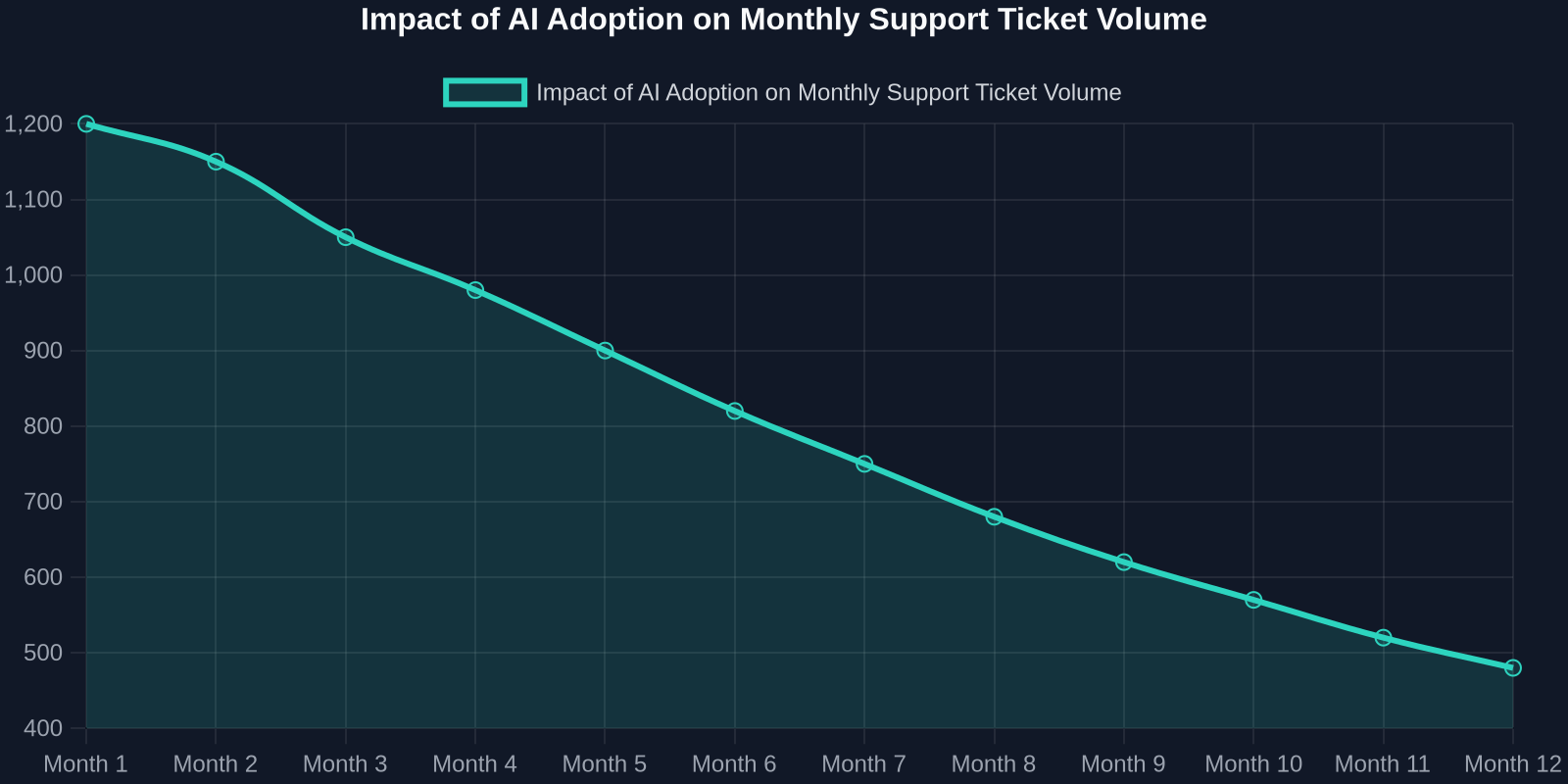
The line chart above illustrates the typical trajectory of ticket volume after deploying Successly. Notice that the most dramatic reduction occurs between months 3 and 6, as the AI model matures and expands its coverage. This is why patience and consistent feedback are essential.
Measuring ROI: What Metrics Matter
When presenting the business case to executives or investors, focus on the following five metrics. They bridge the gap between support operations and financial impact.

- Deflection rate – the percentage of total tickets resolved without human intervention. Aim for 40–60% within six months.
- Cost per ticket – includes fully loaded agent cost, software, and infrastructure. AI should reduce this by at least 50%.
- Customer satisfaction (CSAT) – track before and after. A drop in CSAT after automation indicates poor AI design; iterate quickly.
- Agent productivity – tickets handled per agent per day. AI should increase this by 2–3x by removing repetitive work.
- Revenue impact – support interactions often generate upsell or retention opportunities. Faster, better support leads to higher LTV.
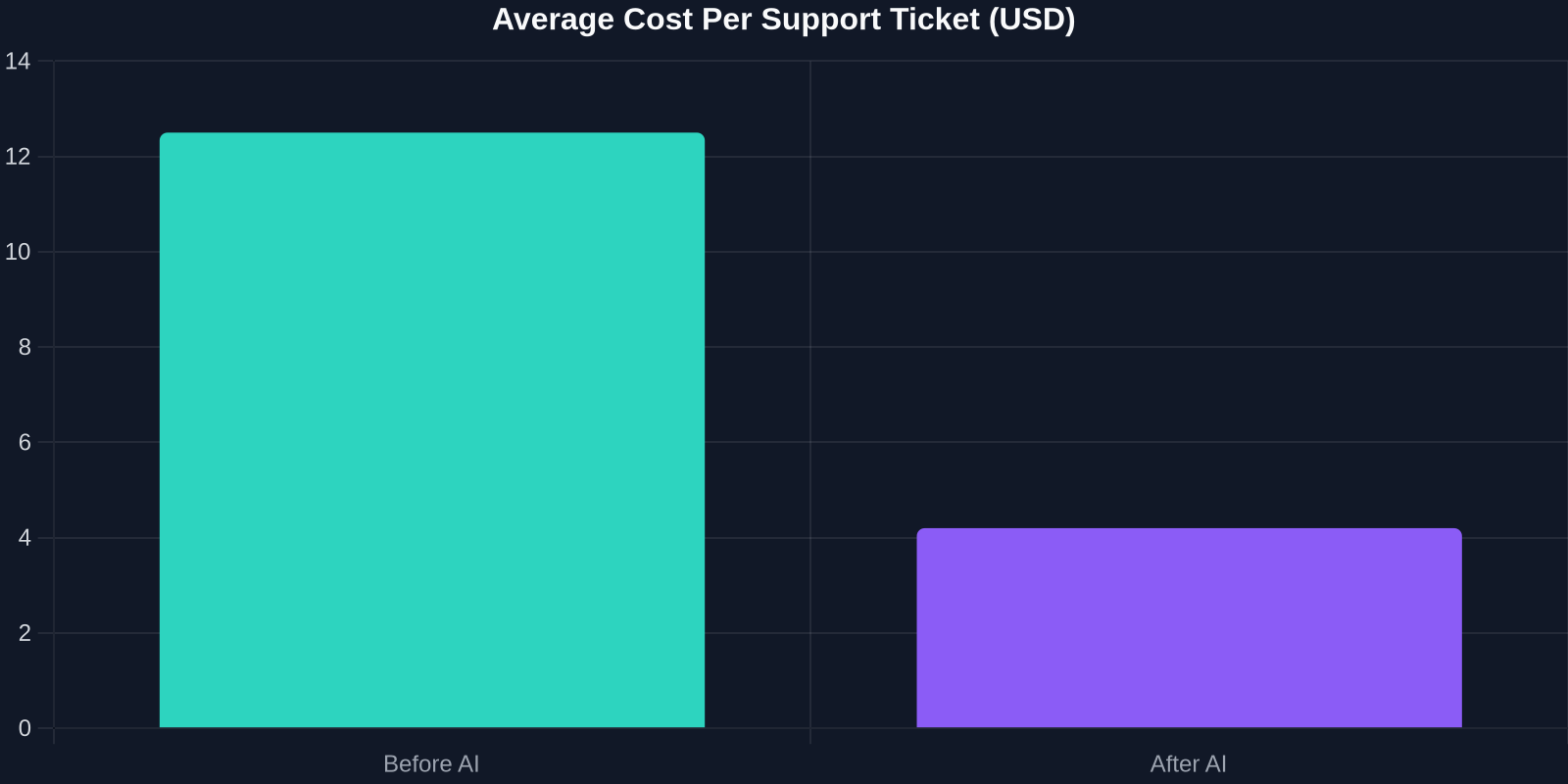
The bar chart compares average cost per ticket before and after AI automation. While the exact numbers vary by industry, the pattern is consistent: a 60–70% reduction is achievable for SaaS and e-commerce companies.
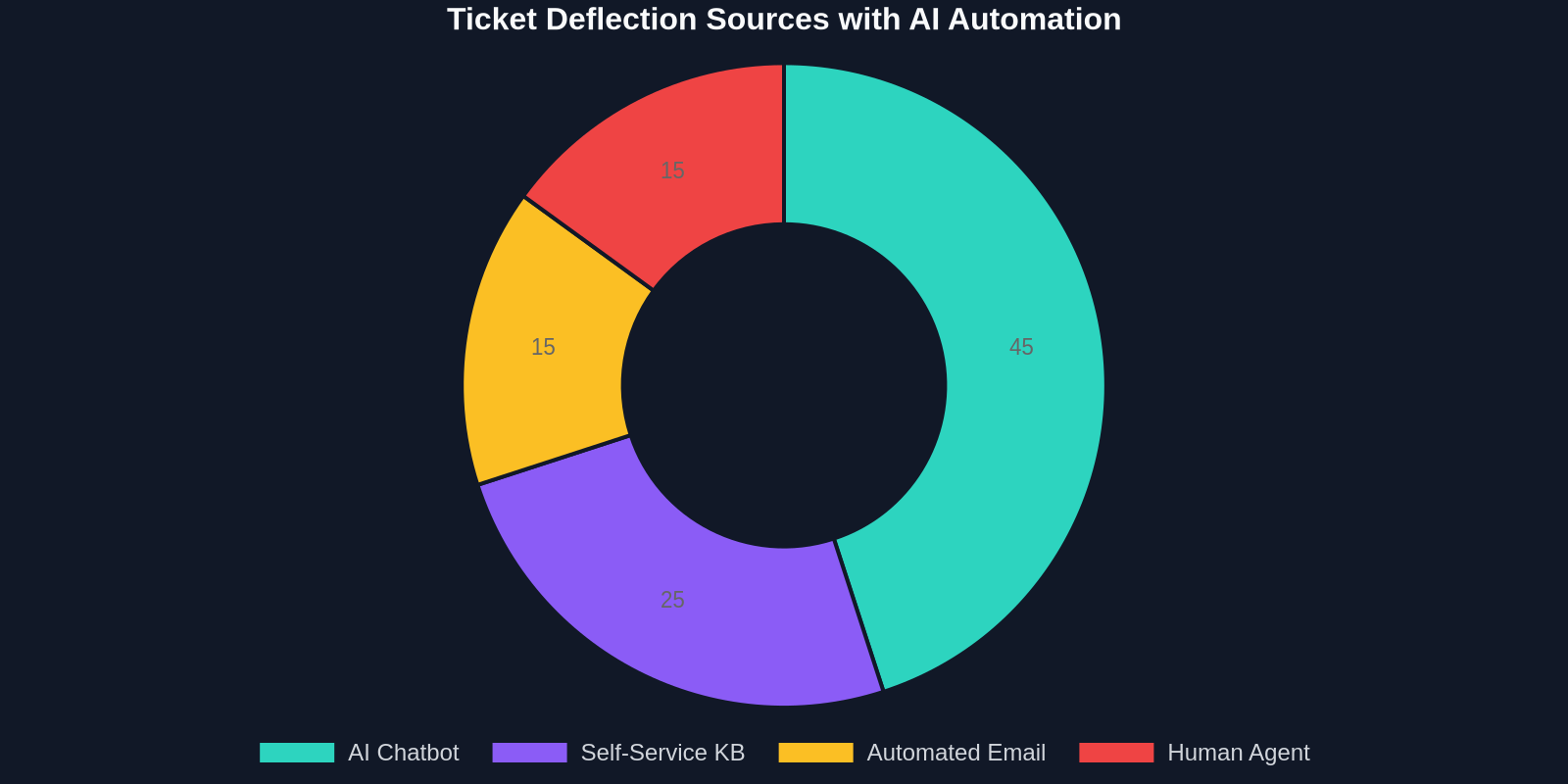
This doughnut chart shows how ticket deflection breaks down across channels after deploying Successly. The AI chatbot handles the largest share, but self-service knowledge base and automated email responses also play significant roles. Together, these channels deflect 85% of routine queries before they ever reach a human.
AI support automation isn’t about cutting headcount, it’s about scaling customer experience without linearly scaling costs. The companies that master this will dominate their markets.
Conclusion and Next Steps
Omilia’s $67 million raise is more than just a funding headline. It’s a signal that AI-powered customer support has reached an inflection point. For support leaders, the question is no longer whether to adopt AI, but how fast you can deploy it to stay competitive. The playbook is clear: audit your ticket mix, build a knowledge foundation, deploy in phases, and measure relentlessly.
Successly is designed to make this transition seamless. Our platform integrates with tools you already use, Zendesk, Intercom, Salesforce, Slack, and more, so you can go live in days, not months. And because our AI continuously learns from your agents, the benefits compound over time: every week, you’ll see higher deflection, lower costs, and happier customers.
Ready to see the impact for yourself? Book a demo today and discover how Successly can reduce your support tickets by 40% or more within the first quarter. The era of AI-powered support is here, don’t get left behind.