OpenAI Codex for Knowledge Work: The Desktop AI Agent Revolutionizing Productivity

OpenAI Codex is rapidly evolving from a specialized coding assistant into a universal productivity tool for knowledge workers. As businesses seek every edge in efficiency, the desktop AI agent is emerging as the 'spreadsheet of our era' — a horizontal platform absorbing bespoke AI projects that once required months of custom development. This article breaks down the latest Codex capabilities, performance benchmarks, and strategic implications for professionals across every industry.
What Is OpenAI Codex and Why It Matters for Knowledge Work
OpenAI Codex was initially launched in May 2025 as a coding agent. But its evolution has been breathtaking. In just a few months, Codex has expanded beyond software development into general knowledge work. According to recent performance data, Codex now runs 25% faster, can be steered mid-task without losing context, and handles long-running agentic work that can last more than a day — a game-changer for complex research, analysis, and content production.
Healthcare and retail are following, albeit more cautiously due to regulatory and data privacy concerns. The core driver is productivity: companies that deploy Codex report an average40% reduction in time spent on routine knowledge tasks.
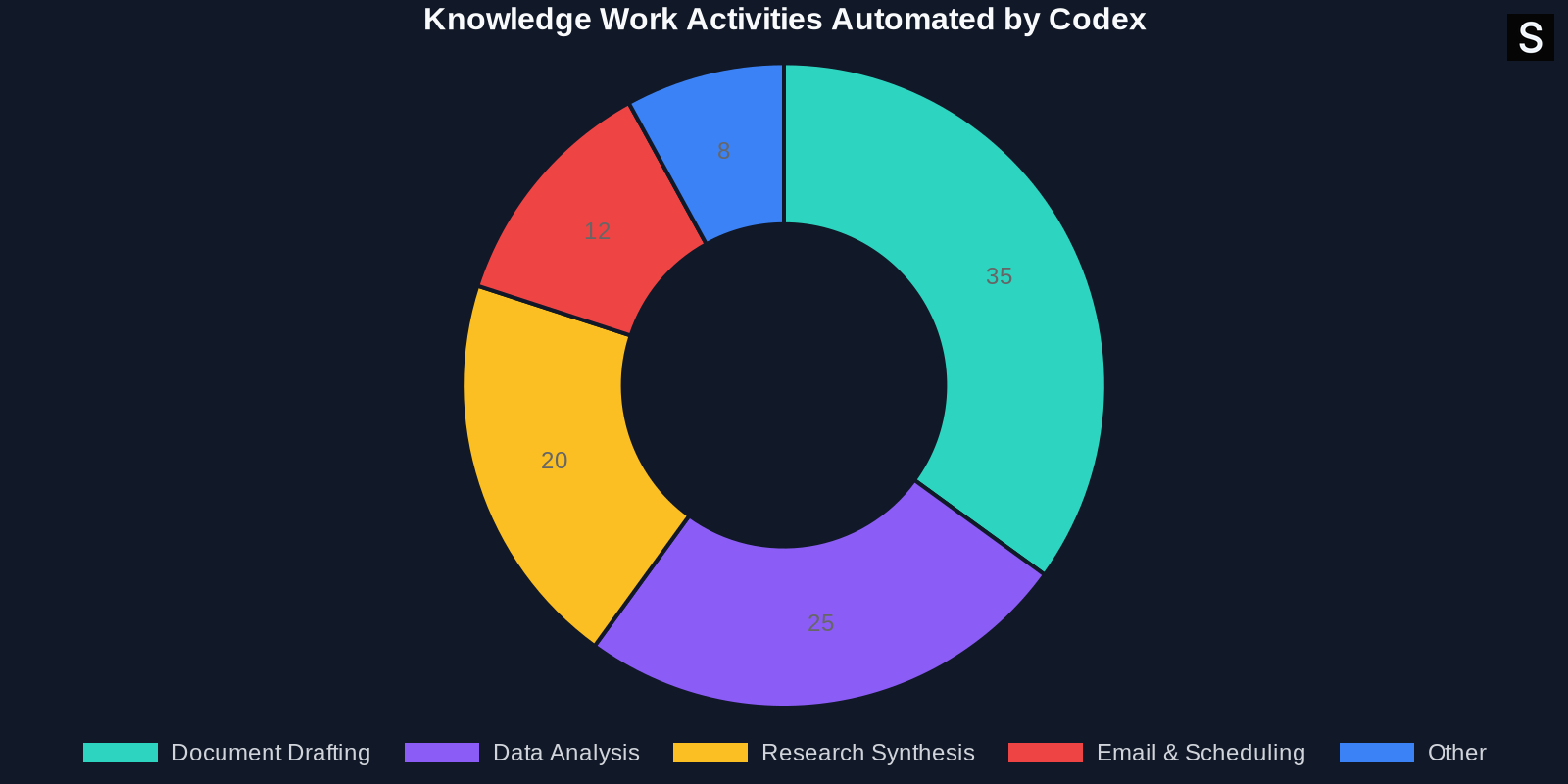
Key Takeaways for Knowledge Workers
If you're a knowledge worker, executive, or IT decision-maker, here are the essential points to understand:
- Codex is not just for coders. Its capabilities extend to writing, analysis, planning, and research — any task that involves manipulating information.
- Mid-task steering is the killer feature. Being able to nudge the AI mid-execution without losing context enables a collaborative workflow that feels natural.
- Long-running agents are the next frontier. The ability to set an agent loose on a complex project and come back hours later to review results is transformative.
- Productivity gains are real and measurable. Users report saving 20-30 hours per week; national productivity data confirms the upward trend.
- **The competitive landscape is shifting.**While Claude Code has brand recognition among developers, Codex's broader vision for knowledge work gives it a strategic advantage.
How to Get Started with Codex for Knowledge Work
Ready to integrate Codex into your workflow? Here's a practical roadmap:
1.Identify high-volume, low-complexity tasks(draft emails, summarize articles, clean data). 2.Start with a single workflowto test reliability and output quality. 3.Use steering promptsto guide Codex mid-task — this is where the real power lies. 4.Review and iterateon outputs, building a library of effective prompts. 5.Scale to more complex projectsas confidence grows.
Conclusion
OpenAI Codex is redefining what's possible for knowledge workers. With25% faster execution, long-running agentic capabilities, and the ability to steer mid-task without context loss, it offers a compelling alternative to both manual workflows and earlier-generation AI tools.
As the data from the BLS and real-world users confirms, productivity gains are not theoretical — they're happening now. The desktop AI agent is becoming the universal tool for the knowledge economy, and Codex is at the forefront.
Whether you're a solo professional or leading a team of hundreds, the time to explore Codex for knowledge work is now. The spreadsheet of our era is here — and it's intelligent.
Ready to transform your productivity? Visit OpenAI Codex to learn more and start your journey.
For further reading, check out our analysis of AI agents in financial services and comparing AI coding tools.