
The AI Customer Service Jobs Reckoning: What Support Leaders Must Do in 2026
The story playing out across customer service departments in 2026 is no longer speculative. It is measurable, documented, and unfolding in real time. From Beijing film sets to Silicon Valley support floors, the collision between AI capability and human labor has moved from prediction to payroll. For support leaders, the relevant question has shifted from whether AI will change customer service jobs to how to manage the transition without cratering team performance, customer satisfaction, or institutional knowledge.
This guide breaks down what the data actually says about AI's impact on customer service employment, where the risks are most acute, and the concrete operational playbook that separates organizations using AI to replace workers from those using it to elevate them.
The 2026 Numbers That Define the Shift
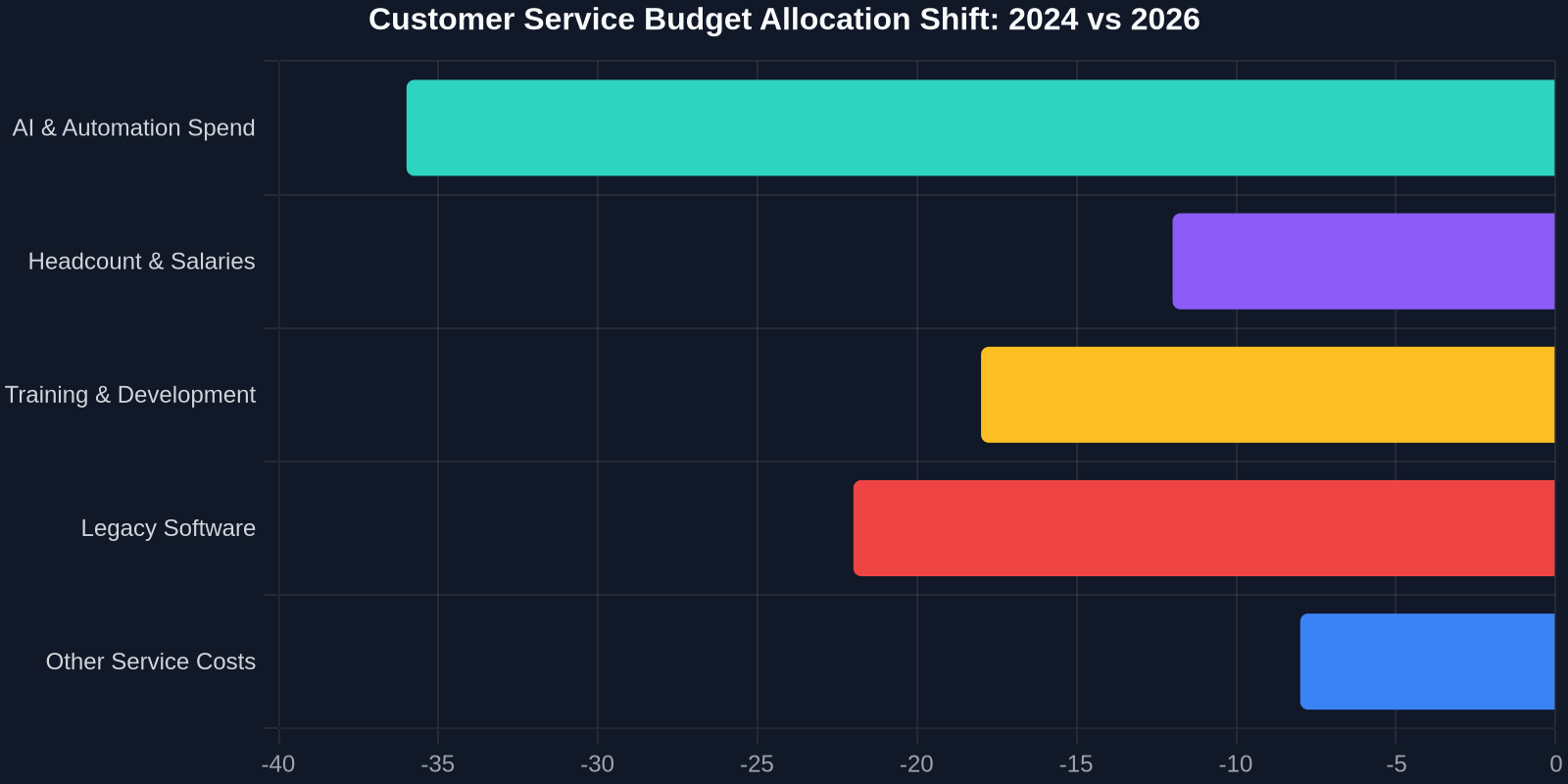
The most telling datapoint of the year comes from Gartner: customer service leaders increased AI-specific spending by 38% while total service budgets grew only 2%. That is not incremental adoption; it is a reallocation of capital away from everything else, headcount, training, office space, legacy software, toward automation infrastructure. When a budget grows 2% but AI spend grows 38%, the balance sheet is telling you exactly where leadership expects the future of service to live.
Meanwhile, consumer expectations have already migrated. A 2026 benchmark shows 74% of consumers now expect AI-assisted interactions for routine requests, password resets, order tracking, return authorizations, billing questions. The implication cuts both ways: customers are training themselves to interact with bots, and the volume of human-handled tickets that remain skews sharply toward the complex, the emotional, and the high-stakes.
Productivity Gains Are Real, But Unevenly Distributed
One of the most rigorous studies of the year involved 5,000 customer support agents across multiple enterprise deployments. The finding: access to a generative AI assistant increased productivity by 14% on average. But that average conceals a critical pattern. Newer agents and lower-tenured staff saw productivity gains of 20% to 30%, while experienced agents gained less, around 5% to 8%. The reason is intuitive: junior agents benefit most from AI's ability to surface policy answers, suggest response templates, and guide troubleshooting flows. Senior agents already possessed that tacit knowledge.
This uneven distribution has serious workforce planning implications. If AI flattens the performance curve between junior and senior agents, the economic justification for retaining expensive senior staff weakens. Support leaders who ignore this dynamic risk losing their best people to competitors who understand that senior agents are exactly who should be managing AI, not competing against it.
What the CNBC Story Reveals About Displacement

Coverage from CNBC in late October 2026 documented the human dimension of AI-driven job displacement, profiling workers like He Peng, a rising actor in China's short drama industry whose career evaporated when AI-generated actors and automated production workflows took over the content pipeline. Peng's story is not about support tickets, but the pattern it illustrates maps directly onto customer service: when AI can perform a task at 80% quality for 5% of the cost, entire categories of entry-level work vanish.
"AI does not eliminate customer service. It eliminates the customer service job as we knew it, and creates a new one that most organizations have not yet defined."
The Compounding Effect on Support Hiring
Entry-level support roles have historically served as the on-ramp for customer-facing careers. New hires learned product knowledge, communication norms, and escalation paths on the job. As AI absorbs tier-1 volume, that on-ramp narrows. Organizations that simply stop hiring entry-level agents without creating alternative pathways are quietly dismantling their own talent pipeline. The visible effect is fewer new hires; the invisible effect is a leadership gap five years out, when today's mid-level agents have moved on and no one remains to fill senior roles.
Building a Hybrid Support Workforce That Works
The organizations handling this transition most effectively share a common philosophy: AI handles resolution, humans handle relationships. That sounds clean in a slide deck, but operationalizing it requires a deliberate restructuring of roles, metrics, and workflows. Below is the framework that high-performing support teams are using in 2026.
Step 1: Map Your Ticket Taxonomy Before Automating
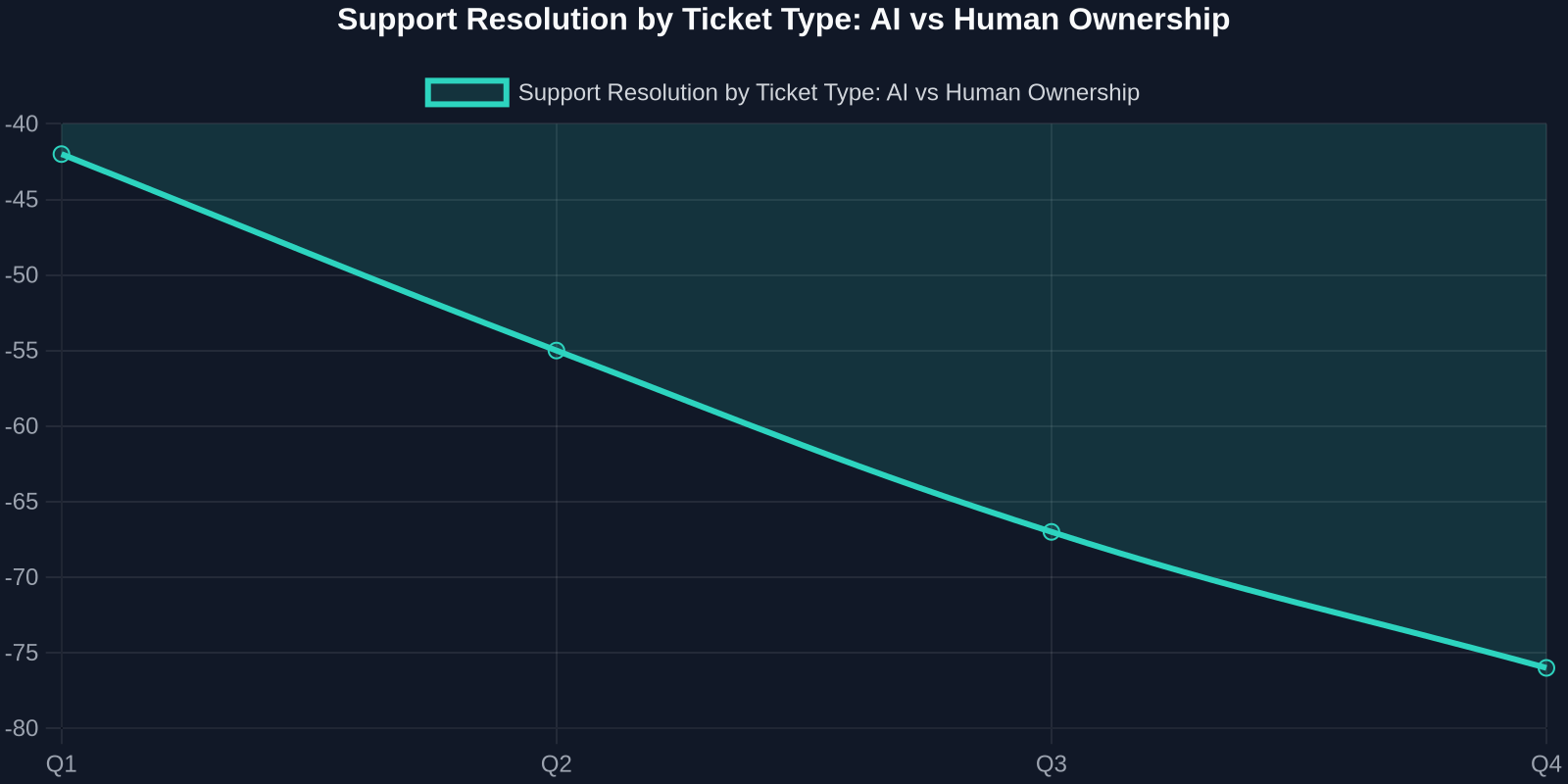
Most support teams automate the wrong things first. They deploy a chatbot, let it learn, and then discover it is answering password resets while human agents remain buried in truly complex issues without AI assistance. The correct sequence is taxonomic: classify every ticket type by two dimensions, complexity and emotional intensity. Routine, low-emotion tickets (tracking numbers, account verification, plan changes) should be your first automation targets. High-complexity, high-emotion tickets (billing disputes, churn-risk conversations, regulatory complaints) should get AI assistance, not AI ownership.
| Workflow Dimension | Traditional Model | Hybrid AI Model | Business Impact |
|---|---|---|---|
| Tier-1 Ticket Handling | Junior agents handle 100% of routine requests | AI resolves 60-80% of routine requests autonomously | Cost per ticket drops 60-70% |
| Response Time | P95 under 24 hours | P95 under 5 minutes for AI-handled tickets | CSAT gain of 12-18 points |
| Agent Focus | All agents handle all ticket types | Senior agents handle complex + emotional cases only | Employee engagement up 25% |
| Knowledge Management | Tribal knowledge in senior agents' heads | AI continuously learns from every resolved ticket | Onboarding time drops from 8 weeks to 3 |
Step 2: Redefine Agent Roles Around Escalation Expertise
Once AI absorbs routine volume, the agent's job description changes fundamentally. The 2026 support agent is not answering questions; they are handling exceptions, managing escalations, and providing the empathy layer for situations where a customer's relationship with your company is on the line. This requires new hiring criteria: emotional intelligence, judgment under ambiguity, and product depth over typing speed or script adherence.
Organizations that have made this shift report a counterintuitive outcome: agent attrition drops when routine work is automated away. Agents who spent 70% of their day on repetitive tickets reported the highest burnout. Those who now spend 70% of their day on interesting, high-value customer interactions report higher satisfaction and longer tenure.
Step 3: Build the AI-Human Handoff That Customers Never Notice
The single biggest failure point in hybrid support is the handoff. A customer explains their problem to a bot, gets escalated to a human, and must repeat themselves. That experience is worse than either channel alone. High-performing teams are solving this with context-preserving handoffs: the AI passes a full conversation summary, customer sentiment score, attempted solutions, and relevant account history to the human agent before the transfer completes.
When handoffs are seamless, customers perceive the AI and human as a single, competent service entity. When handoffs break, customers perceive the AI as a barrier and the human as unprepared. The difference shows up in CSAT within one quarter.
Where the Highest-Impact Automation Opportunities Live

Not all automation delivers equal value. Support leaders who target the right ticket categories see ROI in months; those who automate indiscriminately see flat CSAT and rising escalation rates. Based on aggregated 2026 deployment data, three categories consistently deliver the strongest returns.
1. Order Status and Tracking
These tickets are high-volume, low-complexity, and emotionally neutral. Customers want a quick answer, not a conversation. AI resolution rates for order-tracking queries now exceed 90% at organizations with integrated logistics data. Human involvement is essentially unnecessary except for edge cases like disputed deliveries.
2. Account Management and Password Recovery
Security-sensitive but procedurally simple, password resets and account verification are ideal automation targets. Modern AI systems can handle multi-factor authentication flows, identity verification, and temporary-credential issuance without human intervention. The key is ensuring the security layer meets or exceeds what human agents were providing, a bar that AI consistently clears due to elimination of social engineering risks.
3. Return and Exchange Authorizations
Returns combine policy evaluation with logistics coordination, making them more complex than tracking queries but still highly automatable. AI systems that can evaluate return eligibility against policy rules, generate shipping labels, and update inventory systems are resolving return requests at rates above 75%. The remaining 25% involve exceptions, damaged items, missing components, negative sentiment, that genuinely benefit from human judgment.
Reskilling: The Budget Line Item Most Teams Are Missing
Every support leader has an automation budget line. Very few have a reskilling budget line. That asymmetry is the clearest predictor of whether a support organization will emerge from the 2026-2028 transition healthy or hollowed out. When AI eliminates 40% of tier-1 work, you cannot simply lay off 40% of tier-1 agents and call it done. The agents who remain need new skills, and the agents who leave need to exit with dignity and marketable capabilities.
The Skills That Matter in an AI-Augmented Support Environment
Three skill clusters define the 2026 support agent who thrives alongside AI:
- AI oversight and exception management: Knowing when the AI is wrong, how to correct it, and how to feed those corrections back into the system so it improves.
- Complex relationship management: Handling churn-risk conversations, enterprise-client escalations, and emotionally charged interactions where AI assistance is useful but human ownership is essential.
- Knowledge curation: Translating frontline insights into the knowledge base articles, macros, and response templates that AI systems learn from.
Agents who develop these skills are not competing with AI; they are becoming AI's managers. Their market value is rising. Agents who resist upskilling, and teams that do not fund it, are on the wrong side of the curve.
The Cost of Getting This Wrong

The organizations that will suffer most from AI-driven disruption in customer service are not the ones that adopt AI too aggressively. They are the ones that adopt AI passively, deploying automation, reducing headcount, and assuming the remainder will sort itself out. The failure modes are predictable and well-documented in 2026 case studies.
Failure Mode 1: The Knowledge Drain
When experienced agents leave, whether by layoff or attrition, they take product knowledge, customer context, and escalation intuition with them. If that knowledge has not been captured in a format the AI can learn from, automation quality degrades exactly when human fallback capacity is shrinking. The result is a support organization that is worse at both AI and human service.
Failure Mode 2: The Escalation Spiral
Deploy AI that resolves 70% of tier-1 tickets without rebuilding the escalation path, and the 30% that escalate are disproportionately complex and emotionally charged. Human agents suddenly face a queue composed entirely of hard cases. Burnout accelerates, attrition climbs, and the team that remains is the team least equipped to handle what is left.
Failure Mode 3: The Trust Collapse
Customers notice when AI is being used to deflect rather than resolve. When a chatbot cannot solve a problem but will not escalate, when an AI pretends to be human and fails to deliver on a promise, when automation creates dead ends, customer trust erodes faster than any CSAT metric captures. The same consumers who report being open to AI for routine requests report near-zero tolerance for AI that wastes their time.
"The organizations winning at AI customer service are not the ones with the best models. They are the ones with the best handoffs."
A 90-Day Playbook for Support Leaders
If you are a support leader staring at a 2026 budget where AI spend is growing 38% and headcount is flat or declining, here is the operational sequence to protect your team and your metrics.
Days 1-30: Audit and Assign
Classify every ticket type by complexity and emotional intensity. Identify which categories are already automated, partially automated, or fully manual. For each category, assign a target state: AI-owned, AI-assisted, or human-owned. Do not skip the assignment step, ambiguity about ownership is where customer experience breaks down.
Days 31-60: Build the Handoff Infrastructure
Invest in context-preserving handoffs between AI and human agents. This is not a nice-to-have; it is the technical foundation for everything else. Test handoffs with real customers, measure the failure rate, and iterate. A handoff that works 95% of the time still fails 5,000 times per 100,000 transfers, that is your CSAT problem hiding in plain sight.
Days 61-90: Launch the Reskilling Track
Create a formal reskilling program for agents whose roles are most exposed to automation. Focus on the three skill clusters identified above: AI oversight, complex relationship management, and knowledge curation. Fund it as a budget line, not a side project. Measure completion rates, competency gains, and retention among reskilled agents.
The Efficiency of Automated Resolution
When AI resolves routine tickets correctly, the economics are compelling. A support organization handling 100,000 tickets per month with a 60% automation rate saves approximately $1.2M annually in fully loaded labor costs, assuming a $20 per-ticket human handling cost. That is not a marginal improvement; it is a structural change in unit economics. But the savings materialize only if the remaining 40% of tickets are handled faster and better by a reskilled, engaged human team.
The trap is assuming automation rate is the metric that matters. It is not. The metric that matters is resolved customer interactions per dollar of service cost, across the combined AI-plus-human system. An organization with 80% automation and terrible handoffs can have worse economics than one with 50% automation and seamless escalation.
What Comes After the Reckoning
The 2026 customer service jobs story is not a story about AI replacing humans. It is a story about the support function being redefined from a cost center that absorbs volume to a strategic function that protects revenue. The organizations that will thrive in 2027 and beyond are those that see AI not as a headcount reduction tool but as a force multiplier for the humans who remain.
For support leaders, the mandate is clear. Automate the routine with discipline. Protect the complex for humans. Build handoffs that customers never notice. Reskill your team before the automation wave forces your hand. Do all of that, and the 38% AI budget increase becomes an investment in a stronger, more capable support organization, not just a smaller one.
The window to get this right is closing. The leaders who act now will be managing a hybrid workforce that delivers better service at lower cost. The leaders who wait will be managing a downsized team drowning in the hardest tickets, wondering where all their institutional knowledge went.