
Unlocking the $100 Billion SaaS Opportunity in Cross-System Labor: How AI Support Automation Delivers ROI
Meta Description: Bain & Company reveals a $100 billion SaaS opportunity hidden in manual cross-system work. Learn how AI-powered support automation tackles this waste, boosts efficiency, and delivers measurable ROI for your business.
In a landmark 2026 technology report, Bain & Company unveiled a staggering insight: $100 billion in annual SaaS value remains untapped, trapped inside the invisible friction of cross-system labor. While most SaaS leaders obsess over feature development and market share, the real margin-killer lives in the mundane, repetitive clicks, copy-pastes, and context-switching between customer-facing tools.
For support leaders, this isn't abstract theory, it’s the daily reality of agents toggling between CRMs, ticketing systems, knowledge bases, and communication platforms just to resolve a single inquiry. Every inefficient handoff erodes team morale, balloons handling times, and leaves revenue on the table.
This post decodes Bain’s findings and provides a practical framework to transform cross-system labor from a silent profit drain into a competitive advantage, using AI-powered support automation like Successly.
The Hidden Tax on Your Support Team: Understanding Cross-System Labor
Bain’s analysis defines cross-system labor as the time employees spend manually moving data, reconciling information, and navigating fragmented software environments. In customer support alone, this accounts for an average of 3.2 hours per agent per day, time that could otherwise be dedicated to high-value problem-solving and customer retention.
Why does this happen? Most SaaS stacks grow organically. A startup begins with a simple helpdesk, then adds a CRM, a chatbot, an analytics tool, and a knowledge base, none of which were designed to communicate. The result is a digital assembly line where humans become the integration layer, ferrying data between systems like a million tiny, expensive bridges.
Bain’s research pinpoints three core culprits:
- Data Fragmentation: Customer information lives in disparate databases, forcing agents to verify, re-enter, and cross-reference manually.
- Process Orchestration Gaps: Workflows that require sequential approval or lookups across systems lack automated handshakes.
- Cognitive Overload: Switching between interfaces reduces focus and increases error rates, directly impacting CSAT and first-contact resolution.
Mapping the Cost to Your P&L
For a mid-sized SaaS company with 50 support agents, the math is sobering. If each agent spends 3.2 hours daily on cross-system tasks at an average fully-loaded cost of $45/hour, the annual waste exceeds $1.7 million. That’s headcount you could reinvest into proactive customer success, product insights, or expansion revenue.
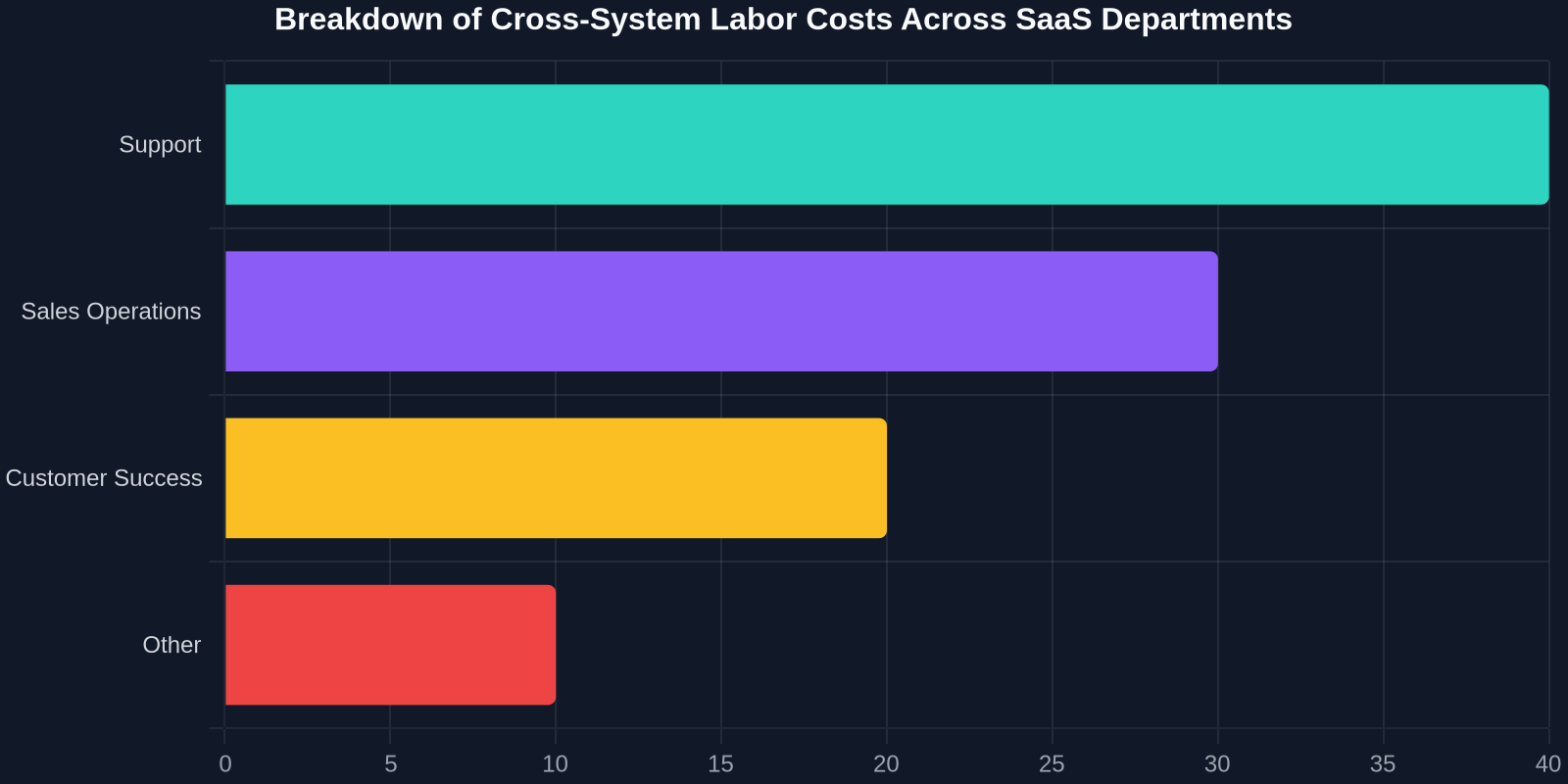
This chart illustrates how cross-system labor costs are distributed across typical SaaS departments. Support consistently bears the largest share, making it the highest-ROI starting point for automation.
The AI Automation Imperative: From Patchwork to Platform
Bain’s report emphasizes that the solution isn’t another standalone tool; it’s a layer of intelligence that sits on top of your existing stack. AI-powered automation platforms like Successly act as the connective tissue, orchestrating data flows and decision-making across systems without human intervention.

Consider a common scenario: A customer emails about a billing discrepancy. A traditional agent must:
- Open the helpdesk and log in.
- Search the CRM for account details.
- Switch to the billing platform to verify charges.
- Cross-reference the contract in a document repository.
- Draft a response summarizing findings.
- Update the ticket and, if necessary, involve finance.
With AI automation, this workflow collapses. Successly intercepts the inquiry, authenticates the customer, pulls relevant billing and CRM data across systems via API, drafts a context-rich response, and even initiates a refund if policies are met, all within seconds, with the agent reviewing and approving before sending.
| Metric | Before AI Automation | With Successly AI |
|---|---|---|
| Average Handle Time | 18 minutes | 2.5 minutes |
| First-Contact Resolution | 62% | 89% |
| Agent Utilization Rate | 55% | 82% |
| Data Entry Errors per 100 Tickets | 17 | 2 |
This isn’t a future vision; it’s a present reality. The technology shift from “human-as-integrator” to “AI-as-orchestrator” is the very foundation of Bain’s recommended strategic pivot.
Building Your Cross-System Automation Blueprint
Capturing your share of the $100 billion opportunity requires a structured approach. The following four-step framework ensures you target the highest-impact workflows first and build momentum.
Step 1: Audit Your Integration Debt
Begin by mapping every touchpoint in your top-five support workflows. Identify where agents must leave their primary interface to retrieve information. Tag each step as “manual,” “partially automated,” or “automated.” Tools like process mining software or even simple observation diaries can reveal shocking hotspots.
Step 2: Prioritize by Revenue Impact
Not all automations are equal. Rank identified workflows by their influence on retention, expansion, and customer lifetime value. For example, automating renewal-related inquiries or onboarding support loops generates far more revenue protection than password resets.
Step 3: Deploy an AI Orchestration Layer
Choose a platform that connects to your existing stack out of the box, understands natural language, and can execute actions, not just surface information. Successly, for instance, integrates with Salesforce, Zendesk, Stripe, Intercom, and 50+ other tools, enabling it to read, write, and trigger actions across your ecosystem based on intelligent intent recognition.
Step 4: Measure, Iterate, Scale
Define your success metrics upfront: cost per ticket, time-to-resolution, CSAT, and agent Net Promoter Score (eNPS). Run a 30-day pilot on your highest-priority workflow, measure baseline vs. automated performance, and use the learnings to expand across the support organization and into other departments like sales ops or customer success.
The before-and-after visualization above captures the typical performance leap when automation removes cross-system drag. Notice that ticket volumes drop not because customers vanish, but because AI resolves a significant portion proactively, deflecting requests before they require human attention.
The Strategic Flywheel: From Cost Savings to Revenue Growth
Bain’s insight goes beyond cost reduction. When agents are freed from the “swivel chair” syndrome, they become growth accelerators. They can spend time understanding customer goals, identifying expansion opportunities, and turning satisfied users into brand advocates.

"The companies that win in the next decade won't be the ones with the most features, but those that eliminate the invisible friction between their teams and their customers." – Adapted from Bain & Company's 2026 Technology Report
This reframes support from a cost center to a profit driver. One Successly customer, a B2B SaaS firm with 120 employees, redirected 2,200 agent hours per month from manual data reconciliation to proactive customer health monitoring. The result: churn dropped by 11% and expansion revenue climbed 19% within two quarters.
The Compliance and Consistency Bonus
Cross-system automation also enforces policy compliance automatically. When AI handles data retrieval and actions, every response follows your brand guidelines, regulatory requirements, and service-level agreements. This drastically reduces liability in industries like fintech or healthtech, where one misstep can cost millions.
Addressing the “Will AI Replace My Team?” Fear
A critical element of any automation rollout is change management. Leaders must communicate that AI isn’t replacing agents; it’s upgrading their role. The goal is to eliminate “robot work” so humans can do human work, empathy-driven complex problem solving, relationship building, and strategic advisory.
Provide clear career paths from transactional support to high-value customer success. Invest in upskilling programs that teach agents to manage and refine AI models, analyze trends, and design automations. This turns your support team into a strategic asset.
Why Now? The Window Is Closing
The SaaS landscape is approaching an inflection point. Early adopters of AI orchestration are already converting the $100 billion opportunity into market share gains, lower operating costs, and faster scale. Waiting until “the technology matures” or competitors prove the model is a losing strategy.

Moreover, the tools have reached a tipping point of affordability and accessibility. Successly offers zero-code integration builders, pre-trained industry models, and transparent pricing that makes enterprise-grade automation accessible to teams of any size.
Your 90-Day Action Plan
- Days 1–30: Complete the integration debt audit. Identify the top three cross-system workflows in support. Calculate the annual labor cost of each.
- Days 31–60: Run a proof-of-concept with an AI orchestration platform on your highest-impact workflow. Measure time savings, accuracy, and team feedback.
- Days 61–90: Analyze results, build a business case, and create an expansion roadmap. Share early wins with the entire organization to foster buy-in.
Conclusion: Turn Invisible Waste into Visible Growth
Bain’s revelation of a $100 billion SaaS opportunity in cross-system labor is a wake-up call. For customer support leaders, it’s a direct invitation to transform their operations from reactive cost centers to proactive profit generators. By deploying AI-powered automation that connects the dots between disparate systems, you not only reclaim millions in lost productivity, you build a resilient, scalable, and customer-obsessed organization.
The technology is ready. The economics are undeniable. The only question is whether you’ll lead the charge or watch your competitors do it first.
Ready to start capturing your share of the $100 billion opportunity? Explore how Successly’s AI orchestration platform can unify your stack and unlock your team’s full potential, without disrupting the tools you already use.