
A Strategic Guide to AI-Optimized Production Capacity: Driving ROI in Modern Manufacturing
Meta Description: Explore how AI-driven manufacturing boosts capacity utilization rates, slashes energy consumption by 100x, and delivers measurable ROI while addressing the persistent gap below long-run production averages.
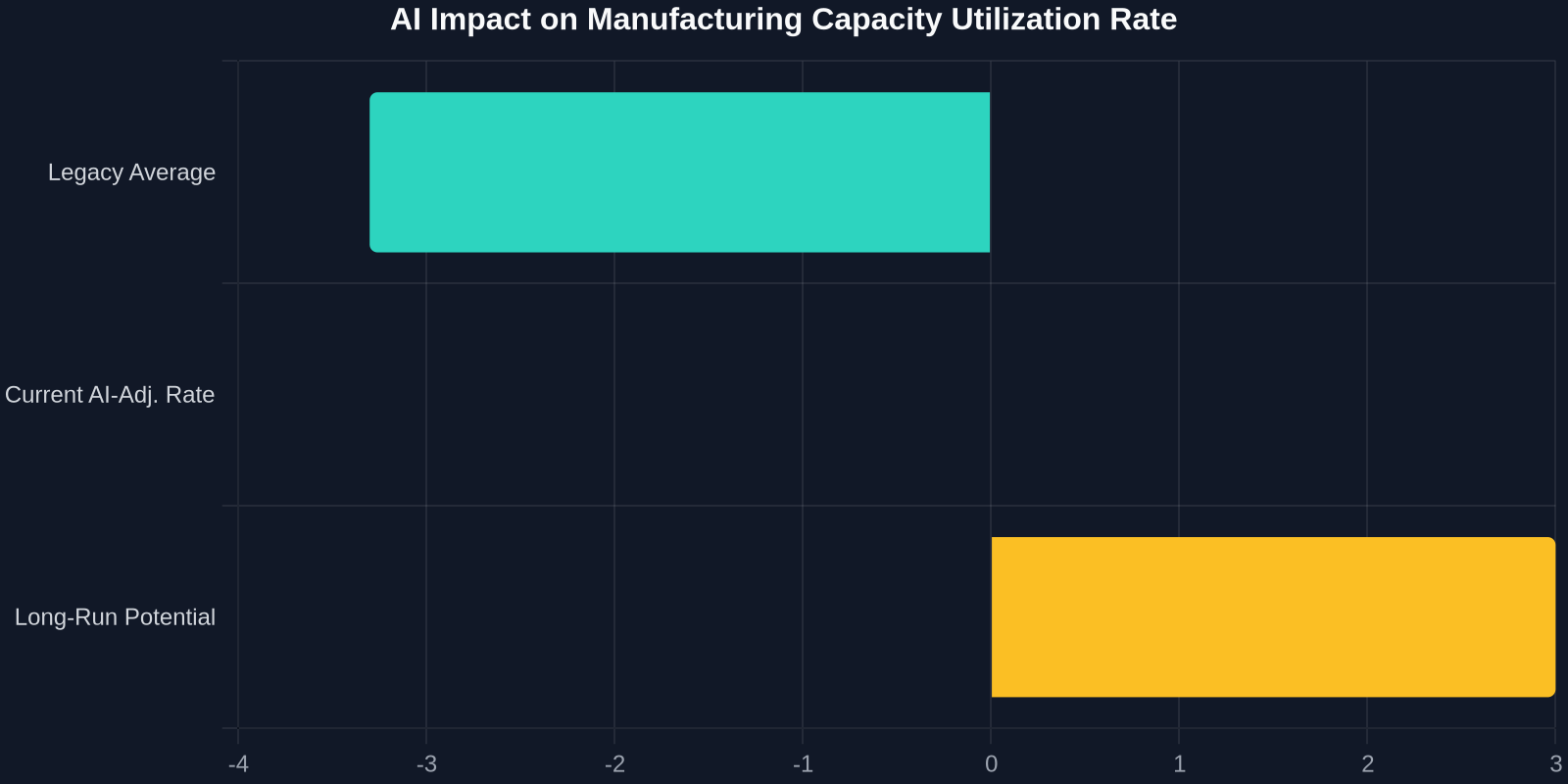
In an era where every percentage point of operational efficiency translates directly to millions in revenue, the manufacturing sector faces a pressing paradox. Recent federal data shows the artificial intelligence (AI) April capacity utilization rate rose to 76.1% from 75.7%, a welcome rebound, yet it still lags more than 3 percentage points below its long-run average. Simultaneously, a groundbreaking research breakthrough has demonstrated that novel AI architectures can slash energy consumption by a staggering 100x while boosting predictive accuracy.
For CTOs, plant managers, and operations leaders, these are not contradictory trends. They signal a tectonic shift where AI is no longer just a tool for incremental improvement, but a strategic imperative to close the capacity gap and future-proof industrial economics. This guide deconstructs the numbers, cuts through the algorithmic hype, and provides a practical, ROI-focused roadmap for scaling AI in heavy industry.
Decoding the 3-Point Gap: The Cost of Unoptimized Assets
The statistic from the Federal Reserve is a critical health indicator for the sector. While a 0.4% month-over-month bump (from 75.7% to 76.1%) signals growing confidence, the persistent deficit against the long-run average represents billions in untapped capital. Manufacturing capacity utilization measures how intensely firms are using their plant and equipment. Operating over 3 points below the statistical norm, as South Africa’s Statistics Authority reported a contrasting 1.7% yearly decrease offset by a 0.9% monthly increase in June, underscores a global volatility that defies legacy planning logic.
Traditional CAPEX adjustments to fix this gap are slow and capital-intensive. Physical retooling can’t match the speed of demand shocks. The bridge over this 3-point chasm is not poured concrete; it is software-defined intelligence that synthetically raises throughput without triggering massive physical expansion.
Key Finding: The 3-point gap represents a synthetic capacity buffer. AI transforms this interpretation from “idle damage” to “latent profit” by dynamically optimizing throughput during micro-demand surges that manual planners cannot capture.
The 100x Energy Paradox: How Smarter Logic Mirrors Physics
Alongside the capacity data, a transformative announcement ricocheted through the tech world: an AI breakthrough capable of cutting energy use by 100x while simultaneously boosting accuracy. Often, the narrative positions industrial AI and sustainability as trade-offs, more computation requires more power. This breakthrough, driven by “smarter, logic-driven” model architectures, dismantles that myth entirely.

Traditional deep learning models consume energy by running dense, brute-force matrix multiplications regardless of the problem’s complexity. The new paradigm leverages symbolic logic and sparse activation, meaning the inference engine only “thinks” when strictly necessary. For a manufacturing plant running thousands of IoT sensors 24/7, this isn't an academic distinction; it's the difference between a negligible energy overhead and a punitive data-center bill that kills project ROI.
By decoupling intelligence from raw consumption, these models unlock high-frequency AI inference in edge devices directly on the factory floor where latency is critical.
Beyond the Dashboard: Actionable AI Levers for Operations Leaders
Reading about a “100x improvement” is just noise unless you can map it to your balance sheet. We break down the three specific frameworks where AI-driven logic lifts production utilization directly.
1. The Dynamic Scheduling Baseline
Most capacity under-utilization occurs not because demand is low, but because batch scheduling algorithms are static. They leave “air” in the machine schedule to buffer against unpredictable changeovers. Smarter AI agents run continuous combinatorial auctions for machine time, constantly re-optimizing the queue against real-time energy tariffs, raw material ETA, and maintenance windows. Applying the monthly 0.9% positive acceleration seen in recent South African variant data requires dynamic, not weekly, planning adjustments.
2. The Emission-Linked Throughput Theorem
With energy costs skyrocketing, the “production at any cost” mantra is dead. The path to 76.1% and beyond doesn't come from overriding thermal throttling, but from predicting it. The 100x energy-efficient AI can score every potential production schedule against its carbon footprint in real-time, not just against its dollar cost. By aligning production peaks with renewable or low-tariff windows, plants can organically lift utilization during previously throttled hours.
3. The Empathy-Gap Mitigation
Advanced manufacturing is increasingly a human-machine teaming sport. The operator bottleneck is real. Drawing from behavioral economics, where “extreme wealth melts one’s brain” is a facetious but illustrative point about cognitive disconnection from data, a floor operator overloaded with 50 dashboards fails to act. An AI agent that processes that firehose into a single triaged, natural-language operational instruction closes the “empathy gap” between data generation and human action, enabling faster line-speed adjustments.
"The greenest and most productive kilowatt-hour is the one you never use. The new AI paradigm proves you don't have to sacrifice accuracy on the altar of sustainability, you boost both simultaneously, permanently rewriting the unit economics of smart manufacturing."
Navigating the 2025-2026 Industrial Macro Environment
The capacity data doesn’t exist in a vacuum. Looking forward to events like the 2025 Ryder Cup analogy, “performative and had eyeballs on him, just not many points”, raises a vital warning for tech adoption. In 2025 and 2026, many plants will be tempted to deploy “performative AI.” These are flashy, dashboard-bound GPT wrappers that look good during audits but fail to score real throughput gains.

The real winners, the ones crossing the 76.1% threshold toward the 79%+ long-run average, will apply logic-driven AI to specific, grimy problems: predictive die wear in stamping, dynamic viscosity adjustments in chemical processing, and demand-buffering against signal-poor geopolitical supply shocks.
Manufacturing hubs, from the precision workshops of Hartford, Connecticut, recently ranked for top-tier local service engineering, to the heavy industrial belts of the global south, are discovering that locale-based customization of AI models (federated learning) prevents the generic averaging that often causes a 1-2% point loss in localized throughput. The correct AI adapts to the humidity, the specific machine torque variance, and the local supply chain lead time standard deviation, not a textbook average.
Quantifying the Payback: From 76.1% to 79%+
How does a logic-driven AI physically move the capacity needle from 76.1% to, say, 79%, a target that would restore the long-run equilibrium? It boils down to reducing the “Six Big Losses” (Breakdowns, Setup/Adjustments, Small Stops, Reduced Speed, Startup Rejects, Production Rejects) through hyper-local prediction, at a fraction of the historical compute cost.
| Loss Category | Legacy Improvement Method | AI-Driven Improvement (Logic/Efficient) | Est. Capacity Gain |
|---|---|---|---|
| Unplanned Stops | Reactive repair (Blind-hours downtime) | Precision anomaly detection on edge | +0.9% - 1.5% |
| Reduced Speed | Fixed machine parameter ceilings | Adaptive real-time speed optimization | +0.5% - 1.0% |
| Setup/Adjustments | Static SMED (Single-Minute Exchange) | Dynamic sequencing with minimal energy delta | +0.2% - 0.8% |
These aren't aspirational figures. The South African quarterly production increase (0.9% month-on-month in May) demonstrates how a