
The Hidden Cost of AI Chatbots in Customer Service: What Support Leaders Must Know in 2026
The conversation around AI in customer service has shifted dramatically. Just two years ago, every SaaS company was racing to deploy chatbots. The pitch was simple: automate everything, cut headcount, and watch support costs plummet.
Today, the reality is more complicated.
A growing body of evidence shows that poorly implemented AI support doesn't just fail to reduce costs, it actively drives customers away. Support leaders are discovering that the question isn't whether to use AI, but how to use it without dismantling the trust that took years to build.
This is the uncomfortable truth at the heart of AI customer service in 2026: automation without intelligence is just a faster way to frustrate people.
The Broken Promise of "Set It and Forget It" AI
When AI chatbots first hit the customer service market, vendors sold them as autonomous solutions. The marketing promised a world where AI agents would handle 90% of inquiries with zero human oversight, cutting support costs by 70% or more.
That promise never materialized.
What actually happened was more nuanced. AI chatbots did deflect simple queries, password resets, order status checks, basic troubleshooting. But they also created a new set of problems that many support leaders didn't anticipate:
- Escalation friction, customers trapped in loops with bots that refuse to connect them to humans
- Incorrect AI answers, confidently delivered wrong information that created liability and brand damage
- Support debt, bot-generated tickets that required expensive human follow-up to fix
- Silent churn, customers who abandoned the interaction entirely and took their business elsewhere
The data tells a stark story. While chatbot adoption has skyrocketed, more than 80% of companies now use some form of AI in customer service, customer satisfaction with automated support has actually declined in the same period.
Why Customer Trust Is the Real Currency of Support
There's a fundamental misunderstanding about what customer support actually does for a business.

Support is often framed as a cost center, something to be minimized. But that framing misses the strategic value of human-assisted support. Every support interaction is an opportunity to:
- Retain revenue, a customer with a solved problem is far less likely to churn
- Build loyalty, exceptional support creates emotional attachment to a brand
- Uncover product insights, support teams hear about bugs, friction points, and feature requests before anyone else
- Drive expansion, a customer who trusts your support team is more receptive to upsell opportunities
When you replace all of that with a chatbot that gives canned answers, you're not just cutting costs. You're cutting off the channels through which customers develop trust and loyalty.
Automation should handle volume. It should never replace the human moments that turn a frustrated customer into a loyal advocate.
The New Paradigm: AI That Supports Humans, Not Replaces Them
The most successful companies in 2026 have abandoned the "AI as replacement" model entirely. Instead, they're adopting what support operations leaders call the augmentation model, where AI handles repetitive, high-volume tasks while amplifying the capabilities of human agents for complex, emotionally-charged, or high-value interactions.
This approach delivers the best of both worlds:
| Support Metric | AI-Only Model | AI-Augmented Model |
|---|---|---|
| Ticket Deflection Rate | 35-40% | 55-65% |
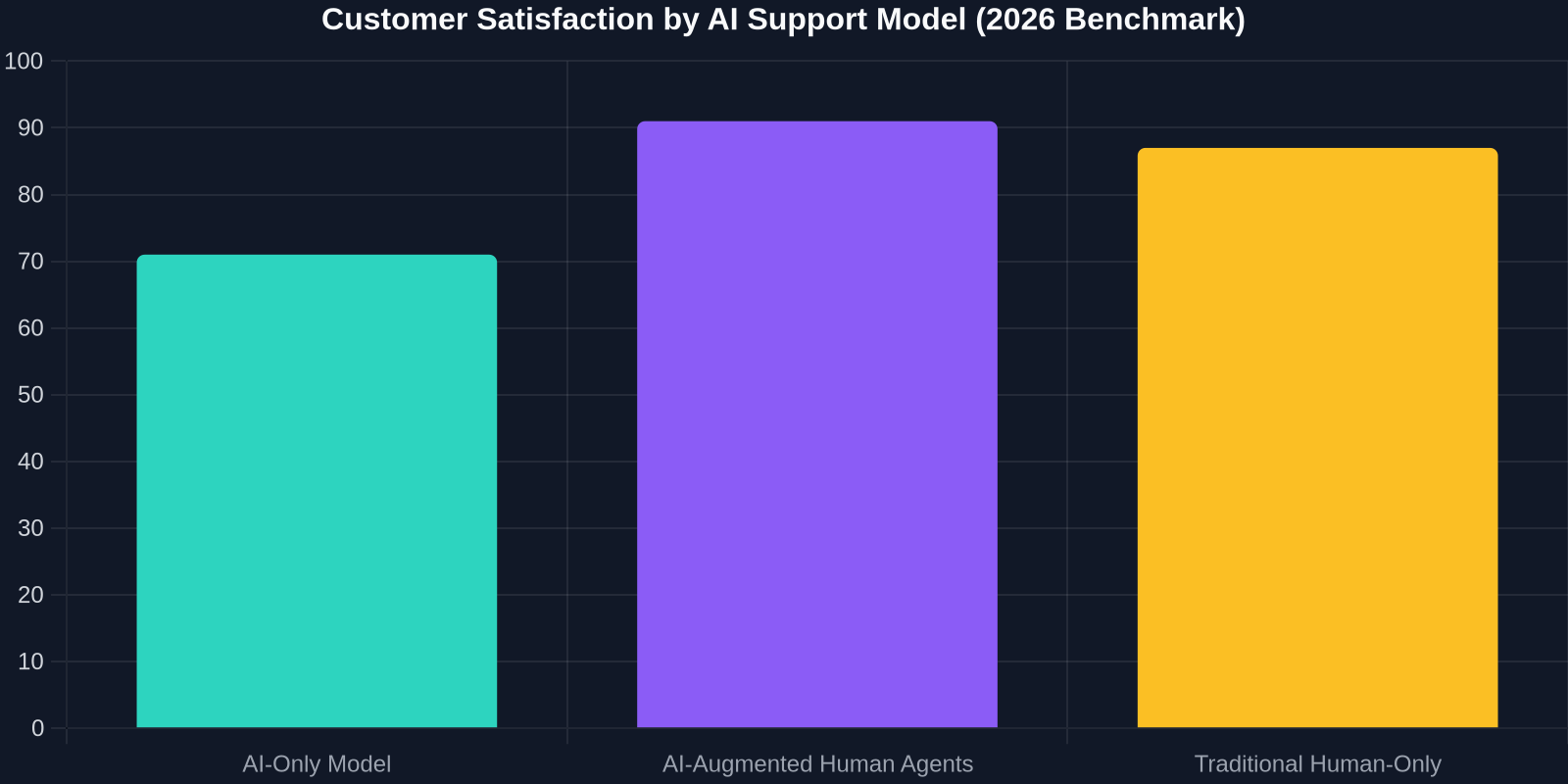
| Customer Satisfaction (CSAT) | 68-72% | 88-94% |
| Average Handle Time | 10+ minutes | 4-5 minutes |
| Escalation Rate | 45%+ | 12-18% |
| Customer Retention Rate | Declining | Stable or improving |
| Agent Burnout | High (escalation overload) | Low (AI handles repetitive work) |
The difference is stark. When AI is used to support human agents, drafting responses, summarizing conversation history, suggesting knowledge base articles, and automating follow-ups, both efficiency and satisfaction improve. When AI is used to replace human agents entirely, efficiency metrics look good on paper, but the underlying customer relationship deteriorates.
The Real ROI of Intelligent Support Automation
For support leaders who need to justify AI investments to their CFO, the conversation needs to move beyond simple cost-per-ticket calculations. The true ROI of AI in customer service comes from multiple sources:

1. Deflection Savings with Quality Guardrails
AI can reliably deflect 50-65% of incoming tickets when it's properly trained on your knowledge base and given clear escalation thresholds. But this number only holds when there's a safety valve for complex queries.
2. Agent Productivity Multipliers
When AI handles the repetitive parts of an agent's job, categorization, summarization, drafting initial responses, agents can handle 2-3x more conversations without burnout. This isn't just a cost saving; it's a capacity multiplier that helps companies scale support without scaling headcount linearly.
3. Reduced Churn from Faster Resolution
Speed matters, but accuracy matters more. Customers don't just want fast answers, they want correct answers. AI that provides instant, accurate responses to common questions reduces time-to-resolution from hours to minutes. AI that provides fast but wrong answers creates a bigger problem than slow customer service ever did.
The Five Pillars of a Customer-Centric AI Strategy
Building an AI support strategy that reduces costs without alienating customers requires a structured approach. Here's the framework that successful support leaders are using:
Pillar 1: Define Clear Automation Boundaries
Not every ticket should be automated. Before deploying any AI, map your ticket taxonomy and identify:
- Definitely automate, password resets, order tracking, account inquiries, simple FAQs
- Assist but don't automate, billing disputes, technical troubleshooting, product configuration
- Never automate, security incidents, legal matters, high-value enterprise accounts, emotionally sensitive situations
Pillar 2: Design for Escalation, Not Containment
Most chatbots are designed with containment rates as the primary KPI. The goal is to keep as many customers in the bot as possible. This creates a toxic dynamic where the AI actively works against the customer's best interests.
Instead, design your AI for efficient escalation. If a customer signals frustration, through language patterns, repeated questions, or explicit requests for a human, the AI should immediately transfer them with full context. This preserves the relationship and prevents the "trapped customer" phenomenon.
Pillar 3: Use AI to Empower Agents
This is where the biggest efficiency gains come from. AI tools that help human agents work faster and better:
- Conversation summarization, AI reads the full history and provides a 3-sentence summary
- Response drafting, AI suggests replies that agents can edit and personalize
- Knowledge retrieval, AI surfaces relevant documentation in real-time
- Sentiment analysis, AI flags escalating customers so agents can intervene proactively
Pillar 4: Measure What Actually Matters
The wrong metrics drive the wrong behaviors. If your only KPIs are deflection rate and cost-per-ticket, you'll optimize for keeping customers in the bot regardless of their experience.
Instead, track:
- Resolution quality, did the AI actually solve the problem, or just mark the ticket closed?
- Customer effort score, how much effort did the customer expend before getting help?
- Re-contact rate, did the customer come back with the same issue within 7 days?
- Escalation with context, when customers are transferred, does the human agent have full history?
Pillar 5: Build Feedback Loops
AI support systems don't improve on their own. They need continuous feedback loops that capture:
- Customer feedback, post-interaction surveys specifically about the AI experience
- Agent feedback, agents reviewing AI-generated responses and flagging errors
- Outcome tracking, did the conversation lead to resolution or churn?
- Escalation analysis, which topics are consistently being escalated and why?
The Regulatory Landscape Is Catching Up
Customer expectations aren't the only pressure on AI support. Regulators are increasingly focused on AI transparency, particularly in customer service contexts.

The landmark chatbots for minors protection law signed by Governor Hochul signals a broader shift: AI interactions with vulnerable populations will face increasing scrutiny. While the law specifically targets minors, the underlying principle, that AI systems must be transparent and accountable, is spreading to all customer service applications.
What this means for support leaders:
- Transparency requirements, customers must know when they're talking to AI, not a human
- Escalation mandates, access to human support cannot be unreasonably restricted
- Data governance, AI systems must be trained on accurate, current information
- Accountability, companies remain responsible for what their AI says, even when it generates incorrect information
The Future of Customer Service Is Hybrid
The companies winning in 2026 aren't the ones with the most aggressive automation. They're the ones with the smartest hybrid models, AI that handles volume, humans that handle complexity, and seamless transitions between the two.
Here's what that looks like in practice:
A typical high-performing support operation:
- AI handles 55-65% of tickets autonomously, with high confidence and clear escalation
- AI drafts responses for human agents, reducing handle time by 40-50%
- Human agents handle complex, emotional, and high-value interactions with enhanced context
- Every AI interaction has a one-click path to human escalation with full conversation history
- CSAT scores hold steady at 90%+ even as ticket volume scales
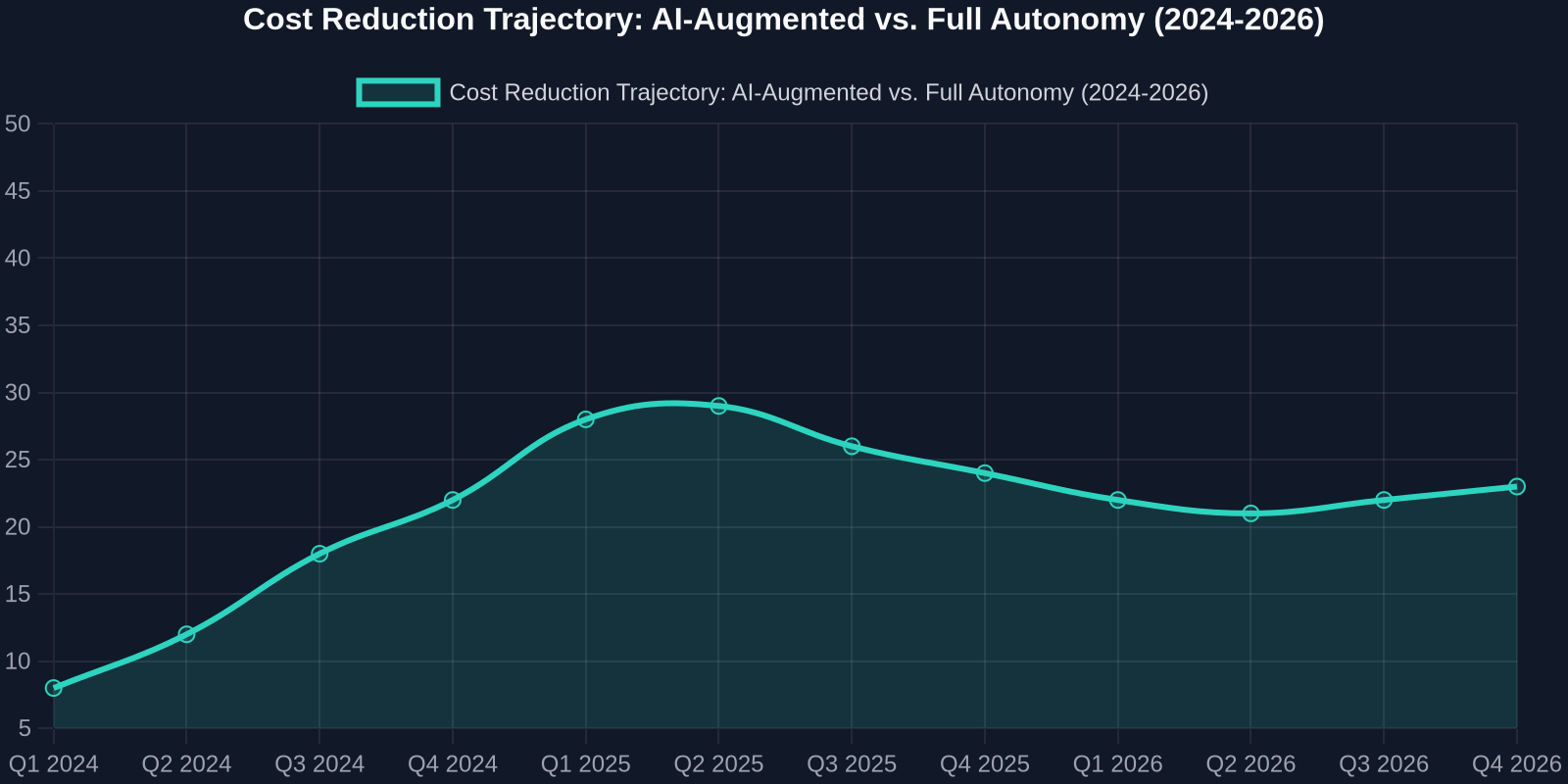
- Support costs decline 35-45% without damaging customer relationships
Conclusion: Build Trust Before You Automate
The lesson from the current AI customer service landscape is clear: automation without trust is just a faster way to lose customers.
The companies that succeed in the coming years will be those that:
- Respect customer time, AI for instant answers on simple questions, humans for complex problems
- Preserve customer dignity, never trap customers in bot loops or make it hard to reach a human
- Empower support agents, use AI to make humans more effective, not to eliminate them
- Measure the right things, prioritize resolution quality and customer effort over raw deflection rates
- Build feedback loops, continuously improve AI based on real customer and agent input
The choice isn't between AI and human support. It's between AI that erodes trust and AI that amplifies it. The companies that get this right will see support transform from a cost center into a competitive advantage.
The companies winning the next decade aren't replacing humans with AI. They're using AI to make every human interaction more meaningful, and every automated interaction more human.