
The True Cost of Phishing: How Consumer Scams Are Draining Trust and Your Bottom Line
Imagine receiving an email from your real estate agent with wiring instructions for your down payment. It has the correct logo, the agent’s signature, and even references a conversation you had yesterday. You send the money, only to find out later that the email was a sophisticated fraud. The agent’s identity was stolen, and your life savings have vanished into a criminal’s cryptocurrency wallet.
This isn't a hypothetical. It’s a rental scam currently active in Atlanta, where fraudsters are cloning the identities and photos of legitimate real estate agents to trick renters out of deposits. It is a stark reminder that the threat landscape has shifted. We are no longer just defending servers against generic malware; we are defending the human psyche against industrial-scale deception.
The modern phishing crisis is a dual-threat. For the individual, it’s the immediate financial loss and emotional trauma. For the business, your business, it’s the erosion of brand trust, the burden of customer support triage, and the regulatory nightmare of a data breach. As we dissect the anatomy of today’s most dangerous scams, it becomes clear that traditional “checkbox” security awareness training is dead. The only viable defense is building a behavioral immune system.
The Phishing Evolution: You Are No Longer Just a “Nigerian Prince”
Phishing has transcended email. We live in an era of omnichannel deception, where attackers combine psychological manipulation with new technologies. The goal is no longer just to steal a password; it is to create an alternate reality where the victim willingly hands over money and data.
1. The Impersonation Economy: Trust Exploitation at Scale
One of the most sinister evolutions is the creation of "sockpuppet" networks. Scammers aren't just messaging you on WhatsApp; they are adding you to a group with 20 other seemingly real people. Fifteen of those members are fake profiles, all coordinated to perform a “financial victory” narrative, building a pressure cooker of social proof to con you into a crypto scam. This trust exploitation leverages group dynamics against the individual, a tactic that traditional phishing filters cannot catch because the attack happens within a trusted, encrypted peer-to-peer application.
2. The Tangled Web of QR Code Phishing (Quishing)
The convenience of contactless interactions has been weaponized. QR code scams redirect users to fraudulent websites that look identical to parking payment portals or restaurant menus. Victims scan, pay, and grant credentials without ever seeing a suspicious URL. The deception is profoundly physical yet digitally devastating. For businesses that use QR codes for payments or authentication, a single defaced physical menu or parking sign becomes an infinite vector for fraud.
3. The Seasonal Gold Rush: Holiday and Travel Scams
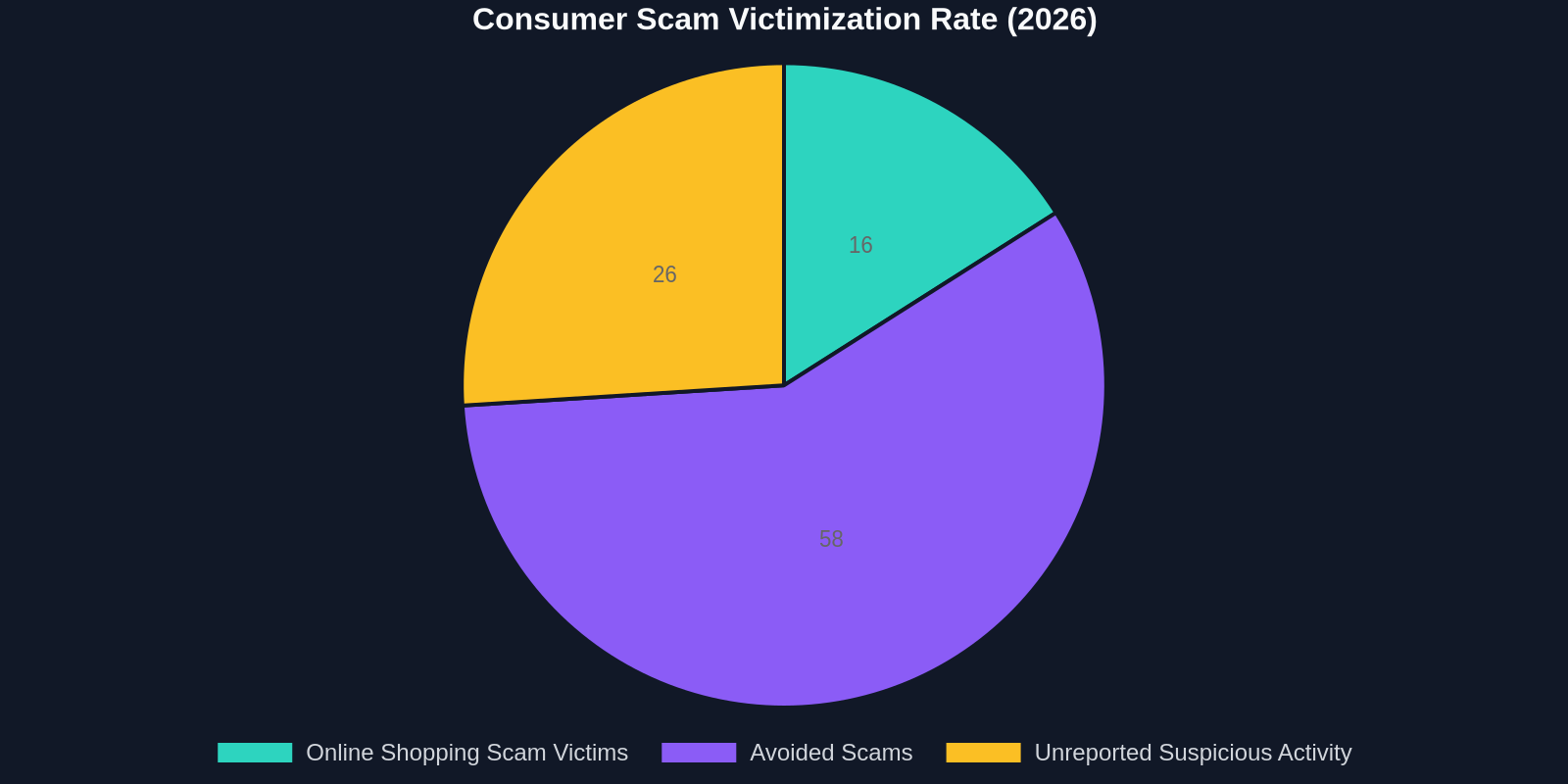
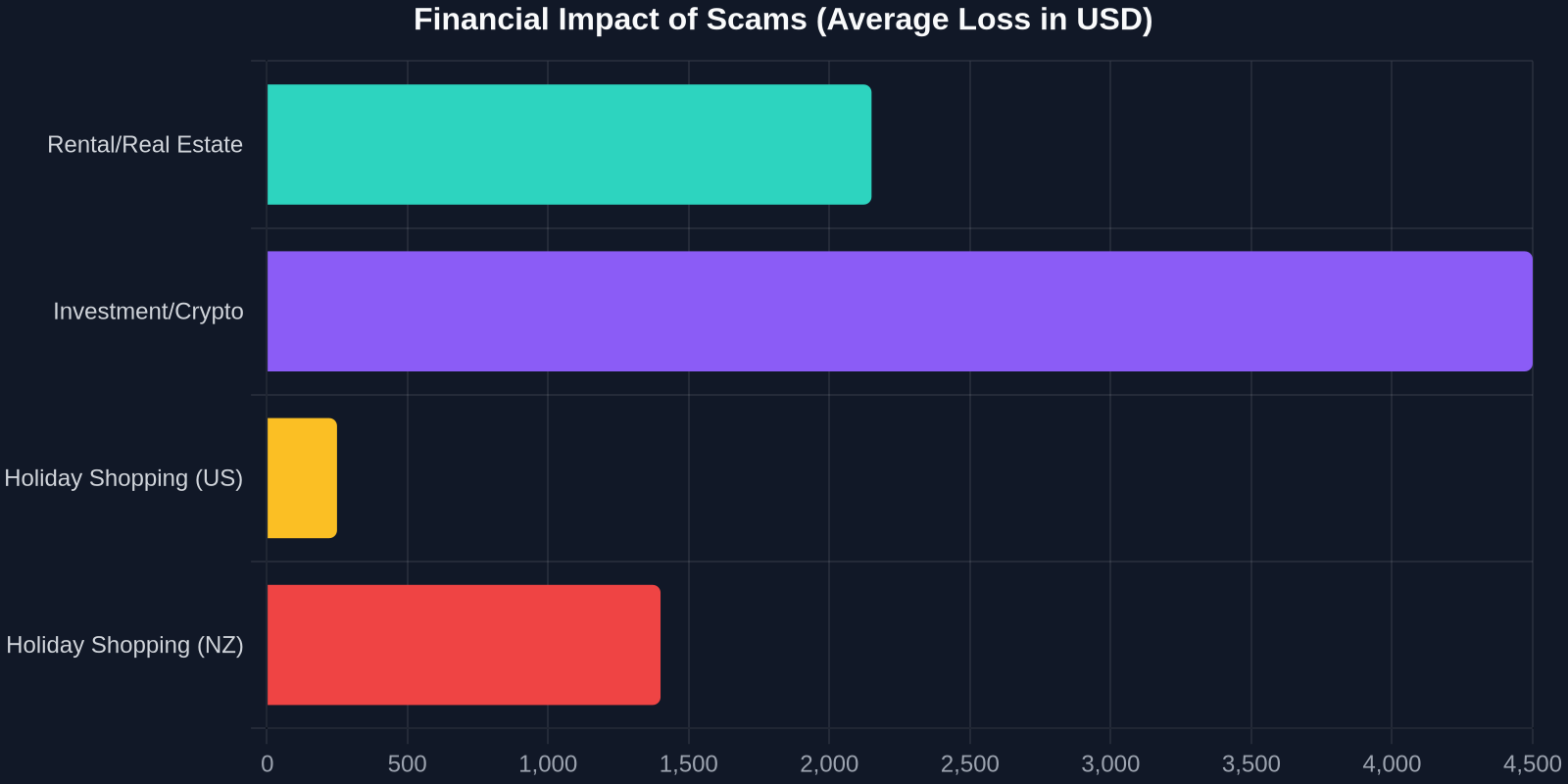
The Norton Holiday Report 2026 delivered a chilling statistic: 1 in 6 Americans (16%) fell victim to online shopping scams during the holiday season. We see a parallel pattern in New Zealand, where 8% of consumers were duped while holiday shopping online, with an average loss of NZ$1,997.12. Vacation rental scams peak during these periods, with fraudsters scraping legitimate Airbnb listings and reposting them on social media with “too good to be true” rates, demanding direct bank transfers.
The risk here isn't seasonal; it's permanent. The fear of missing out (FOMO) that drives holiday shopping is the same psychological trigger exploited year-round in flash-sale spam and ticket scalping fraud.
Dissecting the Business Impact: Beyond the Phished User
When a customer is phished using your brand’s likeness, you might think you are a secondary victim. From a business continuity perspective, you are often the primary casualty of stolen trust.

| Business Impact Area | Surface-Level Symptom | Deep Operational Cost |
|---|---|---|
| Customer Support | Spike in phishing warning calls | Agents spending 40% of time on security remediation instead of growth tasks |
| Brand Equity | Negative sentiment on social media | Long-tail revenue loss as consumers distrust official communications |
| Legal/Compliance | Investigation of fraud | Fines under FTC/PCI-DSS for failure to secure brand channels |
| Transaction Integrity | Chargebacks | Increased processing fees and potential merchant account termination |
The Atlanta real estate scam is the perfect case study. The legitimate agents didn't send the fraudulent emails, but their professional reputations were destroyed when a victim’s viral TikTok claimed, “This agency stole my money.” The business didn’t click the link, but they absorbed the operational damage of the crisis.
The Signal in the Noise: Why Your Current Training Fails
Most organizations treat phishing awareness training as a compliance metric: “95% of employees completed the module.” This is a vanity metric. We need to shift from measuring completion rates to measuring behavior change.
A real-world self-assessment checklist, like the one offered by driving safety expert Ross for fatigue detection, applies naturally to cybersecurity. Drivers self-assess for missing traffic signals and focus drift. Similarly, employees and customers should be trained to recognize the “somatic markers” of a scam: the visceral urgency (“You must pay in 24 hours or lose the deal!”), the unusual payment method, and the subtle mismatches in tone.
From Gateways to Groups: The Digital Attack Surface Expands
The digital surface area has ballooned. It is no longer just your corporate inbox; it’s your customer’s group chat.
The WhatsApp Group Trap
Scammers leverage WhatsApp’s group chat features to pool multiple victims. Here, they deploy multiple “sockpuppet” accounts. These bots build rapport, share fake screenshots of massive returns, and crowd out skepticism. For a support operations team, this is the ultimate amoeba attack. It leaves no trace on your network, yet it leaves dozens of your customers convinced they are investing in your fake crypto division.
The Generative AI Amplifier
What makes the Atlanta agent scam particularly terrifying is the ease of execution. AI tools can scrape a real estate agent’s entire social presence, photos, voice clips from a podcast, writing style, and generate a flawless synthetic persona. This is a Publisher’s Clearing House scam on steroids. The old rule of “call the person to verify” fails when the voice on the phone is an AI-clone that sounds exactly like your trusted contact.
Quantifying the Crisis: The Data Doesn't Lie
To move a board from passive sympathy to active budget allocation, we need hard numbers. Scam data is not just a security metric; it is a customer experience (CX) metric and a direct input into lifetime value (LTV) calculations.

Consider the surge in suspicious communications. A hoax email spoofing a Town Office, like the incident in Boothbay, Maine requesting residents ignore false alerts, seems low-tech. But these civic spoofing attacks drain public sector support systems. In the private sector, a single spoof of your “billing department” can generate:
It’s not the phishing email that breaks the support system; it’s the terrified response of the customers who received it. Your agents become crisis counselors, and your resolution times plummet.
The Psychological ROI: Protecting the Human Firewall
Business continuity relies on cognitive availability. When an employee falls for a scam, they lose focus, struggling to concentrate, missing signals, analogous to the micro-sleeps of a fatigued driver. A workforce reeling from an AI deepfake call is an error-prone workforce. Training must move from “How to Spot a Phish” to “How to Regulate Your Nervous System When Pressure is Applied.”
“The ultimate goal isn't a zero click rate. It's a zero belief rate. We need users to engage with a message, feel the manipulation, and report it, all without the adrenaline spike that shuts down critical thinking.”
A Behavioral Blueprint for Modern Defense
Static policies die on the vine. Here is a dynamic, behavior-focused blueprint to upgrade your organizational immune system.
Step 1: Conduct a Channel Audit
Your email gateway is secure. What about your LinkedIn inbox? Your SMS gateway? The QR code on your user manuals? Map every single digital touchpoint where a brand logo appears.
- Risk Vector: Parking meter stickers, restaurant menus, brochures.
- Action: Regular physical inspection of public-facing QR codes and “report fraud” links directly under the code.
Step 2: Shift from Completion to Competency
Replace “click rate” metrics with a Confidence/Skepticism Index. After training, are employees more confident in reporting, or just more anxious?
- Test the Edge: Run simulations that use zero technical indicators (perfect links) but high psychological pressure (CEO texting, “I’m in a meeting, buy these gift cards”). Measure the “stop and verify” rate, not the click rate.
Step 3: Automate the Customer Vigilance Loop
You cannot hire 200 extra support agents to handle scam fallout. This is where automation and AI defense integrate.
- Verification Layer: Deploy automated