
Agentic AI Self-Service: The Blueprint for Autonomous Customer Support That Reduces Costs and Scales CSAT
The pressure on customer support teams has never been greater. Support leaders are caught between rising customer expectations for instant, accurate resolutions and the need to control operational costs. Traditional chatbots promised to solve this, but most failed, they deflect simple queries but leave complex issues unresolved, forcing customers to repeat themselves to human agents. A new paradigm is emerging: agentic AI self-service. Unlike rule-based bots, agentic AI systems can autonomously handle entire customer journeys, including exceptions, escalations, and backend actions. Adobe's recent exploration of agentic AI self-service underscores the shift from chat-based deflection to true autonomous resolution.
In this guide, we break down what agentic AI self-service is, quantify its business impact, and provide a step-by-step implementation framework, so you can evaluate whether this technology is right for your support organization.
What Is Agentic AI Self-Service?
Agentic AI self-service refers to AI systems that go beyond answering questions, they take action. While a traditional chatbot might suggest a link to reset a password, an agentic AI agent authenticates the user, verifies identity, triggers the password reset in your CRM, sends confirmation via SMS, and logs the interaction in your helpdesk. It does this with minimal human intervention, using reasoning, tool use, and context awareness.
Key capabilities include:
- Autonomous decision-making: The AI evaluates the customer's intent, retrieves relevant data from connected systems, and determines the next best action.
- Tool and API integration: Agentic AI can call APIs to execute tasks, refund a transaction, update an order, schedule a callback, or transfer data between systems.
- Exception handling: When the AI encounters a scenario outside its confidence threshold, it escalates gracefully with full context to a human agent.
- Continuous learning: Each interaction feeds back into the model, improving accuracy and expanding the range of resolvable queries.
The distinction matters. Traditional chatbots operate on predefined scripts and decision trees. They can handle simple FAQ queries but break down when a customer's request requires multiple steps or access to backend systems. Agentic AI, by contrast, reasons about the customer's goal, selects the appropriate tools, and executes a multi-step workflow. It can handle a billing date change, a subscription downgrade, or a shipping address update, actions that previously required a human agent to log into multiple systems.
Agentic AI also differs from generative AI chatbots that only produce text. While generative AI can draft a helpful response, it cannot actually perform the task. Agentic AI combines language understanding with action execution, which is why it delivers true self-service rather than just self-help.
The Business Case: Why Agentic AI Self-Service Is a Must-Have for Modern Support Teams
The financial argument for agentic AI self-service is compelling. According to recent industry research, agentic AI uses autonomous exception handling to resolve up to 80% of common customer service queries, driving a 30% net reduction in operational support costs. These numbers aren't just theoretical, early adopters are reporting transformative results.

Consider the impact on a support team handling 50,000 tickets per month. At an average fully loaded cost of $10 per ticket, that's $500,000 in monthly support cost. Resolving 80% autonomously at a fraction of the cost (often pennies per interaction) could reduce monthly spend by $150,000 or more, while simultaneously improving response times and freeing human agents for high-value interactions.
But the benefits extend beyond cost. Customer expectations have shifted: 72% of customers expect immediate service, and 68% will switch brands after a poor support experience. Agentic AI self-service delivers instant, 24/7 resolution across channels, improving first contact resolution (FCR) and customer satisfaction (CSAT). It also reduces agent burnout by eliminating repetitive, low-complexity tickets, allowing your team to focus on relationship-building and complex problem-solving.
Industry benchmarks reinforce this. Gartner predicts that by 2027, 25% of customer support operations will use agentic AI as a primary channel for resolving customer issues. Zendesk's research shows that companies using AI for autonomous resolution see a 3x faster resolution time compared to traditional chat workflows, and a 20% increase in agent productivity when AI handles tier-1 tickets.
For support leaders, the message is clear: agentic AI self-service is not a nice-to-have experiment. It is a strategic lever for scaling support capacity without scaling headcount, improving customer experience while reducing cost per ticket.
How Agentic AI Self-Service Works: A Step-by-Step Breakdown
Understanding the mechanics helps support leaders evaluate vendor capabilities and set realistic expectations. Here is how a typical agentic AI self-service flow operates:
Step 1: Intent Recognition and Context Gathering The AI agent receives the customer query (via chat, email, voice, or social) and immediately pulls relevant context: customer history, account status, previous tickets, and real-time data from connected systems. Using natural language understanding, it determines the customer's intent with high precision and identifies the required action.
Step 2: Autonomous Decision-Making and Action Execution Based on the intent and retrieved context, the agent selects from a library of pre-authorized actions. For example, if the customer asks to change a billing date, the agent verifies eligibility, updates the billing cycle in the system, confirms the change, and sends a confirmation email, all without human involvement. The agent may also perform multiple actions in sequence, such as checking inventory, placing an order, and applying a discount code.
Step 3: Exception Handling and Escalation When the agent encounters ambiguity, a high-risk action, or a confidence score below a defined threshold, it escalates to a human agent. Crucially, the human receives a full transcript, customer context, and the AI's attempted actions, so the customer doesn't have to repeat anything. This seamless handoff is what preserves customer trust and prevents the frustration of being bounced between bot and human.
Step 4: Continuous Learning and Optimization Every interaction is logged and analyzed. Patterns in escalations trigger workflow updates or new training data. Over time, the AI expands its autonomous resolution range, and support leaders can adjust thresholds and guardrails to balance speed and safety. This closed-loop learning is what differentiates agentic AI from static automation.
The key difference is autonomy: agentic AI doesn't just suggest answers, it executes solutions, closes the loop, and learns from every outcome.
Real-World Impact: Before vs After Agentic AI Self-Service
To ground these concepts in operational reality, consider a typical mid-market SaaS company before and after implementing agentic AI self-service. The table below compares key support metrics over a six-month period.

| Metric | Before AI Self-Service | After Agentic AI Self-Service |
|---|---|---|
| Average Response Time | 8 hours | 2 minutes |
| First Contact Resolution Rate | 45% | 78% |
| Cost per Ticket | $12.50 | $7.50 |
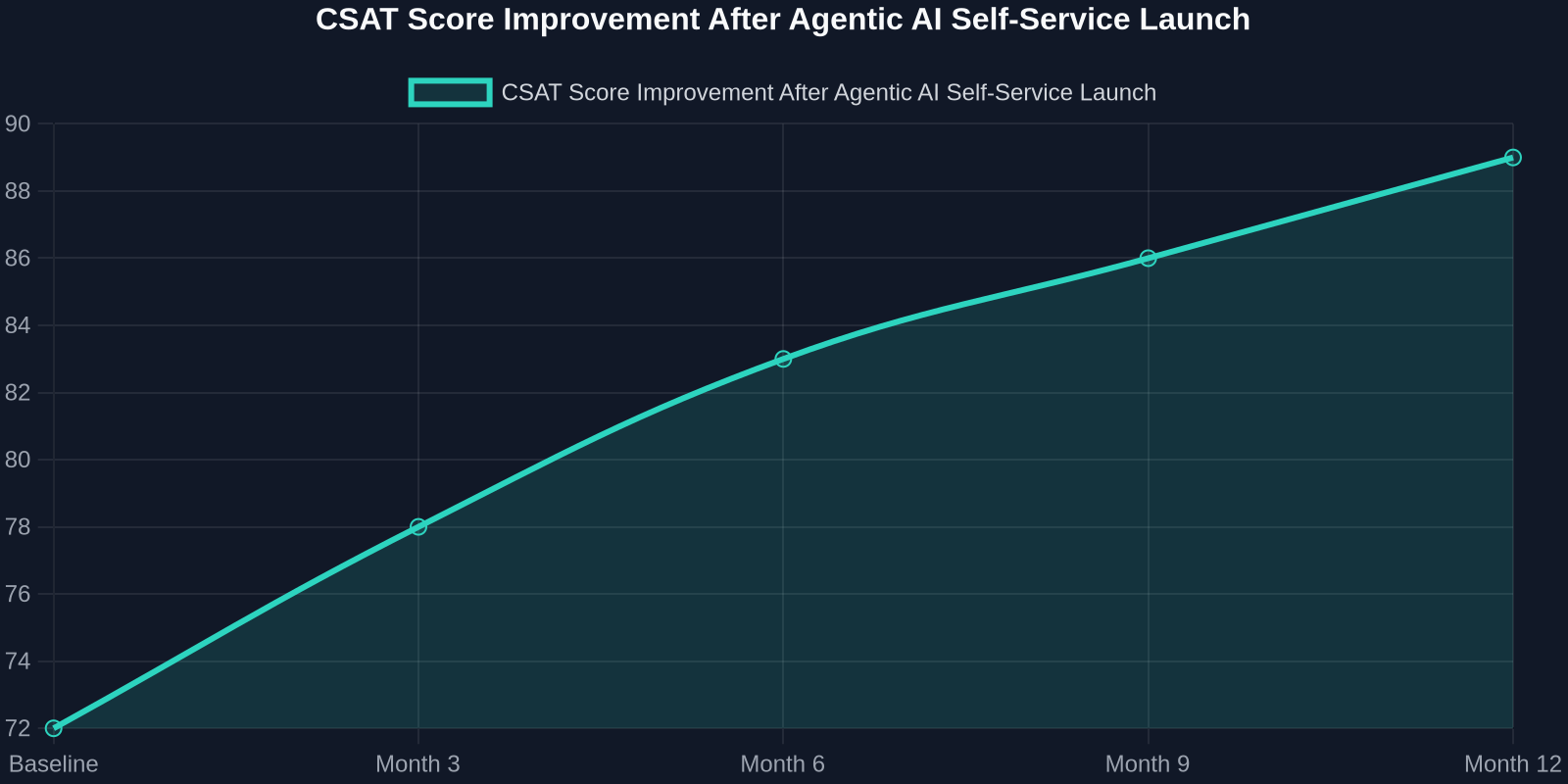
| CSAT Score | 72% | 89% |
| Ticket Volume Reaching Humans | 100% | 35% |
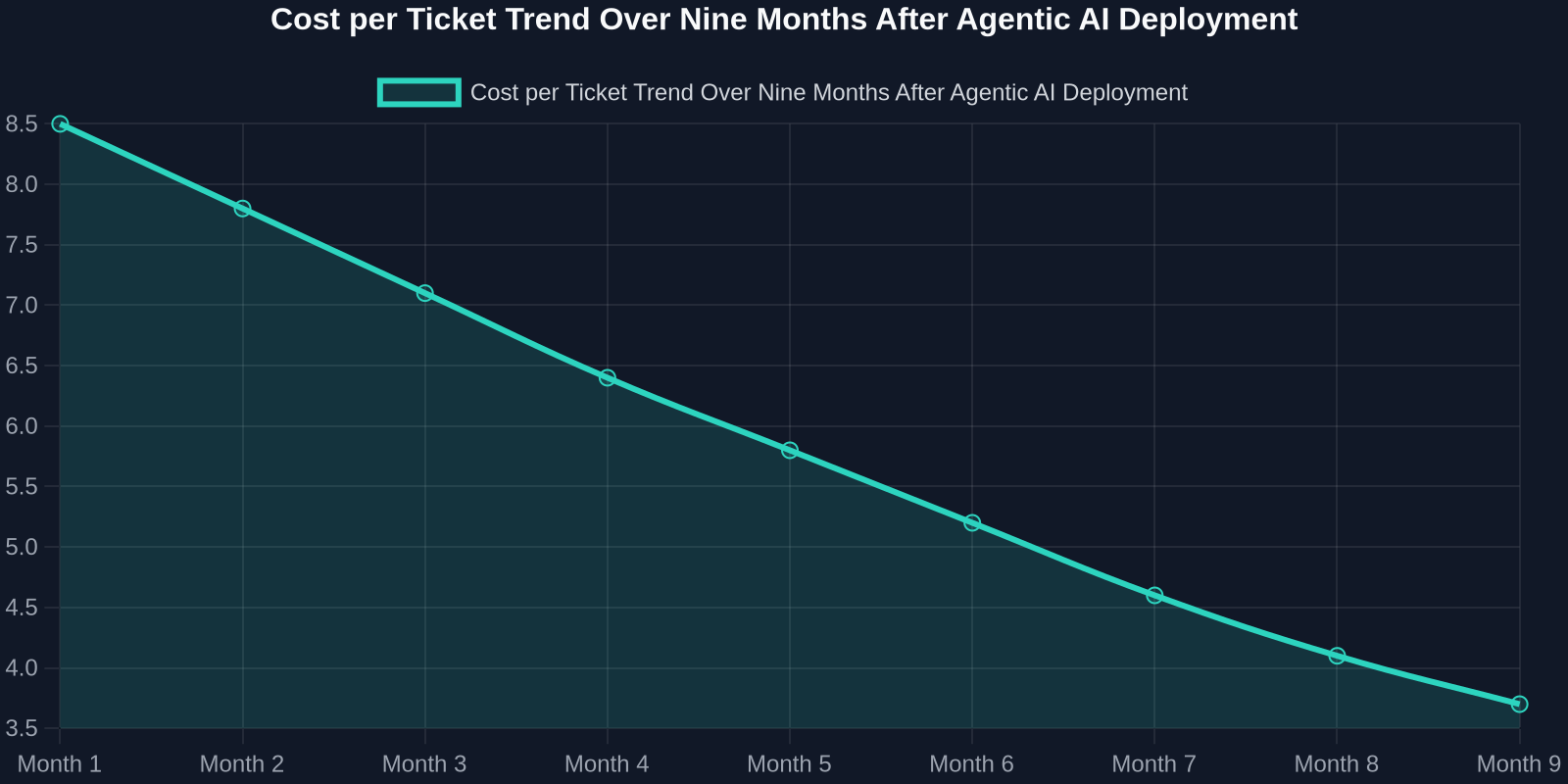
These improvements are not outliers. Multiple studies and vendor case reports show that companies adopting autonomous customer support see response times drop from hours to seconds, FCR rates climb by 30 percentage points or more, and CSAT scores approach 90%. The driver is simple: customers get their problems solved on the first touch, without waiting or repeating themselves.
Moreover, the impact on agent workload is profound. When 65% of tickets no longer reach humans, support teams can shift from firefighting to proactive customer success. Agents can focus on onboarding, upsell opportunities, and complex technical troubleshooting, activities that drive revenue and retention.
Implementing Agentic AI Self-Service: A Practical Framework for Support Leaders
Rolling out agentic AI self-service requires more than flipping a switch. The following four-phase framework will help you sequence the work, secure stakeholder buy-in, and demonstrate ROI quickly.
Phase 1 – Assess and Prioritize
- Audit your ticket mix: Categorize tickets by intent, complexity, and resolution path.
- Identify high-volume, low-complexity queries that are rule-following but time-consuming (e.g., password resets, order status, billing date changes).
- Select 10-20 use cases that account for the largest share of volume. These become your initial scope.
- Calculate the potential cost savings for each use case to build a business case for the pilot.
Phase 2 – Design and Integrate
- Map each use case to required data sources and APIs (CRM, billing system, helpdesk, knowledge base).
- Define escalation triggers: confidence thresholds, high-risk actions, sentiment detection, and compliance requirements.
- Design the human handoff experience: what context is passed, how the agent is notified, and what the customer sees during transfer.
- Establish guardrails and permissions to prevent unauthorized actions (e.g., refund limits, data access restrictions).
- Draft the AI persona and tone guidelines to match your brand voice.
Phase 3 – Pilot and Measure
- Run a 30-60 day pilot with a subset of customers or channels.
- Track both deflection and resolution metrics: autonomous resolution rate, escalation rate, CSAT, time-to-resolution, and cost per ticket.
- Collect feedback from human agents on handoff quality and context completeness.
- Iterate on thresholds and workflows before expanding.
- Document wins and lessons learned to share with leadership.
Phase 4 – Scale and Optimize
- Expand the AI agent to additional use cases and channels (chat, email, voice, SMS).
- Use analytics to identify near-miss escalations, queries that could have been resolved autonomously with slightly better context or permissions.
- Continuously train the model with new data, and refine guardrails quarterly.
- Reallocate human agents to proactive support, customer success, and complex issue resolution.
- Set a target for autonomous resolution rate and monitor monthly to ensure continued improvement.
Agentic AI self-service is not about replacing humans; it's about reallocating human expertise to high-value interactions where empathy and judgment matter most.
Measuring Success: KPIs for Agentic AI Self-Service
To justify the investment and guide optimization, support leaders must track the right metrics. Traditional chatbot metrics like containment rate are insufficient because they measure deflection, not resolution. For agentic AI self-service, focus on the following KPIs:

- Autonomous Resolution Rate (ARR): The percentage of AI-handled interactions that end with the customer's issue fully resolved without human intervention. Target: above 70% for initial use cases.
- Escalation Rate: The percentage of AI interactions that are transferred to a human. A healthy rate is 10-20%, depending on complexity. Too high means the AI is underperforming; too low may indicate risky autonomous actions.
- Time-to-Resolution: The elapsed time from customer contact to problem solved. Agentic AI should reduce this from hours to minutes.
- Cost per Ticket: Fully loaded cost including AI infrastructure, human agent time for escalated tickets, and tooling. Aim for a 30% or greater reduction.
- CSAT and CES (Customer Effort Score): Post-interaction surveys should show improvement, especially for simple requests.
- Agent Productivity: Tickets handled per agent per day, or hours saved per week, to quantify the reallocation benefit.
Overcoming Common Challenges and Pitfalls
Even the most promising agentic AI self-service deployments can stumble without careful planning. Here are the top challenges and how to avoid them.
Challenge 1: Poor Data Quality and Integration Gaps Agentic AI is only as good as the data it can access. If your CRM, billing, and helpdesk systems are siloed or have inconsistent records, the AI will make mistakes or escalate unnecessarily. Solution: invest in API integration and data hygiene before deployment. Start with a few high-quality data sources and expand gradually.
Challenge 2: Inadequate Escalation Design A common failure mode is building an AI that escalates too often (defeating the purpose) or too rarely (risking poor customer experience). Without clear triggers, agentic AI can frustrate customers and damage CSAT.
Challenge 3: Lack of Trust and Transparency Customers and support agents may be skeptical of autonomous AI. Provide transparency about what the AI can do, and always offer an easy path to a human. For agents, ensure the AI's actions are logged and auditable to build trust. A visible AI status indicator (e.g., 'AI is handling your request') can set expectations.
Challenge 4: Compliance and Security Risks Agentic AI that can take actions (e.g., refunds, data changes) must be governed by strict permissions and audit trails. Work with legal and security teams to define allowed actions, data retention, and compliance with regulations like GDPR or TCPA (for voice). Implement role-based access controls and full action logs for every autonomous step.
How Successly Accelerates Agentic AI Self-Service
Successly is designed from the ground up to help support teams deploy agentic AI self-service without the heavy lifting of building custom AI infrastructure. The platform combines autonomous AI agents with human oversight, giving you a single workspace for both AI and human support interactions.
Key capabilities that map to the implementation framework above:
- Pre-built integrations with major CRMs, helpdesks, and billing systems, so you can go live in weeks, not months.
- A visual workflow builder to define autonomous actions, escalation rules, and guardrails without code.
- Real-time analytics dashboards that track autonomous resolution rate, cost savings, CSAT, and escalation quality, so you can prove ROI to leadership.
- Built-in compliance controls for data privacy and auditability, including role-based permissions and full action logs.
- Seamless human handoff: when the AI escalates, the human agent sees the full context, customer history, and AI's attempted actions in one click.
By embedding agentic AI self-service into your existing support stack, Successly helps you achieve the metrics cited earlier, up to 80% autonomous resolution, 30% cost reduction, and CSAT scores approaching 90%, while keeping humans in the loop for the moments that matter.
Conclusion: The Time for Agentic AI Self-Service Is Now
Agentic AI self-service represents a fundamental shift in customer support, from deflection to resolution, from reactive to proactive, and from cost center to strategic advantage. The data is clear: autonomous exception handling can resolve up to 80% of common queries, reduce operational costs by 30%, and dramatically improve customer satisfaction. For support leaders, the question is no longer if to adopt agentic AI, but how fast and how well.
By following the four-phase framework outlined in this guide, assess, design, pilot, and scale, you can de-risk the transition and start capturing measurable ROI within months. And with platforms like Successly, the technical barriers have never been lower. The next step is to evaluate your ticket mix, identify your top 10 autonomous use cases, and run a focused pilot. Your customers, your agents, and your CFO will thank you.