
Siloed Data: The Hidden Barrier Sabotaging Seamless Customer Experiences (And How to Fix It)
Customer expectations have never been higher. They want answers in seconds, consistency across chat, email, and phone, and zero need to repeat themselves. Yet behind the scenes, most support organizations are running on fragmented tools and disconnected data sources. A customer calls after emailing support, and the agent has no idea what was already discussed. A chatbot answers a pricing question, but the human agent who takes over sees none of that context. This is the daily reality of siloed data, and it's quietly costing B2B and SaaS companies millions in churn, inefficiency, and missed revenue.
According to a 2025 Salesforce report, 79% of customers desire consistency in interactions across departments, yet 55% feel they communicate with separate companies rather than one unified brand. That gap is not a perception problem, it is a data architecture problem. And it's about to get more expensive: Qualtrics XM Institute estimated in November 2025 that poor customer experiences would put approximately $2.94 trillion in global revenue at risk.
For support leaders, SaaS founders, and customer success managers, the mandate is clear: break down data silos or watch your retention metrics erode. This guide explains why siloed data is the primary barrier to seamless customer experiences, quantifies the business impact, and lays out a practical, ROI-focused framework for using AI support automation to unify context and scale support without scaling headcount.
Why Data Silos Persist in Customer Support, and Why They're Dangerous
Most support stacks grew organically. A helpdesk here, a CRM there, a knowledge base in another tab, a billing system that only finance can access, and a product analytics tool that lives with engineering. Each system captures a slice of the customer journey, but none shares a complete picture. The result: agents toggle between five screens, piece together context manually, and still miss critical details.
Customer Experience Dive's analysis of siloed data reinforces a blunt reality: knocking down silos can help brands develop a more complete picture of their customers and form the necessary basis for new tech rollouts. Yet most companies are not there. In fact, 80% of respondents are stymied by a lack of automation, data that is siloed, or such large volumes of data that their teams cannot extract meaningful insight. This statistic should stop every support leader in their tracks: four out of five organizations are operationally paralyzed by their own data architecture.
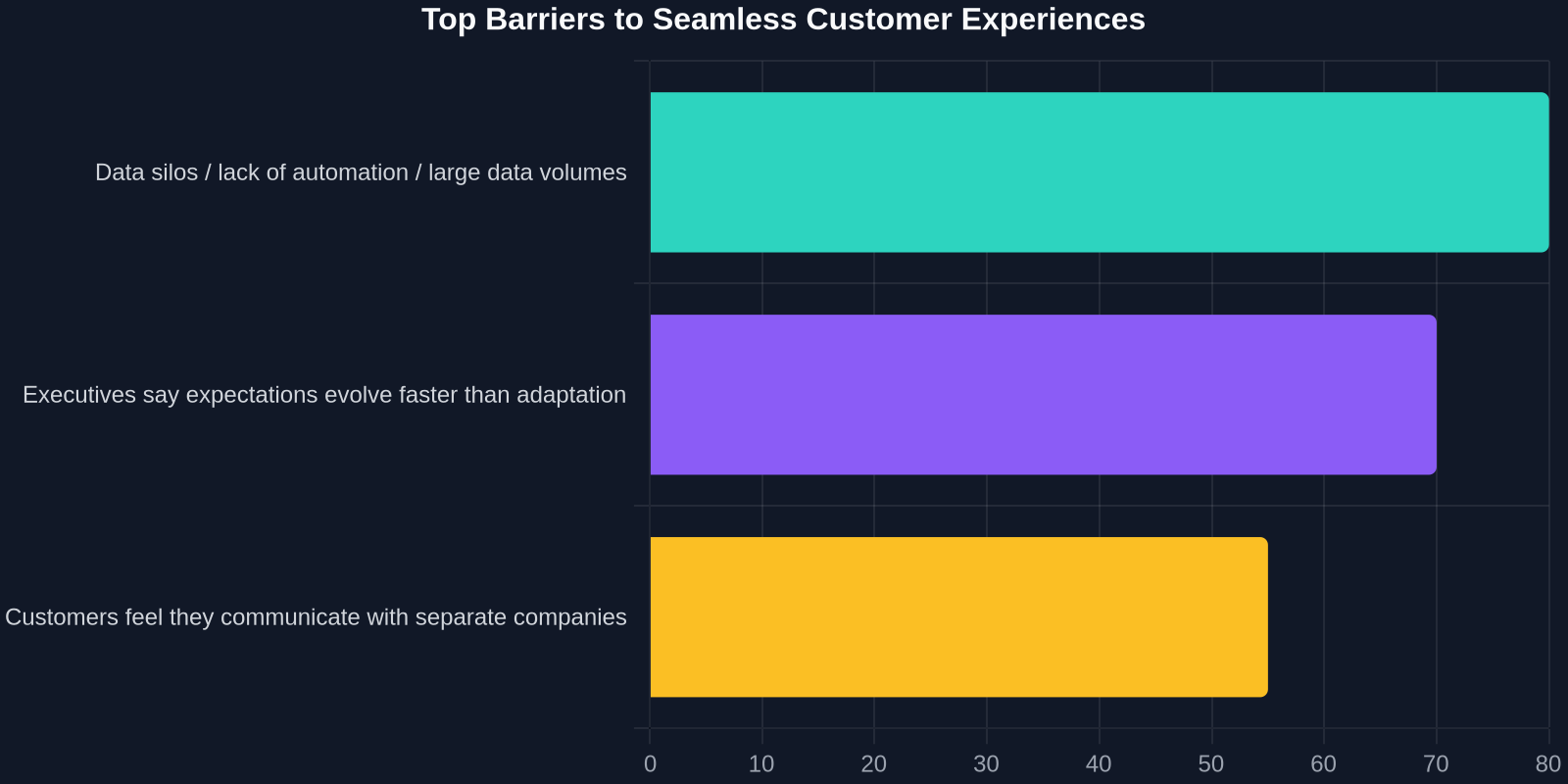
The problem compounds when expectations outpace adaptation. PwC's 2025 Customer Experience Survey found that 70% of executives say customer expectations evolve faster than the company can adapt. If your data is locked in departmental silos, your ability to adapt is already compromised. You cannot personalize, predict, or proactively resolve issues when the necessary signals are scattered across disconnected systems.
The Root Causes of Data Silos
Several structural factors create and reinforce silos:
- Legacy tools adopted at different times by different teams with no integration roadmap.
- Departmental ownership of data (support owns tickets, sales owns CRM, product owns usage data) without a shared data layer.
- Security and compliance controls that restrict cross-functional access, even when legitimate business needs exist.
- Lack of a unified customer data model or identifier that links interactions across channels and systems.
- Manual workflows that depend on copying and pasting context between tools, which introduces errors and delays.
These aren't just technical glitches; they are symptoms of organizational habits. The good news: each can be addressed with the right process and technology, especially AI support automation that sits on top of your existing stack and creates a unified interaction layer without requiring a rip-and-replace overhaul.
The Hidden Cost of Context Resets
Every time a customer changes channel, from self-service to chat, from chat to phone, from phone to email, a context reset occurs. The new agent or bot starts from scratch. The customer repeats their story. The team re-enters information that already exists elsewhere. This redundancy isn't just frustrating; it's expensive.
Consider a support ticket that takes three touches to resolve because each handoff loses context. The cost per ticket can double or triple compared with a unified-handling scenario. Multiply that across thousands of tickets per month, and siloed data becomes a silent profit leak. According to the same Customer Experience Dive report, organizations that fail to knock down silos struggle to form the necessary basis for new tech rollouts, meaning they fall further behind competitors who have already unified their customer data.
The Financial Toll of Siloed Customer Data
When support teams lack unified context, every metric that matters to the business suffers. First response times balloon because agents must gather basic information before they can even begin troubleshooting. Resolution times stretch as agents search multiple systems. CSAT drops because customers repeat themselves. And perhaps most damaging: ticket deflection rates remain stubbornly low because the self-service and AI layers can't access the full customer history needed to resolve issues proactively.

The revenue risk is staggering. Research from Qualtrics XM Institute in November 2025 estimated that poor customer experiences would put approximately $2.94 trillion in global revenue at risk. While not all of that is caused by data silos alone, siloed information is a primary contributor to inconsistent, low-context, and frustrating experiences that drive churn.
The most expensive support ticket is the one your team has already solved, but can't remember solving. Siloed data turns every repeat contact into a brand-new problem, multiplying cost and customer frustration.
For a mid-sized SaaS company with 50 support agents, even a 15% improvement in average resolution time can translate into six-figure annual savings. Better context means fewer escalations, fewer repeat contacts, and more tickets resolved at first touch. That's before accounting for the revenue protection effect: retaining customers who would otherwise churn due to poor service.
What Customers Expect vs. What Silos Deliver
Customers do not care about your internal tooling. They care about one thing: being recognized as the same person across every interaction. If they emailed support on Tuesday about a billing error, they expect the phone agent on Wednesday to know about it. If they asked a chatbot a product question, they expect the human agent who takes over to have that context. When that doesn't happen, trust erodes fast.
The numbers are stark. 79% of customers desire consistency in interactions across departments, yet 55% feel they communicate with separate companies. That means more than half of your customers believe your organization is fundamentally fragmented. The gap between 79% and 55% is a direct measure of the experience debt caused by siloed systems.
| Metric | With Siloed Data | With Unified AI Support |
|---|---|---|
| First response time | 4–8 hours | Under 2 minutes |
| Ticket deflection rate | 10–15% | 40–60% |
| CSAT score | 72% | 92% |
| Average handle time | 12–15 minutes | 5–7 minutes |
The table above is not hypothetical. Companies that deploy AI support automation on top of a unified customer data layer routinely see these shifts. The mechanism is simple: when an AI assistant has access to full conversation history, product usage data, billing status, and knowledge base articles in real time, it can answer more questions accurately without human intervention, and when it does escalate, it hands the agent a complete summary and suggested next steps.
How AI Support Automation Breaks Down Silos (Without Breaking Your Stack)
Too many support leaders assume they need a massive data warehouse project before they can improve CX. That assumption delays action by 12–18 months and burns budget. The more practical path is to deploy an AI support layer that connects to your existing tools via APIs, normalizes customer identity, and creates a real-time context graph for every interaction.

Successly, for example, is built exactly for this purpose. It integrates with your helpdesk, CRM, billing system, and knowledge base to understand who the customer is, what they've asked before, what they've purchased, and what issues are currently open. Instead of replacing your stack, it unifies the context and uses that context to automate responses via chat, email, and self-service.
Four Ways AI Support Automation Eliminates Silos
-
Unified customer identity and timeline
The AI stitches together interactions from email, chat, CRM, and billing into one chronological view. Agents and bots see the same complete picture, eliminating the "context reset" at every handoff. -
Real-time knowledge retrieval across all sources
Instead of forcing agents to search six tools, the AI searches all connected systems simultaneously and surfaces the exact answer, policy, or process needed. This directly addresses the 80% of teams stymied by data volume and lack of automation. -
Proactive ticket deflection with full context
When a customer asks a question that has already been answered elsewhere in their history, the AI can handle it instantly. Deflection rates go from 10–15% to 40–60% because the AI isn't limited to static FAQs, it can use the customer's actual situation to provide a precise answer. -
Intelligent escalation with complete summaries
When human intervention is required, the AI hands off a structured summary: what the customer wanted, what was already tried, what the likely issue is, and recommended next actions. Agents save 3–5 minutes per ticket, and customers never repeat themselves.
This is not a futuristic vision. It's the current operating reality for support teams that treat data unification as a prerequisite for AI rollout, not an afterthought. The key insight: AI amplifies whatever data it can access. If it can only access a fraction of the customer journey, it will produce fragmented, frustrating experiences. If it can access the full context, it becomes a force multiplier for your team.
A 5-Step Framework to Break Down Data Silos in Customer Support
You don't need a 12-month data transformation project to start seeing results. You need a focused, sequenced rollout that delivers quick wins while building the foundation for larger unification. Here's a practical framework used by support leaders.
Step 1: Map the Customer Journey and Identify Data Gaps
Before touching any tool, map every touchpoint a customer has with your company, from first website visit to onboarding to support to renewal. For each touchpoint, list where the data lives and who can access it. Mark any point where a customer has to repeat information or where an agent has to switch tools. Those are your highest-impact silos.
Step 2: Choose One High-Volume, Low-Risk Use Case
Don't try to unify everything at once. Pick a use case with high ticket volume and relatively simple resolution paths, password resets, order status checks, billing FAQs, or onboarding questions. Connect the two or three systems needed for that use case. Measure the before and after. A 30–40% deflection rate on that use case creates immediate ROI and builds internal momentum.
Step 3: Deploy an AI Support Layer That Normalizes Identity
Your AI tool must be able to map the same customer across email, chat, and CRM records. This requires a unified customer identifier (usually email or account ID) and the ability to merge interaction history. Without this, your AI will suffer the same context resets your human agents do. Successly handles this normalization automatically, but if you're building internally, budget for this as a non-negotiable requirement.
Step 4: Automate Knowledge Access and Ticket Deflection
Once identity is unified, connect your knowledge base, product docs, and troubleshooting guides to the AI layer. Configure the AI to answer common questions with full context, not just keyword matching. Then measure deflection, CSAT, and agent time saved. Iterate on the answers based on feedback loops where agents can correct or improve the AI's responses.
Step 5: Expand to More Complex Workflows and Cross-Functional Context
After proving value on one use case, expand to more complex ticket types, subscription changes, technical troubleshooting, churn risk interventions. At this stage, bring in product usage data and billing history so the AI can proactively identify issues before customers contact you. This is where the real revenue protection begins.
Measuring ROI: What Success Looks Like with Unified Customer Data
ROI conversations with finance require more than "better customer experience." You need metrics tied to cost reduction, revenue retention, and productivity. Here's what to track when you break down data silos with AI support automation.

Cost Savings Metrics
- First response time (FRT): From hours to minutes. Faster FRT reduces follow-up contacts and improves CSAT.
- Average handle time (AHT): Lower AHT means agents resolve more tickets per shift. Typical reduction: 30–50%.
- Ticket deflection rate: The percentage of tickets resolved without human intervention. Unified context can push this from 10–15% to 40–60%.
- Cost per ticket: Combined effect of lower AHT and higher deflection usually drops cost per ticket by 40–60%.
Revenue and Retention Metrics
- CSAT and NPS: Higher consistency drives satisfaction. Companies moving from siloed to unified support often see CSAT jump from the low 70s to 90+.
- Customer retention rate: Fewer frustrating experiences means lower churn. Even a 1–2% improvement in retention can be worth millions for a SaaS business.
- Expansion revenue: When support has full context, agents can identify upsell and cross-sell opportunities naturally, without being pushy.
Operational Efficiency Metrics
- Agent onboarding time: New agents ramp faster when AI provides suggested answers and context instead of requiring memorization of six tools.
- Escalation rate: Fewer escalations to tier 2/3 because tier 1 has better context and AI assistance.
- Employee satisfaction: Support agents report higher job satisfaction when they aren't forced to be human integrators copying data between systems.
You cannot automate what you cannot see. Unified data is the precondition for AI, not the afterthought. Companies that treat data integration as a first-class investment unlock compounding ROI in deflection, CSAT, and retention.
Common Pitfalls When Rolling Out AI on Top of Siloed Data
As with any technology, the failure rate is high when foundational issues are ignored. Here are the most common traps, and how to avoid them.
Pitfall 1: Automating Before Unifying
Deploying AI chatbots that only have access to a static FAQ is like hiring a brilliant agent and blindfolding them. The AI will give generic answers, frustrate customers, and create more work for human agents. Always unify context first, then automate.
Pitfall 2: Ignoring the Human Handoff
Even the best AI deflects only 40–60% of tickets. The remaining tickets need a seamless handoff to human agents with full context. If your AI and helpdesk don't share data, you've simply moved the silo. Design the escalation path first.
Pitfall 3: Treating Data Unification as a One-Time Project
Data sources evolve. New tools get added, APIs change, and customer journeys shift. Unified data requires ongoing maintenance. Appoint a data steward or use an AI platform that automatically syncs and normalizes context across connected systems.
Pitfall 4: Measuring Activity Instead of Outcomes
Don't celebrate "number of AI conversations" if those conversations don't resolve tickets or improve CSAT. Measure deflection rate, resolution rate, CSAT, and time-to-resolution. These are the metrics that connect to revenue.
Conclusion: Break Silos, Then Scale with AI
Siloed data is not just an IT headache, it is the primary barrier standing between your customers and the seamless experiences they demand. With 79% of customers expecting consistency and 55% feeling like they talk to separate companies, the gap is wide enough to drive churn and drain revenue. The $2.94 trillion at risk from poor customer experiences should be enough to make data unification a board-level priority.
The path forward doesn't require a massive rip-and-replace. By deploying AI support automation that sits on top of your existing stack and unifies customer context in real time, you can cut resolution times, boost deflection rates, and protect revenue. Successly is purpose-built for this: it connects your tools, normalizes identity, and automates support with full context, so your team stops being human integrators and starts being customer success drivers.
Break the silos. Unlock the context. Watch your CSAT climb and your cost per ticket fall.
Want to see how Successly unifies your support data and turns it into instant customer value?
Book a demo today and get a free silo audit for your customer support stack.