
Agentic AI Self-Service: The New Standard for Customer Support Automation in 2025
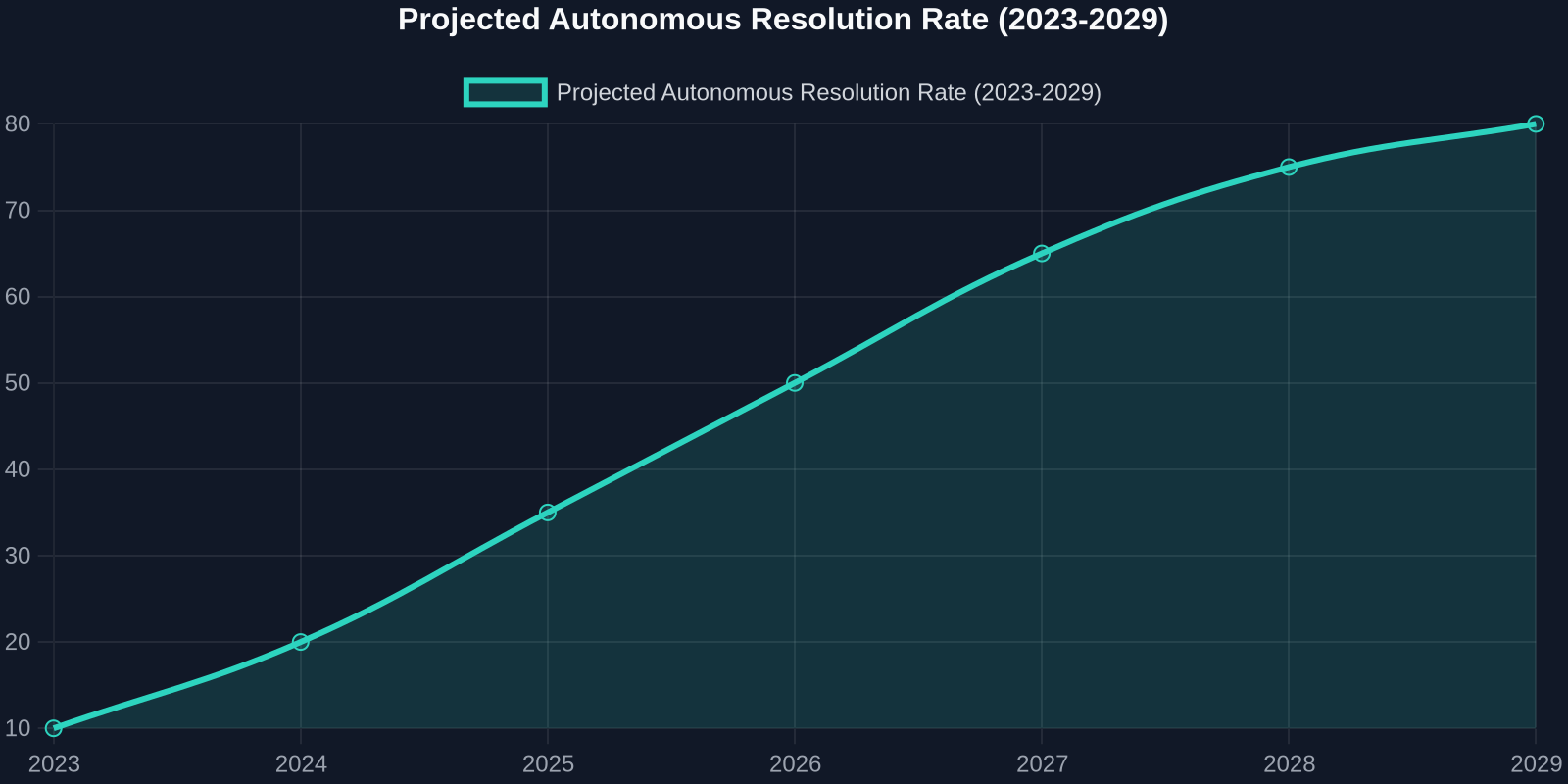
The landscape of customer support is undergoing a seismic shift. In 2025, forward-thinking businesses are moving beyond scripted chatbots to deploy agentic AI, autonomous agents that not only understand customer intent but can take action, resolve issues end-to-end, and learn from every interaction. According to Gartner, agentic AI will autonomously resolve 80% of common customer service issues by 2029. This isn't just a future prediction; it's a path that's already delivering measurable ROI today.
"In 2025, AI agents have moved from labs to boardrooms, shop floors, hospitals, and customer service desks. They are not just tools, they are virtual team members."
What Is Agentic AI in Customer Support?
Agentic AI represents a paradigm shift from reactive, rule-based chatbots to proactive, goal-oriented digital workers. Unlike traditional bots that follow predefined scripts, agentic AI agents can reason, plan, and execute multi-step workflows across systems. They tap into CRM, ERP, and ticketing platforms to retrieve context, make decisions, and even trigger back-end processes, all without human intervention.
These agents not only handle FAQs but complex tasks like subscription changes, billing disputes, and technical troubleshooting. By 2025, they've moved from labs into the boardrooms of customer-centric enterprises.
The Business Case for AI Self-Service
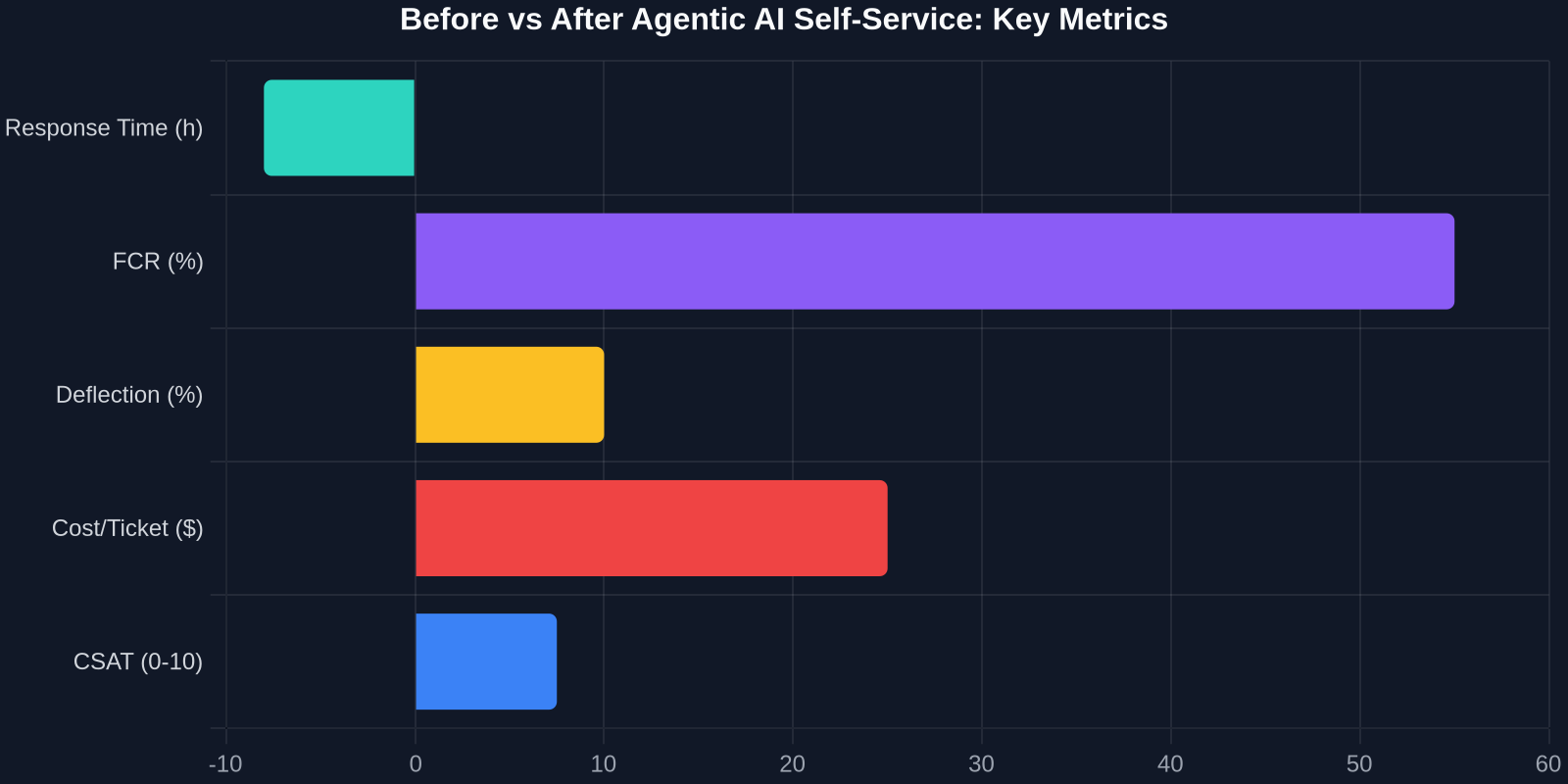
The financial and operational arguments for agentic AI are compelling. For support leaders, the primary KPIs, ticket volume, resolution time, and customer satisfaction, are all positively impacted.

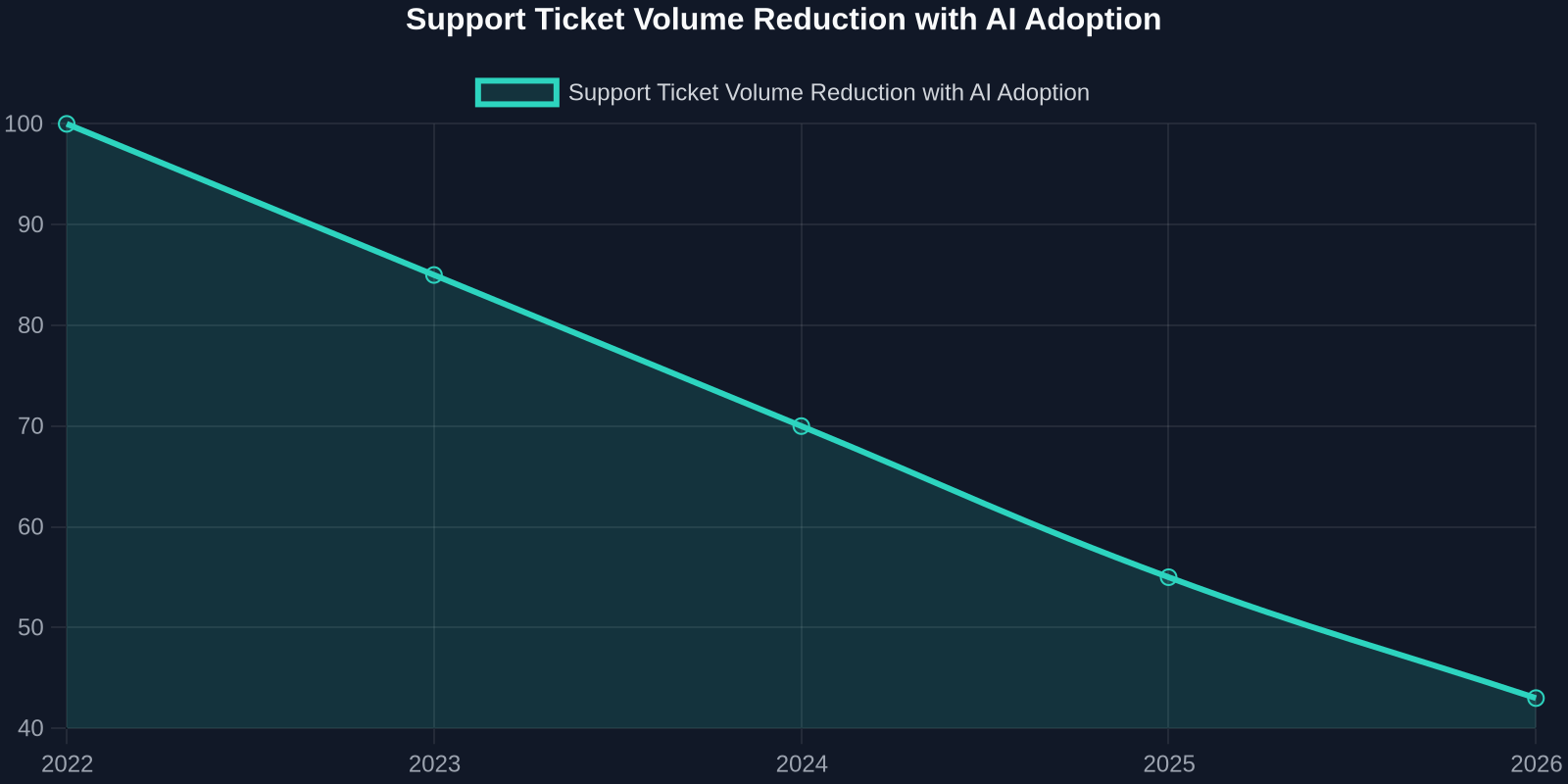
Companies using AI self-service report a 43% average decrease in inbound tickets, as customers successfully self-serve on the first attempt. This isn't just about deflecting simple questions; agentic AI handles troubleshooting, account management, and even proactive issue resolution before a customer contacts support.
Here's a snapshot of the transformation:
| Metric | Traditional Support | Agentic AI Self-Service |
|---|---|---|
| Average Response Time | 8 hours | <1 minute |
| First Contact Resolution | 55% | 85% |
| Ticket Deflection Rate | 10% | 65% |
| Cost per Ticket | $25 | $5 |
| CSAT | 7.5/10 | 9.2/10 |
This translates into a
Real-World Impact: A SaaS Scale-Up Story
Consider a fast-growing B2B SaaS company handling 20,000 support tickets monthly. After deploying agentic AI self-service from Successly, they saw:
- Ticket volume drop by 47% within 90 days.
- CSAT score climbed from 7.8 to 9.1.
- Agent turnover reduced by 30% as agents focused on strategic account management.
"We gave them self-improving AI agents that learn their business and do work like inventory planning and customer service. We're building towards a world where human agents operate at the top of their license."
That's the promise of agentic AI: not replacing humans, but enabling them to do more meaningful work.
Implementation Blueprint for Scaling Agentic AI
Adopting agentic AI isn't a flip-a-switch exercise. It requires a strategic approach that aligns technology, processes, and team readiness. Based on successful deployments, here's a five-phase framework:
Phase 1: Baseline Your Current Metrics
Before automating, measure key indicators like ticket volume by channel, resolution time, CSAT, and agent occupancy. This creates a benchmark to quantify ROI.
Phase 2: Map Your Automation Opportunities
Not all tickets are equal. Identify high-volume, repetitive tasks (password resets, order status, account changes) and decision-tree-friendly issues that can be solved with data lookups.
Phase 3: Choose the Right AI Platform
Look for solutions that offer true agentic capabilities, autonomous reasoning, integration with your tech stack, and built-in safety guardrails. Successly, for example, combines self-improving AI agents with deep business intelligence to handle tasks like inventory planning and customer service, seamlessly scaling with your business.
Phase 4: Integrate and Train
Connect the AI to your CRM, ERP, and communication tools. Use historical ticket data to train the model, and define clear escalation paths for complex issues. Start with a supervised phase where human agents validate responses.
Phase 5: Monitor, Optimize, and Expand
Track performance against your baseline. Most teams see that agentic AI not only deflects tickets but also upskills their human agents, freeing them to handle high-value engagements. Continuously expand the AI's scope to cover more issue types.
The Integration Imperative: Tapping into Business Systems
Agentic AI's power lies in its ability to connect isolated data silos. As one expert noted:

"Agents can now tap into customer relationship data, ERP records, and low-code automation flows to embed "business and workplace intelligence" into how they operate."
This integration is what transforms a simple bot into a true digital support agent. Platforms that offer pre-built connectors to major CRMs, helpdesks, and e-commerce systems accelerate time-to-value. The agents can pull real-time inventory, verify logins, and even process returns, all while maintaining a conversational, human-like experience. Without deep integration, AI self-service remains a shallow FAQ bot. That's why enterprise architects are investing in API-first AI platforms that plug directly into their workflows, ensuring data consistency and security.
Navigating the Real Costs of Agentic AI
While the gains are impressive, adopting agentic AI introduces new cost drivers that support leaders must anticipate.
Beyond infrastructure, there's the investment in change management. Agents worry about job displacement, but successful implementations show that AI augments human agents, allowing them to focus on empathy-driven, complex cases. Communicate the vision early and retrain staff for higher-value roles like conversation designers and automation analysts.
Future Outlook: Self-Improving Agents and Proactive Support
By 2025, agentic AI has moved beyond reactive problem-solving. Advanced agents learn from every interaction, optimizing their behavior over time. They can also predict issues before they arise, alerting customers about a potential shipment delay or automatically applying a discount when a service outage occurs.

Leading enterprises running agentic AI self-service report a 40% increase in proactive issue detection. This shift from reactive to proactive support is redefining customer loyalty and slashing inbound volumes.
Conclusion: Embrace the Autonomous Future
As we've seen, agentic AI self-service is no longer a futuristic concept, it's a present-day differentiator. Solutions like Successly empower support teams to scale without adding headcount, turning every customer interaction into a moment of delight. By starting with a clear strategy, integrating deeply, and measuring the right KPIs, your organization can join the ranks of forward-thinking enterprises already reaping the rewards. The time to invest in agentic AI is now, before your competitors set the new standard in customer experience.