
The $100 Billion SaaS Opportunity Hiding in Cross-System Labor
Bain & Company just published one of the most significant technology reports of the decade. The central finding is startling: there is a $100 billion SaaS opportunity sitting in plain sight, but it is not in a new software category, a new market, or a new AI model. It is in the mundane, invisible work of moving data between systems. Cross-system labor, the human effort required to copy information from one application to another, reconcile records across platforms, and manually bridge disconnected workflows, is quietly consuming billions of hours every year. For support team leads, SaaS founders, and customer success managers, this report is more than an industry observation. It is a roadmap to revenue, efficiency, and competitive advantage.
In this article, we unpack Bain's findings, explain why cross-system labor remains invisible to most leadership teams, and show how AI-native platforms like Successly transform this overlooked cost center into a measurable growth engine.
What Is Cross-System Labor and Why Does It Matter?
Cross-system labor is the manual work required to keep disconnected software tools aligned. It happens every time a support agent copies a customer's order number from an e-commerce platform into a CRM, switches to a helpdesk to log a ticket, then opens a billing system to check payment status. It happens when a customer success manager exports a report from one analytics tool, re-formats it in a spreadsheet, and pastes the results into a slide deck. None of these actions create direct value. They exist only because the systems do not talk to each other.
At first glance, these tasks seem trivial. Individually, they take seconds or minutes. But scaled across a support team of 20 agents handling 50 tickets per day, those seconds compound into dozens of lost hours each week. Bain's research suggests that the average knowledge worker now spends a meaningful portion of each day on exactly this kind of digital glue work. For B2B SaaS support operations, the numbers are even starker.
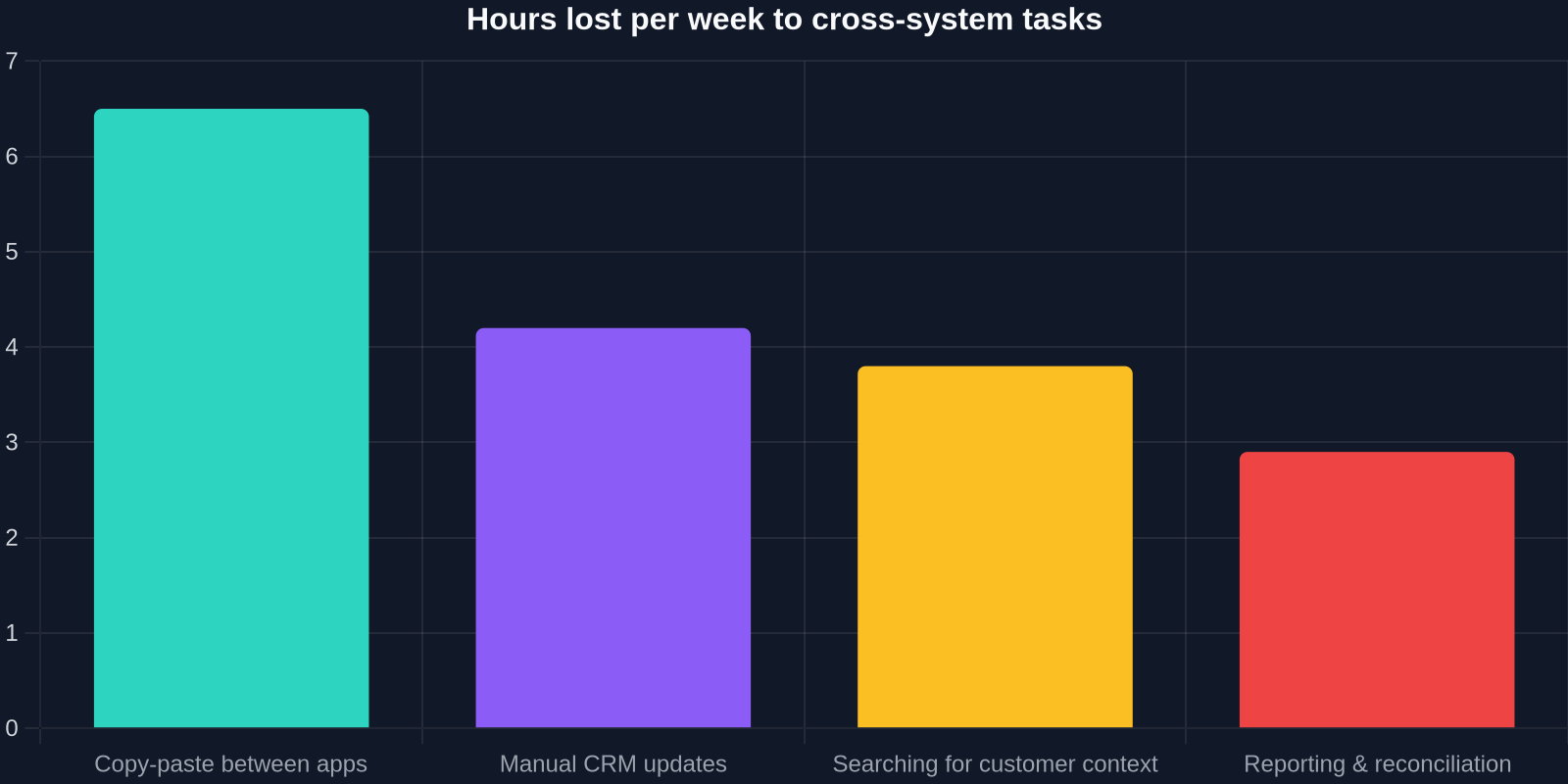
The chart above shows typical time losses across four common cross-system activities. Together, they total more than 17 hours per agent per week. That is nearly half a full-time equivalent lost to work that could be automated today. Multiply that by a team of 10, and you are paying for four full-time employees whose entire output is moving data from one place to another.
Cross-system labor matters because it inflates operating costs, slows response times, and degrades customer experience. Every minute an agent spends copying data is a minute they are not solving the customer's actual problem. For SaaS companies competing on responsiveness, this hidden tax can be the difference between a renewing customer and a churned logo.
The $100 Billion Blind Spot: Bain's Findings
Bain's 2026 technology report estimates that companies will spend more than $100 billion annually on software licenses and IT services aimed at connecting systems and automating workflows. Yet the report argues that this spending is misdirected. Most procurement still focuses on buying more point solutions, rather than on eliminating the labor that point solutions create. The result is a classic enterprise paradox: each new tool promises efficiency, but the aggregate effect is more fragmentation, more logins, and more manual reconciliation.

The opportunity hiding in cross-system labor is not about selling more seats. It is about capturing the value of the work that disappears when systems are properly integrated. For SaaS vendors and support operations alike, this shifts the conversation from feature count to flow efficiency. A platform that prevents 10 manual handoffs is more valuable than a tool with 10 new features that require another manual handoff.
Consider this dynamic through a support lens. A typical B2B support ticket may touch four or more systems: the helpdesk, the CRM, the billing platform, and the knowledge base. If only two of those systems are integrated, agents must manually transfer context between the other two. That manual transfer is cross-system labor. It is also a direct driver of average handle time, first response time, and CSAT.
Bain's report frames this as a once-in-a-decade opportunity for technology companies. But for support leaders, the implication is immediate: stop asking whether AI can answer customer questions. Start asking whether AI can eliminate the swivel-chair work between your existing tools. That is where the hundred billion dollars actually lives.
Why Traditional Support Tools Can't Bridge the Gap
Most support stacks are built on a hub-and-spoke model. A helpdesk like Zendesk, Intercom, or Freshdesk sits at the center, and other applications are connected through APIs or integration marketplaces. The problem is that these connections are often shallow. They may sync contact records or create tickets from emails, but they rarely understand the full context of a customer interaction across billing, product usage, and support history.
As a result, even teams with dozens of integrations still rely on agents to copy data between screens. The integrations are present, but the labor remains. This happens because traditional integrations are rules-based and brittle. They handle simple triggers, if a new email arrives, create a ticket, but they fail when the workflow requires judgment, context assembly, or multi-step reasoning.
Legacy support automation also tends to be reactive. It waits for a customer to contact support, then triages and routes the ticket. It does not proactively resolve the underlying cross-system friction. This is where AI-native platforms differ fundamentally.
| Metric | Before AI Automation | After AI Automation |
|---|---|---|
| First response time | 8 hours | 2 minutes |
| Manual data entry per ticket | 12 minutes | 30 seconds |
| Average resolution time | 3 days | 4 hours |
| Agent tickets per day | 25 | 60 |
The table above is illustrative, but it reflects results we see across high-performing support teams. The difference is not marginal. It is a step-change in operating efficiency. When AI handles the cross-system labor, fetching customer history, updating records, triggering billing adjustments, and logging outcomes, agents can focus on judgment, empathy, and complex problem-solving.
Where the Revenue Actually Hides: 5 Workflow Categories
Cross-system labor is not one problem; it is a collection of recurring workflow patterns. Bain's report identifies several categories where the economic value is largest. For support and customer success teams, five categories stand out.

1. Customer Context Assembly
Agents often spend the first five minutes of every interaction gathering context: who is this customer, what plan are they on, what have they contacted us about before, and is there an outstanding invoice? With disconnected systems, this context is scattered across the CRM, billing platform, product analytics, and previous tickets. Cross-system labor means manually searching and copying this information into the current conversation.
AI automation can assemble this context in under two seconds. It can pull the relevant account record, summarize recent interactions, flag outstanding issues, and present a unified customer timeline. The value is immediate and measurable: shorter first response times, fewer repeated questions, and higher CSAT.
2. Troubleshooting and Escalation Handoffs
When a ticket escalates from tier 1 to tier 2, the customer's history must be transferred. In many teams, this transfer is a manual note, a forwarded Slack message, or a copied ticket link. The receiving agent then repeats the context-gathering steps. Cross-system labor doubles.
AI platforms can automate the handoff by generating a structured summary, tagging the relevant systems, and routing the ticket with full context attached. No copy-paste. No re-explaining. The result is a smoother escalation path and fewer dropped balls.
3. Billing and Account Changes
Support teams frequently handle requests that span billing and product access: proration, refunds, plan changes, seat additions, and trial extensions. In a disconnected stack, these actions require agents to navigate multiple systems, verify permissions, and manually update records. Errors are common and costly.
With AI-driven workflow automation, a single support interaction can trigger the correct billing update, send the right confirmation email, and log the change in the CRM, all without human keystrokes beyond the initial approval. This reduces both labor and revenue leakage from missed billing actions.
4. Knowledge Base and Deflection
Many teams have a knowledge base, but it is often disconnected from the support queue. Agents must search a separate portal, copy the relevant article, and adapt it to the customer's specific question. Worse, customers cannot always find the answer themselves, so they open a ticket.
AI-native platforms can ingest both the knowledge base and live ticket history. They can deflect routine questions before they reach an agent, and when a human is needed, they can surface the exact article as a suggested response. This is the classic 43% deflection figure, and it comes from eliminating cross-system lookups, not from better search.
5. Reporting and QA
Support leaders need to understand team performance, ticket backlog, and customer trends. In a disconnected environment, building these reports means exporting data from the helpdesk, cleaning it in a spreadsheet, and manually joining it with CRM and billing data. This is pure cross-system labor.
AI platforms can generate these reports on demand, with natural language queries. Instead of spending Friday afternoon building a dashboard, a team lead can ask, "What were the top escalation reasons last week, broken down by customer segment?" and receive a structured answer. The hours saved are reinvested in coaching and improving the customer experience.
How AI-Native Platforms Unlock Cross-System Value
The Bain report makes one thing clear: the $100 billion opportunity is not evenly distributed. It accrues to platforms that remove cross-system labor at the workflow level, not to individual tools that simply add another integration. Successly is built for exactly this purpose.
Successly sits across your existing support stack and acts as an intelligent orchestration layer. It does not replace your helpdesk, CRM, or billing system. It connects them and automates the repetitive labor between them. When a ticket arrives, Successly pulls customer context from every connected system, drafts a response using your tone of voice, and pre-fills the next actions. When an agent approves a refund, Successly triggers the billing update and logs the outcome without opening another tab.
The business impact is direct: fewer manual tasks per ticket, faster response times, higher agent utilization, and lower cost per resolution. Because Successly learns from every interaction, the automation improves over time. What starts as a suggested reply becomes a fully automated workflow for common request types.
The $100 billion opportunity isn't in selling more software seats. It's in making the software you already have work together without human effort.
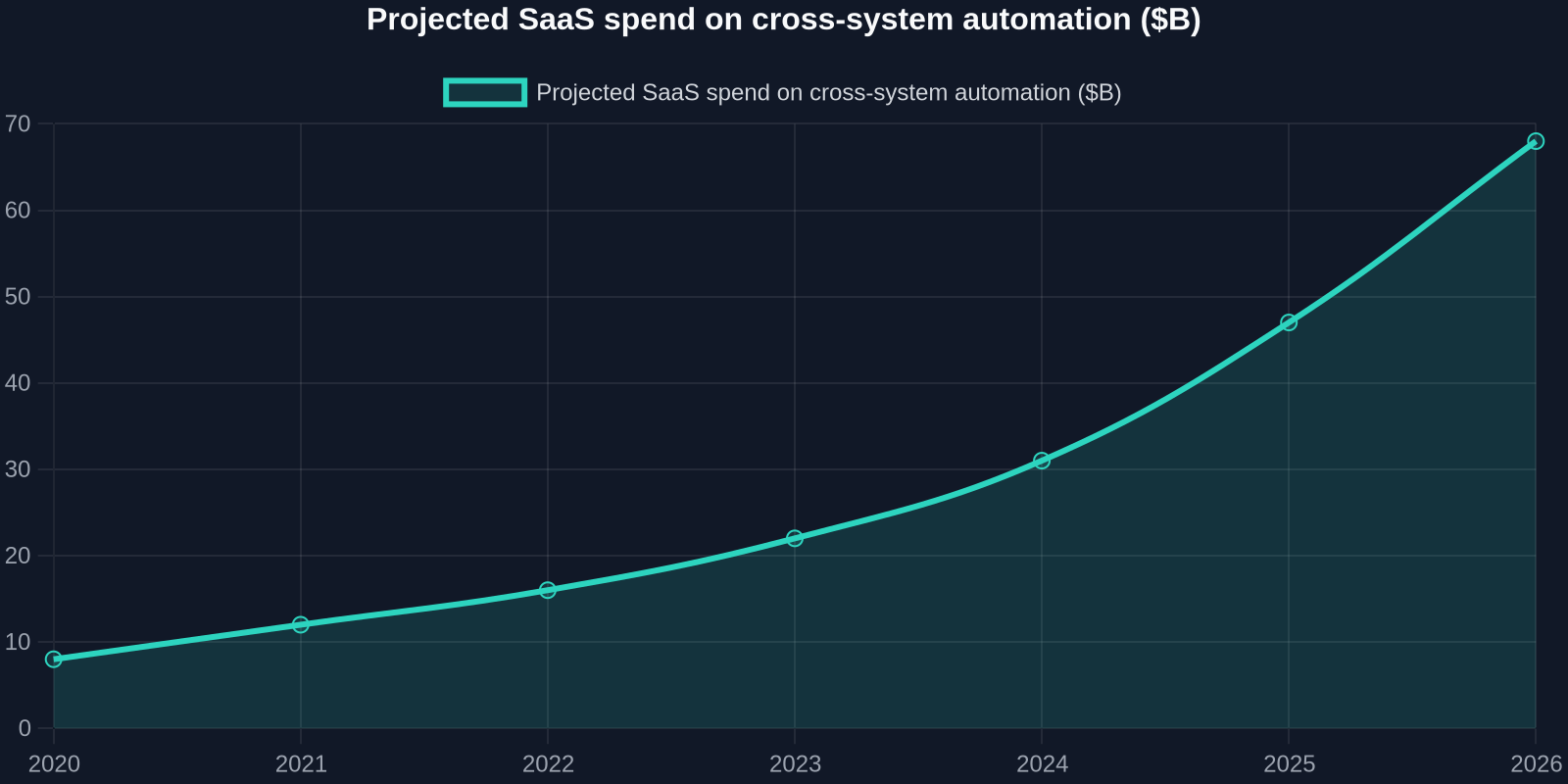
This projected growth in cross-system automation spend reflects the broader market shift Bain describes. The companies that capture this value are not adding complexity; they are removing it. For support leaders, that means choosing platforms that reduce the number of screens your agents touch, not increase them.
Building the Business Case: ROI Framework
Moving from awareness to investment requires a clear business case. Here is a simple framework any support leader can use to quantify the cross-system labor opportunity in their own operation.
Step 1: Identify the Top Repetitive Tasks
Start by shadowing your agents or reviewing ticket timestamps. Look for the moments when they switch applications, copy a value, or re-enter information. Group these into categories: context assembly, billing updates, escalation notes, report building, and so on.
Step 2: Measure Time and Frequency
For each category, estimate the average seconds per ticket and the number of tickets per week. Multiply to get weekly hours. Most teams are surprised to discover that three or four tasks consume more than 10 hours per agent per week.
Step 3: Calculate Fully Loaded Cost
Multiply the weekly hours by the number of agents and your fully loaded cost per agent hour. This gives the direct labor cost of cross-system work. Add a factor for quality errors, typically 2% to 5% of ticket volume, and you have a conservative annual cost.
Step 4: Model the Automation Impact
Assume AI automation can eliminate 80% of the manual time for the identified tasks. Apply that saving to your annual cost. For a team of 15 agents, this often exceeds $200,000 per year. That is before accounting for faster response times and higher CSAT.
Step 5: Include Revenue Protection
Faster resolutions reduce churn risk. A one-point improvement in CSAT can correlate with meaningful retention gains for a B2B SaaS business. If your annual revenue is $10 million and churn drops by 2%, that is an additional $200,000 in preserved ARR. Cross-system automation is not just a cost play; it is a revenue protection lever.
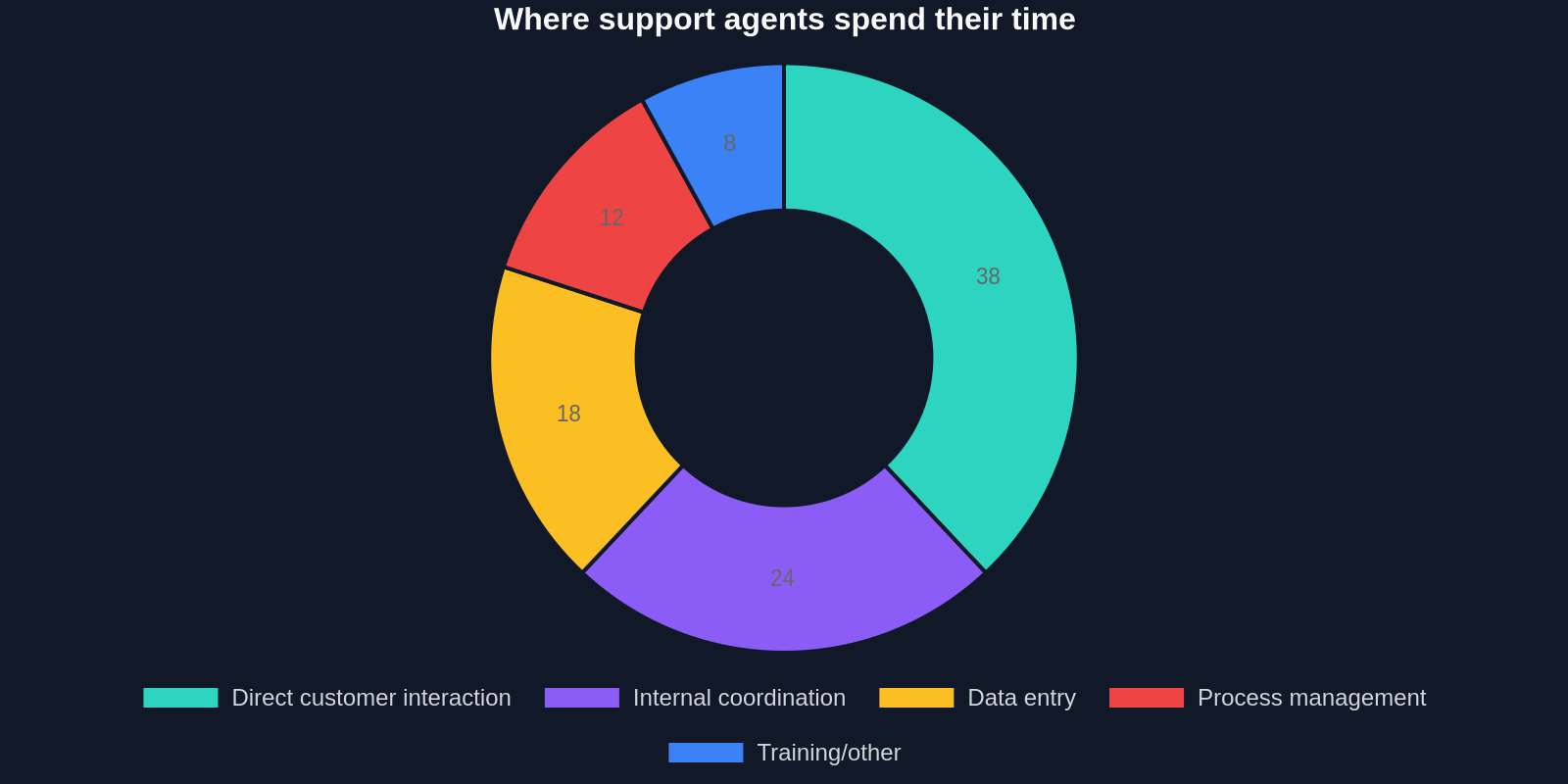
The doughnut chart above shows a typical time distribution for support agents. Notice that direct customer interaction is only 38% of their time. The rest is internal coordination, data entry, process management, and training. Cross-system labor hides in the gaps between those categories. Eliminating even half of the coordination and data entry time frees up 20% more capacity for actual customer work.
Implementation Playbook for Support and CS Leaders
Translating the Bain insight into operational reality requires a deliberate rollout. Here is a practical playbook used by fast-moving support teams.
- Map the top five cross-system workflows that consume the most agent time.
- Choose one workflow with high volume and low judgment requirements, typically account lookups or simple billing changes.
- Connect the relevant systems to your AI orchestration layer and define the desired outcome.
- Run a two-week pilot with a subset of agents, measuring time per ticket, error rate, and CSAT.
- Refine the automation based on agent feedback, then expand to adjacent workflows.
- Track the ROI metrics monthly and report the savings to executive stakeholders.
The key is to avoid boiling the ocean. A single automated workflow that eliminates five minutes per ticket across 100 tickets per day is worth more than a dozen half-implemented integrations. Start narrow, prove the value, then scale.
Measuring Success: KPIs and Benchmarks
To sustain momentum, support leaders need a clear set of KPIs that isolate cross-system labor from other variables. The most useful metrics include:
- Average handle time (AHT) per ticket
- Time from ticket creation to first meaningful response
- Number of application switches per agent per day
- Manual data entry events per ticket
- Escalation transfer time
- CSAT and CES (customer effort score)
- Agent overtime hours
Benchmarks vary by industry, but high-performing teams that have automated cross-system workflows typically see a 35% to 50% reduction in AHT, a 60% to 80% reduction in manual data entry, and a 10 to 15 point improvement in CSAT. The critical insight is that these gains are compounding. As more workflows are automated, the remaining manual tasks become easier to identify and eliminate.
The Future of Cross-System Labor Automation
Bain's report positions cross-system labor as the next great SaaS frontier. But the future is not just about connecting APIs. It is about AI that can reason across systems, understand intent, and take action without explicit instructions. This is the shift from workflow automation to agentic orchestration.
In the next three to five years, support platforms will not simply route tickets. They will resolve them. An AI agent will detect a failed payment, check the customer's history, attempt a retry, send a payment link, update the CRM, and escalate only if the customer responds negatively. The human agent becomes an exception handler and relationship builder, not a data mover.
For support and customer success leaders, the message is clear. The companies that invest now in eliminating cross-system labor will lower their cost-to-serve, improve customer retention, and free their teams to do the work that actually drives growth. Those that wait will find themselves paying a hidden tax that erodes margins and slows response times.
Every minute an agent spends copying data between systems is a minute of customer empathy your competitors can steal.
Conclusion
The $100 billion SaaS opportunity hiding in cross-system labor is not a theory. It is a measurable, everyday reality in support queues around the world. Bain's research makes the economic case; your own ticket data will confirm it. The question is whether you will treat cross-system labor as an unavoidable cost of doing business or as a strategic lever for efficiency and growth.
Platforms like Successly exist to answer that question in your favor. By automating the repetitive work between your existing tools, Successly cuts manual effort, accelerates resolutions, and gives your team back the hours they need to deliver exceptional customer experiences. The opportunity is hiding in plain sight. The only remaining decision is whether to capture it.