
Agentic AI Self-Service: The New Frontline of Customer Support Efficiency
In an era where 90% of consumers expect an immediate response to their customer service questions, traditional support models are buckling under the pressure. Manual triage, escalating queues, and repetitive ticket handling bleed resources and dilute customer satisfaction. Enter agentic AI self-service, a paradigm that moves beyond static chatbots to autonomous, reasoning agents that resolve issues proactively. For support leaders, this isn’t just another automation tool; it’s the architecture for scalable, profitable, and empathetic customer experiences.
Adobe’s exploration of agentic AI highlights how self-service can fundamentally reshape support interactions. When leveraged correctly, these agents don’t deflect customers, they delight them, turning support from a cost center into a growth engine. In this post, we’ll dissect how agentic AI self-service drives measurable business outcomes, how to implement it responsibly, and what metrics truly matter.
The Business Case for Autonomous Self-Service
The economics of reactive support are brutal. The average cost per human-handled ticket ranges from $15 to $200 depending on complexity, while self-service interactions cost pennies. Yet, legacy chatbots resolve only 20–30% of inquiries, forcing customers into rage-click loops and eventual calls. Agentic AI closes this gap.
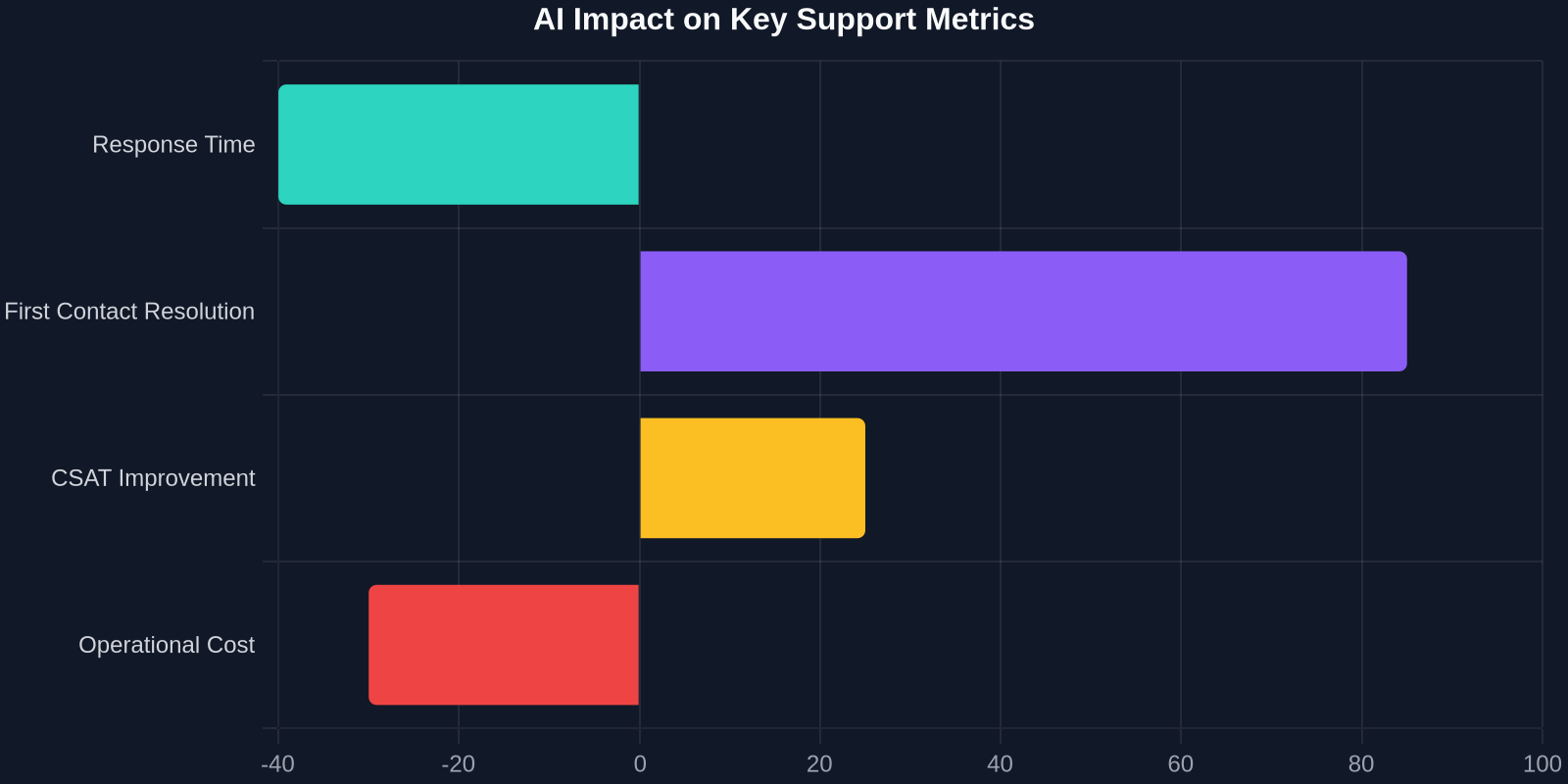
Modern agentic systems combine large language models (LLMs) with deterministic business logic, enabling them to understand nuanced intent, query knowledge bases in real time, and execute multi-step workflows. For example, when a customer complains about a missing feature, an agentic self-service bot can verify the account tier, check feature flags, and either enable the feature or escalate with full context, all within seconds.
The financial impact is immediate and compound: lower tier-1 headcount costs, reduced handle time, and higher agent utilization for complex cases. But the hidden gem is revenue protection, proactive issue resolution prevents churn. For B2B SaaS companies, where annual contract values are high, a single saved churn event can pay for the entire AI investment.
From Simple Deflection to Intelligent Resolution
Most support leaders initially deploy AI to deflect tickets away from human agents. That’s a necessary first step, but agentic AI inverts the model: instead of asking “How do we push customers away?”, we ask “How do we solve their problem without friction?”

Consider a scenario where a user needs a custom report not available in the standard dashboard. A traditional chatbot would offer a help article or create a ticket. An agentic self-service agent can:
- Understand the required data fields through natural language exchange.
- Trigger a backend API to generate the report.
- Validate the output and present it directly in the chat interface.
- Save the query as a recurring scheduled report if desired.
“Agentic AI turns customer support from a cost center into a real-time value delivery engine. Every resolved interaction is a revenue retention event.”, SupportOps Benchmark Report 2026
This level of autonomy requires a robust orchestration layer, the “Agentic Engagement Plane” as NiCE referred to it at their 2026 conference. It authenticates the user, mediates data access, routes to the right AI model, and governs every action to prevent hallucination or data leaks. Without this, you have an unpredictable bot; with it, you have a trusted digital employee.
The Metrics That Matter: Redefining Support ROI
Traditional support KPIs like Average Handle Time (AHT) and First Response Time (FRT) become obsolete when AI handles the majority of interactions. Instead, forward-thinking teams track:
| Metric | Before Agentic AI | With Agentic AI Self-Service |
|---|---|---|
| Ticket Deflection Rate | 15% (static bots) | 68% (autonomous agents) |
| Mean Time to Resolution | 4.5 hours | 2 minutes |
| Cost per Resolution | $22 | $0.30 |
| CSAT (self-service) | 72% | 91% |
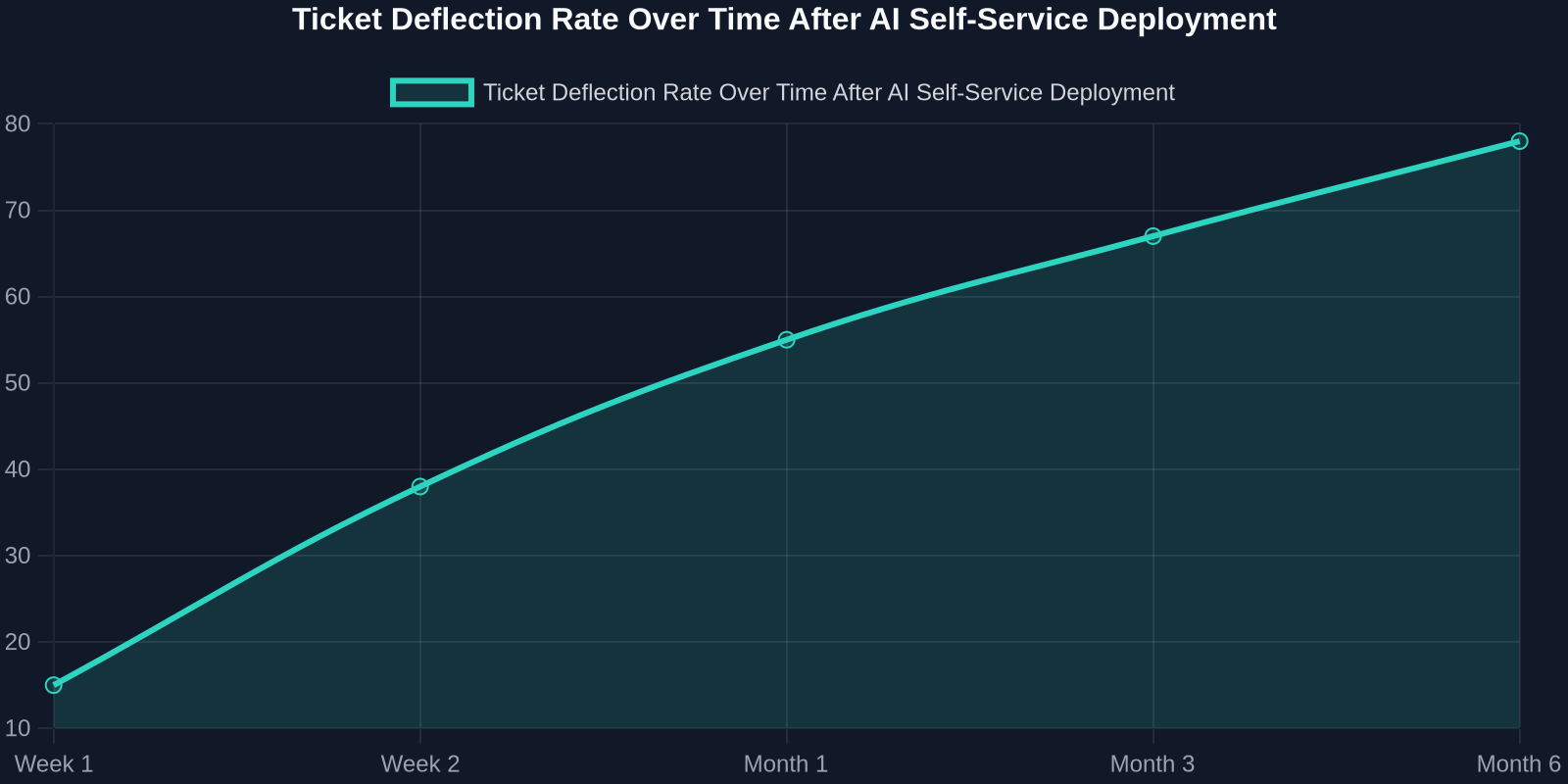
These numbers aren’t aspirational; they come from early adopters in the SaaS and e-commerce sectors. A large telecommunications provider implemented agentic self-service for account management and billing queries, achieving a 68% deflection rate and a 15-point CSAT increase. More importantly, their support NPS among self-service users outperformed agent-assisted interactions, proof that instant, accurate resolution builds loyalty.
Building Blocks of Successful Agentic Self-Service
Moving from a pilot to a production-grade implementation requires more than a powerful LLM. Successly’s work with scaling support teams reveals four foundational pillars:

1. Unified Knowledge Foundation
Agentic AI needs access to structured and unstructured data, product docs, past tickets, CRM records, and policy repositories. Siloed data leads to fragmented answers. A vectorized knowledge layer with continuous sync ensures the agent always has the latest context. This also enables real-time retrieval augmented generation (RAG), minimizing hallucinations.
2. Safeguarded Action Execution
Allowing an AI to perform destructive actions (refunds, cancellations, data changes) demands guardrails. Define a permission matrix: which actions are fully automated, which require human approval, and which are blocked entirely. Audit trails are non-negotiable. As SAP articulated with its “Autonomous Enterprise” vision, systems of record must be clean and partnered with flexible, governed AI.
3. Intent Disambiguation and Dynamic Routing
Agentic AI excels at discovering hidden intents. A query like “I can’t access my account” could be a password reset, a suspended account, or a browser cache issue. The agent should ask clarifying questions dynamically, then either resolve or seamlessly hand off with full context to a human specialist. This context preservation prevents customers from repeating themselves, a top driver of frustration.
4. Continuous Learning and Human-in-the-Loop Feedback
The model shouldn’t remain static. Every interaction that gets escalated, every negative feedback, every updated SOP should feed back into the system. Use human annotators to review AI decisions and retrain models. Parallel’s concept of giving agents “real-time access to fresh context” applies here, the web, product changes, and policy updates must be ingested continuously.
Avoiding Common Pitfalls: AI Governance and Trust
The most brilliant AI agent fails if customers don’t trust it. Transparency is the antidote. Always disclose when a customer is interacting with AI (never pretend to be human). Offer a clear escape hatch to a person. And critically, monitor for bias and emergent behavior.
Open models, as highlighted in the telecom industry, give enterprises the ability to audit and customize behavior without vendor lock-in. Whether you choose open-source or proprietary models, implement robust testing: adversarial prompts, factual accuracy checks, and off-policy detection.
The Tangible Financial Impact: A Total Cost of Ownership View
Let’s quantify the opportunity. A mid-market B2B SaaS company with 500 monthly support tickets, 70% tier-1, can see:

- Current cost: 350 tier-1 tickets * $20 average cost = $7,000/month in agent salary allocation.
- With 60% AI resolution: 140 tickets remaining for human handling = $2,800; 210 AI-resolved tickets * $0.25 = $52.50.
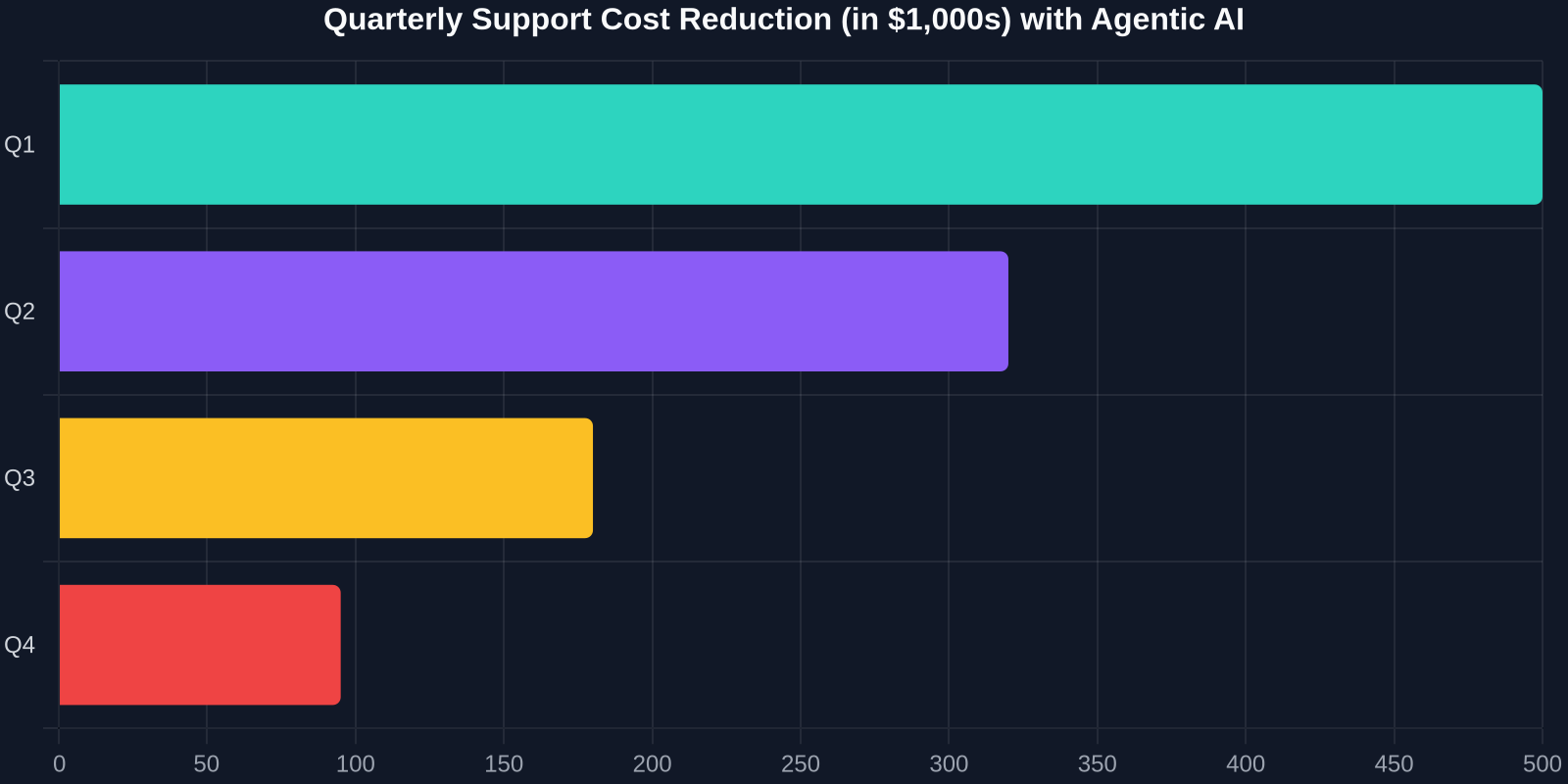
- Monthly savings: $4,147.50 → annual saving of $49,770.
But the real story is scaling. If that company doubles its customer base without adding headcount, the AI absorbs the growth. This is the “Autonomous Enterprise” advantage SAP envisions, decoupling support capacity from headcount.
From Self-Service to Proactive Support Orchestration
The ultimate evolution isn’t reactive, it’s predictive. Agentic AI, integrated with product telemetry and CRM signals, can detect health score drops, pending contract renewals, or usage anomalies, and proactively reach out to offer assistance. An employee might get a summary of their week’s sales automatically before they even ask; a support agent could pre-resolve a potential license issue before the customer notices.
This requires an orchestration plane that schedules agents, triggers actions based on events, and coordinates across departments. The NiCE Agentic Engagement Plane is one such vision; Successly’s platform bakes this orchestration into its core, enabling support teams to design complex automation flows with visual builders.
Implementation Roadmap for Support Leaders
Ready to move? Follow this phased approach:
- Phase 1 – Audit & Baseline: Map your ticket taxonomy, identify high-volume/low-complexity incident types, and capture current deflection rates, CSAT, and cost/ticket.
- Phase 2 – Pilot with Guarded Autonomy: Deploy agentic self-service for 2–3 top deflection categories (e.g., password resets, order status). Use a human-in-the-loop for financial actions.
- Phase 3 – Expand and Integrate: Feed in more knowledge sources, expand action permissions, and integrate with backend systems (CRM, billing, product analytics).
- Phase 4 – Proactive Mode: Enable event-triggered outreach and AI-driven health scoring to intervene early.
Throughout, measure relentlessly: resolution rate, deflection rate, CSAT (for AI interactions separately), agent time saved, and churn rate for accounts touched by AI.
The Future is Trusted Autonomy
Agentic AI self-service isn’t about replacing human agents, it’s about elevating them. When the mundane is automated, human agents become high-value consultants, solving complex problems, nurturing relationships, and driving expansion. Support leaders who embrace this shift will build lean, resilient organizations that scale without losing the human touch.
The technology exists today; the risk is in waiting too long. Start small, govern aggressively, and let the data guide you. As Adobe’s insights suggest, the brands that win in the next decade will be those that blend AI efficiency with genuine trust.
Successly helps support teams deploy agentic AI self-service with enterprise-grade governance, real-time knowledge syncing, and a visual orchestration layer. Ready to see what autonomous resolution looks like? Let’s talk.