
Agentic AI Self-Service: The Next Era of Autonomous Customer Support
Picture a customer reaching out late at night, frustrated by a billing issue. Instead of waiting hours for a human agent, they interact with a virtual assistant that not only understands the problem but also accesses the billing system, corrects the error, and confirms the resolution, all within seconds. This isn’t a distant dream; it’s the reality of agentic AI in customer support. According to industry research, agentic AI has introduced systems that combine reasoning with planning, memory, retrieval, tool use, and sequential action, fundamentally transforming how businesses handle customer inquiries.
For support leaders, the pressure to deliver instant, accurate service while curbing costs is relentless. Traditional chatbots, bound by scripted responses and limited context, fail at complex requests, leaving customers frustrated and agents overwhelmed. Agentic AI changes this by deploying autonomous agents that can triage, diagnose, and resolve issues end-to-end. The result? Faster resolutions, lower operational costs, and a measurable boost in customer satisfaction. In this post, we’ll explore what agentic AI means for support, the business impact it creates, and a roadmap to implement it successfully, all while subtly spotlighting how platforms like Successly can turn this vision into practice.
What Is Agentic AI in Customer Support?
Agentic AI refers to artificial intelligence systems capable of autonomous action. Unlike reactive chatbots that follow predefined flows, agentic AI agents can plan multi-step tasks, retrieve real-time data, use external tools, and maintain context across interactions. As one recent study notes, agentic AI combines reasoning with planning, memory, retrieval, tool use, and sequential action, which enables them to handle complex customer support use cases like processing refunds, troubleshooting technical issues, or even upselling based on customer history.
Agentic AI doesn’t just answer FAQs; it can diagnose product issues, initiate refunds, update account details, and escalate to humans only when necessary, transforming support from a cost center into a strategic asset.
Traditional AI tools could answer simple questions, but they lacked agency. For example, a customer asking for a refund on a standard bot might get a link to a form. With agentic AI, the system can verify the purchase, check refund eligibility, trigger the payment gateway, and send a confirmation email, all without human intervention. This capability stems from its architecture: memory stores interaction history, retrieval pulls from knowledge bases, and tool use interfaces with CRMs, billing systems, and inventory databases.
As Adobe’s business blog recently highlighted, agentic AI self-service is helping customer support teams handle high-volume inquiries while improving service quality. The shift is from simple “deflection” to “resolution,” where AI acts as a full-tier support agent.
The Business Case for Agentic AI Self-Service
Why should support leaders care? The numbers are compelling. Companies deploying agentic AI for support consistently report double-digit gains in efficiency and customer satisfaction. Consider this: a 43% reduction in support tickets is achievable when AI resolves issues that would otherwise reach a human. That means fewer heads needed for Tier-1, faster time-to-resolution, and a 24/7 service that scales globally.

The financial impact is equally dramatic. Labor costs often consume 60–70% of support budgets. By automating routine and moderately complex queries, businesses can cut support costs by up to 60%, as early adopters have shown. Moreover, consistent AI interactions reduce human error, leading to fewer repeat contacts and higher CSAT scores.
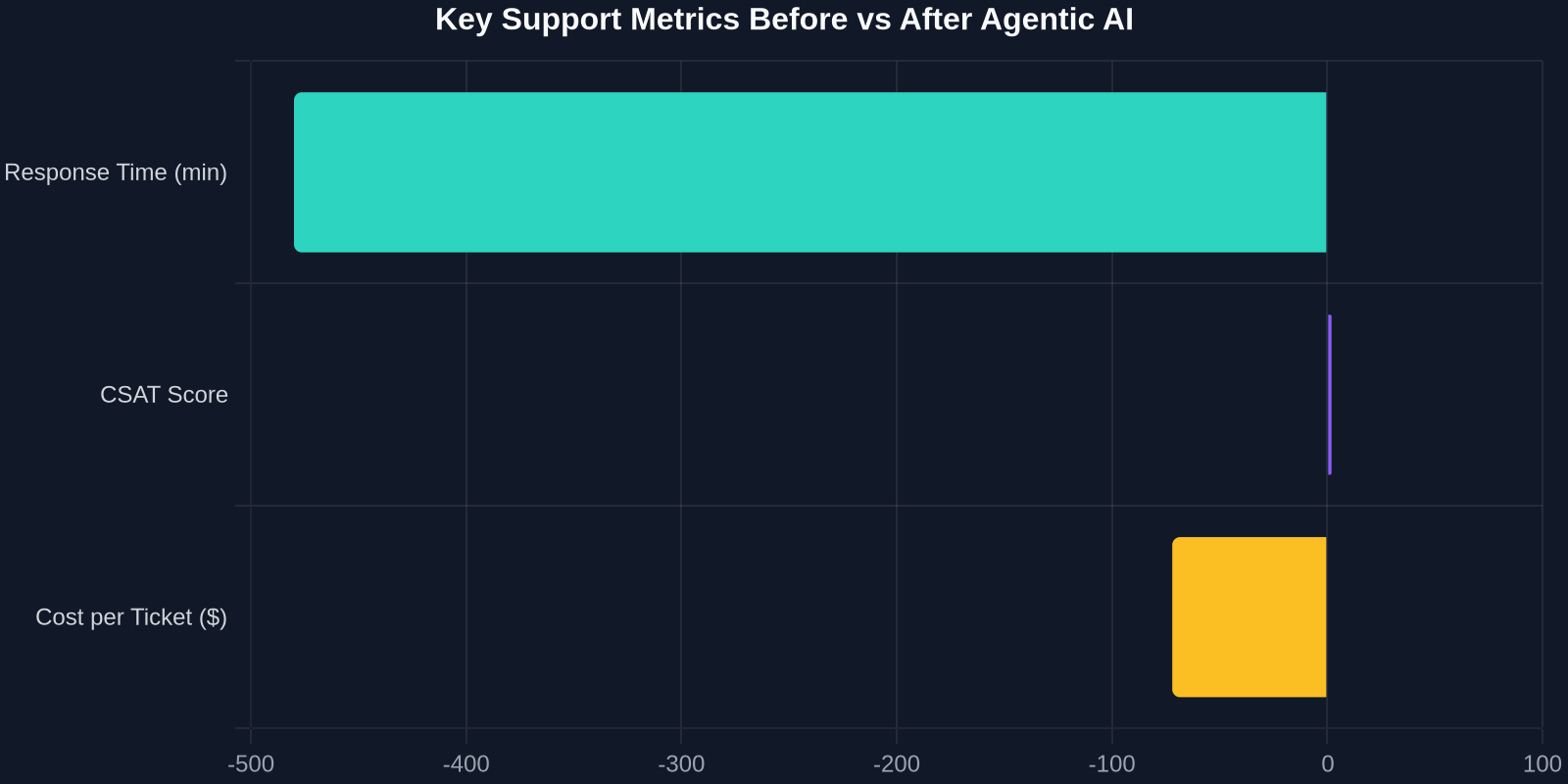
Beyond hard metrics, agentic AI elevates the agent experience. Reps spend less time on mundane resets and form-filling, and more on high-empathy, revenue-generating conversations. This reduces burnout and attrition, a hidden cost center for many scaling businesses.
How Agentic AI Overcomes Traditional Chatbot Limitations
Typical chatbots falter when the conversation deviates from the script. Agentic AI thrives on variability. Here’s how it defeats common pain points:
Contextual Memory
Unlike stateless chatbots, agentic AI retains information from past interactions. A returning customer doesn’t need to repeat their account number or device model, the agent already knows, creating a seamless experience.
Tool Integration
Agentic AI can query APIs, update records, and execute actions. For example, a wireless carrier’s agentic bot can adjust data plans, add international roaming, or troubleshoot network settings in real time, all while cross-referencing service status pages.
Multi-Step Reasoning
These agents handle complex workflows. A customer reporting a broken appliance can be guided through troubleshooting steps, and if unresolved, the agent automatically schedules a technician visit, places part orders, and sends confirmation, an orchestration beyond any scripted bot.
The secret sauce is retrieval-augmented generation (RAG). Agentic AI searches billions of support articles, product documentation, and real-time web results to deliver accurate answers, not hallucinated ones.
Parallel access to fresh web context is particularly potent. As one analysis points out, agentic systems monitor changes and extract key information from across the web, keeping responses up-to-date without manual content curation.
Real-World Applications: From Triage to Resolution
Leading support teams are already using agentic AI across the customer journey:

- Intelligent Triage: Agents classify incoming queries by intent, sentiment, and urgency, routing complex issues to the right human expert while resolving simple ones instantly.
- Proactive Support: Agentic AI monitors product usage and can reach out to a customer before they report an issue, detecting a failing integration, for instance, and offering a fix.
- Automated Order Management: Customers can modify, cancel, or return orders through conversational AI, with real-time inventory and payment checks.
- Billing Disputes: Agents can access payment history, explain charges, and even process refunds or credits, fully in-channel.
Agentic AI transforms support from a reactive cost center into a proactive growth engine, resolving issues before they escalate and creating opportunities for upsell and retention.
A notable pattern: when AI agents handle high-volume, repetitive tasks, human agent productivity jumps. One support ops manager shared that their team went from resolving 20 tickets per day to 80 after deploying agentic AI, because the cognitive load shifted to strategic problem-solving. This matches the statistic that AI agents perform product research, triage inquiries, and even manage marketing campaigns, freeing staff for higher-value work.
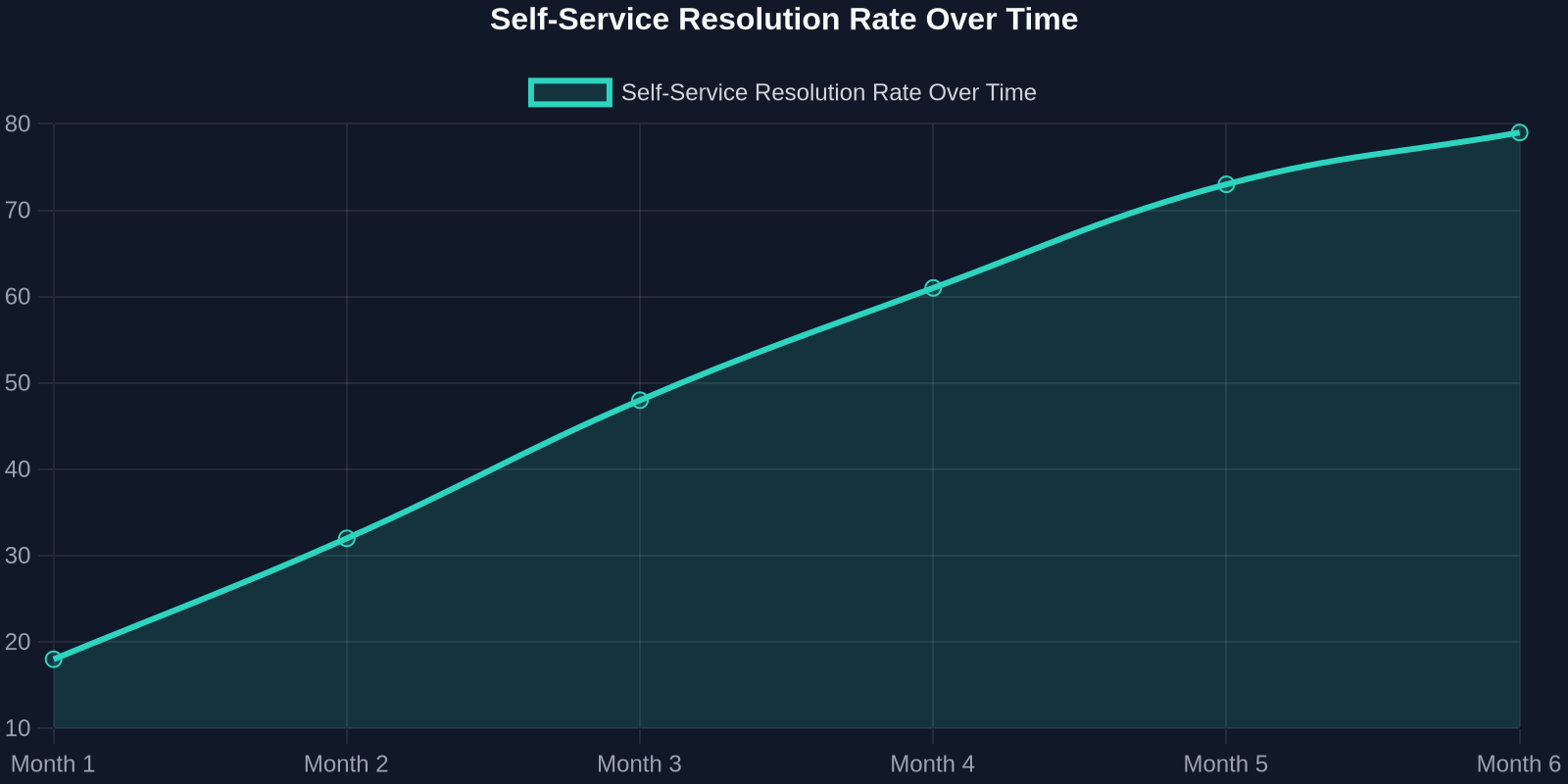
The chart above illustrates how self-service resolution rates typically climb over the first six months as the AI learns and expands its scope. Early adopters see steady improvement as they integrate more data sources and refine the reasoning engine.
Implementing Agentic AI for Self-Service: A 5-Step Framework
Adopting agentic AI is not just about software installation; it requires a strategic shift. Here’s a roadmap tailored for support leaders:
1. Audit Your Current Support Ecosystem
Map all channels, ticket types, and common resolution paths. Identify which queries are deflected, which stall, and where agent time is wasted. Quantify volumes to set a baseline.
2. Define Success Metrics and Scope
Choose KPIs: ticket deflection rate, average handle time, CSAT, cost per ticket. Start with a narrow, high-impact use case, like password resets or order status checks, before expanding.
3. Integrate with Core Systems
Agentic AI needs APIs to your CRM, helpdesk, billing, and inventory systems. Ensure robust, real-time data access. This is where platforms like Successly shine, offering pre-built connectors and a unified agent workspace.
4. Train and Fine-Tune the AI
Feed the system historical tickets, knowledge articles, and policy docs. Use human-in-the-loop feedback to correct errors and expand capabilities. Continuously monitor for drift.
5. Roll Out with a Hybrid Model
Begin with AI-assisted suggestions for human agents; then gradually enable autonomous resolution for vetted scenarios. Always keep an escalation path to humans for sensitive or emotional cases.
Start small, think big. Most organizations pilot agentic AI on a single channel (like web chat) and one or two ticket types. This derisks the deployment and generates quick wins to secure executive buy-in.
Measuring Success: KPIs That Matter
To validate ROI, track a mix of operational and experience metrics:

- Ticket Deflection Rate: Percentage of total support volume handled entirely by AI without human touch. A target above 50% signals a strong implementation.
- Mean Time to Resolution (MTTR): How fast a customer’s issue is fully solved. Agentic AI can cut MTTR by over 90% for automated workflows.
- Customer Satisfaction Score (CSAT): Post-interaction surveys should measure whether AI-delivered service meets expectations. Many firms report a 20+ point CSAT lift.
- Agent Utilization: Reps free to focus on complex, revenue-generating interactions, track their ticket mix and average value.
Beyond these, monitor containment rate (how often customers return for the same issue) and cost savings per ticket. One support director noted, “We’ve seen a 70% drop in repeat contacts because the AI remembers and resolves the root cause, not just the symptom.”
The Future of Agentic AI in Support
Agentic AI is not standing still. Emerging trends point to even deeper autonomy:
- Multi-Agent Orchestration: Several specialized AI agents collaborate, one triages, another accesses billing, a third schedules appointments, all under a supervisory agent that ensures cohesion. This mirrors how human teams work but at machine speed.
- Predictive Support: By analyzing product telemetry and user behavior, agentic AI will anticipate issues and intervene before a customer notices. Imagine a SaaS platform detecting a login anomaly and the AI proactively resetting the password and notifying the user.
- Emotional Intelligence: With advances in sentiment analysis, agents will adjust tone and cadence based on customer frustration levels, de-escalating tense situations or knowing when to involve a human.
“The future of customer support isn’t about choosing between bots and humans; it’s about orchestrating them seamlessly so each does what they do best.”
Gartner predicts that by 2027, 25% of customer service interactions will be fully resolved without human involvement, a leap from less than 5% today. Agentic AI is the engine behind that shift, and businesses that adopt early will differentiate on speed and accuracy.
How Successly Enables the Agentic AI Transformation
While the concept of agentic AI may sound complex, purpose-built platforms like Successly are making it accessible. Successly combines conversational intelligence with deep integrations into popular support tools, enabling teams to deploy autonomous agents within weeks, not months. Its agentic engine handles memory, retrieval, and tool execution out of the box, so support leaders can focus on strategy rather than engineering.
With pre-trained models on millions of support interactions, Successly agents understand industry-specific nuances and continuously learn from each customer conversation. The platform’s analytics dashboard also provides the KPIs we’ve discussed, closing the feedback loop for continuous improvement. Whether you’re a SaaS founder looking to scale support without linear headcount growth or a support ops lead aiming to hit CSAT targets, agentic AI self-service, with the right partner, is the competitive edge you need.
Ready to see agentic AI in action? Explore Successly’s capabilities and start redefining what your support team can achieve.