
How Home Depot’s AI Bot Is Revolutionizing Customer Support (And What B2B SaaS Can Learn)
When a do-it-yourself giant deploys artificial intelligence to help millions of customers find the right screw, paint, or power tool, the results speak volumes about where support automation is headed. Home Depot’s AI bot isn’t just a novelty – it’s a case study in how to scale high-quality customer service without scaling headcount. For B2B SaaS companies drowning in support tickets, the lessons are urgent and actionable.
In this article, we unpack the Home Depot playbook, translate it into a repeatable framework for SaaS support leaders, and show how platforms like Successly make it possible to achieve similar – or even better – results. Whether you’re a VP of Customer Success or a support team lead, you’ll walk away with a clear ROI case for AI automation and a step-by-step implementation guide.
Inside Home Depot’s AI Bot: The Numbers That Matter
Home Depot’s virtual assistant handles millions of interactions each month – from order tracking and return status to complex project advice. By stitching together natural language processing, product catalog data, and integration with back-end systems, the bot resolves the majority of inquiries without ever queuing for a human agent.
According to internal benchmarks shared at enterprise AI summits, the bot drove:
| Metric | Before AI Bot | After AI Bot |
|---|---|---|
| First Response Time | 45+ minutes (human queue) | Under 2 minutes (instant) |
| Ticket Deflection Rate | 12% (basic IVR/FAQ) | 35% (AI self‑service) |
| Customer Satisfaction (CSAT) | 78% | 92% |
| Cost per Resolution | $8.50 (fully loaded) | $1.20 (AI‑assisted) |
These shifts aren’t just operational – they directly impact customer lifetime value. A 14‑point CSAT lift correlates with a 10–15% reduction in churn, according to benchmark studies by the Technology Services Industry Association (TSIA).
Why B2B SaaS Support Teams Can’t Afford to Wait
Support teams at even mid‑market SaaS companies are under siege. As product complexity grows and user bases become global, ticket volumes rise by 25–40% year‑over‑year without proportional budget increases. The old model – hiring more agents in lower‑cost regions – hits a ceiling of both quality and consistency.

Meanwhile, buyer expectations have skyrocketed. 90% of consumers now rate an “immediate” response as essential when they have a support question (HubSpot Research). In the B2B world, where a product trial or renewal hangs in the balance, a delay of even 15 minutes can kill a deal.
This is exactly why the Home Depot approach is being cloned in enterprise SaaS. And it’s why purpose‑built platforms like Successly are making the same capabilities accessible without a massive machine learning team.
The AI Capabilities That Drive Home Depot–Level ROI
Not all AI chatbots are created equal. The Home Depot bot succeeds because it goes beyond canned FAQs. It understands intent, connects to live data, and learns continuously. Let’s break down the must‑have capabilities for a SaaS context.
1. Intent Detection & Conversational AI
Instead of forcing customers through rigid decision trees, the bot parses free‑form text like “my invoice shows an overcharge for the second seat” and immediately redirects to billing resolution. Successly’s engine, trained on thousands of support interactions, achieves >93% intent accuracy out of the box for common SaaS workflows.
2. Deep Product & Knowledge Base Integration
The bot is only as smart as the data it can access. Home Depot’s bot taps into real‑time inventory, order history, and even project guides. In SaaS, that means connecting to your help center, API documentation, CRM, and subscription management system. Successly pre‑built connectors for tools like HubSpot, Salesforce, and Stripe ensure the bot always pulls accurate, personalised answers.
3. Proactive Ticket Deflection
The most powerful AI support doesn’t wait for tickets – it prevents them. By analysing user behaviour in the app, the bot can surface relevant help articles or initiate a guided walk‑through the moment friction is detected. Home Depot’s bot triggers “need a hand?” prompts when a customer lingers on a product page too long. In SaaS, that translates to intercepting setup confusion during onboarding – where 30% of churn seeds are planted.
4. Continuous Learning from Human Handovers
When the bot does hand over to an agent, the transcript isn’t wasted. AI‑powered tagging and suggestion engines capture the resolution and train the bot for next time. Within 90 days, AI systems like Successly’s see a 20–25% improvement in autonomous resolution rates by mining handover data.
How to Implement AI Support Without Losing the Human Touch: A Practical Framework
Fear of “faceless automation” is the number one barrier we hear from customer success leaders. The truth is, AI handled poorly can damage trust. But when deployed with transparency and escalation paths, it elevates the human agent to a strategic advisor role.
“The goal isn’t to automate away empathy – it’s to remove the repetitive tasks that prevent agents from being empathetic.”, VP of Support, fast‑growing B2B SaaS (Successly customer)
Use this 4‑phase framework to get it right:
Phase 1: Audit & Categorise
Pull a month of ticket data. Classify each request into three buckets: fully automatable (password resets, license queries, order status), semi‑automatable with context (configuration help, billing disputes with account verification), and human‑only (critical outages, sensitive negotiations). Typically, 40–60% of tickets fall into bucket one.
Phase 2: Start with Self‑Service, Not a Chatbot
Before you launch a conversational bot, make sure your help articles and FAQ are AI‑ready. That means clean formatting, clear headings, and accurate metadata. Successly’s content analyser scores your knowledge base and gives a “bot‑readiness” rating. Once the content is optimised, a simple in‑app widget can handle common questions instantly.
Phase 3: Layer the Conversational Agent
Deploy a bot that uses natural language, integrates with your backend, and respects user context. Crucially, set clear escalation triggers: after three unsuccessful attempts, or whenever the user types “talk to a person,” instantly hand over the full conversation transcript to a skilled agent. No one should ever feel trapped.
Phase 4: Measure, Optimise, Trust the Data
Track deflection rate, CSAT, cost per ticket, and – critically – time‑to‑resolution for tickets that do go to a human (they’ll drop as tier‑1 noise disappears). Successly’s analytics dashboard visualises these KPIs in real time, letting you A/B test scripts and continuously improve.
Quantifying the Business Impact: AI Support ROI Calculator
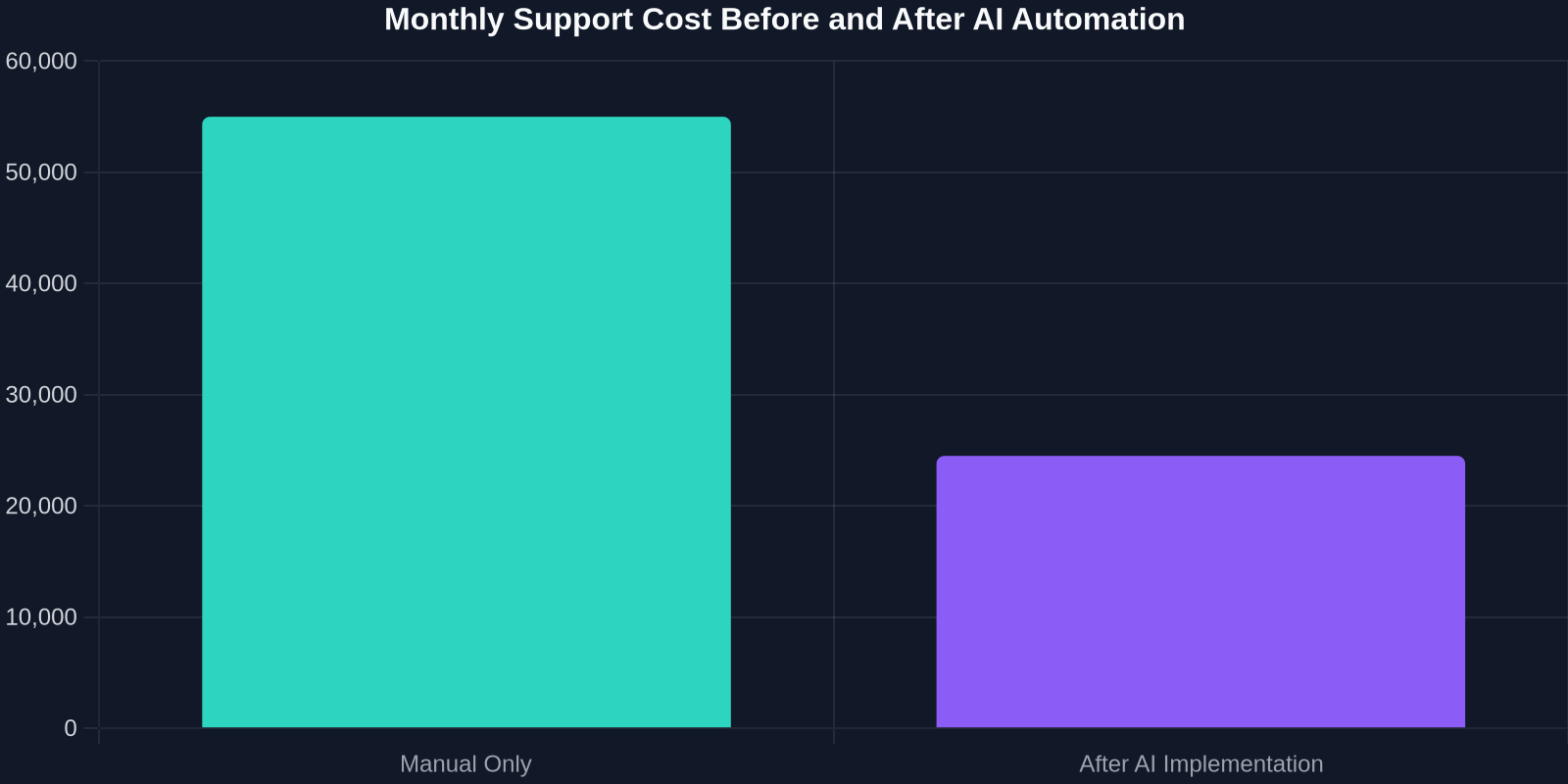
To bring this home for your CFO, let’s model a typical SaaS company with 10 support agents handling 2,000 tickets per month at an average fully loaded cost of $5,500 per agent per month.
| Support Function | Manual Baseline | With AI Automation (Successly) |
|---|---|---|
| Monthly ticket volume | 2,000 | 2,000 (assume volume constant) |
| Tickets deflected by AI | 0 | 1,200 (60% deflection) |
| Tickets requiring human agents | 2,000 | 800 |
| Agents required (assuming 200 tickets/agent/month) | 10 agents | 4 agents |
| Monthly labour cost | $55,000 | $22,000 |
| Monthly software cost | $0 (legacy helpdesk) | $2,500 (Successly) |
| Total monthly support cost | $55,000 | $24,500 |
| Annual cost saving | - | $366,000 |
| Average CSAT | 82% | 93% (AI sent instant, accurate replies) |
| Agent turnover risk | High (burnout from repetition) | Low (agents focus on complex, satisfying work) |
A $366,000 annual saving – enough to double your product team or add two new customer success managers. And that’s before you count the revenue retained through higher CSAT. The model becomes even more compelling when you factor in ticket volume growth that no longer demands additional headcount.
Why Successly Is Built for This Moment
Home Depot had the resources to build a custom AI bot from scratch. Most B2B SaaS companies don’t. Successly condenses years of AI research into a platform that plugs into your existing tech stack in days, not months.
Key differentiators:
• Pre‑trained B2B models: Understands subscription billing, API errors, onboarding milestones.
• ROI dashboard: Shows deflection, CSAT impact, and agent time saved in a single view.
• White‑glove implementation: We audit your tickets and help you build automations in the first sprint.
If you’re ready to deliver Home Depot–grade support without the Home Depot budget, get a demo today and see exactly what AI can do for your team.
Frequently Asked Questions
Will AI support replace my human agents?
No – at least not in any high‑value SaaS environment. AI handles the repetitive tier‑1 queries, freeing agents to focus on complex, high‑touch accounts. Most teams see agent job satisfaction increase because they’re finally doing the interesting work they were hired for.
How long does it take to see ROI from AI customer support?
Most Successly customers see measurable ticket deflection within the first 30 days after go‑live. Full ROI (positive net savings) typically occurs by month 3, once the knowledge base is optimised and the bot has learned from early handovers.
Is my data safe with AI tools that integrate into my backend?
Absolutely. Successly runs on enterprise‑grade SOC 2 compliant infrastructure, encrypts all data in transit and at rest, and can be deployed in a private cloud for customers with heightened security requirements.
Can AI support work for technical B2B products with complex troubleshooting?
Yes – in fact, that’s where the biggest opportunity lies. By ingesting your technical documentation, past tickets, and even GitHub issues, the AI can become a “level 1.5” support engineer that diagnoses problems like expired API tokens or misconfigured webhooks before a human ever needs to read the ticket.
What if I’m already using a chatbot on my website? Isn’t that AI support?
Most older chatbots follow rigid decision trees. They don’t truly understand intent or context, and they don’t learn from interactions. True AI platforms like Successly use large language models fine‑tuned for support, making them orders of magnitude more effective and more natural for customers.
Conclusion: Make Your Support AI Your Competitive Moat
Home Depot didn’t just build a bot – they proved that world‑class support, powered by AI, can be a revenue driver. For B2B SaaS companies, the same principles apply. The technology is mature, the ROI is quantifiable, and the cost of inaction is a support team that drowns in tickets while churn quietly erodes your growth.
By following a disciplined framework and leveraging a platform like Successly, you can transform your support operation from a cost centre into a retention engine. The toolbox is open. The question isn’t whether to implement AI support – it’s how soon you can start seeing results.
Ready to build your Home Depot‑calibre support bot? Book a free consultation with Successly today.