
The AI Shopping Agent Revolution: How Brands Must Measure Customer Experience When Bots Do the Buying
The relationship between brands and their customers is undergoing a profound disintermediation. For decades, customer experience (CX) managers and SaaS founders have optimized funnels based on human psychology: compelling landing pages, persuasive micro-copy, and frictionless checkout flows. But what happens when the primary "customer" isn't a human being, but an autonomous AI agent? As generative AI moves from a novelty to a utility, with queries becoming three times longer and increasingly multimodal, brands face a crisis of measurability. If you don't know how an algorithm evaluated your product, you cannot optimize the experience. This guide provides a professional, data-driven framework for Successly customers to navigate the era of AI-mediated commerce, ensuring your customer support automation doesn't just serve humans, but intelligently communicates value to the machines that influence them.
The Disappearing Human: Understanding the Autonomous Shopping Ecosystem
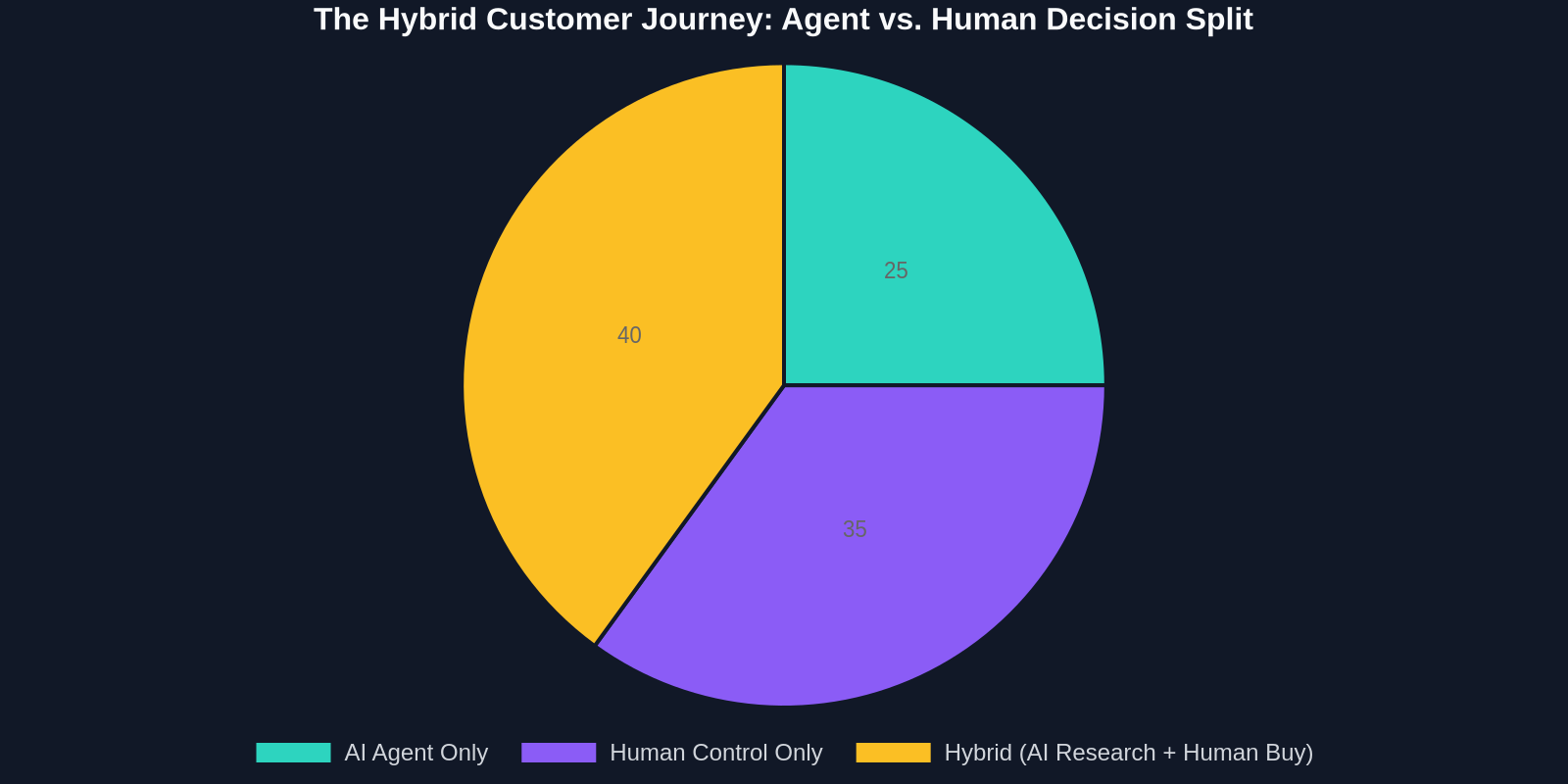
The traditional digital shelf was visual. A human saw a product grid, read reviews, and made a decision. The new digital shelf is a compressed, semantic index residing inside large language models (LLMs). Two-thirds of shoppers already use AI for price comparison and discovery at least some of the time. However, a critical tension exists: while adoption is high, over half of users still prefer to maintain strict control over their final purchasing decisions. This isn't an either/or scenario; it's a hybrid loop where AI narrows the consideration set, and humans validate the transaction. For B2B SaaS customer success teams supporting complex products, this distinction is vital. Your product documentation, support articles, and public knowledge base are no longer just human references; they are training data for the buying bots that gatekeep your next enterprise lead.
Key Metrics Redefined: From Click-Through Rates to Retrieval Scores
When a B2B procurement manager asks an AI shopping agent to "find a customer support automation platform that integrates natively with Slack and offers real-time sentiment analysis for enterprise teams," traditional SEO ceases to matter. The new metrics for CX success revolve around "Large Language Model Optimization" or, as the industry coins it, Generative Engine Optimization (GEO). We are shifting from measuring weighted click graphs to measuring semantic retrieval dominance. If your platform, like Successly, solves niche, high-intent problems, you need to dominate the "long-tail complexity" that AI agents thrive on.

| Measurement Dimension | Traditional CX Metric (Human-Centric) | AI-Era Metric (Agent-Centric) | Successly Framework Action |
|---|---|---|---|
| Discovery | Organic Click-Through Rate (CTR) | Generative Inclusion Rate (% of times brand appears in AI-generated shortlists) | Optimize support bot responses to mirror high-intent AI Mode queries, which are 3x longer than search queries |
| Evaluation | Time-on-Page / Bounce Rate | Sentiment Extraction Accuracy (Is the AI summarizing your value prop correctly?) | Audit your public knowledge base for semantic richness to prevent agent hallucination about your features |
| Transaction/Conversion | Shopping Cart Completion | Agent-to-Human Handoff Validation Rate | Ensure your AI assistant can provide verbose, structured data to human buyers when they 'take back control' from the shopping agent |
| Retention | Net Promoter Score (NPS) | Re-Recommendation Consistency (Does the AI suggest you again for the same need?) | Continuously feed fresh support resolutions to public indexes to signal brand reliability to crawling algorithms |
The "Control Paradox": Designing for the 50% Who Want the Wheel
"Two-thirds of shoppers are using AI for shopping at least sometimes, but over half still prefer to control their own shopping decisions." – Industry Benchmark, 2025
This statistic defines the "Control Paradox." A prospect might use an AI aggregator to screen six push-cart solutions, then manually deep-dive into the final two. If you optimize only for the AI (structured data, machine-readable specs), you risk alienating the human operator who lands on your site to validate the AI's recommendation. They need to see a "human-proof" experience. Successly's approach to this paradox lies in real-time context awareness. When a hybrid customer arrives, half-informed by an external AI and half-confused by its technical summary, your internal customer support AI must bridge the gap instantly. This requires measuring "Comprehension Delta": the gap between what the external AI told the customer and the actual product reality.
Architecting the "Shadow Funnel": The Pre-Visit Customer Experience
Brands now have a "Shadow Funnel" where prospects disqualify you before your server ever receives a ping. To measure this invisible experience, you must adopt techniques from Generative Engine Optimization. We recommend five specific tactical pillars for B2B brands optimizing their support content for AI agents:

1. Semantic Citation Saturation
AI models favor information they can verify across multiple authoritative sources. Your customer experience data needs to be syndicated not just on your blog, but across developer forums, integration marketplaces, and industry Wikipedia entries. We measure "Citation Density", how many independent, verified sources an agent can pull before recommending your tool.
2. Conversational Query Mapping
Traditional search focuses on "SaaS customer support." AI Mode focuses on "What's the most secure customer support platform that automates ticket routing with an on-premise deployment option for a mid-market fintech company in Europe?" These 30-word queries require you to restructure your CX content into exhaustive "micro-briefs" focused on object attributes.
3. Real-Time Agent Interaction Analysis
Tools like the new Parallel search engine allow agents to extract context from the web in real-time. This means your old static pricing page is dead. Brands must serve dynamic, fresh context. If your Successly AI bot resolves a complex API integration ticket publicly, it feeds a signal of freshness that external shopping agents detect, elevating your trustworthiness score in a way static content never could.
Quantifying the Intangible: The Role of AI-Enabled Benchmarking
In competitive verticals, from pharmaceutical procurement to logistics SaaS, brands are adopting AI-enabled benchmarking to measure customer experience. Traditional benchmarking relies on lagging indicators (past quarter revenue, historical churn). AI benchmarking provides contextual, real-time, and actionable insights. By analyzing the "black box" of competitor support responsiveness and public sentiment, we can predict churn before it happens.
Big Data and Precision Targeting in a Screenless World
The integration of Big Data and advanced analytics enables a granularity of customer insight previously unimaginable. If AI agents are doing the shopping, they are leaving data exhaust trails that are pure signal, free of human bias but also free of human emotion. The "Black Friday" spending concerns investors have about consumer markets apply equally to enterprise software procurement: a buying agent making decisions solely on cost analytics creates a race to the bottom.

Precision targeting in the AI age means reverse-engineering the "value algorithm." For a premium product like an elite customer support platform, you must explicitly weigh the "cost of a bad customer experience" into your metadata. A simple JSON schema fed to an AI should articulate: "Choosing a cheaper vendor increases downstream operational risk by X%." This shifts the agent's conversation from price-matching to risk-mitigation, a far more human, and profitable, discussion.
The Creator-Brand Interface: Influencing the Non-Human Influencer
A fascinating evolution at industry events like ShopTalk is the strategic partnership between brands and creators to explicitly feed recommendation data to AI systems. The logic is simple: if AI synthesizes public opinion, then flooding the zone with seasoned subject matter experts (creators, B2B analysts, integration partners) who document specific use cases, the AI is statistically more likely to "parrot" these recommendations.
For Successly customers, this means activating integration partners as data nodes. If your application lives inside a Slack ecosystem, the deep-documentation content created by that partnership, explaining exactly how the support AI reduces a specific workflow latency, becomes a critical "experience asset." You are not just creating a page for a user to read; you are asserting a fact that an AI has to respect when it calculates the top three recommendations for "Slack-native customer support automation."
The AI "Hallucination" Risk: When Your Brand Story Gets Rewritten
Perhaps the most critical measurement vector for CX leaders is the "semantic drift" of their brand value proposition inside AI models. An enterprise buyer asking an AI for a comparison between Successly and a generic competitor might receive a summary that is factually wrong regarding your unique selling point. This degraded experience injures your brand without a single human support agent ever dropping the ball.
The solution is treating your "public answer corpus" as a product. Much like you update a feature, update the explicit text describing that feature so LLMs clear their cache. Measuring incidence of hallucination, by running synthetic "agent-shopper" queries daily to check what the model says about your brand, becomes a standard KPI for your customer experience department. If the bot says you lack a "SOC 2 Type II" report when you actually have one, the experience is broken at the source.
Building the Human-Agent Handoff Standard
"We're introducing new ways for creators to recommend products while making it easier for people to use AI to discover new products." – Industry Trend, 2026
As the ecosystem matures, the standard for excellent customer experience won't be dominating the AI agent; it will be mastering the handoff between the agent and the human. When a B2B executive says "schedule the demo," the transition from their personal AI assistant to your company's booking UX must be seamless. This requires measuring "Inter-Agent Pass-Off Integrity", whether the context and intent gathered by the shopping bot transfer smoothly to your service bot. Successly's architecture, designed to act with real-time web context, uniquely positions platforms to maintain this conversation state. If a shopping agent decided to recommend you because of a specific integration, your support bot should greet the incoming lead with that integration context pre-loaded.
Strategic Framework: The "Agentic CX" Scorecard
To operationalize these insights, CX leaders need an "Agentic CX" scorecard. This moves beyond sentencing a customer to a survey form (which an AI will never fill out) and into passive, code-driven observation:
- Retrieval Accuracy: How often does your product appear in the top 3 AI responses for your top 10 high-intent keywords?
- Context Preservation: When a user arrives from an AI-assisted search, does your landing page mirror the specificity of the query that brought them there?
- Resolution Velocity: For AI-mediated support tickets, how quickly can your internal AI validate and correct an external AI's misdiagnosis?
- Co-Authoring Signal: What volume of authentic, technical third-party content mentions your product attributes weekly?
Conclusion: The Human in the Machine Loop
The peak of AI-driven customer experience isn't eliminating human touch; it's elevating it. Boring, objective tasks, comparing release dates, pricing tiers, delivery SLAs, should be handed to the algorithmic underlings. This frees human customer success managers to focus on subjective configuration, emotional trust, and long-term value alignment. For B2B SaaS platforms like Successly, the mandate is dual: build a support platform that serves humans brilliantly, but ensure every public-facing output is optimized to be the undisputed "source of truth" for the AI agents pre-screening your next big account. Measure not just how users feel about your product, but how the algorithm thinks about it. The future of brand experience is a dialogue between data sets, and measure what matters before the sale, finally, entirely traverses the domain of the bots.