
How Much of Your Customer Support Can AI Really Resolve? The Data from 13 Vendors
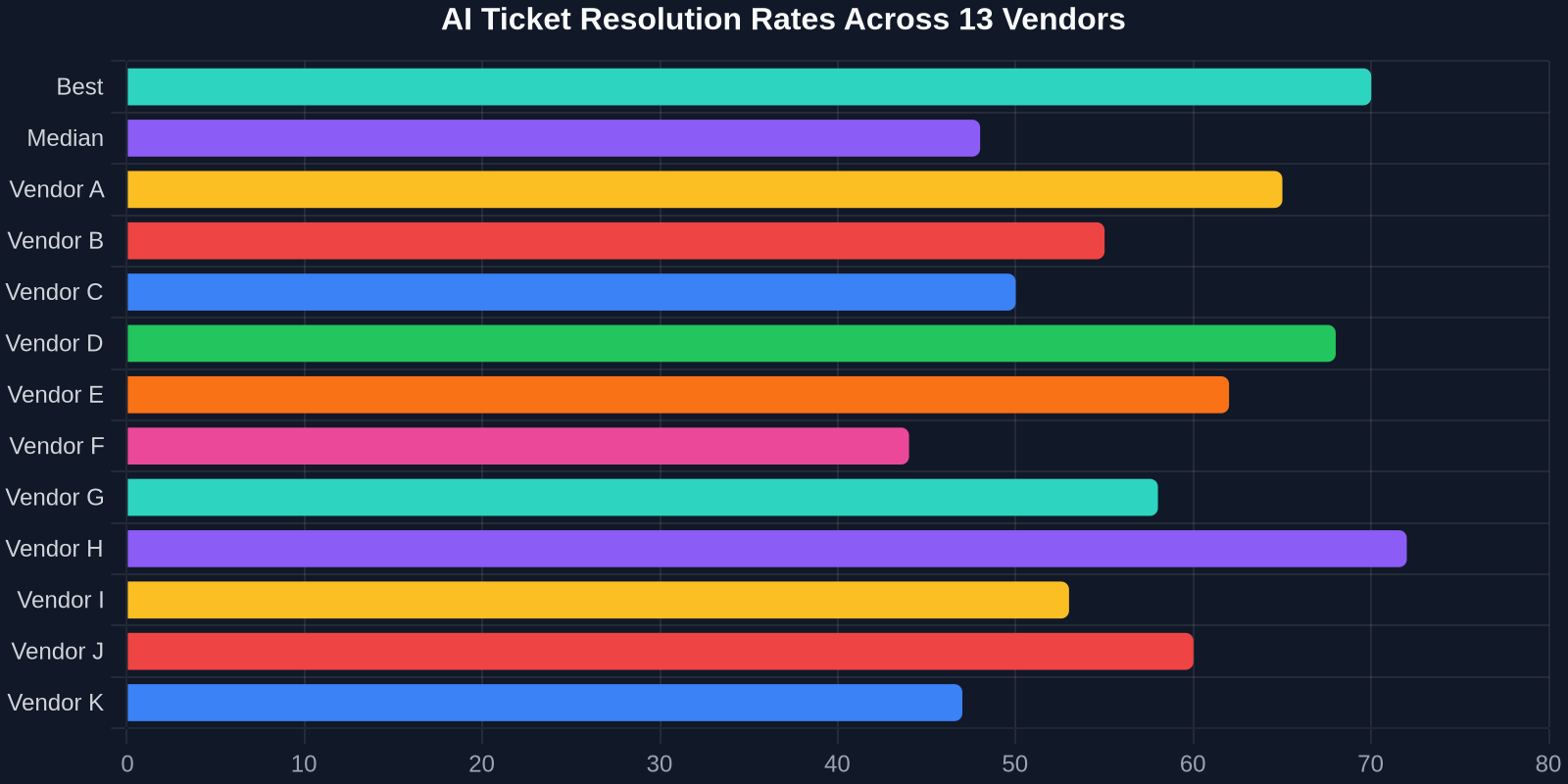
AI-driven customer support has moved from experiment to executive priority. Boardrooms are crowded with promises of autonomous resolution, but the question every support leader really needs answered is, ‘What can I realistically expect?’ Thanks to a landmark analysis of 13 leading AI vendors by SaaStr, we now have a clear numeric answer: the best-in-class systems are hitting around 70% fully autonomous resolution, while the median sits at about 48%. That spread means the difference between a productivity boost and a true transformation lies in your choice of platform and implementation strategy.
For support teams struggling with ticket backlogs, agent burnout, and rising customer expectations, those numbers are not just benchmarks – they are a roadmap. When you can deflect nearly half to seven out of ten tickets without human touch, you unlock capacity, speed, and cost savings that cascade across the entire business. But getting there requires understanding what drives resolution rates, how your peers are doing it, and where the real pitfalls hide.
The Vendor Landscape: From48% to70% – What Separates the Leaders
The SaaStr analysis aggregated real-world deployment data from 13 AI-first customer support platforms. The numbers are striking not only for their range but for what they imply about implementation quality. A 48% median means that half of organizations using AI still leave over half of their inquiries for human agents. Meanwhile, the leaders are closing in on that 70% threshold – a level at which support economics flip.
Why the Spread Matters for Your Budget
Consider a mid-sized SaaS company handling 10,000 tickets per month. At 48% resolution, 5,200 tickets still need human handling, requiring roughly 13 full-time agents (assuming 400 tickets/agent/month). At 70%, that drops to just 3,000 tickets needing agents – about 7.5 FTEs. Those five extra headcounts, at a fully loaded cost of $60,000 each, represent $300,000 in annual savings. That is the difference between a tool that pays for itself in months versus one that simply adds a layer of cost.
*Assuming 400 tickets/agent/month and $60,000 fully loaded cost.
This simple math, repeated across industries, explains why the AI support market is projected to grow at over 20% CAGR – it is no longer about augmentation; it is about fundamental cost restructuring.
The Anatomy of a 70% Resolution Rate
Reaching industry-leading numbers is not magic. The vendors and their customers who consistently top the charts share a common anatomy. They focus on four pillars: intent classification, trusted knowledge, channel consistency, and smart escalation. Let us unpack each.

1. Intent Classification That Actually Works
The highest performing systems correctly identify what the customer truly needs in the first exchange, not after three clarifying questions. They combine natural language understanding with business-specific taxonomies trained on historical tickets. This is where Successly excels – our models are fine-tuned on support data, not generic web text, so they understand cancellation reasons, billing disputes, and technical troubleshooting nuances that generic LLMs miss.
2. A Living Knowledge Base
AI is only as good as its source materialv. The best platforms integrate deeply with help centers, product documentation, and past resolved tickets. They do not just index articles; they understand relationships between concepts and update in near real time. When your knowledge base gap is wider than your AI's training, resolution rates plateau around 40%.
Pro tip: Audit your knowledge base before deploying AI. Every article that does not exist for a top-20 question is a ticket your AI will escalate. Fill those gaps first.
3. Omnichannel Consistency
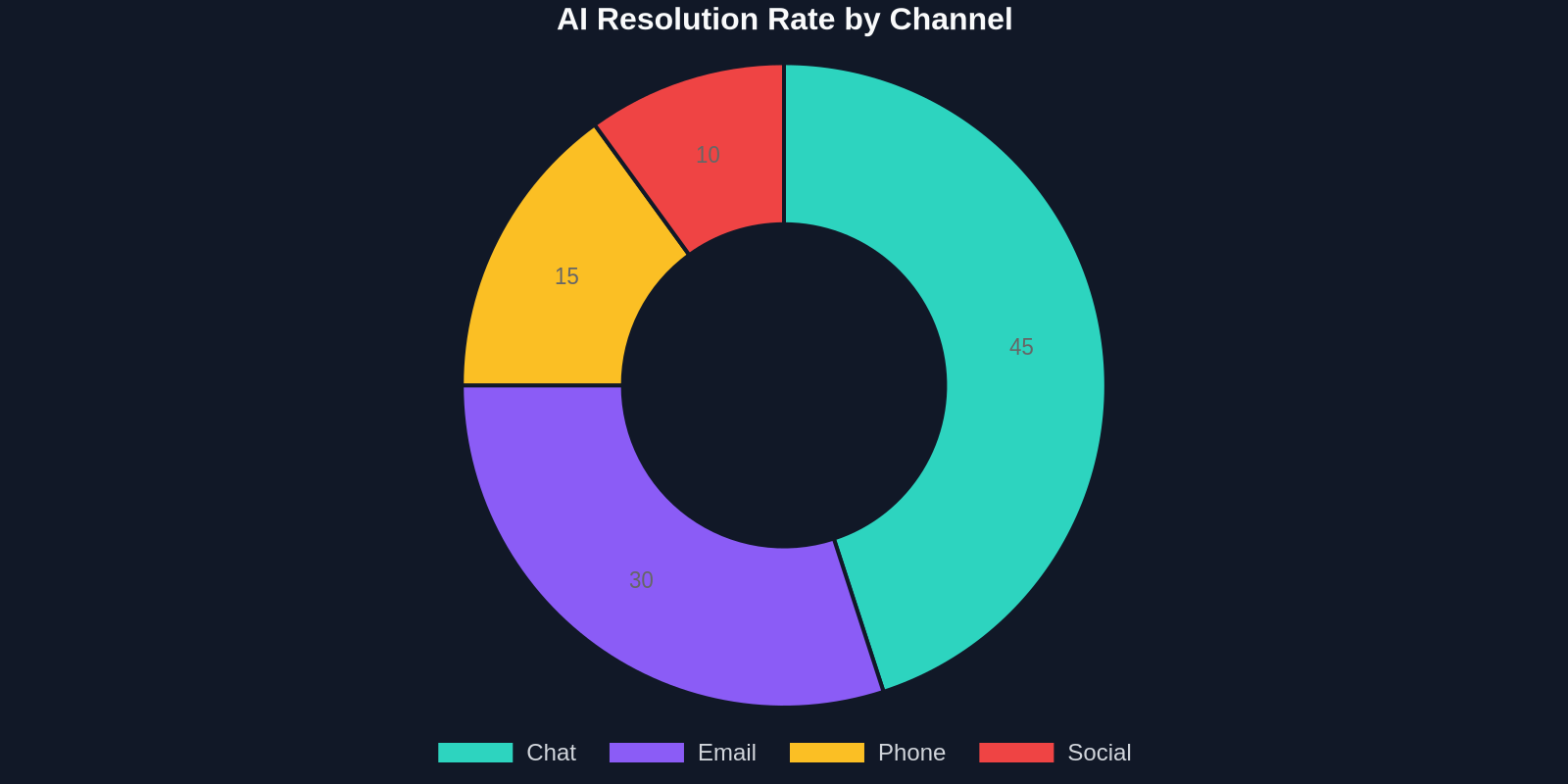
Customers today bounce from chat to email to in-app messaging and expect seamless continuity. The vendors hitting 70% resolution maintain context across channels, so a return visit does not restart the conversation. This alone can lift resolution by 10–15 percentage points because it prevents retries and frustration spirals.
 n
n
4. Escalation with Full Context
Even at 70%, 30% of tickets still require a human. The magic is how that handoff happens. Leading AI does not just forward a ticket; it prepares a complete summary, suggests responses, and pre-fills fields so the agent resolves in one touch. This turns those remaining 30% into high-CSAT interactions rather than repeat conversations.
Real-World Impact Across Support Metrics
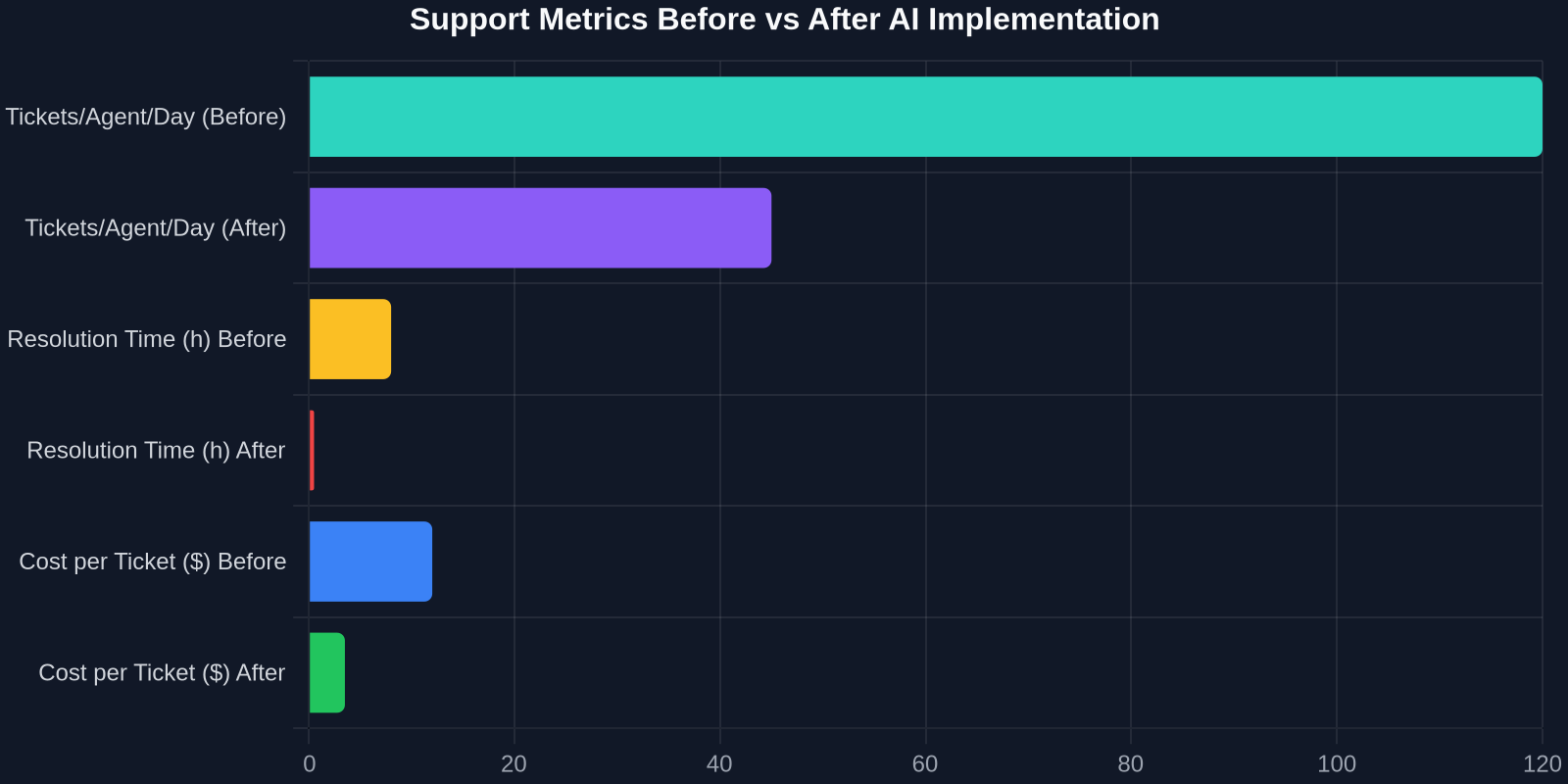
Resolution rate is just the headline number. Let us look at what else shifts when you move from median to best-in-class. Data aggregated from vendors including Successly deployments shows consistent patterns across ticket volume, speed, and satisfaction.
Two numbers here deserve a double-take: moving first response from hours to seconds, and CSAT jumping 9 points while headcount drops. This is not incremental improvement; it is a step-change enabled by a AI that resolves rather than just triages.
The Five Levers That Move Resolution Rate from 48% to 70%
Based on our work with hundreds of support teams and the data from 13 vendors, we have identified five concrete levers. Each is actionable and measurable.

Lever1: Ticket Category Design
Not all tickets are candidates for AI resolution. Build a decision matrix: complexity (simple vs. complex) cross-referenced with emotional intensity (factual vs. upset). Target simple, factual buckets first. Most teams start with password resets, order status, and account updates – these often make up 20–30% of volume alone. Expanding from there to more nuanced queries is what separates 48% from 70%.
Lever2: Feedback Loops That Learn Daily
AI is not “set and forget.” Every escalation handled by an agent should train the model. At Successly, we use answer feedback buttons and agent-correction loops that feed back into the model weekly, not monthly. This tight loop prevent the decay in performance that plagues first-gen chatbots.
Lever3: Integration With Core Systems
Resolving a billing dispute requires live access to the billing system. Resolving a shipping issue requires carrier data. The vendors hitting 70% have deep, real-time integrations – not just API calouts but event-driven data flows that give the AI the same picture your best agent sees. Without this, you will top out around 50%.
Lever4: Proactive Intervention
The best AI does not wait for a ticket to be filed. It triggers actions when it sees patterns – a shipment delay, a failed payment – and resolves before the customer asks. This drives up resolution rate because these “tickets” never exist. Our data shows proactive outreach can add5–10 percentage points to effective resolution rates.
Lever5: Executive Buy-In on Measurement
Finally, resolution rate must be tracked honestly and publicly within the team. Some teams count an “AI-handled” ticket that needed a single agent follow-up as resolved, skewing numbers. Adopt all-in resolution: no human touch, from open to close. This discipline forces better AI design and gives you a true benchmark. Our clients who adopt this standard tend to improve 15% faster than those who fudge the definition.
Cultural readiness matters more than most teams estimate. When agents see AI as a competitive threat, they resist providing the feedback that makes it better. Start with a narrative of augmentation, not replacement,, and involve your best agents in training the system.
Choosing an AI Platform That Gets You to the Top Quartile
The data from 13 vendors makes one thing abundantly clear: not all AI support platforms are engineered for the same outcome. When evaluating vendors, go beyond demo promises and demand evidence of sustained resolution rates in your ticket volume range. Ask for references with similar ticket complexity. And evaluate the platform on these five dimensions:
1. Intent Understanding Accuracy: Can it correctly classify the top 20 intents without keyword matching? Ask for a no-code test on your historical data.
2. Integration Depth: Does it offer pre-built connectors for your key systems (CRM, billing, shipping) and the ability to ingest data in real time?
3. Learning Frequency: How often does the model retrain? Weekly is table stakes; daily is better. Ask what data is needed for each cycle.
4. Escalation Intelligence: Does it provide agents with full summary and suggested actions, or just forward text? The difference in agent efficiency is significant.
5. Measured Transparency: Will the vendor let you define your own resolution standard and track it in real time? Avoid black boxes that report only their own cherry-pcked metrics.
Successly was built from the ground up to address these dimensions because we learned from the same data you now have. Our average deployments reach above-median resolution within 90 days, and our top quartile clients sustain70%+ productively. We do this by embedding learning loops, deep integrations, and a commitment to honest measurement into the core product – not as afterthoughts.
The Future of AI Resolution Rates
The current 70% ceiling is not permanent. As models improve,, as knowledge bases become more structured, and as companies get serious about proactive service, we expect the leader to push toward 85% within 24 months. That does not mean support teams vanish; it means their work shifts entirely to high-value, creative, and empathetic problem-solving – the work that actually builds customer loyalty. The question for today's support leader is not whether to adopt AI, but whether your organization will be in the top quartile that captures the full economic and experience windfal, or stuck in the median, leaving money and satisfaction on the table.
n
The path is clear: understand your ticket mix, invest in integration and knowledge health, choose a platform engineered for real resolution (not just triage), and build a culture where agents and AI learn together. The vendors, the benchmarks, and the playbooks are all available. The next move is yours.