
Agentic AI Self-Service: The New Frontier in Automated Customer Support
In the fast-evolving landscape of customer support, traditional chatbots have hit a wall. They answer simple FAQs but crumble when faced with multi-step, context-heavy requests. The emergence of agentic AI, autonomous agents that not only understand queries but reason, act, and resolve complex issues, is rewriting the rules of self-service. For SaaS founders, support team leads, and B2B customer success managers, this shift is more than a technology upgrade; it's an opportunity to slash ticket volumes, accelerate response times, and elevate the customer experience while controlling operational costs.
The goal of this post is to equip you with a complete understanding of agentic AI self-service for customer support, its measurable business impact, and a practical framework for implementation. We'll draw from the latest research and real-world application, culminating in how platforms like Successly help you harness this capability without a massive engineering lift.
The Evolution from Chatbots to Agentic AI
For years, customer service automation relied on rules-based chatbots: if a user typed "reset password," the bot would send a link. The limitation was stark: these tools possessed no reasoning, no memory, and no ability to act across multiple systems. They defected rudimentary tickets but often frustrated customers who needed more.
Agentic AI represents a fundamental leap. These agents are designed with persistent context, the ability to break down complex goals into smaller tasks, and the authorization to execute actions, updating records, initiating workflows, and integrating with backend systems in real time.
This evolution is driven by large language models (LLMs) that can process nuanced language, retrieve relevant knowledge, and chain together multiple operations. Instead of scripting every possible path, organizations now define objectives and boundaries, and the agent navigates to a resolution autonomously.
Why Agentic AI Self-Service Matters for Customer Support
The strategic importance of agentic AI self-service boils down to three massive leverage points: scale, speed, and satisfaction.

Scaling Support Without Linear Headcount Growth
As SaaS businesses grow, support volumes explode. Hiring proportionally to maintain service quality is costly and unsustainable. Agentic AI allows you to deflect a significant portion of tickets without compromising resolution quality.
Meeting Modern Customer Expectations
Customers expect instant, accurate resolutions 24/7. A study by Zendesk found that 75% of customers believe they should be able to resolve complex issues without speaking to a human. Agentic self-service fills this gap, handling multi-step issues, from order modifications to account provisioning, that used to require agent intervention.
Empowering Human Agents for High-Value Work
When AI handles tier-1 and many tier-2 requests, human agents can focus on relationship-building and complex, sensitive cases. This not only improves efficiency but boosts agent job satisfaction and reduces burnout.
Core Capabilities of Agentic AI Platforms
Not all AI self-service tools are created equal. A true agentic platform must demonstrate:
- Reasoning and Multi-step Planning: The agent can understand intent beyond keywords, decompose a request like "change my subscription and apply the loyalty discount" into distinct tasks, and execute them in the correct sequence, pulling information from CRM, billing, and knowledge bases.
- Contextual Memory: The agent remembers previous interactions, preferences, and decisions within a session and across conversations, eliminating repetitive questions.
- Tool and API Integration: It's not just a text interface; the agent calls APIs to fetch order status, update shipping addresses, restart services, or adjust licenses, all without human intervention.
- Dynamic Learning and Guardrails: Through thoughtful design, the agent learns from feedback and new data while operating within strict governance boundaries to prevent errors and security breaches.
"The reasoning capability means agents can handle multi-step customer service escalations, legal document analysis, and financial modeling workflows."
These capabilities translate into a self-service experience that feels less like a bot and more like a knowledgeable concierge.
Measuring the Business Impact: Data That Matters
Implementing agentic AI self-service without clear metrics is like sailing without a compass. Companies that deploy these systems track a handful of key indicators to demonstrate ROI.

| Metric | Before Agentic AI | After Agentic AI |
|---|---|---|
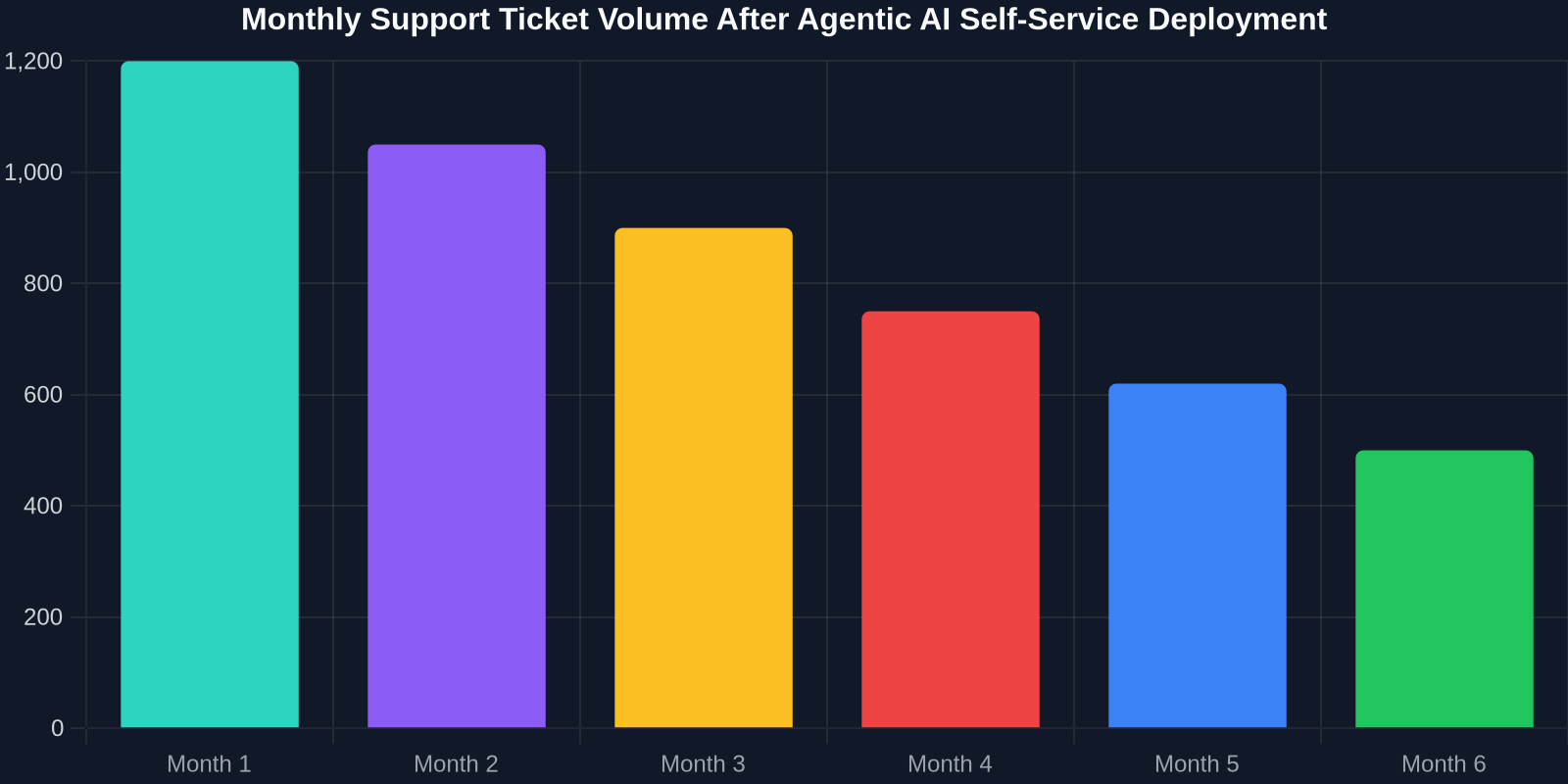
Following a structured deployment, one B2B SaaS company saw ticket volume drop by nearly 60% over six months, as reflected in the chart above. The deflection rate alone allowed them to redeploy five full-time agents into customer success roles, deepening relationships without adding headcount.
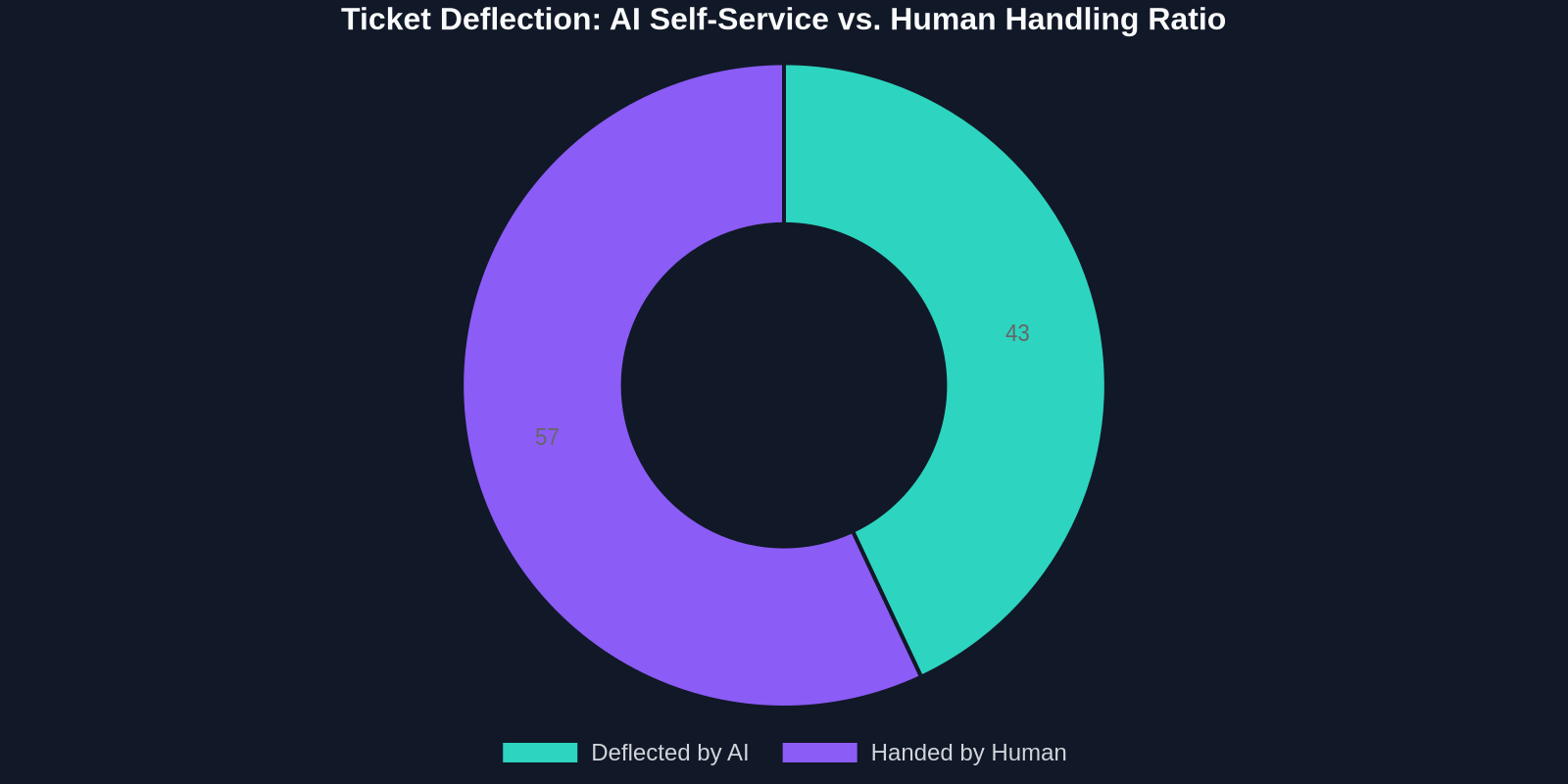
The doughnut chart visualizes the ticket deflection split: 43% of all inquiries are resolved entirely by AI, without a human touch. This number climbs to over 50% for common transactional tasks like billing inquiries, password resets, and plan upgrades.
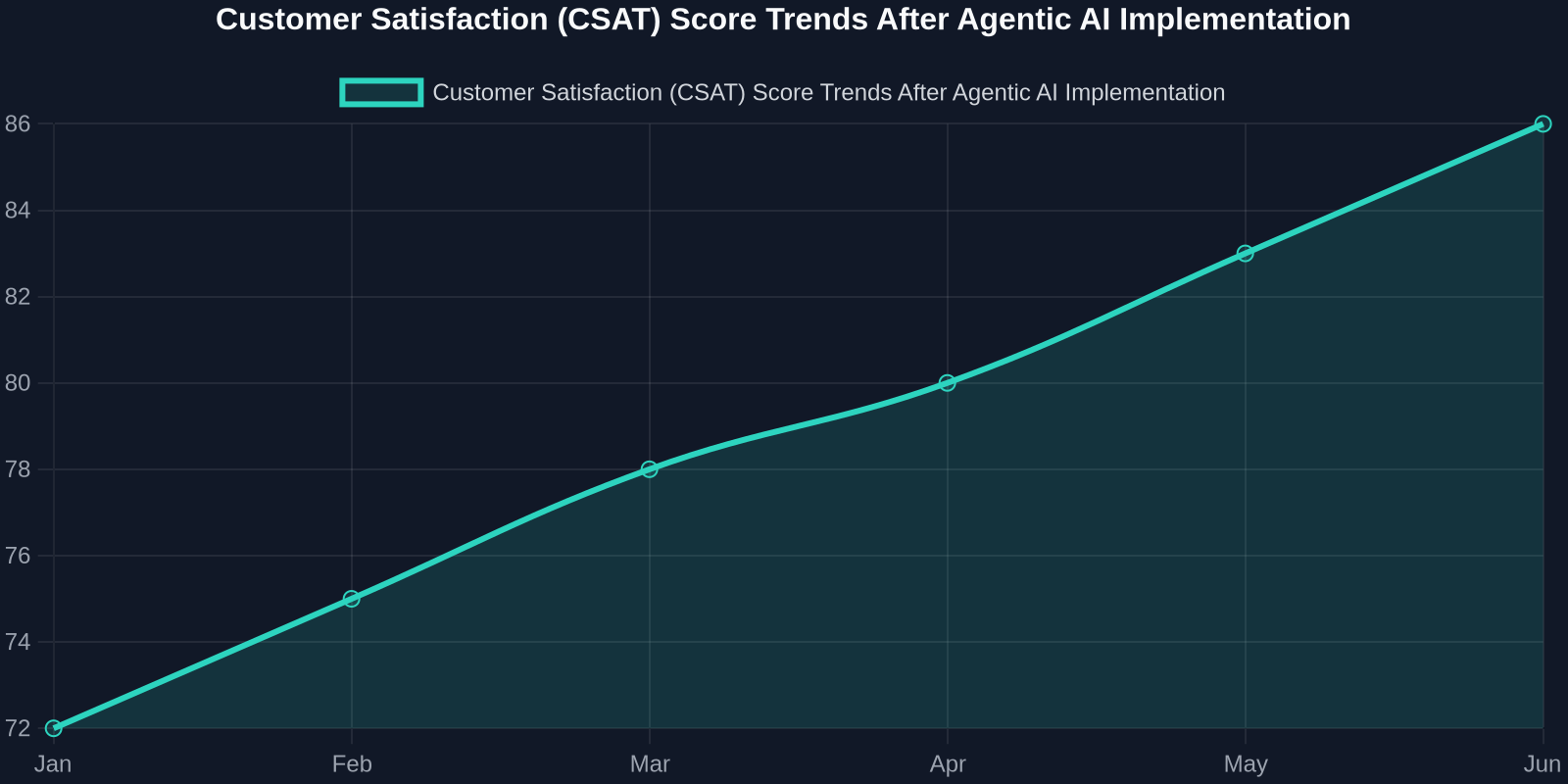
CSAT improvements are not instantaneous, they build as the AI becomes more accurate and as customers trust the system. The line chart above shows a steady rise from a baseline 72% to 86% over six months, driven by faster resolutions and 24/7 availability.
Implementing Agentic AI: A Step-by-Step Framework
Rolling out agentic self-service isn't a one-click task. It requires process alignment, data preparation, and change management. Here's a practical four-phase approach:
Phase 1: Audit and Prioritize Use Cases
Start by analyzing your ticket data. Categorize requests into fully automatable (password resets, billing queries), partially automatable (order changes requiring validation), and complex (legal or specialized technical diagnosis). Agentic AI scales best when you target the middle category, voluminous, semi-repetitive tasks that follow discernible patterns but need multi-system coordination.
Phase 2: Unify Your Knowledge and System APIs
Agentic AI feeds on structured and unstructured data. Ensure your knowledge base articles, SOPs, and policy documents are current and accessible via API. Then, map out the integrations the agent will need: CRM, billing, identity management, and internal admin panels. Platforms like Successly come with pre-built connectors that drastically reduce this setup time.
Phase 3: Design the Agent's Behavior and Guardrails
Define the agent's persona, fallback rules, and escalation triggers. Implement rigorous testing with internal teams and a friendly beta group. Set clear thresholds: when should the agent attempt self-correction, and when should it immediately escalate? Establish tiered authorization levels so the AI cannot perform high-risk actions without secondary confirmation.
Phase 4: Launch, Monitor, and Iterate
Go live with a subset of use cases. Monitor deflection rate, CSAT, and containment rate (issues solved without escalation). Use analytics to identify where the agent struggles and feed those examples back into training. Continuous improvement is the hallmark of successful agentic deployments.
Overcoming Common Challenges
While the promise is enormous, teams must navigate innate challenges:
- Data Silos: Agentic AI is only as good as the context it can access. Break down silos between support tools, CRMs, and product data lakes.
- Change Resistance: Customers may initially mistrust an AI that acts on their behalf. Build transparency, e.g, "I'm updating your shipping address now", and always allow a quick path to a human.
- Governance and Security: AI that can execute actions requires strict identity and access management. Ensure the agent operates with a service account limited to only the necessary permissions.

Why Successly is the Agentic AI Solution for Support Teams
As you consider weaving agentic AI into your support stack, the platform you choose makes all the difference. Succesly is purpose-built for customer support automation, with an emphasis on business outcomes rather than mere conversation.
- Zero-code Playbooks: Succesly lets you design multi-step workflows that mimic your best agents' processes, no engineering required.
- Omnichannel Integration: It plugs into your existing helpdesk (Intercom, Zendesk, Freshdesk) and chat tools, so your team can go live in days, not months.
- Action Orchestration: Through secure API calls, Succesly resolves common tasks like refunds, subscription changes, and account merges directly, without leaving the conversation.
- ROI-Focused Analytics: Get real-time dashboards showing ticket deflection, CSAT contribution, and agent time saved, metrics that matter to the CFO.
By offloading routine but complex requests, Succesly's agentic AI frees your human agents to focus on strategic customer relationships, orchestrate high-value expansions, and reduce churn, all while keeping support costs predictable.
Conclusion: The Self-Service Imperative
Agentic AI self-service is no longer a futuristic concept; it is a current competitive necessity for scaling SaaS and B2B support operations. The data is compelling: deflection rates of 40%+, CSAT jumps of 15 points, and response times measured in seconds rather than hours. More importantly, it allows support teams to shift from a reactive cost center to a proactive driver of customer success.
The key is to start with a clear strategy, choose a capable platform like Succesly, and iterate relentlessly. Your customers get the instant, accurate service they demand; your agents get to do the work they love. That is the future of support, autonomous, intelligent, and undeniably human at its core.
"Agentic AI doesn't just answer questions, it executes tasks, learns from outcomes, and turns support into a growth engine."