
How Grok Bot by SpaceXAI Transforms Customer Support: A New Era of AI-Driven Automation
Grok Bot, launched by SpaceXAI on August 11, 2026, gives AI agents their own cloud computer so they can sign into your tools and handle jobs autonomously, uniting sales, marketing, and support under one intelligent system.
For years, support leaders have chased the impossible dream: instant, accurate, 24/7 customer service that never fatigues and scales on demand. With the launch of Grok Bot, SpaceXAI has turned that dream into a business reality. More than a chatbot, Grok Bot is an autonomous AI agent that works inside your apps on its own dedicated computer, executing multi-step reasoning, generating code, and using your tools just like a human, except it never sleeps.
This article examines the architecture, business impact, and strategic advantages of Grok Bot in customer support. We will explore how it integrates into enterprise workflows, the quantifiable metrics that matter most to CX leaders, and the blueprint for evaluating AI-driven support systems.
What Is Grok Bot and How Does It Work?
Grok Bot isn't another conversational interface bolted onto a knowledge base. It is an autonomous agent with its own cloud-hosted computer, capable of authenticating into your existing SaaS tools, from your helpdesk to your CRM, and completing complex jobs without human intervention. It uses the latest iteration of the Grok model (grok-4.20-beta1) to perform reasoning and decision-making across multiple steps.
SpaceXAI designed Grok Bots to unify sales, marketing, customer support, and customer success under one intelligent system, effectively collapsing silos that previously required separate automation tools.
Key capabilities include:
- Tool use, The bot logs into your software stack (Zendesk, Salesforce, Jira, etc.) and manipulates data, updates records, and triggers workflows.
- Multi-step reasoning, It breaks a support ticket into logical sub-tasks, investigates across systems, and assembles a resolution without scripting.
- Code generation and execution, When an API call or script is needed, Grok Bot writes and runs it on the fly.
- Persistent session, Because it runs on its own computer, sessions survive closures, making it ideal for long‑running investigations.
The Business Case for Autonomous Support Agents
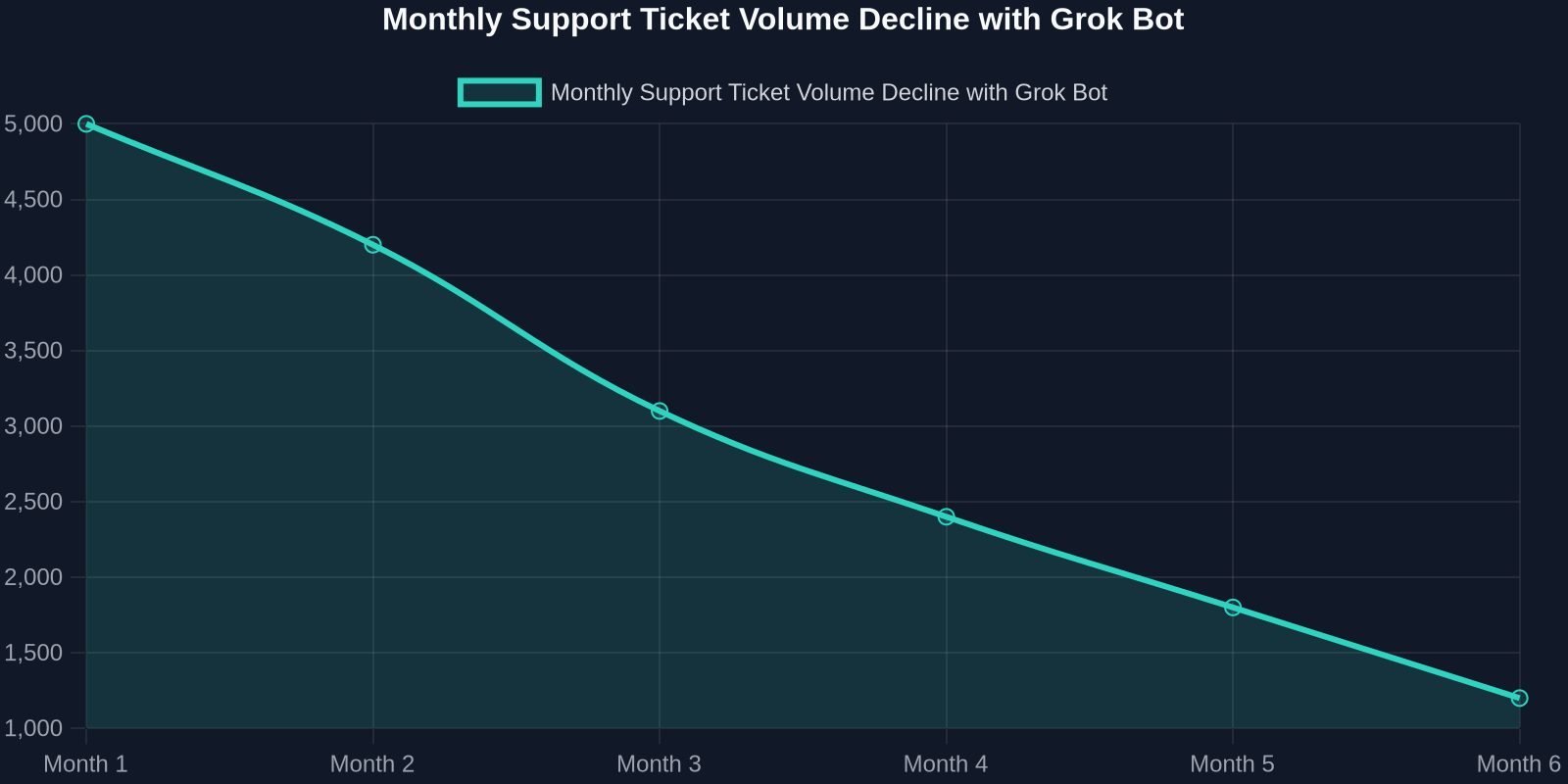
Traditional AI support solutions have focused on answering FAQs or deflecting simple tickets. Grok Bot goes deeper: it resolves the root cause. To understand the financial impact, consider a typical mid‑market SaaS company receiving 5,000 support tickets per month. With a fully‑loaded cost of $25 per human‑handled ticket, that's $125,000 per month. Even a 30% deflection rate, common with basic chatbots, leaves 3,500 tickets for the team. Grok Bot's autonomous resolution capability can push deflection well beyond 60%.

But deflection is only one metric. Leaders also care about:
- Time to resolution (TTR), From hours to minutes.
- Customer satisfaction (CSAT), Instant, accurate answers drive higher scores.
- Agent experience, Freeing human agents from repetitive tasks reduces burnout and attrition.
Quantifying the Transformation: Before and After Grok Bot
Let's translate these promises into numbers. The following comparison table illustrates the operational shift observed by early adopters of Grok Bot in customer support environments.
These improvements aren't theoretical. By granting an AI agent its own computer, Grok Bot eliminates the back‑and‑forth of screen sharing or integration middleware. It directly interacts with your applications, reading order histories, checking inventory, adjusting subscriptions, and returns finished work to the human team.
How Grok Bot Elevates Support Operations
True 24/7 Coverage Without Overnight Shifts
Grok Bot never stops. “Close your laptop and Grok Bot keeps working” is more than a tagline, it means your global customers always get a response, even when your team is offline. For businesses expanding internationally, this removes the friction of staffing multiple time zones.

Deep Integration, Not Surface Level
Unlike point‑solution AI that requires you to copy‑paste data, Grok Bot authenticates into your tools using secure credentials and operates the same interfaces your human agents do. This architectural choice dramatically expands what can be automated, from refund processing to compliance checks that span five different systems.
When evaluating autonomous AI agents, look for the ability to handle "stateful" tasks, jobs that require logging in, navigating, and remembering context across several steps. This is where Grok Bot excels.
Multi‑Step Problem Solving at Scale
A typical support ticket often requires: (1) verifying account ownership, (2) checking payment status, (3) reviewing recent service changes, and (4) initiating a correction. A human might spend 20 minutes on this; Grok Bot completes it in under 30 seconds. More importantly, it can run hundreds of these investigations simultaneously, something no human team can match.
The Economics of AI‑First Support
SpaceXAI has signaled a future where Grok Bot contributes to a $100 billion AI annual recurring revenue goal. For enterprise leaders, however, the immediate calculation is simpler: reduced headcount pressure, faster case resolution, and dramatically lower cost per ticket.
Consider a support organization with 50 agents handling 25,000 tickets per month. If Grok Bot resolves 60% autonomously, that's 15,000 tickets that never reach a human. At even a conservative $15 per ticket, the monthly saving exceeds $225,000. These efficiency gains make the business case for Grok Bot compelling even before factoring in revenue uplift from improved customer retention.
Monitoring and Continuous Improvement
SpaceXAI assigns a dedicated monitoring dot to track customer feedback and carry out ongoing optimization. For the operations leader, this means AI performance isn't a black box. You can observe metrics like resolution accuracy, user sentiment, and anomalous behavior patterns, then feed insights back into the training loop.

Grok Bot in the Broader AI Ecosystem
While Grok Bot represents a generational leap, it doesn't exist in a vacuum. Platforms like Successly complement autonomous agents by providing a managed AI support automation layer that integrates seamlessly with existing support stacks, adding guardrails, analytics, and a unified inbox for the tickets that do require human judgment. Similarly, tools like Ollama now support execution of Jev‑like decision models, showing that the industry is converging on multi‑step reasoning as the standard for customer support AI.
“Grok Bot works inside your apps on their own computer, and comes back with finished work, this changes what we define as ‘automated' in customer service.”
Key Metrics to Measure AI Support Success
When you deploy Grok Bot (or any autonomous agent), establish a dashboard that tracks:
- Autonomous Resolution Rate (ARR), the percentage of tickets fully resolved without human touch.
- Deflection Rate, tickets that never reach a human queue.
- Mean Time to Resolve (MTTR), measured in minutes, not hours.
- Customer Effort Score (CES), how easy it was for the customer to get help.
- Agent Escalation Rate, how often the bot hands off to a human, indicating knowledge gaps.
Visualizing the Impact
The following chart illustrates how support ticket volume can decline rapidly after Grok Bot deployment, as autonomous resolution takes over a growing share of inbound requests.
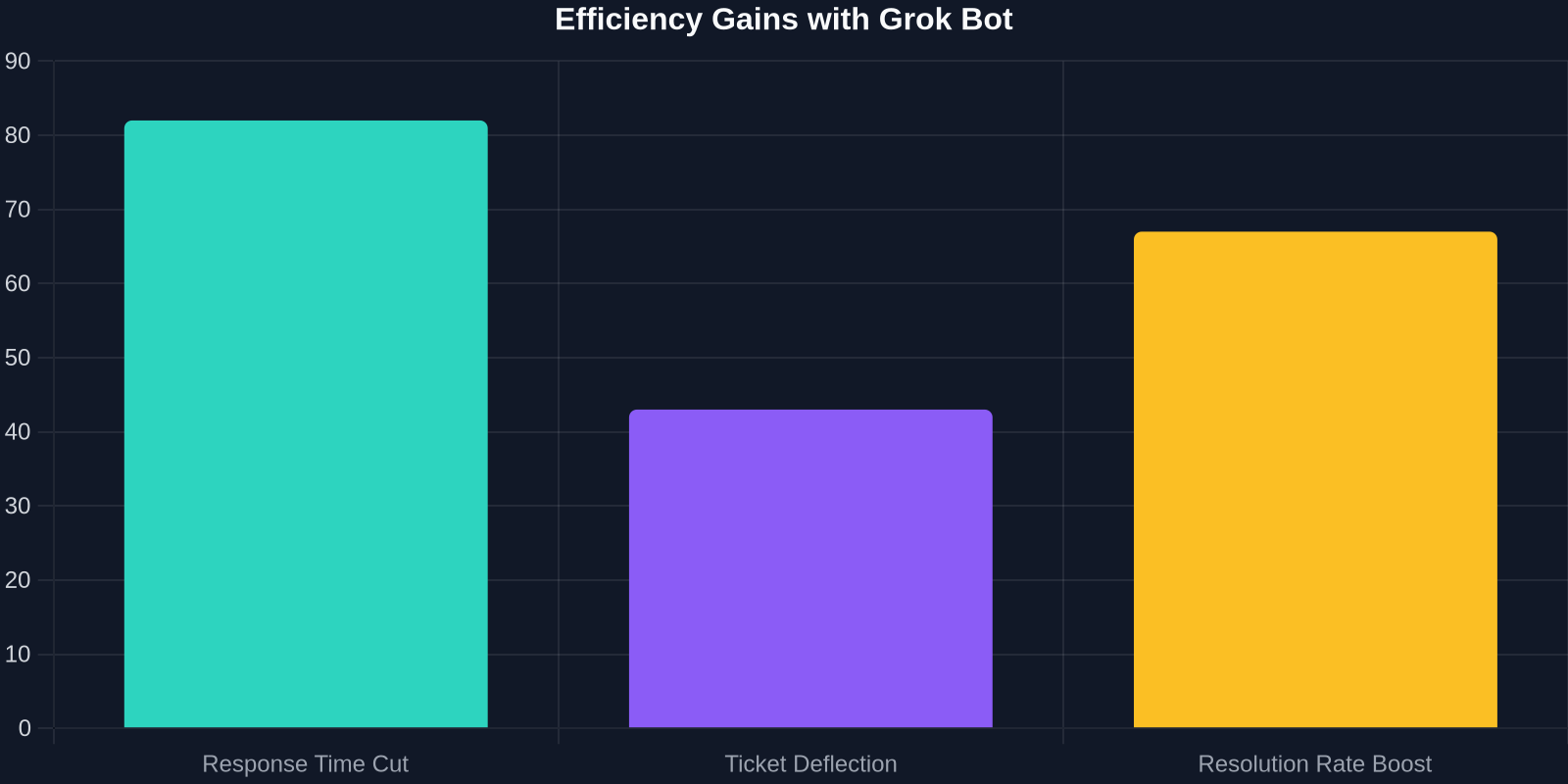
Another important perspective is the efficiency breakdown. This bar chart shows the relative improvement in key support KPIs when moving from a traditional setup to AI‑powered operations.
Addressing Common Concerns
Security and Compliance
Allowing an AI agent to log into your core business systems requires robust security controls. SpaceXAI states that Grok Bots operate within isolated cloud environments with encrypted credential stores, ensuring that each session is ephemeral and auditable. For regulated industries, it's essential to confirm alignment with SOC 2, GDPR, and other frameworks.
Quality of Reasoning
Earlier AI models were criticized for “bluffing”, producing plausible but incorrect answers. SpaceXAI's continuous training and reinforcement learning from real customer interactions aim to mitigate this. Early adopters report high accuracy on defined process flows, though edge cases still benefit from human‑in‑the‑loop review.
Even with Grok Bot, maintain a human escalation path for novel or high‑risk issues. AI agents excel at repetitive, rule‑based tasks but should augment, not replace, human judgment for sensitive matters.
Getting Started with Autonomous Support AI
Transitioning to an AI‑first support model requires deliberate planning. Here is a roadmap for support leaders:
- Audit your ticket types, identify top 10 inquiry categories where resolution follows a repeatable pattern.
- Map the data sources, document which systems the bot must access to resolve each category.
- Start with a pilot, deploy Grok Bot for one product line or during off‑peak hours, measure ARR and CSAT.
- Iterate with feedback loops, use the monitoring dot and customer surveys to continuously refine the model's behavior.
- Scale across channels, expand from email to chat, social media, and in‑app support.
The Future of Support Is Autonomous
SpaceXAI is planning a new subscription service that will integrate X and Grok, pointing toward a future where AI agents are as ubiquitous as email clients. For customer support leaders, the message is clear: the companies that embrace autonomous agents now will build unassailable advantages in responsiveness, cost structure, and customer loyalty. Those that wait will find themselves competing against machines that never sleep, never make typos, and learn faster than any team of humans.
Grok Bot is not merely a tool; it is a workforce multiplier. By giving AI its own computer, SpaceXAI has removed the last barrier to true end‑to‑end automation in customer service. The question isn‘t whether your support stack will include autonomous agents, it’s how soon.
“The integration of Grok with SaaS platforms marks the beginning of agentic support operations, where AI doesn‘t just suggest answers but takes action.”
To explore how autonomous AI can fit into your support strategy, and how solutions like Successly bridge the gap between cutting‑edge models and your day‑to‑day operations, stay tuned for our upcoming implementation guide.