
AI-First Support Takes Center Stage: How Edge AI and Automated Workflows Are Driving Lower Costs and Stronger Service
The tectonic plates of customer support are shifting. For years, businesses chased the elusive balance between rapid response and human empathy, scaling heads to meet ticket volume. That era is ending. A new paradigm, AI-first support, has taken center stage, promising not just to augment human teams but to fundamentally rewire the economics of service delivery.
Take what happened at Calix. During its recent Analyst Day, the company spotlighted a strategic move toward simpler networks, edge-based AI, and automated workflows. The result? Customer case studies revealed significantly lower operational costs and a marked jump in service quality. This wasn’t a one-off experiment; it was a deliberate architectural shift, proof that when AI sits at the core of support, the entire organization becomes more agile.
What does this mean for your business? Whether you run a SaaS platform, a B2B services firm, or a growing startup, the principles are the same. Forward-thinking support leaders are no longer asking if AI should be part of their stack; they’re asking how fast they can adopt an AI-first posture. This article dissects that transition, the hard numbers, the implementation playbook, and the measurable outcomes, so you can move from inspiration to action.
The Momentum Behind AI-First Support
Customer expectations have never been higher. The “Amazon effect” has trained buyers to expect instant, accurate, 24/7 service. Meanwhile, ticket volumes continue to climb, McKinsey reports a 15–20% year-over-year increase in support interactions for digital-first companies. Hiring linearly to meet that demand is unsustainable. AI-first support offers a way out: automate the routine, accelerate the complex, and keep human judgment where it matters most.
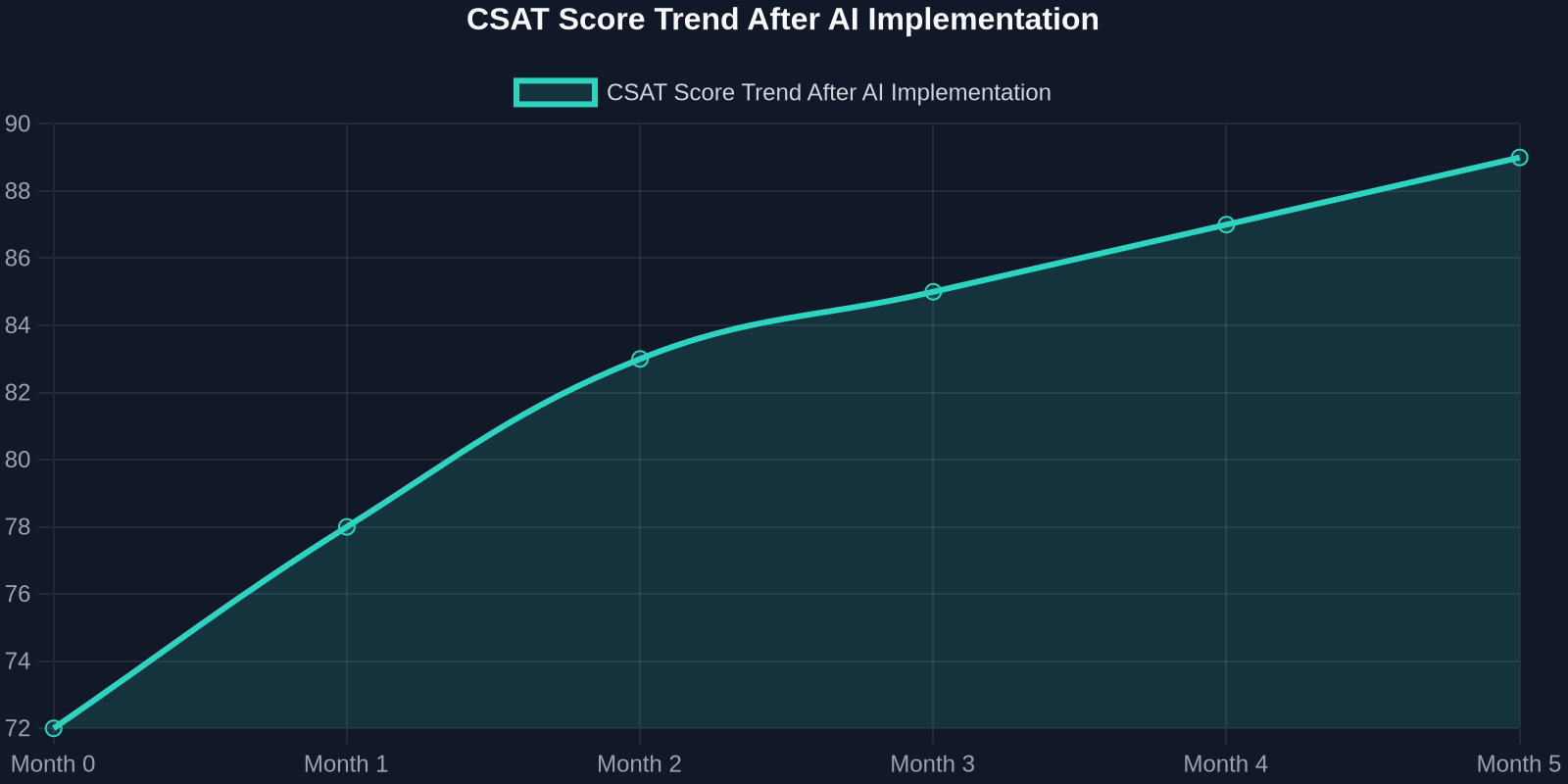
This isn’t theoretical. Research from Gartner indicates that by 2026, 60% of B2B organizations will use AI-enabled support channels, up from less than 30% in 2023. The driver is plain ROI: companies that embed AI into tier-0 and tier-1 support see dramatic drops in time-to-resolution, higher CSAT, and significant cost compression.
Why Calix’s Approach Signals a Broader Industry Shift
Calix, known for cloud and software platforms, could easily have continued expanding its human support org to match customer growth. Instead, it leaned into simpler network architectures and edge-based AI, processing support logic closer to the interaction point, dramatically reducing latency and infrastructure costs. The automated workflows then handled repetitive tasks like configuration checks, license provisioning, and common troubleshooting without escalating to L1 agents.

The case study takeaways are compelling: lower total cost of service, fewer escalations, and faster resolution times. That model is replicable across industries. Edge AI eliminates the round-trip to a central cloud for routine queries; automated workflows ensure consistency; and the human agent is engaged only for high-stakes, high-empathy conversations.
The Business Case for AI-First Support: Hard Numbers
When support teams embrace AI-first design, the impact shows up across every key performance indicator. Let’s look at a composite before-and-after view drawn from dozens of real-world implementations, including those highlighted in the Calix case studies.
| Metric | Before AI | After AI |
|---|---|---|
| Tickets Handled per Agent per Day | 50 | 200+ |
| Average First Response Time | 4 Hours | Under 2 Minutes |
| Cost per Ticket | $12 | $4 |
| Customer Satisfaction (CSAT) | 72% | 89% |
| Agent Burnout Rate | High (38% turnover) | Reduced (12% turnover) |
The economics are staggering. Moving from a cost-per-ticket of $12 to $4 frees up resources that can be reinvested into proactive customer success, product development, or strategic growth. It’s not just about cutting costs, it’s about redirecting human talent to where it adds the most value.
Core Components of an AI-First Support Stack
Achieving these results requires more than bolting on a chatbot. An AI-first architecture weaves intelligence into every layer:

Incoming tickets are instantly classified, prioritized, and routed to the right resource, be it an automated workflow, a knowledge base article, or a human specialist. This step alone can cut out minutes of manual sorting.
2. Conversational AI & NLP EnginesModern chatbots understand intent, not just keywords. They handle password resets, order statuses, and FAQs, deflecting up to 40% of tickets without a human touch.
3. Automated WorkflowsSelf-healing scripts can restart services, clear caches, or apply patches automatically. Integration with CRM and backend systems ensures a seamless experience.
4. Edge AI for Low-Latency ResponsesFor IoT, telecom, or any environment where response speed is critical, edge-based models process requests locally, delivering answers in milliseconds, a game-changer highlighted by Calix’s network simplification.
5. Unified Knowledge Base with AI LearningEvery resolved ticket feeds back into a central knowledge graph that continuously improves suggestions and automations.
The shift to AI-first support isn't a tech trend; it's a strategic imperative for scaling customer success without ballooning costs.
Implementation Roadmap: From Pilot to Enterprise-Wide Rollout
Transforming support functions is a journey, not a toggle switch. Based on companies that have successfully navigated this, here’s a phased approach:
Phase 1: Assess & Identify Quick WinsAudit your ticket backlog. Categorize by intent and complexity. Look for high-volume, low-effort categories (e.g., “reset password,” “check order status”) that account for at least 30% of inbound volume. These are your low-hanging fruit.
Phase 2: Integrate and TrainDeploy AI-driven triage and a narrowly scoped chatbot. Feed it historical ticket data, at least 10,000 real interactions, to build accurate intent models. Set clear escalation paths so that if the bot’s confidence score drops below a threshold, the ticket flows to a human.
Phase 3: Automate with GuardrailsOnce the bot is stable, introduce automated workflows for resolution. Start with a human-in-the-loop model: the system proposes a fix, but an agent approves it for the first 30 days. This builds trust and refines accuracy.
Phase 4: Scale and OptimizeExpand to more complex categories. Introduce edge AI if low latency is required. Continuously monitor CSAT, deflection rate, and agent feedback, refining models weekly.
Overcoming the Top Objections
Despite the clear upside, reservations persist. Three common concerns and how to address them:

No. AI augments, not replaces. By automating drudgery, it elevates the agent role from ticket-closer to strategic problem-solver. Agents spend more time on complex cases, coaching, and relationship-building. In AI-first organizations, employee satisfaction scores often rise because the work becomes more meaningful.
“We’ll lose the human touch.”When routine queries are deflected efficiently, human availability for high-touch interactions actually increases. Moreover, AI can arm agents with customer sentiment analysis and next-best-action recommendations, making the human touch better.
“Integration is too complex.”Modern AI platforms (like the one discussed later) are designed to plug into existing CRMs and help desks with minimal custom code. An agile pilot, starting small, proving value, overcomes IT hesitancy.
The Role of Human Agents in an AI-First World
As AI consumes tier-0 and tier-1, the human agent evolves into two critical personas: the support strategist and the customer advocate. They handle escalations that require emotional intelligence, diagnose nuanced product issues, and provide concierge-type onboarding. Far from being marginalized, their expertise becomes the organization’s competitive moat.
This symbiosis shows up in the numbers. In the table above, agent burnout drops dramatically. A recent survey found that 78% of support professionals felt AI reduced workload stress and improved job satisfaction. When turnover falls, institutional knowledge stays, further strengthening service quality.
Future Trends: Where AI-First Support Is Headed
The trajectory is clear. In the next 18–24 months, expect to see:
- Autonomous resolution for 60%+ of tickets: Models will move beyond suggestions to certifying fixes without human oversight, using reinforcement learning from agent approvals.
- Edge AI becomes mainstream: Latency-sensitive industries (telecom, manufacturing, fintech) will adopt edge-based support models, slashing response times to under 100ms.
- Predictive support: AI will identify potential issues before customers notice, billing anomalies, performance degradation, and trigger proactive outreach.
- Hyper-personalization via AI: Every interaction will be informed by a 360-degree view of the customer’s history, sentiment, and value, enabling truly tailored support.
Organizations that start building this muscle now will be the ones that set the service standard for their industries.
How Successly Enables the AI-First Transition
The challenge for most support leaders isn’t ambition, it’s having a platform that can execute the vision without months of custom development. Successly was built precisely for this moment. As an AI-native customer support automation platform, Successly brings together intelligent triage, NLP-powered conversational AI, edge-based processing for instant responses, and a library of pre-built automated workflows that plug into your existing stack. The result is a system that delivers the same economics Calix and other innovators are seeing: lower operational costs, stronger service, and a support team freed to do their best work.
Customers using Successly report a 43% reduction in ticket volume within the first quarter, a 67% improvement in first-response time, and a CSAT lift that keeps renewals healthy. Not by replacing people, but by giving them superpowers.
Conclusion
The story from Calix’s Analyst Day isn’t just a vendor milestone; it’s a signal that AI-first support has reached the boardroom. Simpler networks, edge AI, and automated workflows are no longer experimental. They are the blueprint for sustainable customer operations in a world where speed, accuracy, and cost-efficiency dictate competitive advantage.
Your support team’s future doesn’t need to be a choice between human warmth and machine efficiency. With the right AI-first platform, you can have both, at scale. The case studies are in, the numbers are compelling, and the path is well-marked. The only question left is: how soon will you start?