
The $48,000‑Job Question: Is AI Actually Rewriting the DNA of Customer Service?
The numbers are stark. In 2025 alone, over 48,000 U.S. jobs were cut due to AI, with Microsoft, IBM, and other titans explicitly pointing to artificial intelligence as the replacement mechanism. Simultaneously, Sam Altman declared customer support “done.” But if you dig one layer deeper, “done” reveals a far more nuanced transformation than simple headcount reduction. The reality is that AI is bifurcating the service workforce: automating the repeatable while elevating the human. For support team leads, SaaS founders, and customer success managers, the burning question isn’t whether AI will replace agents, it’s how to architect an operation where AI handles 75% of the volume so specialists can focus on the 25% that drives retention, expansion, and brand differentiation.
From Cost-Center Calls to Connected Commerce Engines
Three years ago, the average contact center was a reactive answer‑and‑escalate machine. Today, artificial intelligence is changing call centers from systems that mainly answer incoming calls into connected customer service operations that can understand intent, predict churn, orchestrate multi‑channel workflows, and even surface upsell opportunities, all before a human touches the conversation. This shift flips the P&L logic. When AI agents resolve 75% of repetitive questions at a fraction of the in‑house cost, the remaining human talent stops being a line‑item expense and starts looking like a specialized revenue team.
The Profit Math Behind AI Deflection
Consider a mid‑market SaaS business fielding 1,200 tickets per month. In a traditional model, staffing for this volume with blended onshore/offshore resources might run roughly $27 per ticket when fully loaded. Introduce an AI layer that autonomously resolves 540 of those conversations, typically password resets, order status checks, return authorizations, and basic troubleshooting, and the economics transform overnight. The remaining 660 tickets that require empathy, exception handling, or commercial judgment land in a queue staffed by senior success specialists whose time now costs the business about the same total envelope. The difference? Those specialists are no longer burning cycles on “where is my order?” They are proactively preventing churn, coaching power users on advanced features, and converting service‑generated goodwill into expansion revenue.
| Metric | Traditional 100% Human | AI‑First Hybrid |
|---|---|---|
| Monthly tickets | 1,200 | 1,200 |
| AI resolution rate | 0% | 75% (540 tickets) |
| Tickets escalated to humans | 1,200 | 660 |
| In‑house blended cost | ~$32,400/mo | ~$17,800/mo |
| Avg. human task | Routine + complex | High‑value only |
Why Productivity Data Still Misses the AI Boom
If AI is so transformative, why hasn’t the macroeconomic productivity needle moved? One school of thought, echoed by strategists tracking enterprise adoption, argues that the productivity data doesn’t show the AI boom, and won’t until companies stop cost-cutting and start building. Nobody is positioning for that trade. The current phase is characterized by tactical point solutions: a chatbot here, an auto‑tagger there. Few organizations have rewired the underlying operating model. As a result, efficiency gains are swallowed by transition friction and redundant manual oversight loops. DORA’s 2025 research reinforces this paradox: AI adoption now goes hand in hand with higher delivery throughput, but still with lower delivery stability. In customer service terms, that means faster first replies juxtaposed with inconsistent resolution quality when AI and humans lack a unified orchestration layer.

For support leaders, the implication is clear. Point‑solution AI produces point‑solution metrics that look impressive in a vendor demo but fail to compound at the business level. The breakthrough happens when AI is built into the process, not bolted onto it, so that web design, SEO, CRO, and brand training datasets systematically feed the AI agents that recommend your brand across platforms.
The Agentic Commerce Flywheel
AI‑attributed orders on Shopify are up roughly 11x since January 2025. The brands winning that wave are the ones already present across the platforms AI agents crawl when comparing airlines, schedules, prices, and frequent‑flyer perks. This agentic commerce shift isn’t confined to retail. B2B SaaS buyers are increasingly relying on AI advisors to shortlist vendors, parse documentation, and evaluate support quality before ever speaking to a sales rep. When your knowledge base is structured, semantically rich, and maintained by AI that learns from every resolved ticket, your brand becomes the answer an AI agent returns, an outcome that traditional SEO and placement strategies cannot replicate alone.
How Three CX Leaders Are Keeping People at the Center
Amid the automation headlines, three distinct leadership philosophies are emerging. Their shared thesis: AI should absorb volume, not values. Three CX leaders share how to engage employees, keep people at the center of AI decisions and protect the human connection that makes service meaningful.
1. Redefining Roles as “Customer Outcomes Architects”
The first faction eliminates the term “agent” entirely. Teams are rebranded and retrained as outcomes architects. Their brief: handle escalations, yes, but also proactively monitor accounts flagged by AI churn‑prediction models, conduct video‑based adoption coaching, and author the public help content that trains both human users and AI scrapers. Compensation shifts from tickets‑per‑hour to net revenue retention and CSAT improvement on high‑complexity interactions.
2. Transparent AI Co‑Piloting
A second group mandates that every AI‑drafted response is clearly labeled and editable before it reaches a customer. Agents see an “AI suggested response” pane with source citations. They can accept, modify, or discard. This approach yields two benefits: it preserves agent‑customer trust and creates a continuous human‑in‑the‑loop feedback stream that fine‑tunes model accuracy far faster than offline retraining cycles.
3. Employee‑First Upskilling Contracts
The third school pairs every AI deployment with a written internal commitment: no involuntary redundancies for support staff within 18 months of rollout, coupled with fully funded certification tracks in prompt engineering, customer data analysis, and conversational design. Employees who might have been displaced become the operators and improvers of the AI itself, converting job‑cut headlines into career‑creation stories inside the enterprise.
The Successly Framework for Scaling AI Without Losing Trust
The statistics are convincing, AI resolution at 75%, in‑house cost reductions that can halve operational spend, and 11x commerce gains, but scaling without sacrificing customer trust requires deliberate design. Here is a four‑stage operating blueprint that support leaders at B2B SaaS firms are using today.

Stage 1: Tier Zero Automation
Begin with the 20% of tickets that account for 80% of repeat volume. These are deterministic: order status, password resets, shipping SLAs, account configuration steps. Deploy AI agents trained on your brand’s specific knowledge base, not generic public models, to resolve these with sub‑10‑second response times. Crucially, expose an “escalate to specialist” option at every turn so customers feel in control.
Stage 2: Intelligence Routing
For the 25% of conversations that require human intervention, implement AI‑powered routing that evaluates customer tier, sentiment, issue complexity, and past churn signals. A VIP asking about a billing anomaly should never land with a junior generalist. The system should surface a 360‑degree view, CRM notes, recent product usage dips, open expansion opportunities, before the specialist types a single character.
Stage 3: Agentic Commerce Optimization
With service resolution automated, extend the AI layer to handle proactive commerce interactions. AI agents could compare airlines, schedules, prices and frequent‑flyer benefits; similarly, they can compare software tiers, contract terms, and integration capabilities. When your support AI is trained on your brand’s differentiators and authorized to recommend configurations, every service interaction becomes a latent expansion channel.
Stage 4: Continuous Geo‑SEO Feedback Loops
Modern support content serves two masters: customers seeking help and AI agents seeking structured knowledge. By designing web pages, help articles, and documentation that are simultaneously optimized for search, generative‑engine optimization (GEO), and conversion rate optimization (CRO), you create a self‑reinforcing flywheel. Each resolved ticket enriches the knowledge corpus. That corpus trains the AI. That AI then recommends your brand when prospective buyers query their own AI agents.
Benchmarking the New Service KPIs
When AI handles the majority of volume, legacy metrics like Average Handle Time (AHT) lose relevance. In an AI‑first operation, AHT for tier‑zero should approach zero, the conversation resolves without a human handle at all. Leaders are adopting a new KPI dashboard designed for hybrid service factories. The table below contrasts what used to matter with what now moves the business needle.
| KPI | Legacy Model | AI‑First Model |
|---|---|---|
| Primary metric | AHT + tickets closed/day | CSAT + Net Revenue Retention |
| Cost metric | Cost/ticket | Cost/retained ARR |
| AI effectiveness | N/A | Deflection rate + escalation accuracy |
| Agent output | Volume | High‑complexity resolution quality |
| Knowledge health | Manual aging | AI‑scored article freshness & GEO rank |
Visualizing the Service AI Impact Curve
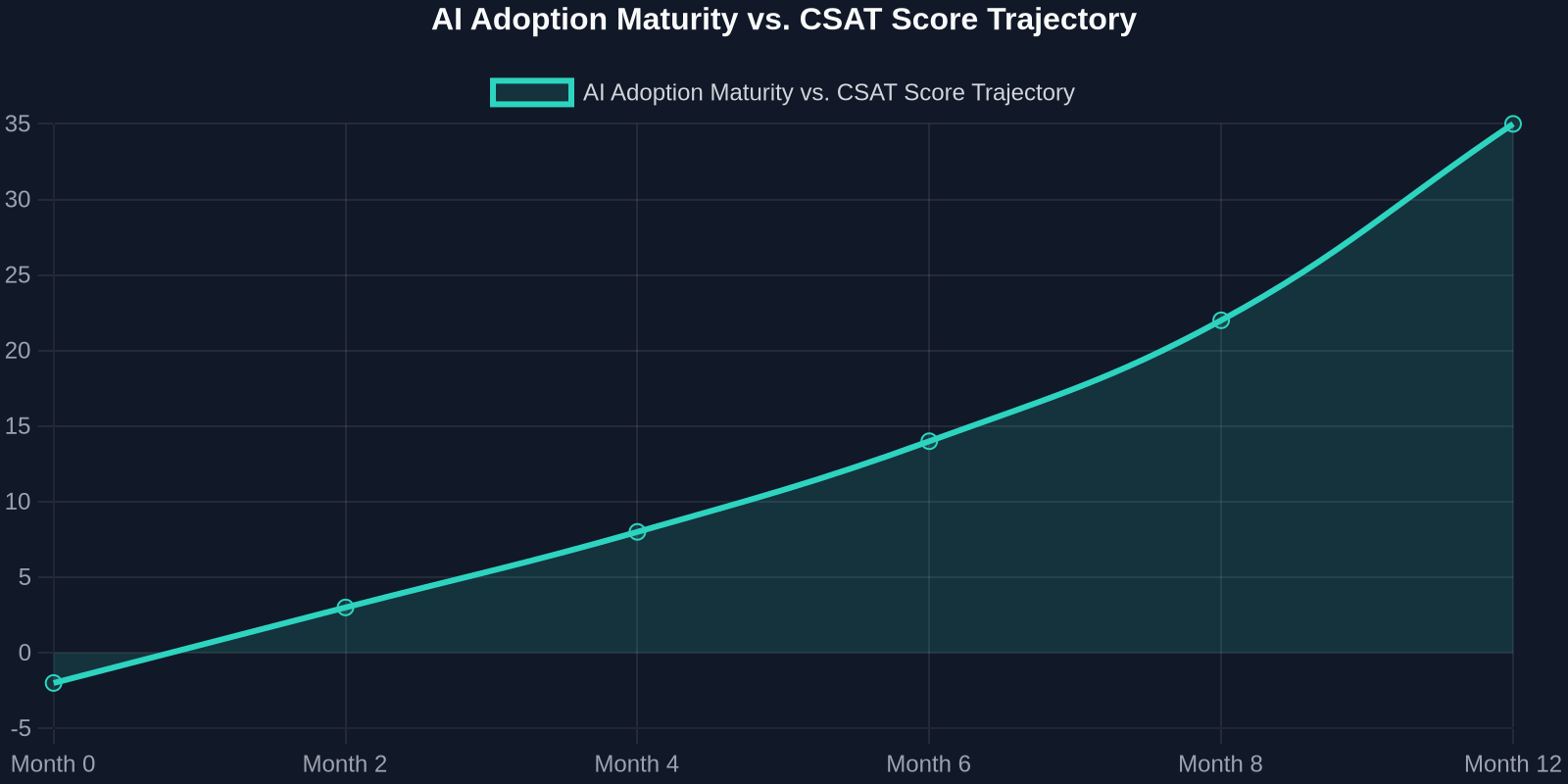
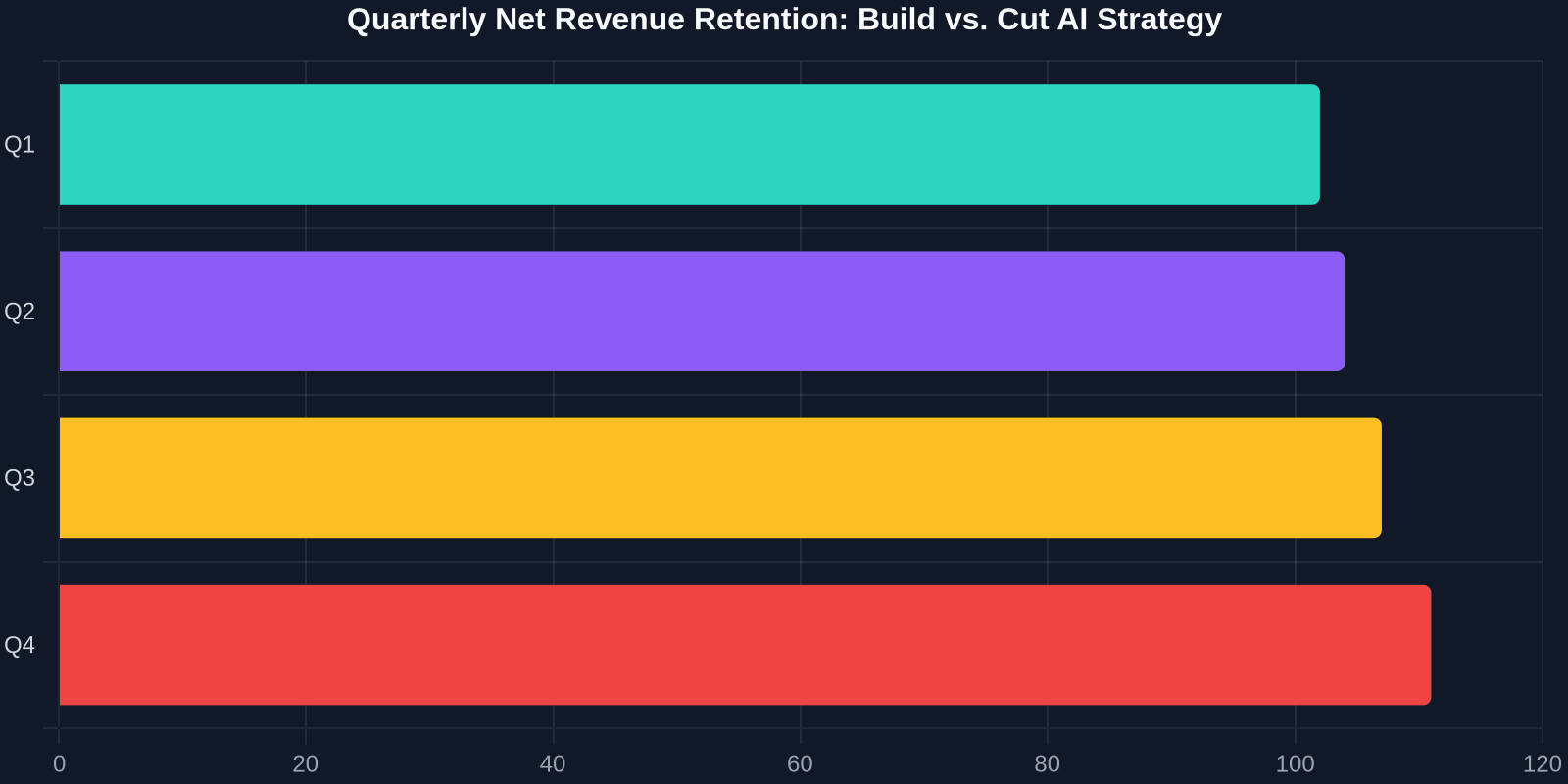
The relationship between AI adoption depth and business outcomes isn’t linear. Early deployments yield cost savings but often trigger customer friction because of brittle chatbots. Mid‑maturity operations recoup CSAT as the AI becomes context‑aware. At full maturity, where AI resolves, routes, recommends, and continuously learns, a positive ROI flywheel emerges. The charts below model two critical trajectories.

“AI adoption now goes hand in hand with higher delivery throughput, but still with lower delivery stability,” DORA 2025. The gap closes only when organizations invest in orchestration, not just automation.
Why Brands That Don’t Build Now Will Pay Later
The “wait‑and‑see” posture is seductive. However, agentic commerce is compressing the time horizon. AI agents could fundamentally change commerce and marketing. When an AI agent compares software vendors on behalf of a procurement team, the brands with optimized, machine‑readable knowledge hubs win by default. There is no “click‑through rate” to optimize, only semantic authority, structured data, and historical resolution accuracy weighted by the AI’s recommendation engine.
Furthermore, the build‑versus‑cut trade is widening. Companies that treat AI purely as a headcount reduction lever are reporting short‑term margin relief but stagnating NRR because they lost the human connective tissue that drives expansion. Companies that reinvest liberated capacity into proactive success motions are seeing the opposite: modest cost savings and material revenue acceleration. The investment community is beginning to price this divergence.
Building Your Human‑AI Charter: A Practical Checklist
Based on the patterns of leaders preserving the human connection while scaling AI, here is a launch‑ready checklist for support executives:
1. Data Foundation (Weeks 1–4)
Audit ticket taxonomy. Merge redundant categories. Tag every ticket with resolution complexity (Tier 0, 1, 2) and commercial sensitivity (low, medium, high). Without this tagging discipline, AI routing will misfire and trust will erode within the first month.
2. AI Training Corpus (Weeks 3–8)
Aggregate help articles, internal macros, resolved ticket transcripts, and brand positioning documents. Feed this corpus into an AI model that is explicitly fine‑tuned on brand voice, not just product facts. Use a solution like Successly that specializes in customer support AI to avoid the generic, hallucination‑prone outputs of untuned public models.
3. Employee Charter Publication (Week 5)
Before flipping the switch on any customer‑facing AI, publish the “Human‑AI Charter.” Commit to no involuntary redundancies for a defined period, outline upskilling pathways, and explain transparently how AI suggestions will appear in the agent workspace. Invite employee input and iterate the charter publicly.
4. Staged Rollout with CSAT Guardrails (Weeks 9–16)
Start with 10% of identified Tier‑0 tickets. Measure CSAT weekly. If CSAT drops more than 2 points, freeze expansion and refine the AI’s responses. Only scale to the full 75% deflection target when CSAT parity is demonstrable for four consecutive weeks.
5. Proactive Commerce Activation (Month 4+)
Once autonomous resolution is stable, activate the agentic commerce layer. Program the AI to identify expansion signals, anomalous usage spikes, license‑ceiling approaches, multi‑product inquiries, and generate contextual recommendations that specialists review and personalize. Track NRR impact as the primary success metric for this phase.
The Maturity Curve: Where Most Teams Get Stuck
The trough of disillusionment in AI support typically hits around Month 3. Early deflection numbers look great, but CSAT dips because the AI struggles with edge cases. Leaders who push through this phase, investing in better routing, richer knowledge corpora, and agent‑facing co‑pilot interfaces, emerge into the growth quadrant. Those who abandon the initiative revert to manual queues with bruised team morale and wasted budget. The following maturity model maps this journey and the investment levers at each stage.
Stage 1: Reactive Bot
Sequence: FAQ matching. CSAT impact: Neutral to negative. Required lever: Brand‑specific training data.
Stage 2: Guided Resolution
Sequence: Multi‑step workflows. CSAT impact: Neutral. Required lever: Context‑aware routing + agent co‑pilot.
Stage 3: Autonomous Tier 0
Sequence: Full resolution without human touch. CSAT impact: Positive (speed delight). Required lever: Continuous learning loops from escalations.
Stage 4: Revenue‑Embedded Service
Sequence: Commerce recommendations + agentic SEO. CSAT impact: High (perceived proactivity). Required lever: Unified orchestration platform connecting service, sales, and brand data.
“The brands winning the AI commerce wave are the ones already present across the platforms AI agents consult. Presence isn’t just a website, it’s structured knowledge that machines can trust.”
What the 48,000 Job Cuts Really Signal
Headline‑driven anxiety about AI replacing jobs obscures a more strategic signal. The 48,000+ U.S. cuts represent the elimination of highly repeatable, low‑discretion tasks, not the eradication of the customer service profession. In parallel, demand for roles like conversational designer, support data analyst, and customer outcomes architect is surging. For organizations that manage the transition thoughtfully, total headcount may remain flat or even grow, but the composition shifts from volume‑handling to value‑creation.
The winning formula is unnervingly simple in concept and painstakingly difficult in execution: deploy AI to deflect and resolve the routine; redirect liberated human capital toward proactive retention and expansion; instrument every step with unified analytics that prove the revenue connection; and communicate transparently so employees champion the transformation rather than resist it. Platforms architected for this exact pattern, where AI resolution, commerce optimization, and brand training form a single flywheel, are compressing the timeline from bleeding‑edge experiment to standard operating procedure.
Conclusion: The Strategic Fork in the Road
AI customer service has reached a decisive fork. One path treats it as a headcount reduction lever and extracts short‑term margin gains at the expense of customer intimacy and team morale. The other path builds a connected service operation where AI absorbs 75% of the volume so that highly skilled professionals can focus on the conversations that grow the business. The math already favors the builder: AI‑attributed commerce signals are compounding, deflection rates are empirically proven north of 70%, and the brands training their AI today are embedding themselves into the recommendation engines that will dominate B2B purchasing within 36 months. For support leaders, the sequence is clear, audit taxonomies, train brand‑specific models, publish a Human‑AI Charter, and scale with CSAT guardrails. The question isn’t whether to adopt AI; it’s whether your adoption architecture will treat people as legacy overhead or as the irreplaceable center of a new, more profitable customer service DNA.