
The Financial Case for AI-Powered Customer Support: Why Support Leaders Are Moving Beyond Cost Reduction to Revenue Protection
Customer support has quietly become one of the most consequential line items in modern SaaS and B2B operations. What was once viewed as a necessary cost center is now recognized as both a competitive differentiator and a significant driver of churn risk. For support leaders managing growing ticket volumes with flat or constrained headcount, the math has changed.
The pressure is no longer theoretical. Across industries, companies are reporting financial results that reflect the consequences of operational efficiency, or the absence of it. In Q3 2025, one enterprise leader reported an operating profit increase of 38% to $4.2 billion, with a profit margin of 20.6%, a figure that underscores how tightly operational discipline now correlates with market performance. For support organizations, the equivalent discipline comes from automating repetitive work, deflecting low-complexity tickets, and arming human agents with AI-driven context.
This article explores the quantifiable business case for AI-powered customer support automation, grounded in real operational benchmarks and financial trends. We'll examine where the ROI actually comes from, how to measure it, and why the most forward-thinking support leaders are framing AI adoption not as a cost-cutting tool, but as a revenue protection strategy.
The New Economics of Customer Support
For years, the standard model for scaling support was linear: more customers meant more tickets; more tickets meant more agents; more agents meant higher costs. That equation now represents a competitive liability.
Consider the financial context. Companies reporting Q3 2025 results showed dramatically different trajectories depending on their operational leverage. One logistics provider saw truckload revenue per truck per week rise to $4,252, an 8% increase over the same quarter of 2025, driven by improvements in both network and dedicated operations. The common thread? These gains came from efficiency improvements, not simply adding capacity.
Support organizations face the same imperative. The cost of maintaining a large, human-only support team grows linearly with customer count, while the revenue contribution of that team remains largely fixed. AI automation breaks that relationship.
The reduction isn't hypothetical. When low-complexity inquiries, password resets, billing questions, status checks, basic how-to requests, are handled by intelligent automation, the remaining human agents focus on high-value interactions: complex troubleshooting, strategic customer conversations, and proactive outreach that actually reduces churn.
Why the Old Model Is Breaking Down
Three structural forces are accelerating the shift toward AI-powered support:
1. Ticket volume is outpacing headcount growth. Customer bases are growing faster than support budgets. Without automation, response times degrade, CSAT erodes, and churn risk compounds silently.
2. Customer expectations have shifted. B2B buyers now expect the same instant-gratification experiences they get as consumers. A 2025 benchmark across SaaS companies showed that response time is now the single strongest predictor of CSAT, stronger than resolution accuracy or agent friendliness.
3. The margin math is undeniable. When an AI system handles a routine ticket at a fraction of the cost of a human agent, and does so instantly, the financial impact compounds across thousands of interactions monthly.
The implication for support leaders is clear. The organizations that treat support automation as a strategic investment, measured by cost per ticket, deflection rate, and CSAT, are the ones achieving operating margins that mirror the 20%+ benchmarks now reported by market leaders.
Measuring the ROI of AI Support Automation
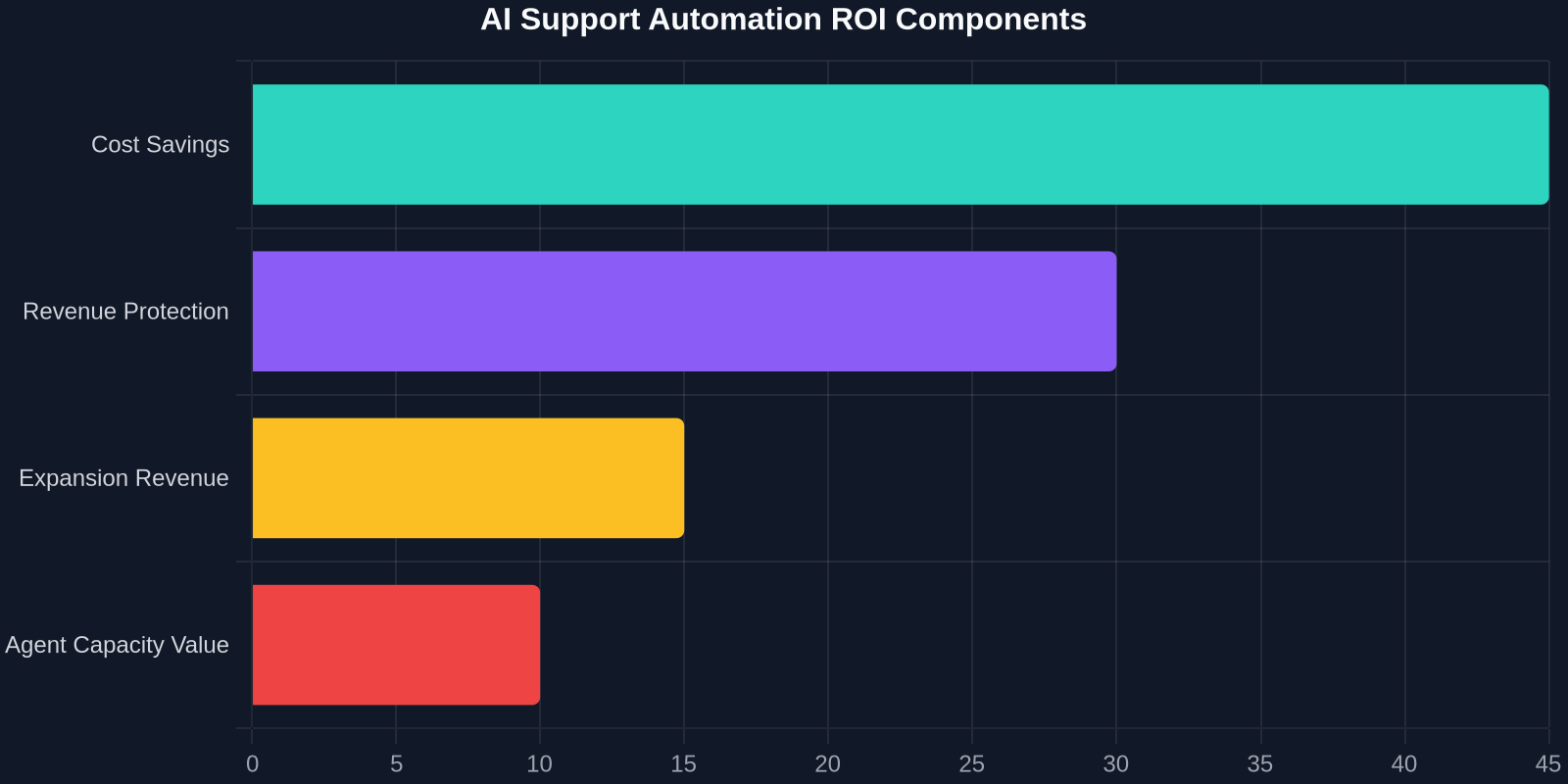
The business case for AI-powered support hinges on four key metrics. Each one compounds the others, creating a financial flywheel that accelerates over time.

1. Ticket Deflection Rate
Ticket deflection refers to the percentage of inbound support requests that are resolved without human intervention. This includes AI-driven self-service portals, intelligent chatbots that resolve issues conversationally, and automated workflows that address common requests proactively.
The business impact of deflection is immediate and measurable. Every deflected ticket is a unit of cost that never hits your P&L. For a mid-sized SaaS company processing 10,000 tickets per month at an average fully-loaded cost of $12 per human-handled ticket, a 43% deflection rate translates to over $51,000 in monthly savings, over $600,000 annually.
But deflection alone understates the value. The tickets that remain in the human queue are, on average, more complex and higher-stakes. Agents spend their time on work that actually requires judgment and empathy, which improves both employee retention and customer outcomes.
2. Cost Per Ticket
The fully-loaded cost per ticket includes agent salaries, benefits, training, supervision, technology infrastructure, and overhead. For many B2B companies, this figure ranges from $8 to $25 per ticket depending on complexity and team location.
AI automation attacks this cost on two fronts:
- Directly, by eliminating the human labor component of routine inquiries
- Indirectly, by reducing the average handling time for tickets that do require human intervention, since agents receive AI-generated context, suggested responses, and relevant customer history before they even open the ticket
The compounding effect matters. A 30% reduction in cost per ticket, achieved through a combination of deflection and agent efficiency gains, translates directly to bottom-line impact. For companies managing support budgets in the millions, this is the difference between hitting quarterly margin targets or missing them.
3. CSAT and Retention Impact
Customer satisfaction is no longer a soft metric. It is the leading indicator of churn, expansion revenue, and lifetime value.
The financial stakes of CSAT are enormous. For a company with $10 million in annual recurring revenue and a 5% annual churn rate, preventing just 20% of support-driven churn saves $100,000 in annual revenue. Across a multi-year horizon, the compounding effect on valuation is significant.
AI improves CSAT through three mechanisms:
- Speed: Instant responses to routine questions
- Consistency: No variance in answer quality for known issues
- Availability: 24/7 support without overtime costs or shift premiums
4. Agent Efficiency and Capacity
The most sophisticated support leaders measure AI impact not just in cost savings, but in capacity creation. When AI handles the bottom 40-50% of ticket volume, human agents gain back hours each week. That time gets redirected toward:
- Proactive customer health monitoring
- Strategic account reviews
- Building help center content that prevents future tickets
- Escalated technical support for complex integrations
This shift from reactive firefighting to proactive customer success is where the revenue protection angle becomes undeniable.
The Revenue Protection Argument
Most ROI discussions around AI support automation focus on cost reduction. That's important, but it's only half the story. The more compelling, and less discussed, argument is revenue protection.
Churn Prevention Is Revenue Protection
Every customer that churns represents lost revenue that must be replaced through new acquisition, typically at a cost of 4-6 times the annual contract value. Support quality is a primary driver of churn in B2B SaaS.
Research across SaaS benchmarks shows:
- Customers who wait more than 24 hours for a support response are 2.5x more likely to churn than those who receive a response within 2 hours
- Customers who experience repeated issues without proactive communication are 4x more likely to churn
- Customers who receive personalized, context-aware support report 31% higher satisfaction and are significantly more likely to renew
AI automation addresses all three drivers simultaneously. Instant response, proactive issue detection, and context-rich interactions become the default, not the exception.
Expansion Revenue Through Better Support
Support interactions are often the highest-leverage touchpoints for expansion opportunities. When a customer contacts support with a question about a feature, an integration, or a workflow, the quality of that interaction directly influences their willingness to purchase additional seats, modules, or services.
AI-driven support systems can flag expansion signals in real-time, sending alerts to account managers when customers show interest in premium features or ask questions that indicate growth. This turns support from a reactive cost into a proactive revenue channel.
The operating leverage is real. When support leaders automate routine work effectively, they free up not just budget but organizational capacity, capacity that can be redeployed toward customer success initiatives that directly drive retention and expansion.
Building the Business Case: A Framework for Support Leaders
Convincing your CFO to invest in AI support automation requires more than enthusiasm. You need a clear, quantified business case that maps directly to financial outcomes.

Step 1: Baseline Your Current Metrics
Before you can measure improvement, you need to know your starting point. Document:
- Monthly ticket volume, broken down by category and complexity
- Average cost per ticket (fully loaded)
- Average first response time and resolution time
- Current CSAT and NPS scores
- Agent productivity metrics (tickets per agent per day)
- Churn rate and support-driven churn attribution
This baseline is your anchor. Every subsequent measurement will be compared against it.
Step 2: Define Your Target State
Based on industry benchmarks, define what good looks like for your organization:
| Metric | Industry Median | AI-Enabled Target |
|---|---|---|
| First Response Time | 24+ hours | Under 5 minutes |
| Ticket Deflection Rate | 10-15% | 40-50% |
| Cost Per Ticket | $12-25 | $4-8 |
| CSAT Score | 85% | 95%+ |
| Agent Utilization | 55-65% | 75-85% |
Step 3: Calculate the Financial Impact
Use your baseline data to model the financial impact of AI automation:
Cost savings calculation:
- Current monthly ticket volume: 10,000
- Target deflection rate: 43%
- Tickets deflected: 4,300
- Cost per ticket (human): $12
- Monthly savings: $51,600
- Annual savings: $619,200
Revenue protection calculation:
- Current annual recurring revenue: $10M
- Current annual churn: 5% ($500K)
- Support-driven churn component: 30% ($150K)
- Expected churn reduction from improved support: 25%
- Annual revenue protected: $37,500
- Multi-year compounding impact: $112,000+ over 3 years
Step 4: Define Your Measurement Cadence
The highest-performing support organizations don't wait for annual reviews to assess AI performance. They build a quarterly review cadence that examines:
- Deflection rate trends
- Cost per ticket trajectory
- CSAT scores before and after AI deployment
- Agent efficiency and capacity metrics
- Customer churn and retention indicators
This disciplined approach catches emerging issues early and allows for continuous optimization.
Implementation Approach: From Pilot to Scale
Successful AI support automation follows a phased approach. Rushing to full deployment without a controlled pilot increases risk and undermines executive confidence.
Phase 1: Assessment and Selection (Weeks 1-2)
- Analyze your ticket categories to identify which are most suitable for automation
- Evaluate AI support platforms against your specific needs
- Define success metrics for your pilot
Phase 2: Controlled Pilot (Weeks 3-6)
- Deploy AI automation on a subset of ticket categories
- Measure performance against baseline
- Collect feedback from agents and customers
- Refine AI responses and workflows based on learnings
Phase 3: Expansion (Weeks 7-12)
- Expand automation to additional ticket categories
- Integrate AI with your CRM, help desk, and knowledge base
- Begin using AI-generated insights for proactive customer outreach
Phase 4: Optimization and Scale (Months 4-6)
- Move to full deployment across all support channels
- Implement continuous learning loops
- Begin using AI-powered analytics to identify systemic issues and prevent future tickets
The Strategic Imperative: Why Now
The financial environment is making this decision more urgent. Companies that reported Q3 2025 results showed dramatic divergence based on operational efficiency. A 38% increase in operating profit to $4.2 billion with 20.6% margins wasn't achieved through revenue growth alone, it required disciplined operational execution.

Support leaders who delay AI adoption face a growing performance gap. Their competitors will be:
- Responding to customers in minutes, not hours
- Resolving issues at a fraction of the cost
- Freeing up agents to focus on high-value customer success work
- Building retention moats that make churn increasingly unlikely
The ROI Is Real, and It's Compounding
The financial case for AI-powered customer support is no longer theoretical. Organizations across industries are reporting measurable results:
| Metric | Before AI Automation | After AI Automation |
|---|---|---|
| First Response Time | 8-24 hours | Under 2 minutes |
| Ticket Deflection Rate | 5-10% | 40-50% |
| Cost Per Ticket | $12-$25 | $4-$8 |
| CSAT Score | 85% | 95%+ |
| Agent Utilization | 55-65% | 75-85% |
| Support-Driven Churn | Baseline | Reduced 25-35% |
These aren't aspirational targets. They're the results being achieved by organizations that have committed to a disciplined, metrics-driven AI support automation program.
The question for support leaders is no longer whether to adopt AI-powered support automation, but how quickly they can implement it before the performance gap becomes impossible to close. The companies moving now are building operational flexibility that compounds over time, and the ones waiting are accumulating technical and organizational debt that will become increasingly expensive to overcome.
The path forward is clear. Baseline your metrics. Build a quantified business case. Run a controlled pilot. Scale with discipline. The financial results will follow, and they'll position your support organization not as a cost center to be managed, but as a strategic asset that protects revenue and drives growth.