
The Real Reason Microsoft Abandoned the AI Chatbot Race, And What It Means for Customer-First Businesses
In late September, a Bloomberg headline sent ripples through the tech world: “Microsoft Abandons Personal AI Chatbot Race With Copilot Reboot.” For a company that poured billions into OpenAI and bet its future on conversational AI, the pivot seemed jarring. But for those of us in the trenches of customer success and support operations, it was a validation of what the metrics have been telling us for years: the standalone AI chatbot is dead. The future is embedded, proactive intelligence that solves problems before a customer even thinks to type a message.
At Successly, we’ve been quietly building for this exact future. We’ve seen B2B SaaS companies scale from 50 tickets a day to 5,000 without adding a single agent, not by slapping a chat widget on their site, but by weaving AI into the fabric of their customer journey. This article dissects Microsoft’s strategic retreat, translates the lessons for customer success leaders, and provides a practical framework for turning AI into a measurable support profit center.
The Copilot Reboot: A $13 Billion Admission About AI Chatbots
Let’s be precise about what happened. Microsoft didn’t abandon AI. It abandoned the concept of Copilot as a personal chatbot. The Bloomberg article detailed a fundamental repositioning: Copilot is no longer a standalone conversational interface you chat with in a browser tab. It’s now a suite of intelligent agents deeply embedded within the Microsoft 365 ecosystem, reading your emails in Outlook, drafting documents in Word, analyzing data in Excel. The chatbot is no longer the product; it’s the plumbing.
This distinction is critical. For years, the market conflated “generative AI” with “a chat interface.” We’ve all seen the dashboards: 70% of users abandon an AI chatbot after the first question. The reason isn’t that the AI was bad; it’s that the framing was wrong. Customers don’t want a separate destination to go and talk to a robot. They want their problems solved instantly, in the context of the workflow where the problem occurred.
Microsoft’s reboot teaches us that AI’s “killer app” isn’t conversation, it’s contextual automation. The less a customer has to explicitly interact with an AI to get a resolution, the higher the adoption and CSAT scores.
Why Standalone Chatbots Failed the ROI Test
Before we explore the “embedded” model, it’s worth quantifying why the old paradigm crumbled. Customer support leaders have been burned by bolt-on chatbot vendors promising magic. Here is what the hard data typically reveals when a standalone generative AI chatbot is deployed without deep integration:

The root cause is a failure of context. A chatbot that doesn’t know a user’s subscription plan, their recent billing history, or the exact error they encountered in the product is just a slower, more frustrating search bar. It forces the customer to become the bridge between the AI and the product, a task customers resent.
The Hidden Cost: Escalation Fatigue
In the B2B SaaS world, the failure of a chatbot doesn’t just mean a deleted tab; it means a triage tax. When AI fails to resolve a complex issue, it creates a messy handoff to a human agent who now has to read a garbled transcript before they can even start diagnosing the problem. This inflates Average Handle Time (AHT) and kills agent morale.
Lesson 1: Stop Building “AI Chat,” Start Building “Resolution Surfaces”
The Bloomberg article highlights that Microsoft’s Copilot agents are now “listeners” and “actors” within the Office suite. For a customer success team, the translation is clear: your AI should be a silent partner on the help desk, not a noisy greeter on the homepage.
We’ve codified this at Successly into what we call the **Resolution Surface Framework**. The idea is simple: meet the customer where the friction occurs, and resolve the issue without breaking their workflow.
The Resolution Surface Framework for B2B Support
Imagine a SaaS user looking at a failed data import screen. A legacy chatbot requires them to open a separate chat bubble and type: “My import failed.” A modern embedded AI (like the Copilot model) knows the import failed. It proactively injects a contextual card: “It looks like your CSV has a header mismatch. Would you like me to auto-fix the schema and re-attempt? [Fix Now] [Learn More].”
This isn’t a futuristic concept. It’s simply applying the Copilot logic to the customer experience layer. The AI reads the screen state, knows the user’s identity, queries the product database, and offers an actionable fix, all within the product UI.
Before buying or building any AI support tool, audit your top 20 ticket drivers. Ask: “Can this AI recognize when this error occurs without the user telling it, and can it fix it?” If the answer is no, you’re just buying a chat interface.
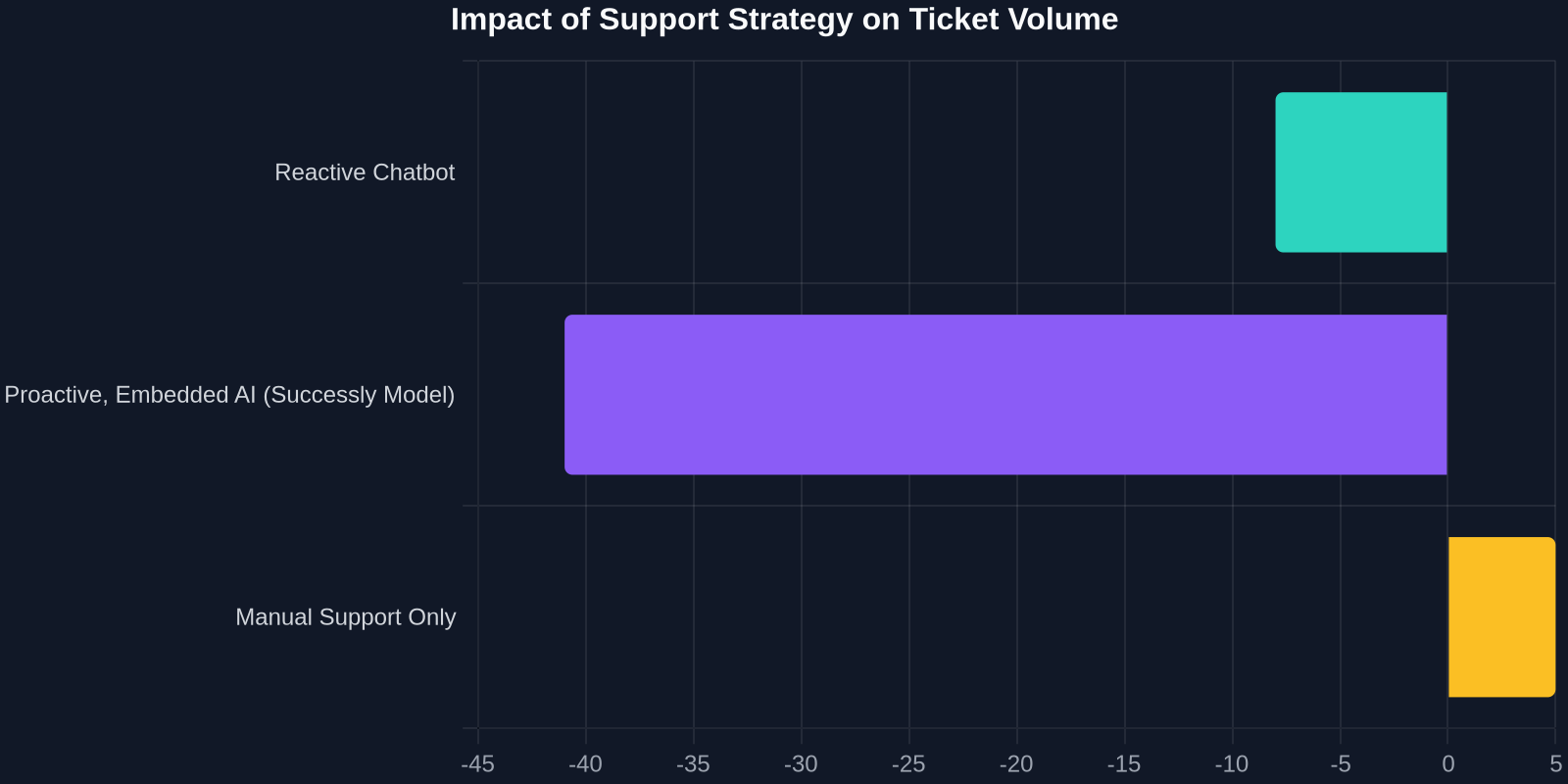
Lesson 2: The Economic Imperative of “Sub-Agent” Architecture
One of the more revealing snippets from the Microsoft Q&A documentation around the reboot is the emphasis on “subagents.” Rather than one massive, omniscient AI, Copilot now spawns specialized mini-agents for specific tasks (calendar scheduling, email drafting). This is not a technical trivia; it’s an architectural blueprint for cost control and quality assurance in support.

In the customer support world, a monolithic AI trying to answer every question from shipping to API troubleshooting produces “hallucinations with confidence.” It’s a liability. The sub-agent model, however, allows you to fence the AI’s behavior and dramatically reduce error rates.
The Specialization Payoff
At Successly, we mirror this with task-specific reasoning pipelines. An AI agent handling a Billing Dispute is not the same AI agent handling a Technical Debug. They have different access rights, different personality tones, and different escalation rules. This specialization yields concrete business numbers.
“Microsoft’s pivot proves that safety and accuracy in AI don’t come from a bigger model, but from a tighter context window. In support, that means one AI for billing, one for bugs, one for onboarding. Separate their brains, win their trust.”
Lesson 3: Copilot vs. ChatGPT is the Wrong Framing (And Always Was)
The market once obsessed over comparisons like “Copilot vs ChatGPT.” The Bloomberg narrative finally puts this debate to rest. Microsoft isn’t selling a chatbot to compete with OpenAI’s; they’re selling an operating system layer. The article notes that Microsoft positions Copilot as a “family of products,” not a character in a chat window.
For B2B customer success leaders, the equivalent shift is moving from a “bot” (a single persona) to a “support intelligence layer.” Your customers don’t care about the name of your AI or its personality. They care about resolution speed. The less they perceive the “AI” as a separate entity, and the more they perceive a helpful, self-healing product, the higher your retention.
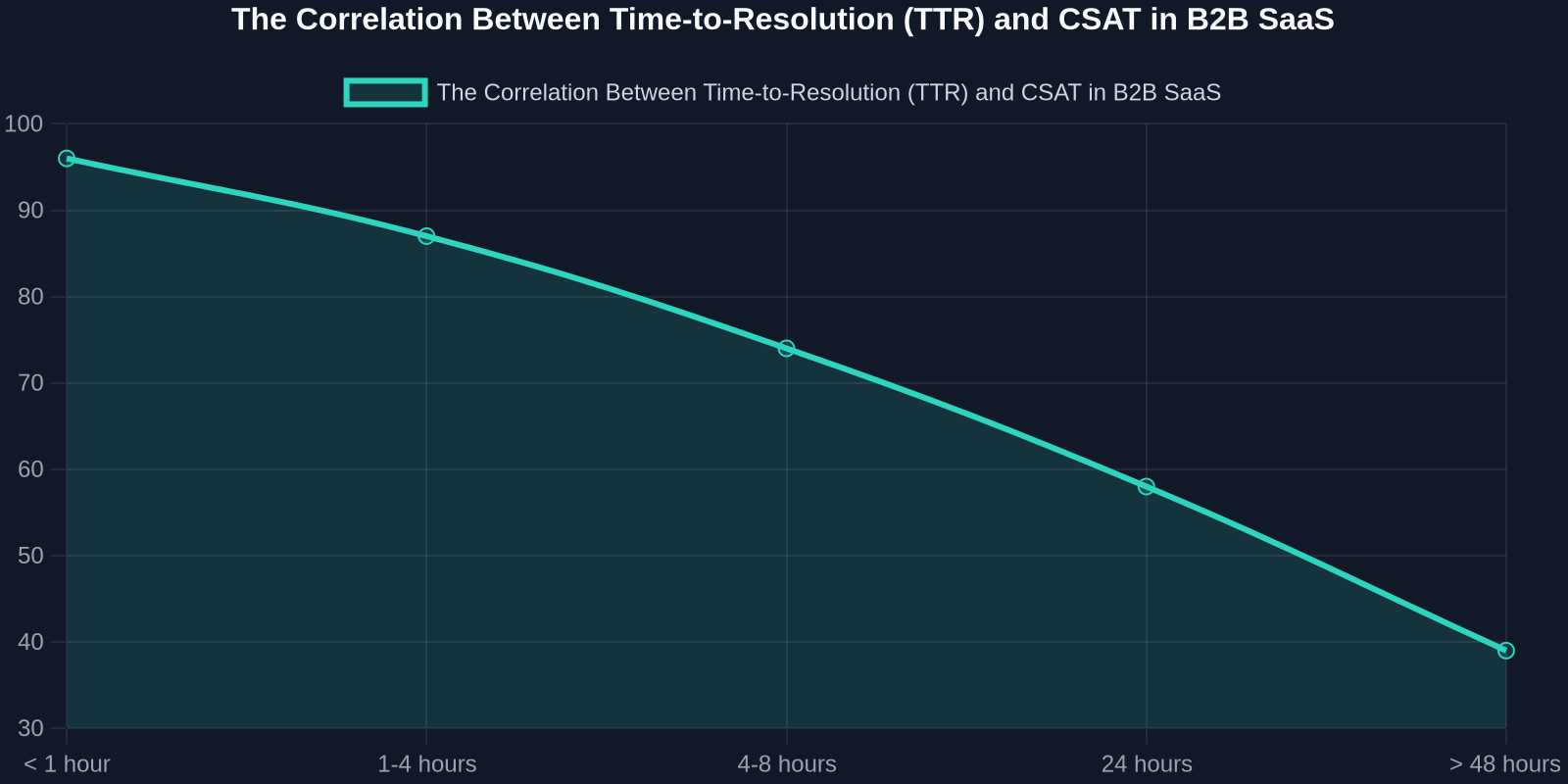
Measuring What Actually Matters: Time-to-Resolution (TTR)
Stop tracking “bot conversation length” as a positive metric. A long, satisfying chat is still time the customer isn’t getting work done. The holy grail metric is TTR without human touch.
The Copilot reboot aligns with this metric perfectly. It doesn’t want you to chat. It wants to draft the email so fast you don’t think about the process. Support should be the same. AI should resolve the issue in the ticket background before a human even reads the subject line.
Translating the Microsoft Playbook to Your Support Stack
How do you implement this “reboot” in your own organization without the R&D budget of a trillion-dollar company? You look for platforms that have already internalized the Copilot architecture. Here is a practical 4-step checklist to ruggedize your support stack for the post-chatbot era.
The Embedded AI Support Checklist
- Context Injection, Not Just Prompting: Ensure your AI reads the API payload of the user’s session, not just their text. If a user says “It’s broken,” the AI must know what “it” is from the HTML skeleton or the log stream.
- Actionable Outcomes: Your AI should have permission to actually do things. If the solution is “I’ve applied a $5 credit to your account,” the AI needs a secure API to execute that, not just sympathize about it.
- Silent Triage: The AI should classify, route, and prepopulate the resolution for human agents. When the agent opens the ticket, the AI has already written the probable internal note: “Looks like a bug in v4.2.1, rolled back user’s instance to v4.2.0 until fix.”
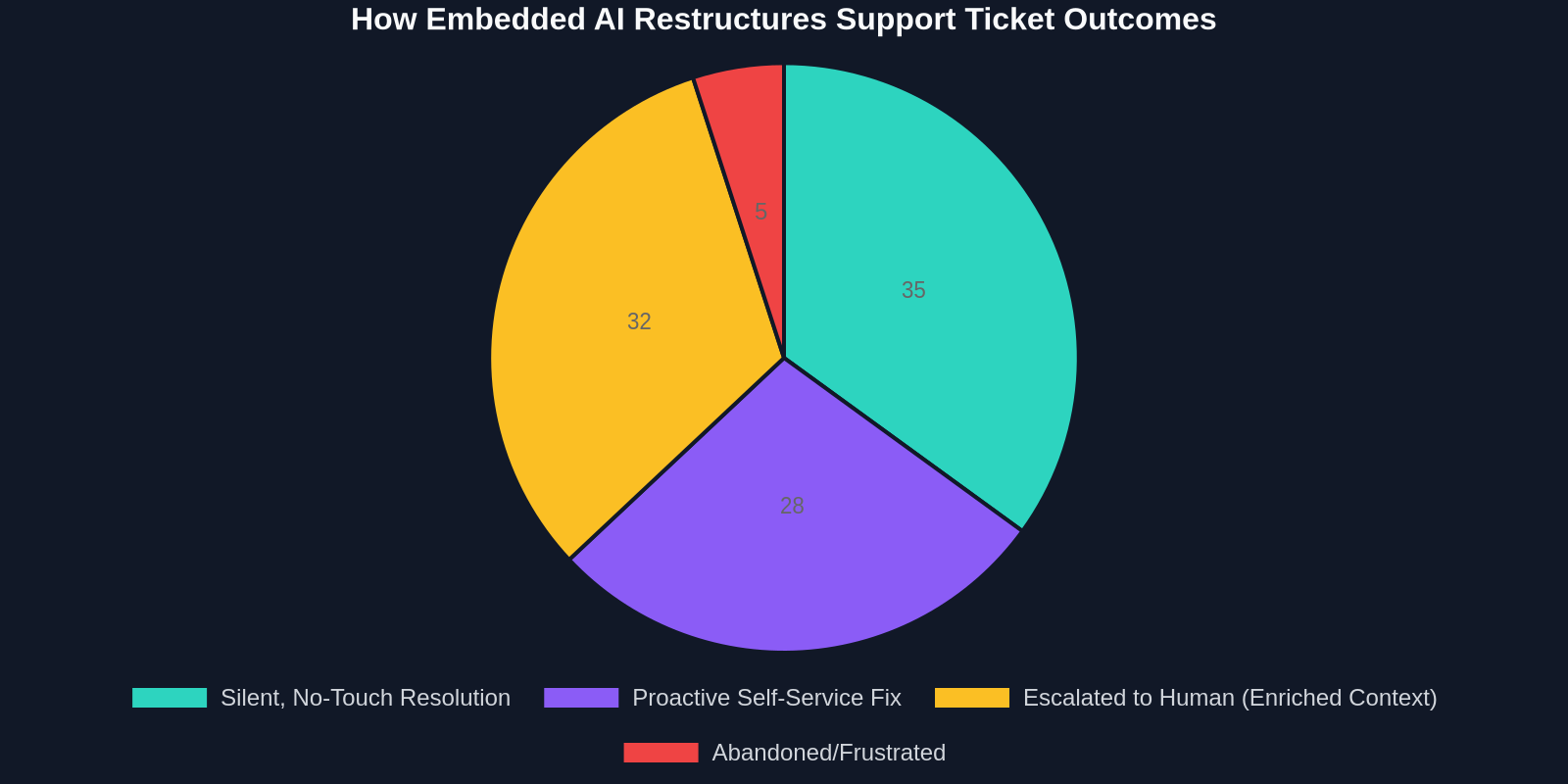
- Outcome-Driven Dashboards: Kill the “deflection rate” vanity metric. Focus on “Human Effort Avoided”, a composite metric measuring whether the customer had to interact with a human, or if the AI resolved the issue with zero-touch or via a contextual self-service fix.
Microsoft’s $13 billion bet isn’t on language models, it’s on distribution. The best support AI isn’t the smartest one in a chat window; it’s the one that’s already inside your product, your email, and your ticket system, invisible and effective.
Why This Matters for B2B SaaS Founders Right Now
If you’re a founder or head of customer success at a scaling B2B company, you have a narrow window to overhaul your support architecture before the market fully internalizes the “Copilot model.” The danger is that you renew a contract with a legacy conversational AI vendor, locking your support motion into a paradigm that even Microsoft has declared obsolete.
The customer experience landscape of 2025 and 2026 will be defined by the silent automation war. The winners won’t be the teams with the flashiest chat UI; they’ll be the teams where customers never open a support ticket because the product DMA (Directly Managed AI) fixed the glitch first.
The Successly Approach in a Post-Copilot World
At Successly, we’ve architected our platform exactly for this moment. We don’t front your site with a chat avatar. We ingest your product logs, your help center, and your API docs. We deploy silent agents that triage incoming tickets and, where safe, execute self-healing actions (password resets, cache clearing, subscription pauses) with zero contact center involvement. When a human is needed, they inherit a perfectly structured case, not a blank screen.
The result for our customers is not just a marginal NPS bump, it’s a fundamental change in the support cost curve. They break the linear relationship between customer growth and headcount.
The Final Takeaway: Stop Chasing the Chatbot, Start Solving the Problem
Microsoft’s “Copilot reboot” is a watershed moment for the entire software industry. It draws a thick line between the era of novelty AI chat and the era of productive, invisible AI. For customer success leaders, the memo is loud and clear.
Reallocate your budget from chat interface customization to deep product integration. Hire a support ops engineer who thinks in API calls, not conversational flows. Train your team to judge AI quality not by the elegance of its prose, but by the sharpness of its deflection and the speed of its resolution.
Legacy chatbot vendors will try to “bolt” AI onto your chat widget. Don’t be fooled. If the AI can’t see the user’s screen, API history, and plan state, it’s a gimmick, not a strategy.
The future of customer support isn’t a better bot. It’s a better product experience where the concept of “support” becomes a hidden infrastructure layer. Microsoft just proved it. It’s time the rest of the B2B world follows suit.