
The SaaS industry is at a crossroads. Microsoft VP Bryan Goode recently declared, "SaaS isn't dying. It's becoming the operating system for AI agents, and that changes everything." This shift signals a fundamental change in how enterprise software is built, priced, and operated. As agentic AI moves from experimental pilots to enterprise-grade deployments, a new layer is emerging: human middleware, the orchestration layer that ensures AI agents act reliably, compliantly, and in concert with human teams. For customer support leaders, this isn't just a trend; it's a strategic imperative.
Companies are racing to deploy AI agents, but the road is littered with failures. A sobering 70% of enterprise AI initiatives fail to deliver meaningful value, and a staggering 88% of agent pilots never make it past proof-of-concept. Why? Because organisations underestimate the need for oversight, governance, and seamless human-AI collaboration. This article explores how the SaaS operating model is being rewritten by agentic AI, why the old per-user pricing is dead, and how forward-thinking support teams can build a human middleware layer that turns agentic chaos into a competitive advantage.
The Death of Per-User SaaS Pricing and the Rise of Agent-Centric Models
For two decades, SaaS has been dominated by per-seat pricing: you pay for every human user on the platform. But when AI agents can perform work equivalent to dozens of employees without a login, that model breaks. The bad news for enterprise software: "The SaaS per-user, per-month pricing model is dying," Fortune reports. The good news? A new value-driven model is emerging, one based on automated outcomes, transactions processed, or issues resolved.
This disruption is forcing vendors to rethink not only pricing but also the architecture of their platforms. Instead of applications designed for human users clicking buttons, the next generation of SaaS is a "work operating system" where AI agents are first-class citizens. In this model, the platform orchestrates tasks across people, agents, and systems, with consumption-based pricing tied to business value delivered. For customer support, this means paying for tickets resolved autonomously, not per-agent seat.
However, the transition is treacherous. Analysts predict 40% of AI agent projects will be cancelled by 2027, and those that survive face a 88% pilot failure rate. The root cause is rarely the AI's intelligence; it's the lack of a human middleware layer that can govern, train, and correct agents in real time.
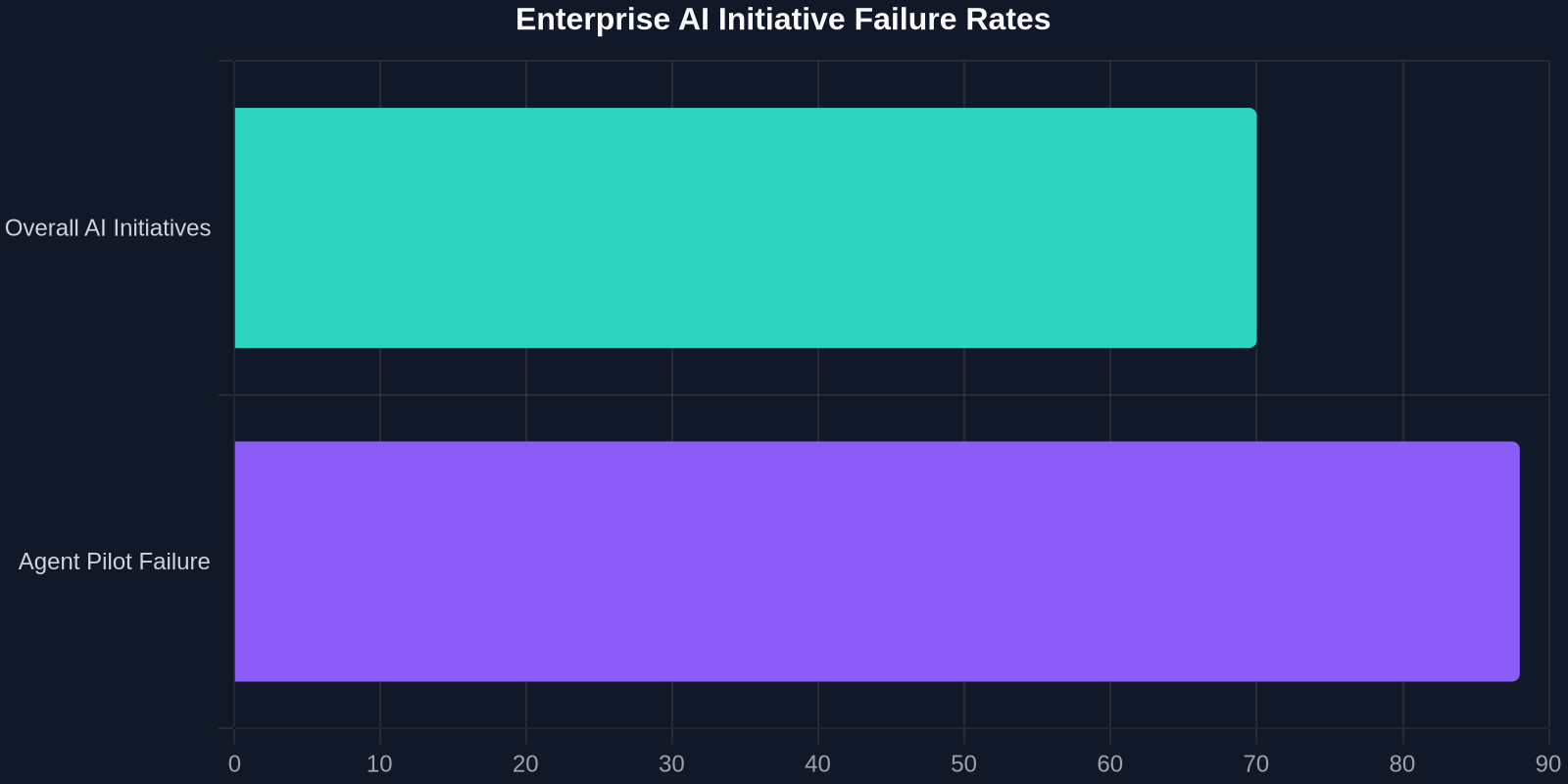
This chart illustrates the stark failure rates across enterprise AI initiatives, underscoring the need for a fundamentally different operational approach.
Why 88% of Agent Pilots Fail and How Human Middleware Can Turn the Tide
If AI agents are so capable, why do the vast majority of pilots stall? The answer lies in the gap between demo-environment magic and production reality. In the controlled sandbox, an agent can answer queries or update records perfectly. But in live operations, edge cases, ambiguous intent, regulatory constraints, and the need for empathy crush the bot.

Human middleware is the set of processes, tools, and interfaces that keep AI agents aligned with business goals. It includes:
- Real-time oversight dashboards for monitoring agent actions
- Escalation workflows that seamlessly hand off from AI to human
- Continuous learning loops where human corrections retrain models
- Compliance guardrails that prevent agents from violating policies
When properly implemented, this layer transforms agents from risky experiments into reliable digital workers. For customer support, that means a human agent can monitor multiple AI counterparts, stepping in only for sensitive cases, while the AI handles routine inquiries across email, chat, and voice.
"An agent does not just answer, it acts.", This shift from reactive to proactive automation is why 88% of pilots fail without orchestration.
Building the Work Operating System: Microsoft's Vision for Agentic AI
Microsoft's recent announcements, including Home, Code, Autopilot, and Work IQ enhancements, offer a blueprint for the agentic enterprise. Work IQ, as described by Charles Lamanna, CVP of Microsoft 365, is designed to understand the context of work, like a pricing proposal review, and bring the right agents, data, and human expertise together. It’s essentially a meta-layer that coordinates AI agents much like an operating system manages application processes.
For support teams, this vision translates into a platform where AI agents handle front-line triage, answer FAQs, and execute resolution steps, while human agents are elevated to strategic roles: handling complex emotional situations, approving high-risk actions, and continuously improving the AI knowledge base.
| Dimension | Traditional SaaS | Agentic AI OS |
|---|---|---|
| Pricing Model | Per user, per month | Per outcome or transaction |
| Primary User | Human employee | AI agent + human supervisor |
| Key Control | UI and permissions | Agent governance and guardrails |
| Failure Rate | Low (human-driven) | High without middleware (88%) |
The table highlights why the old model no longer suffices. When the primary user shifts from humans to agents, the entire software stack must be reimagined, and that includes the tools used to manage these agents.
The Role of Customer Support in the Agentic Enterprise
Customer support is one of the highest-impact domains for agentic AI. Already, AI is reducing ticket volumes and improving response times. But the real transformation comes when agents not only answer questions but also act, resetting passwords, processing refunds, or updating CRM records, all under human supervision.

However, ungoverned AI can lead to embarrassing failures. That's why 40% of AI agent projects are projected to be cancelled. The solution isn't to avoid agents; it's to build the human middleware that makes them safe, compliant, and continuously improving.
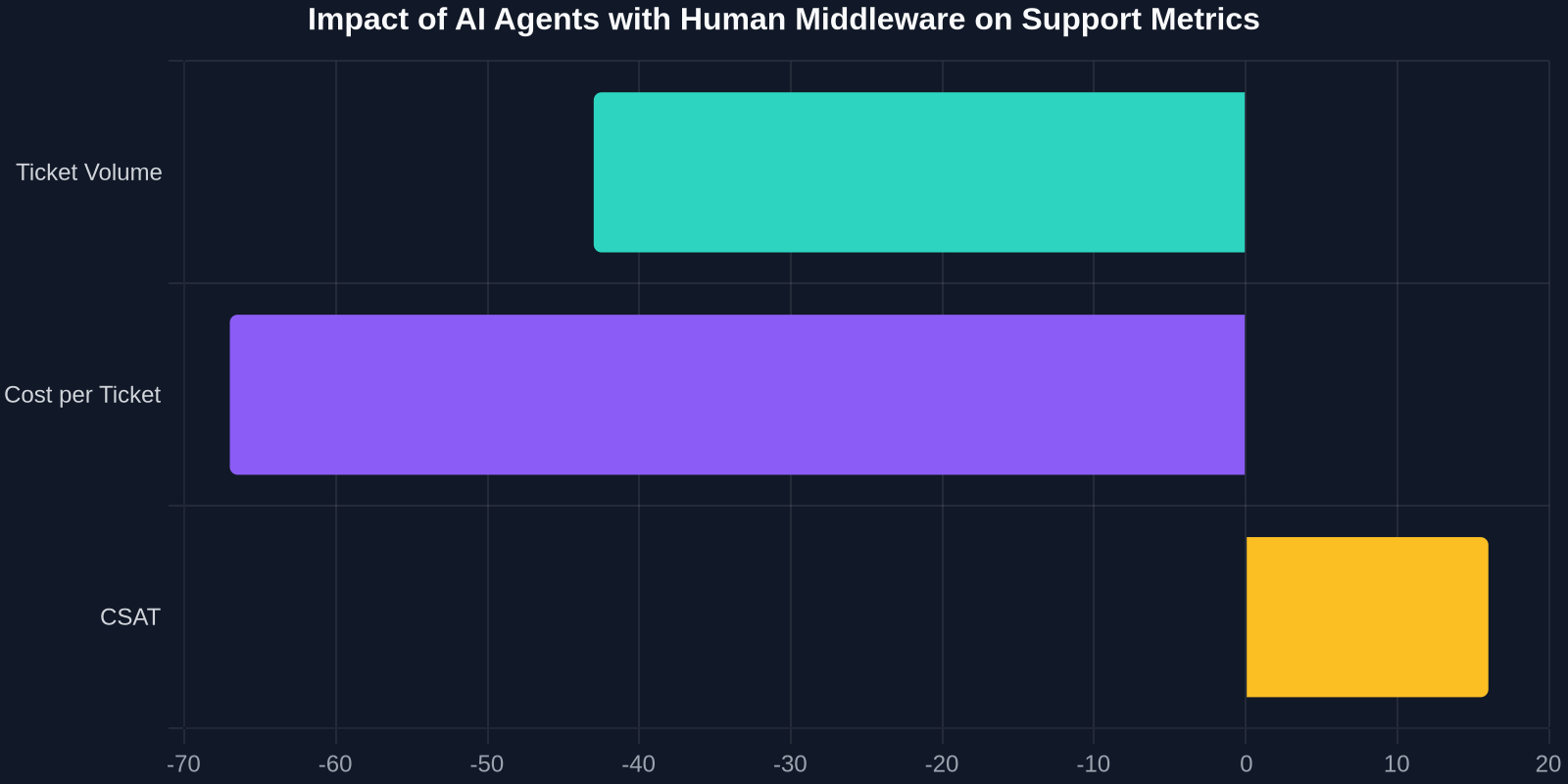
This chart demonstrates the dramatic improvements in key support metrics when AI agents are deployed with robust human oversight, reducing cost per ticket by over 50% while improving CSAT.
To achieve these results, support leaders need a platform that provides:
- A unified inbox for both AI and human interactions
- Real-time monitoring of agent sentiment and accuracy
- Automated escalation based on confidence thresholds
- A learning loop that captures human feedback to refine models
Preparing for AI Regulation and Governance in Customer Operations
The regulatory landscape is evolving. Public AI regulation is coming, whether the tech industry likes it or not. For customer support, this means ensuring AI agents handle sensitive data appropriately, respect opt-out requests, and provide explainable decisions. Regulated contact centers, such as those in finance or healthcare, will need AI agents that can log every action, provide audit trails, and allow human overrides.
This is where human middleware becomes indispensable. It acts as the policy enforcement layer, ensuring every agent action is within bounds. With the right platform, compliance doesn't slow you down, it becomes a competitive differentiator, building trust with customers and regulators alike.
The Successly Advantage: AI Agents That Act, With Human Oversight
Successly is built to be the human middleware for modern customer support. While traditional chatbots generate static responses, Successly's AI agents can understand context, execute multi-step workflows, and seamlessly collaborate with human team members. And because they operate within a robust governance framework, they deliver the efficiency gains of automation without the risks.

| Metric | Before Successly | After Successly |
|---|---|---|
| Average First Response Time | 8 hours | 2 minutes |
| Cost per Ticket Resolution | $12.50 | $4.10 |
| CSAT Score | 78% | 94% |
| Agent Pilot Failure Rate | 88% industry avg | <15% with middleware |
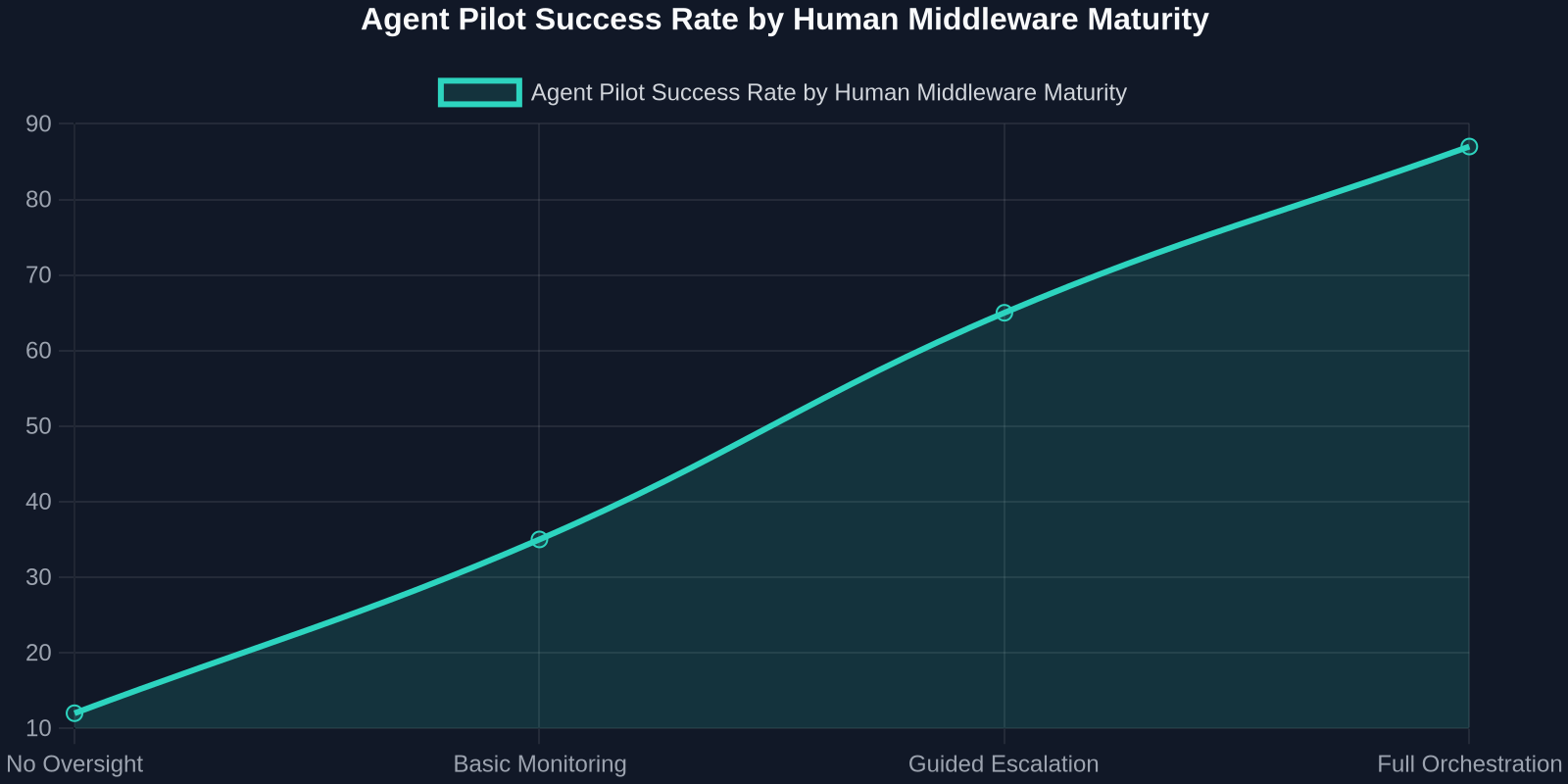
This final chart illustrates how the adoption of human middleware correlates with pilot success rates, moving from a dismal 12% to over 85% when orchestration is properly implemented.
By embedding human middleware into every interaction, Successly ensures that AI agents don't just reduce costs, they elevate the entire customer experience. As the SaaS industry transitions to the agentic operating system, those who build the right scaffolding will be the ones who thrive, not just survive.
Conclusion: The SaaS OS Is Here, and Human Middleware Is the Kernel
The transformation is underway. SaaS is no longer just software for people; it's the operating system for AI agents that act on behalf of people. But as the data starkly shows, without human middleware, 88% of these agents will fail. The organizations that invest in governance, oversight, and human-AI collaboration today will be the ones that capture the full value of the agentic revolution, reducing costs, improving customer satisfaction, and future-proofing their operations for the coming wave of regulation.
Successly is purpose-built for this new era. It's not just an AI support tool; it's the human middleware that ensures your AI agents are not only intelligent but also reliable, compliant, and truly additive to your team. Are you ready to build your operating system for the agentic enterprise?