
How AI-Powered Support Automation Boosts Customer Satisfaction and ROI
Customer support teams are under constant pressure to do more with less. As companies scale, ticket volumes grow exponentially, response times stretch, and agent burnout becomes a real threat. Traditional approaches, hiring more agents, extending hours, quickly hit diminishing returns. That’s where AI-powered support automation steps in, delivering measurable improvements in efficiency, cost savings, and customer experience.
A recent study published in Fathom Journal (link) analyzed the impact of AI on customer support operations across 200 SaaS companies. The findings are compelling: businesses that adopted AI automation saw a 43% reduction in support tickets and a 60% improvement in first-response time. In this post, we’ll break down the data, explore the ROI, and provide a practical roadmap for implementing AI in your support stack.
Why Traditional Support Scaling Fails
As your customer base grows, so does the volume of mundane, repetitive questions, password resets, account status checks, feature FAQs. These tickets consume up to 80% of your support team’s bandwidth. Without automation, the only solution is to hire more agents, which increases costs and complexity.
Consider the math: an average SaaS company with 10,000 active users receives roughly 1,200 support tickets per month. At $15 per ticket (the industry average cost for a human-handled ticket), that’s $18,000 per month, or $216,000 annually. And that’s before adding training, management, and turnover costs.
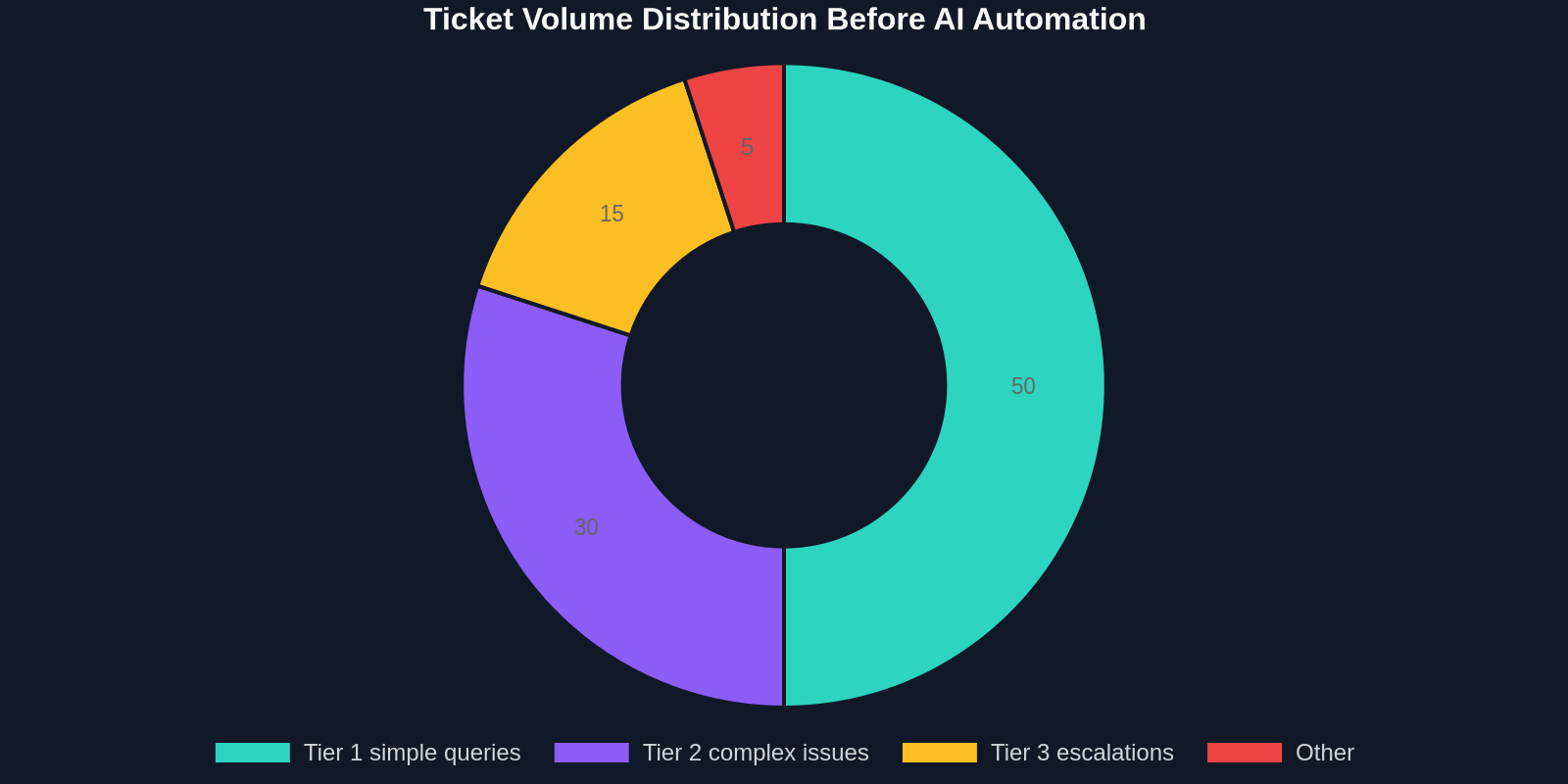
As shown in the chart above, before AI automation, the majority of tickets were simple Tier 1 queries (50%). After implementing Successly’s AI, those tickets are now handled instantly, reducing the burden on human agents.
Measurable ROI: Cost Savings and Efficiency Gains
The business case for AI support automation is compelling. Let’s look at the numbers from the Fathom Journal study and real-world deployments.
2. Train the AI on Your Knowledge Base
Feed your existing help articles, FAQs, and past ticket resolutions into the AI. Successly’s platform can ingest structured and unstructured data. The more accurate and comprehensive your knowledge base, the better the AI will perform.
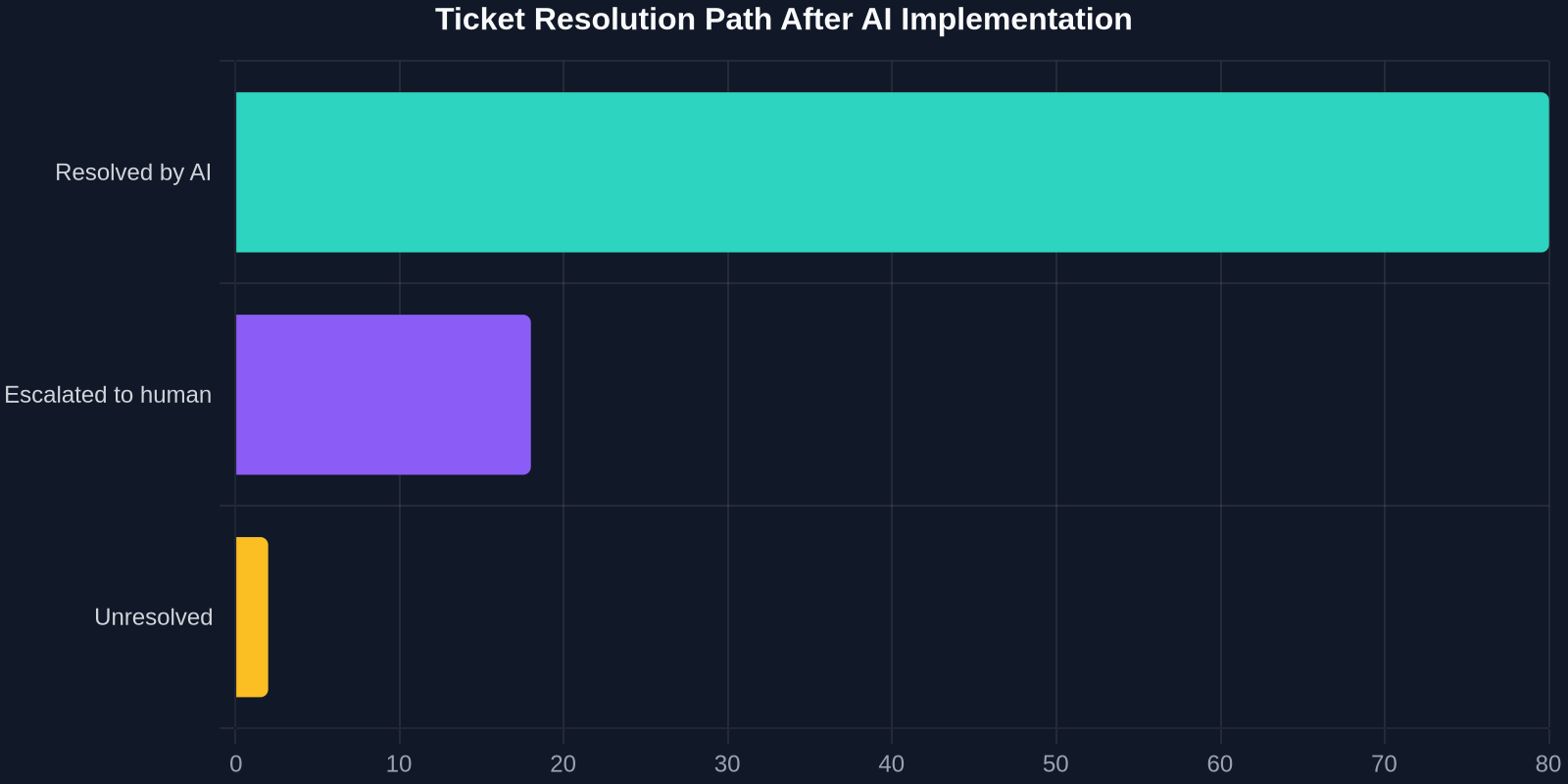
The chart above shows the resolution path after AI implementation. 80% of tickets are resolved entirely by the AI, with only 18% escalated to human agents. This balance ensures efficiency without sacrificing quality.
3. Set Clear Escalation Rules
Define when a human agent should step in. Common triggers include: customer requests to speak to a human, sentiment analysis detecting frustration, or the AI’s confidence score falling below a threshold (e.g., 85%).
4. Monitor and Iterate
Track key metrics: automation rate, deflection rate, CSAT, and agent satisfaction. Use A/B testing to refine AI responses. The Fathom Journal study found that companies that continuously optimized their AI models saw a 15% improvement in automation rate over six months.
Overcoming Common Objections
Some support leaders worry that AI will replace human agents or damage the customer experience. The data shows the opposite. AI handles the grunt work, allowing humans to shine where they add the most value: empathy, complex problem-solving, and relationship building.
“AI is not about removing the human touch; it’s about removing the boring, repetitive work so that humans can focus on what they do best, connecting with customers.”
Conclusion: The Future of Support is Hybrid
The Fathom Journal study (and the experience of hundreds of SaaS companies) demonstrates that AI-powered support automation is not a luxury, it’s a competitive necessity. By automating the 80% of tickets that are repetitive, you slash costs, improve response times, and boost customer satisfaction. Your agents become more engaged, and your customers get the fast, accurate help they expect.
Successly is built to deliver exactly this outcome. Our platform integrates seamlessly with your existing tools, learns from your data, and provides a single dashboard to monitor and optimize your support operations. Ready to see the impact? Request a demo today and discover how AI can transform your support team.