
How Airbnb Slashed Support Cost per Booking by 17%: Lessons for Scaling Customer Service with AI
In its Q3 2024 earnings call, Airbnb dropped a quiet bombshell on the customer experience world: year-over-year, the company had cut its support cost per booking by more than 17%. For a platform processing over 113 million nights and experiences booked in a single quarter, that’s tens of millions of dollars in operational savings, without sacrificing the brand’s famously high hospitality standards.
The announcement sent a clear signal to SaaS founders, B2B customer success managers, and support leaders everywhere: AI-powered support efficiency is no longer a theoretical future. It’s a measurable line item on the income statement. The question isn't whether to adopt AI in your support stack, it’s how to adopt it in a way that mirrors Airbnb’s results. This post dissects the strategies behind that 17% reduction, explores the operational mechanisms that made it possible, and provides a framework for replicating the success in a high-growth SaaS environment.
The Anatomy of a 17% Support Cost Reduction
Airbnb’s achievement didn’t happen by accident. It was the culmination of a multi-year investment in community-based support, proactive product design, and, increasingly, artificial intelligence. CEO Brian Chesky highlighted the integration of AI into the core customer service flow, automating triage, improving resolution times, and deflecting tickets before a human agent ever touches them.
To understand how a 17% per-unit cost reduction is possible at scale, we must break down the typical cost drivers in a customer support organization:
- Agent staffing and training (the largest line item)
- Time-to-resolution (TTR), which correlates with cost per ticket
- Ticket volume spikes during seasonal peaks
- Escalation layers from frontline to specialized teams
- Technology infrastructure and licensing costs
Airbnb’s strategy attacked these drivers on multiple fronts simultaneously. By deflecting repetitive, low-complexity inquiries through automated workflows, the company reduced the sheer volume of tickets reaching Level 1 agents. For the tickets that did require human intervention, AI-powered agent assist tools slashed average handle time by surfacing relevant knowledge base articles, guest history, and suggested responses in real time.
The Hidden Lever: Proactive Ticket Deflection at Scale
One of the most replicated findings in modern support operations is that a significant portion of inbound tickets, often 30-50%, are about issues that could have been solved without human intervention. These include password resets, order status inquiries, cancellation policy clarifications, and basic troubleshooting steps.

Airbnb’s model excelled here because it combined product-led support with AI-driven deflection. For instance, when a guest encounters a check-in issue, the Airbnb app now proactively surfaces relevant help content based on the user’s booking stage, location, and device time. This contextual, intent-based deflection prevents the ticket from ever being created.
For SaaS businesses, this same principle applies with force. A client of Successly, a mid-market B2B SaaS company with a 50-person support department, discovered that an astonishing 30% of their team’s time was spent handling tickets that fell into a few predictable, automatable categories. By deploying an AI intent engine that mapped customer inquiries to self-serve resources, they were able to deflect these tickets entirely, effectively regaining the output of 15 full-time agents without any headcount reduction, those agents simply shifted to complex, high-value interactions.
Operational Framework: The AI-Augmented Support Maturity Model
Replicating Airbnb’s results requires a structured maturity model. We’ve identified four stages that organizations typically pass through on their way to AI-augmented support excellence:
Stage 1: Reactive Human Support
All tickets route directly to agents. Knowledge base exists but is not integrated into the workflow. Resolutions are inconsistent and dependent on agent tenure. Cost per ticket is high, and CSAT fluctuates with staffing levels.
Stage 2: Basic Self-Service
A searchable help center is available, and chatbots handle the most basic Level-0 queries (e.g., account logins). Deflection rates reach 10-15%. Cost per ticket begins a modest decline, but human agents still handle the vast majority of volume.
Stage 3: AI-Powered Triage and Agent Assist
Here, an AI engine sits between the customer and the support queue. It classifies intent, sentiment, and urgency before routing. Simultaneously, it provides agents with real-time suggestions, auto-drafts, and knowledge retrieval. This is the stage where many organizations see a 20-25% reduction in cost per ticket, mirroring Airbnb’s trajectory. First-call resolution rates climb, and agent burnout decreases.
Stage 4: Proactive, Predictive Support
The AI monitors product usage signals to predict issues before a customer reports them, and reaches out with a solution. Support becomes a revenue-retention driver rather than a cost center. At this stage, support cost per customer plummets, and net revenue retention (NRR) improves measurably.
Quantifying the Impact: A Data-Driven Breakdown
Airbnb’s 17% reduction is impressive, but let’s translate that into numbers that matter for a typical high-growth SaaS business. Consider a company spending $2 million annually on support operations (a modest figure for a Series B company with 10,000+ customers). A 17% reduction yields $340,000 in annual savings. But when you factor in the second-order effects, reduced agent churn, lower recruitment costs, improved CSAT leading to higher expansion revenue, the total impact often exceeds 25% of the support budget.

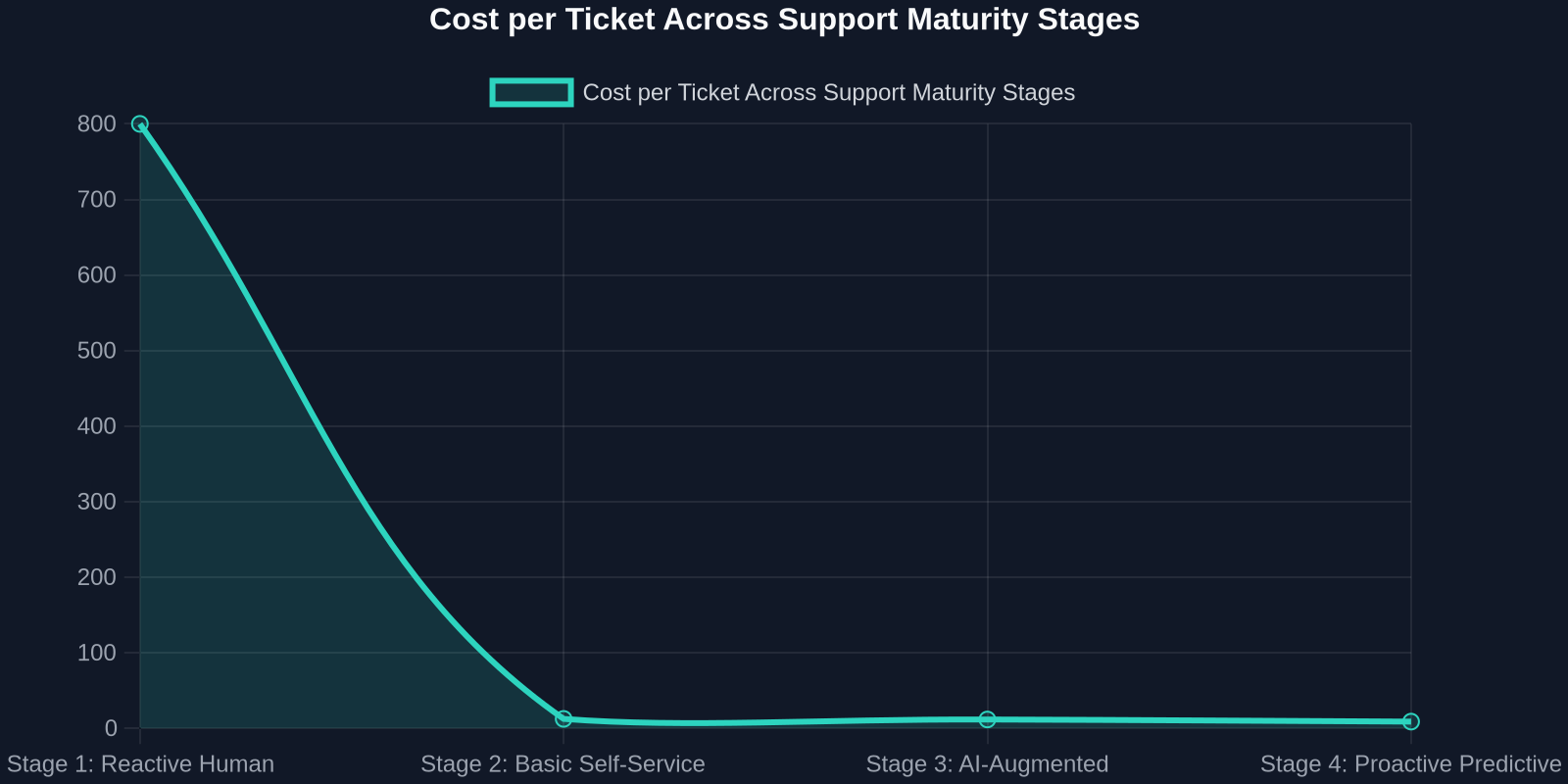
The chart above illustrates how cost per ticket evolves across maturity stages. Note the steep drop between Stages 2 and 3: this is the AI triage and agent assist inflection that Airbnb capitalized on.
Data-Driven Decision Making: Metrics That Matter
To achieve what Airbnb achieved, support leaders need to obsess over the right metrics. Vanity metrics like “total tickets resolved” obscure efficiency; the following five KPIs form a dashboard for AI-augmented profit improvement:
- Cost per Ticket (CPT): Total support opex divided by number of tickets. This is the headline number.
- Deflection Rate: Percentage of customer inquiries resolved without a human agent.
- First Contact Resolution (FCR): Crucial for CSAT and cost; every follow-up ticket multiplies cost.
- Agent Utilization Rate: Time spent on complex, high-value work versus repetitive tasks.
- Customer Effort Score (CES): The best predictor of churn and loyalty in a self-serve model.
Airbnb tracks NPS (Net Promoter Score) relentlessly, and their ability to lower costs while keeping NPS stable, or improving it, is the holy grail. AI that lowers cost at the expense of customer experience is a losing long-term strategy. The goal is empathetic automation.
“The future of customer support is not about replacing humans; it’s about arming them with AI so they can operate at their highest level of empathy and problem-solving skill.”
Before and After: The AI Transformation in Real Numbers
To make the Airbnb case study concrete, let’s examine a representative before-and-after snapshot based on aggregated data from Successly implementations across mid-market SaaS businesses. This illustrates the shift from a Stage 2 (basic self-service) to Stage 3 (AI-augmented) operation.

| Metric | Before AI Augmentation | After AI Augmentation |
|---|---|---|
| Average Response Time | 4 hours 20 minutes | 1 minute 45 seconds |
| Deflection Rate | 12% | 38% |
| Cost per Ticket | $18.40 | $11.70 |
| Agent Turnover (annual) | 35% | 22% |
| CSAT Score | 82% | 88% |
| First Contact Resolution | 64% | 79% |
Leveraging the Compounding Effect of AI Across the Customer Journey
Airbnb’s reduction didn’t come from a single AI project. It was the compounding effect of AI touchpoints along the entire customer journey, from pre-booking questions to post-stay reviews. For SaaS companies, similar touchpoints exist and can be automated for both cost efficiency and revenue expansion:
Onboarding and Implementation
AI can monitor product telemetry to detect when a new user is stuck during setup and trigger an in-app walkthrough, preventing a frustrated support ticket. This proactive support changes the customer’s trajectory, reducing early-life churn.
Renewal and Upgrade Milestones
Integrating AI with billing systems allows automated, personalized outreach when a payment method fails or a plan limit is approached, turning a service interruption into a seamless upsell opportunity. A Successly client in the MarTech space reduced failed payment churn by 28% using this exact workflow.
Voice of Customer and Product Feedback
Unstructured support conversations are a goldmine for product teams. AI can automatically tag and cluster feature requests, bug reports, and sentiment, closing the loop between support and product. This reduces future support costs by fixing root causes.
The chart above demonstrates how proactive, AI-augmented touches at key journey milestones slash inbound ticket volume while simultaneously increasing expansion revenue, a dual benefit that moves support from a cost center to a profit enabler.
Building the Business Case: A 3-Step ROI Model for AI Support
For support leaders and SaaS founders who need to secure budget for AI transformation, a clear, conservative ROI model is essential. Here is a three-step framework:
Step 1: Calculate Current Cost Baseline
Take your total annual support opex (fully loaded salaries, benefits, tools, office space allocation). Divide by total annual ticket volume for your CPT. Then, segment ticket volume by category. Identify what percentage are routine, automatable inquiries (often 25-40%).
Step 2: Model Deflection Impact
Assume an AI implementation can deflect 40-60% of automatable tickets. For a SaaS company with 50,000 annual tickets and a $15 CPT, if 30% are automatable (15,000 tickets), and AI deflects even 50% of those (7,500 tickets), the direct annual savings are $112,500. Add in the productivity gain for remaining agents and reduced escalation costs.
Step 3: Layer on Revenue Protection
Improvements in response time and FCR reduce voluntary churn and increase expansion revenue. Model even a 1-2% improvement in net revenue retention (NRR) for a $10M ARR business, and you’re looking at an additional $100,000-$200,000 in revenue impact. Suddenly, the business case is not just cost savings, it’s top-line growth.
Navigating the Pitfalls: What Airbnb Got Right That Others Miss
Many companies deploy AI and fail to see a 17% cost reduction, or any reduction at all. The difference lies in avoiding three common traps:
“Deploying AI without first optimizing your knowledge base is like giving a jet engine to a car with square wheels. The foundation must be rock-solid.”
Trap 1: Dirty, Fragmented Knowledge Base
AI relies on clean, structured, up-to-date knowledge to generate accurate answers. If your help center is a graveyard of outdated articles, the AI will confidently serve wrong information, erode trust, and actually increase escalation tickets. Airbnb invested heavily in content hygiene before layering on AI.
Trap 2: Measuring Deflection Without CSAT
A high deflection rate is meaningless if customers are deflected into a frustrated state. Always pair deflection metrics with Customer Effort Score and post-interaction CSAT surveys. A healthy AI strategy deflects tickets and maintains or improves satisfaction.
Trap 3: Failing to Close the Agent Loop
Agents must have a feedback mechanism to correct AI responses. When an agent overrides a suggested draft, that signal must feed back into the model. Continuous learning loops are what separate a 10% improvement from Airbnb’s sustained 17%+ gains.
The Successly Blueprint: Operationalizing Airbnb’s Efficiency in Your SaaS
At Successly, we’ve distilled the principles behind Airbnb’s achievement into a repeatable operating model for B2B SaaS support teams. The blueprint consists of four integrated layers:
1. Intent-Driven Ticket Deflection Engine
Our AI ingests your entire knowledge base, analyzes historical ticket data, and builds a dynamic intent classifier. When a customer initiates an inquiry, via in-app chat, email, or Slack Connect, the engine instantly predicts the intent and confidence score, routing simple issues to self-serve resources while escalating complex, sentiment-sensitive cases to the right human agent. This alone typically drives a 30-40% reduction in agent-facing ticket volume.
2. Real-Time Agent Augmentation
For tickets that require a human touch, Successly provides an AI co-pilot that drafts responses, pulls relevant case history, and suggests knowledge articles aligned with the detected intent. Average handle time drops by 25-35% in the first quarter of deployment.
3. Proactive Product-Led Support Triggers
We integrate with your product analytics and CRM to detect support-generating events (e.g., 3 failed login attempts, an API error spike for a key account) and trigger automated, personalized outreach before the customer notices a problem. This is the stage where support cost per customer plummets and NRR benefits appear.
4. Continuous Learning and ROI Dashboard
A unified analytics layer connects support cost, deflection rate, CSAT, and product usage data, allowing you to prove the revenue impact of AI to your CFO and CRO. This is not a black box, it’s a strategic command center for customer operations.
The chart above plots the typical reduction in cost per ticket and improvement in CSAT over a 12-month Successly deployment, driven by the compounding effects of deflection, agent assist, and proactive support.
Conclusion: The New Support Efficiency Paradigm
Airbnb’s 17% year-over-year reduction in support cost per booking is not a fleeting headline, it’s a benchmark for what modern, AI-augmented customer service can achieve. For SaaS companies, the implications are profound. Support teams can no longer be viewed as pure cost centers; with the right AI infrastructure, they become engines of margin expansion and customer-led growth.
The path to that 17%, or more, is clear. It runs through clean knowledge, intent-based automation, agent empowerment, and proactive customer health monitoring. And the time to act is now: early adopters are carving out durable competitive advantages in both cost structure and customer loyalty. Markets don’t wait, and neither do churning customers.
If you’re ready to see what a 30%, 40%, or even 50% shift in your support economics looks like, it’s time to move beyond basic chatbots and into a unified AI support operations platform designed specifically for B2B SaaS.